One of the activities at the Open Storage Summit party was to have our portraits drawn by talented caricature artist Doug Shannon.
I’ve been thinking lately about the differences between videoblogging and professional video.

One of the activities at the Open Storage Summit party was to have our portraits drawn by talented caricature artist Doug Shannon.
I’ve been thinking lately about the differences between videoblogging and professional video.
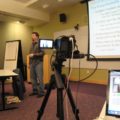
^ filming at the Open Storage Summit after-party
I don’t claim to be a professional videographer (for one thing, I’m entirely self-taught). I do videoblogging, which is fundamentally different.
From my (very limited) experience, it seems that professional corporate video is, usually:
Videoblogging, on the other hand:
Sun’s Jim Grisanzio interviews Chad Mynhier, the first outside contributor of DTrace code.

Isn’t it gorgeous? It’s my very own Thumper, aka Sun Fire X4500 Server.
Jeff Cheeney and I (and whoever we can rope in to help) are going to make it into a video compression/archive/streaming server. (Before you start worrying about budget, don’t: this one is rebuilt and didn’t cost us anywhere near sticker price.)
Why do I need such a thing? Take a look:

I’ve shot over 100 hours of video since I began videoblogging for Sun about a year ago, and much more is on the way. I haven’t edited even half of it, partly because I’m doing all the editing and compression a Windows laptop which I also have to use for all my other work. So it would be useful to be able to offload some of the processing onto a different machine, one that can also archive and share the results.
This is also a learning exercise, to see what we can do with all this cool technology we have around, similar to the project that Jeff and Chase distilled into a ten-minute recipe for building a NAS box. Similar also to Dominic’s new recipe series, which began recently with Configuring Sun Storage J4000 Arrays and the ZFS File System in Ten Minutes.
It will probably take some months of poking around and figuring things out, and we’re not entirely sure we’ll be able to boil this one down to “Build a Video Archive/Server in 10 Minutes” – but that’s what we’re trying for. We’ll keep you posted!
Note: The images in this post were originally on a Sun site, and were lost in the Oracle transition.
About a year ago, Dan Maslowski had a simple-but-brilliant idea to increase the reach of some of Sun’s Open Solaris Storage blogs: translate them! Sun’s globalization team was initially cautious: they already had their hands full translating interfaces and documentation, and weren’t sure where this blogging thing fit into their scope of work. But they agreed to give it a shot.
We started with Bob Porras’ blog. Based on attendance at Sun Tech Days worldwide, he opted to have it translated into Chinese (first post July 9th), quickly followed by Spanish (first post August 17th) and Russian (August 20th). We’ve recently added Japanese (April 30th) and Brazilian Portugese (May 22nd).
The results were good, though not surprising: traffic increased.
What’s more interesting than the simple increase in page views is the range of countries now represented in Bob’s readership. Here’s a breakdown of traffic by (roughly calculated) language areas:

New entrants Japanese and Brazilian Portugese are already making a noticeable contribution – clearly, there was demand for material in these languages. (Note that “all others” refers to all other countries that have sent traffic to Bob’s blog – folks from these countries are obviously reading one of the six languages so far represented.)
Our geographic reach increased. For example, look at the number of Spanish-speaking countries from which people are reading Bob’s blog each month:
| Jun | Jul | Aug | Sep | Oct | Nov | Dec | Jan | Feb | Mar | Apr | May |
| 3 | 6 | 8 | 8 | 9 | 13 | 8 | 10 | 10 | 12 | 11 | 11 |
The list varies a bit from month to month, altogether 15 Spanish-speaking countries are represented so far:
Andorra
Argentina
Bolivia
Chile
Colombia
Costa Rica
Dominican Republic
Ecuador
El Salvador
Guatemala
Honduras
Mexico
Peru
Puerto Rico
Saint Lucia
Spain
Venezuela
Some of these are tiny countries bringing us only one or two visitors a month – but that’s one or two more people we’re talking to that we weren’t before.
Now let’s look at Storage Stop, a very different kind of blog which we began translating into Chinese in November, but have neglected to since March. Umm, we’ll just claim that was a web traffic experiment, not an oversight, right?

I wonder whether translating Storage Stop is useful, because it’s primarily an aggregator, pointing at material on other blogs (so far mostly in English), and a venue for videos which are so far entirely in English. (We’re looking into ways to translate videos.) For that or whatever reason, Storage Stop never got a lot of traction in Chinese, and I may abandon that experiment to spend translation resources more productively.
Since December we’ve also been translating Scott Tracy’s blog and Lynn Rohrer’s blogs into Chinese.
But it was clear from the overall trends of traffic to Sun storage blogs that our most-valued material is mostly highly technical. So over the last few months we’ve been translating selected posts into various languages. Examples include:
These translations are mostly too recent to draw conclusions; I’ll report back after we’ve got some numbers to analyze.
We also translated one important post by Jim Grisanzio on Building OpenSolaris Communities, into multiple languages. Early returns show that this is having an effect on traffic and, more importantly, as Jim had hoped, it’s opening up new conversations.
Sun’s globalization team are now enthusiastically and ably taking over more of the blog translation process: all I have to do is identify the posts to translate, and they do the rest. With their help, more blogs are being translated all over Sun, in other technology areas such as Sun Cluster.
We’re opening up to the global conversation, and the world is talking back. Sometimes the simplest ideas have the profoundest effects.