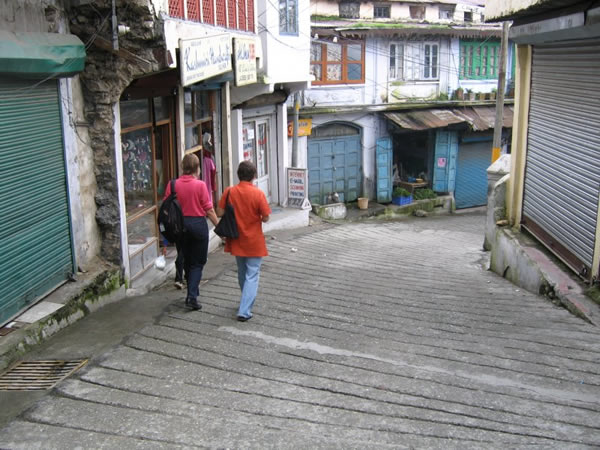
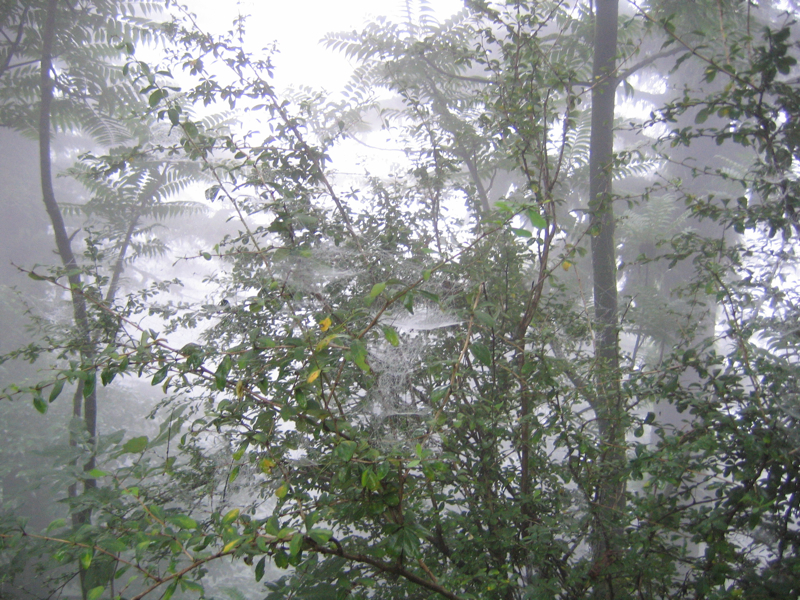
Ross, Sharon and I went to the “buzz” (local bazaar). On the way down Mullingar Hill (photo above), we stopped by the tailor, who told us that the shawl we had bought for Ross’ jacket wasn’t enough material to make a jacket with a hood. We took a snippet of the shawl to try to match it with some plain black wool, but eventually ended up buying another shawl, plain black (no embroidery) but a close match in color and texture.
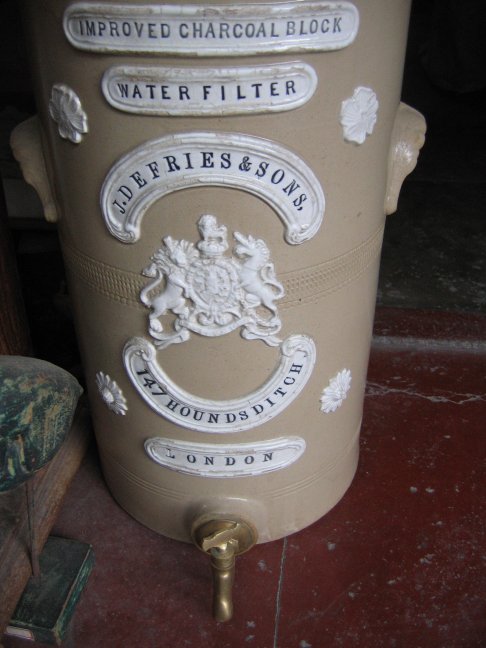
Vinod’s shop is still at the bottom of the Landour Clock Tower, though Sharon tells me he’s seldom open. He was that day, so we spent a happy hour browsing among reproductions of antiques and even a few real ones. My favorite item was this beautiful crockery water filter; I would have bought it if I could have thought of a safe and inexpensive way to get it home.
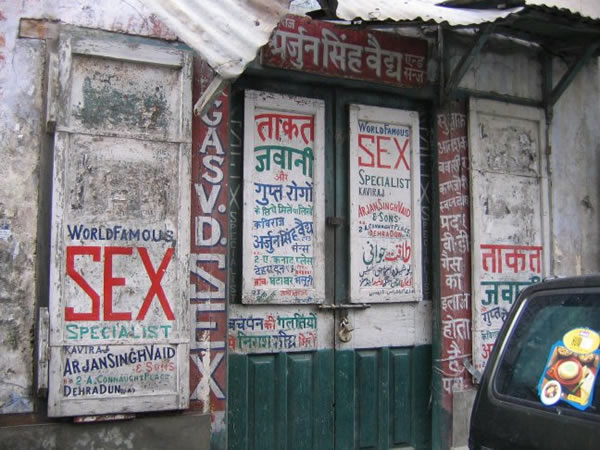
The “world famous sex specialist” still has his hoarding next door, as he has for over 30 years, though I’ve never actually seen these doors open. Maybe it’s just meant to function as a billboard.
Most Woodstockers are nostalgic about the monsoon, though we’d probably be a lot less so if we had to live through the entire season again!
I had not been to India during the monsoon season since 1981, and had forgotten how beautiful the hills are when they’re lush and green and wet. Every tree is covered in ferns and moss. And, after a while, so are you. Nothing ever dries thoroughly during the monsoon; bedsheets feel damp when you crawl in at night, and you have to keep a strong lightbulb burning in the closet so your shoes don’t go moldy.
Tenzing Nima, Woodstock alum, actor, and proprietor of Momotours, came over for dinner at Sharon & Steve’s, and regaled us with monkey stories.
There are two types of monkeys in Mussoorie, langurs and rhesus. Langurs are beautiful, graceful, and fairly shy of people. Rhesus are very aggressive and can be dangerous. So langurs are hard to get pictures of, while rhesus may attack if photographed.
These are sometimes called Hanuman langurs, because the monkey god Hanuman is often depicted as having silver or white fur and a black face (although he’s also often portrayed as hairless or human flesh-colored).
The voices are myself and Kishore, our driver from Uday Travel.
We arrived after midnight at Indira Gandhi International Airport, and proceeded down the hall to a marble staircase, with a man-sized bronze statue of Ganesh at the top brightly polished and freshly garlanded, welcoming us to India, then down the stairs to the immigration line. I noted fancy new immigration counters, and the same old grim-faced immigration officials.
“What’s that smell?” asked Ross. As soon as we had stepped off the plane, I had noted, happily, the familiar smell of India, but I had to think a moment about exactly what it was comprised of. “Burning charcoal for cooking fires. Jet fuel, since we’re at the airport. And Dettol, a disinfectant used for cleaning.”
Standing there in the line, we sprayed ourselves with mosquito repellent. “It’s not likely that we’d get malaria,” I said, “especially since we’re taking the anti-malaria pills. But we’ll take every precaution. In the monsoon season, there are more mosquitoes around. The bad thing about malaria is that, once you’ve got it, you never get rid of it.”
A chubby American in line ahead of us turned and asked in alarm, “Really?” He had flown in from Portland on business. This was his second trip to India, and apparently no one had told him much of anything. I explained that he could get his hotel to send someone to a pharmacy for the anti-malarial medications, and that keeping covered up and sprayed against mosquitoes should see him safe.
After this guy and yesterday’s Italian couple, I wondered how many people come to India completely unprepared. No wonder some end up having horrible experiences and hating it!
NB: Italy’s public health system provides medical advice for travellers. I was familiar with the very efficient and expert office in Milan (via Senato), from all my previous trips and vaccinations. In Lecco, we had to make an appointment a month in advance, then were lectured by a nurse, reading from a booklet, who knew a great deal less about tropical medicine than I did, and became agitated when I interrupted her flow to ask specific questions. But she did have all the information we needed; when I mentioned recent reports of meningitis in Delhi, she took out a binder full of bulletins from the World Health Organization, and was able to give me the latest info (which was: situation under control).
As it turned out , Ross had already had almost every vaccination she needed. Like all Italian kids, she had been vaccinated against Hepatitis B in middle school, and she’d had tetanus shots for horseback riding. So the only shot she needed was Hepatitis A, and we both took an oral vaccine against typhoid. The nurse also prescribed two kinds of malaria prophylaxis, which we faithfully took throughout the trip and for the required four weeks after our return).
We got through immigration (with my usual huge sigh of relief), waited a bit for our luggage, gave our forms to the customs man, and were free to go. As always, there was man waiting to meet us, holding up a sign with “Mrs. Straughan” on it. Delhi is not safe for women at night, and there have been “incidents” (robbery, rape, and murder) even with the supposedly reliable pre-paid taxis that you book at the airport counter as you exit. So I pre-arrange to be met at every stop in or out of Delhi, by my trusted travel agency, Uday Travel.
This sometimes feels like wimping out – after all, I’ve travelled a lot in India, alone and on a very low budget! But I’m not that poor anymore, and I can afford to spare myself some hassles, especially when it’s my daughter’s first trip, and I don’t want either of us to get overtired, stressed, and ill.
The agent and driver took us to the Connaught Hotel, near Connaught Place in central Delhi, helped get us checked in, and took the rest of my payment for all the arrangements (hotels, trains, and cars) that I had made with Uday Travel via email months before. We went up to our room and collapsed.
Note to self: Next time, I’ll pay more to stay in a better hotel. Every time I’ve stayed at the Connaught, over 10 years of travel, there is some kind of construction going on, and people coming and going noisily all night. And the beds are uncomfortable. Back in November I stayed at the Park, also near Connaught, which was a lot nicer, and cost a lot more ($120 vs. $70 – hotels in Delhi are not cheap).
It was around 3 am when we finally got to sleep, but I woke up early, as usual, and eventually persuaded Ross to get up. We had the included hotel breakfast – a choice of western fare (with dubious-looking sausages), or south Indian idlis: steamed rice flour cakes, tasteless on their own, but eaten with sambar, a thin, spicy vegetable soup, and a rich coconut chutney. And Indian-style coffee, which is… drinkable.
The car and driver I’d hired for the day were waiting for us outside the hotel. First stop was a tiny shop – about two meters wide by four deep – providing all kinds of telephone services: private phone booths from which to make local, long distance, or international calls, and cellphone plans and top-ups. I bought a local SIM card for Ross’ cellphone (Rs. 500 – about $10), and Rs. 700 of talk time – of which you actually get to use about Rs. 500. They take off a ridiculous amount in service fees for each chunk of talk time you buy. The fees would probably be proportionally less if you bought in larger chunks, but not many shops can handle larger transactions.
So we were back in touch with the world, or at least with Italy and Ross’ boyfriend. Enrico was in the US with a home phone that he was rarely near, and no cellphone.
We were also now in easy touch with my friends and classmates all over India. I called Sara in Ahmedabad to find out how her family had come through the floods in Mumbai. One of her sisters had had to walk til 4 am in neck-deep water to find her son at school. Stories eventually came in from others: Yuti’s husband Sumeet slept two nights in his office, and Yuti’s car, waiting for her in the garage back home, was completely immersed in water. Deepu and Shilpin were trying to get back to Mumbai from Mussoorie via Delhi, and, after hours waiting for any flight at all to depart, spent more hours circling Mumbai while air traffic cleared after the airport finally reopened.
But they all counted their blessings. Mumbai had been hit with 94 cm of rain in 24 hours, a record even for India. About 1200 people died in the water or in mudslides. As usual, the poor suffered most, as their fragile “hutments” were swept away or crushed by falling hillsides. Communications went out, and Mumbai, the financial capital of India, ground to a halt.
Delhi, in the meantime, was hot and dry. Ross and I went briefly to the National Museum, which had some very interesting collections, not all of them well-lighted, and few offering much explanation. She soon tired of that, and wanted to go shopping.
Connaught Place, though annoying with people trying to sell you things or take you places, has plenty of shops. I hadn’t been able to find my comfy walking sandals in our voluminous suitcase, so we first went to an upscale shoestore, where I got a nice pair for Rs. 1700. At the hole-in-the-wall shop next door, Ross bought a pair of red-beaded slippers – a purchase she’d been looking forward to – for Rs. 650.
We stopped in a Levi’s store; at Rs. 2700 per pair, I could afford jeans in Delhi far more easily than in Lecco, but Ross couldn’t find a style that she’d wear back in Europe. Levi’s may be an American company, but its jeans are localized: fashion-conscious teens in Delhi do not wear the same jeans as their peers in New York or Milan. My hopes of reducing the back-to-school wardrobe budget were dashed. (I subsequently learned that there’s a shop in Connaught Place called Wow! Jeans which will MAKE your jeans, in any style and material you like – including leather – to order, fast, and cheap.)
The afternoon we spent resting in the cool of our hotel room. In the evening, we went to the sound and light show at the Red Fort.
We were among the first people in line for our flight from Milan Linate airport to Frankfurt (Lufthansa, connecting on to Delhi). As we checked in, a young Italian couple arrived at the counter beside us. I had previously noticed the woman, wearing a clingy, spaghetti-strapped top, and thought in passing, “I hope she’s not going to India dressed like that.”
She was. They were… or not. No foreigner can enter India without a visa, and it’s part of the check-in agent’s job to ensure that all passengers have the papers they need for their final destination. The agent looked through their passports, then asked if they had visas. “What visas?” they asked. A long discussion ensued. The travel agent who sold them the tickets had not mentioned the need for a visa. None of their friends who had previously travelled to India had mentioned it. The airline agent had to be wrong!
They were finally more or less convinced that they needed a visa, but still suffered under the illusion that they would be able to get one and still make that 10:30 am flight. The airline agent thought they had to go to Rome for a visa. At that point I intervened and explained that they could get visas at the Indian consulate in Milan, and, if they applied this morning, they could pick up the visas in the evening. I confirmed that they did need visas, and showed them ours.
Ross and I felt sorry for them. What a crushing disappointment, to be all ready to depart on your big trip, and find out you can’t go. As we walked towards security, Ross said, “I wonder if they know they need shots?”
The flights were uneventful – about the best anyone can hope for in this day and age. Why is it that flights from Italy always park at the furthest possible gate in any other European airport? Without fail, when I fly from Italy to anywhere, I end up walking miles just to reach the terminal, or even having to take a bus from tarmac to terminal. Gah! Ross summed it up: “I guess they think Italians like buses.”
The departure wing where we had to wait for the flight to Delhi is one of the most boring airport areas I’ve ever been in. Other parts of Frankfurt airport seem reasonably well-equipped. This one had only a couple of sausage stands (when many of the people on flights to India are probably vegetarian!) and beer bars and some uninteresting shops, and there was a shortage of seats for all the people waiting – I have yet to take a flight to India that isn’t absolutely full.