Stephen Colbert Roasts the White House Press Corps

Comedy Central’s Stephen Colbert was the featured speaker at this year’s White House Correspondents’ dinner. The White House correspondents are, of course, those journalists we see in the White House briefing room, asking questions of presidential spokesmen and (under this administration) getting few answers. Their dinner guests are the President and many of his staff. The event is an opportunity for the two sides to trade humorous barbs in a sort of mutual roast, but the jokes are usually clawless.

Not this year. Standing six feet away from George W. on the speakers’ dais, before a crowd of media luminaries, Colbert (an actor who plays a rabid right-wing journalist on “The Colbert Report”) proceeded to rip everybody a new one, with a biting sarcastic wit that was evidently not appreciated by the President or his nominal adversaries in the press – neither side was spared.

Live coverage of this event was carried by C-Span, the station usually devoted to boring wall-to-wall coverage of votes and hearings in the US Congress. I suspect that relatively few people saw the event live on C-Span TV, but C-Span posted it on their website for a day or so, and it quickly made its way onto popular video sharing sites such as YouTube and the torrent networks, where it’s been thoroughly enjoyed by millions of ravening liberals like myself.

The mainstream media was slow to pick up the story, preferring to focus their coverage of the dinner on Bush’s own act, a comedy routine featuring himself and a Bush impersonator. The denizens of the blogosphere cried foul at the press’ failure to mention Colbert, so loudly that their outcry is now the story being covered, finally, by the New York Times et al. (Some of the press claim that they didn’t have much to say about Colbert’s routine in the first place because they didn’t find it funny.)

Whether or not the mainstream media tried deliberately to ignore Colbert, the role of by the Internet has been critical: the event was widely seen because it was distributed online where everybody could judge for themselves, regardless of whether the press chose to cover it. Copyrights be damned – this is important! Somebody finally got through Bush’s protective bubble, right in the face of the professional press who have so notably failed to do so. Chalk one up for the forces of online democracy.


Cambio di Stagione – Changing Seasons in Italy

For several days last week, the spare bed in my studio was covered in piles of winter clothing. Mimma, the wonderful woman who cleans our house, would normally be unable to tolerate such a state of disorder, but she merely looked at it and observed: “Cambio di stagione.”

“Change of season” isn’t a precise period on the calendar – the weather varies from year to year, and this year has been unusually cold – but it’s a biannual ritual and, to some extent, a frame of mind.

Few Italian homes have American-style built-in or walk-in closets (though we all wish they did!). Some have old-fashioned wooden wardrobes, but more often you see enormous units that cover an entire wall and go all the way up to the (high) ceiling, custom made to fit the room, and installed by professionals. These are split into two vertical sections, with bars for hangers on both levels and shelves all the way to the top, which can only be reached if you’re standing on a ladder.

Hence the cambio di stagione, when you move your winter clothes up to long-term storage and your summer clothes down within easy reach (and, in fall, the reverse). It’s also a good time to review your wardrobe and realize just how many things you never wore the entire season – maybe it’s time for those to go to charity. So my bed was covered in piles to be stored and piles to be un-stored, while a good part of floor is still occupied by large bags of clothing to give away.

Cambio di stagione also refers to the period of unstable weather that occurs as winter turns to spring to summer to fall and back to winter, when you may suddenly find yourself over- or underdressed because the weather did something you weren’t expecting. It’s considered hazardous to your health: every little sniffle you get at these times is attributed to cambio di stagione, when your defenses are down as your body adjusts to the new season.

I used to scoff at this, but it makes sense when you consider that Italians live closer to the seasons than Americans do. American homes, offices, and public spaces tend to overcompensate for the weather, being overheated in winter and overcooled in summer. The net result is that you can (indeed, must) wear much the same clothing all year round, just throwing a coat over it in winter. You get from place to place in a climate-controlled car, and the only time that most Americans face the elements is when they choose to do so, for recreational purposes.

In Europe, people more often travel by public transport and on foot, so nature is a force to be reckoned with. Trains are usually heated, but the platform you stand on to wait for them is exposed and windy. Milan’s Central Station is made up of huge volumes of space, impossible to heat and bitingly cold in winter (though pleasantly cool in summer). Even the underground metro stations, with a wind howling down the tunnels, can be miserable in cold weather – and the trains surprisingly hot when packed with sweaty bodies at any time of year.

Hence our seasonal vulnerabilities. This year, the cambio di stagione got me with a vengeance: no mere sniffle, but full-on bronchitis. I must be becoming Italian.

Trainwriting

Visit the new gallery here.

One that got away: I didn’t get a picture of it, but a few months ago, coming into Milan’s Central Station, I saw a train engine on which someone had scrawled: “Sex is boring” (in English). Poor dear. Must be doing something wrong.

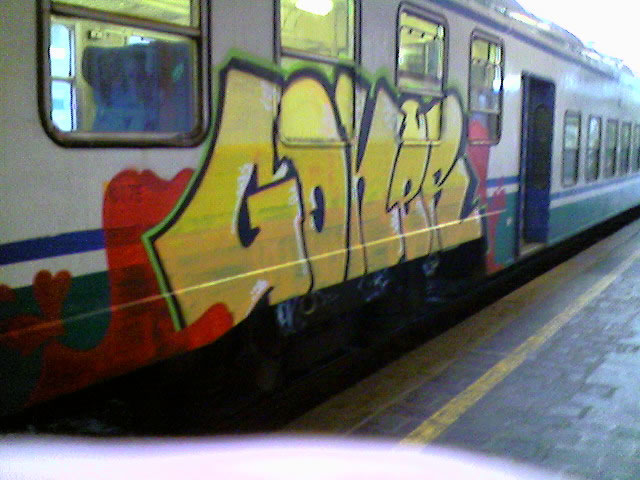
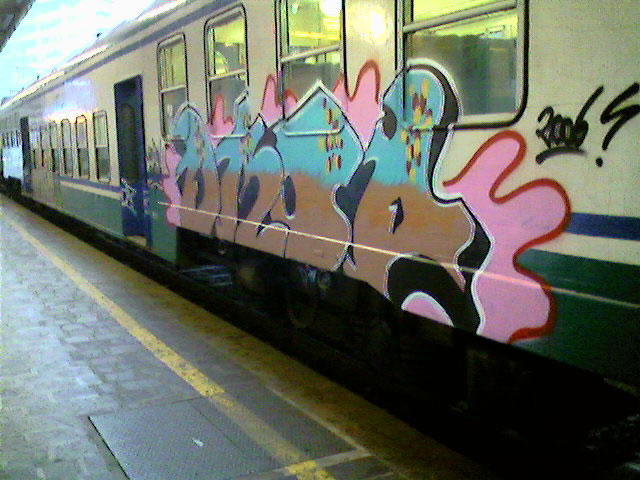
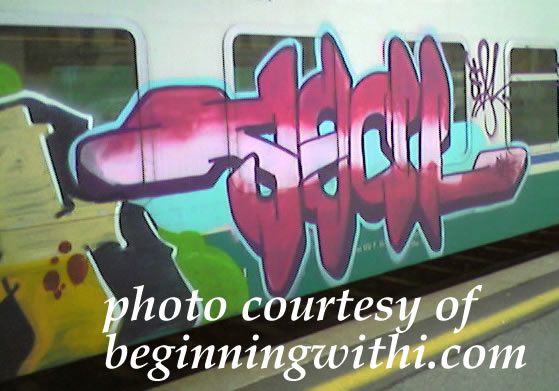
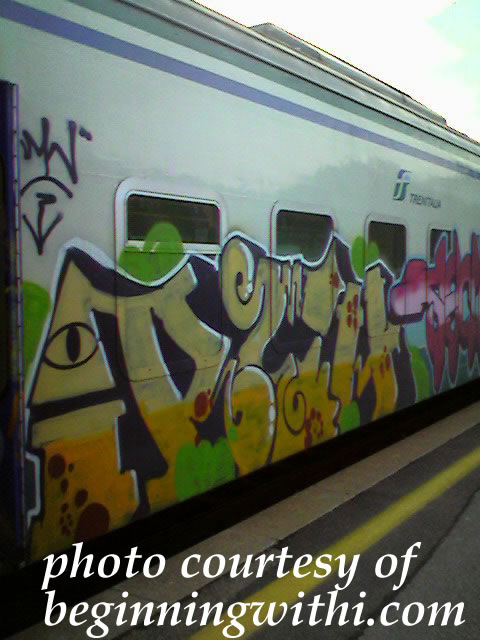
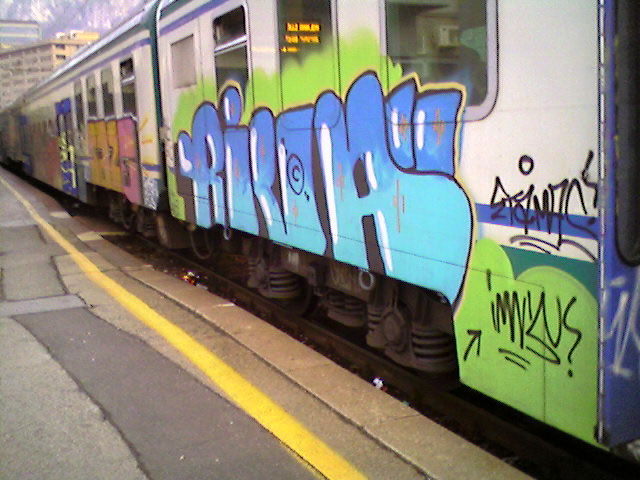
Graffiti-ers in Italy are called “writers” (using the English word). They often decorate the commuter trains. Which look better this way, really.

One artist added this motto: “Colora et labora” – paint and work).

The lower-quality photos were taken with my cellphone, during the time that my digital camera wasn’t working.

Too much window coverage on these (above and below).

Italian train graffiti

my full collection of train graffiti

Muvee: Fun Software for Home Music Videos

Some months ago I was invited to try Muvee AutoProducer software (and become an affiliate marketer – if you click on the banner at the bottom of this page and buy the software, I get a cut).

I didn’t have a lot of time to play with it then, and my first reaction was that this software, while cute, would be of limited interest to hard-core videobloggers – it just doesn’t give you enough control. Then, at CES, Jack Olmsted raved about it to me, and said it was far more flexible than I had realized. More recently, it came to mind when someone asked in the videoblogging group:

“I’ve got a large number of hour-long digital video tapes of my family sitting on the shelf.  I’d like to share key clips of these with my family and friends, but am turned off by the hassle of culling through each tape manually to find the most interesting clips (it seems that 80% of the time, the camera is just rolling and my kids aren’t doing anything too interesting to anyone else but me and my wife).  Is there an easy way to solve this online…?”

Online, I don’t think there is, but it occurred to me that Muvee might be a fun solution for him. So I decided to try it out again, and the Muvee lady graciously sent me a product key so I could try it at no charge.

The process (as explained in Muvee’s helpful startup window), is simple: select the video clips and/or photos and music you want to use, select an “editing style,” then select Make Muvee.

The first time around, this can be slow (especially with large videos) as Muvee analyzes all the material you’re using. But this analysis is only performed once, so you can make changes to your project and test it again very quickly.

Muvee is essentially designed to make music videos using your own video and/or photos; it assumes that you are going to add an audio soundtrack, probably a song. The two samples shown here illustrate this:

Test One – Our Smiling Cat

This Muvee includes about 10 clips from Ross’ digital still camera, plus a bit of video shot with my Canon digital video camera.

I used Muvee’s “simple music video” style.

music: James Taylor “Your Smiling Face”

Test Two – Beautiful Baby

This one uses only still photos, with Muvee’s “personal” style.

The effects on still photos (zooming in or out, panning across) can be done automatically by Muvee. I didn’t like what it was doing by default, so I used Muvee’s magicSpot settings on most of the photos to control “camera movement”.

Muvee produces video in MPEG1, MPEG2, WMV, AVI, DivX, and MOV (Qucktime) formats. I used my usual Sorenson Squeeze software to compress it into FLV (Flash) format for viewing on this page, so don’t judge the quality of Muvee’s video output by what you see here.

My conclusion is still that Muvee won’t be appealing to videobloggers like myself who need a lot of editing control. But it’s a lot of fun for the casual user who wants to create personal videos to share with friends and family, quickly and easily.

I’ll be playing with it some more as I have time and will post the results here.

Barcelona: Parc Guell

Part 6, continued from part 5

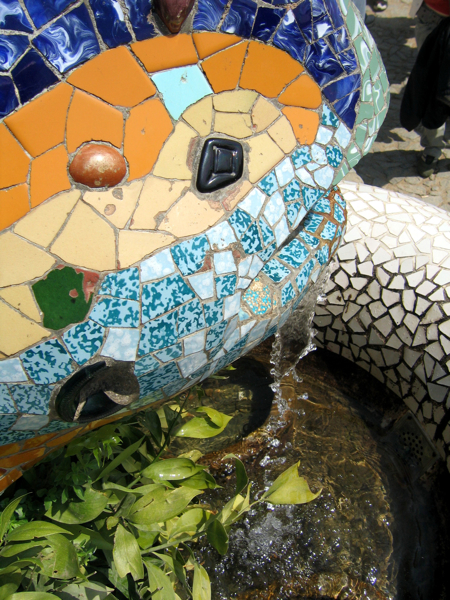
We hopped back on the tourist bus and rode to the other Gaudí house that we hadn’t yet seen, only to find a long line for it. So we rode the other bus line to Parc Guell, the “English-style” park that Gaudi’­ had designed for his patrons, the Guells. We walked around there, photographing and filming, until we were hungry, then got back on the bus (rush hour – we had to wait in line and the first two buses were full before we could board, but they were running every 5-10 minutes) to go to another part of town in search of lunch.

We dismounted in Sarria’¡ and walked until we found, on a side street, a small restaurant full of local people – not a tourist in sight, and no one spoke English. But we managed to communicate well enough to obtain appetizers of fried artichokes (greasy, but yummy), followed by a cheeseburger with no bun (for Ross) and a small tuna steak (for me). Total cost: 20 euros.

Travel Tip: For a cheap, decent meal, follow your nose to where the local people are eating.

Back on the bus for a leisurely ride, with explanations of the sights we were seeing, until we got back to the university area and went to meet Enrico. I checked my email on his office computer while he sat outside on a bench helping Ross with her math homework, then we all headed back to Sant Cugat to pick up our luggage, and Enrico drove us to Gerona airport and our Ryanair flight back home. Nothing much to say about that except that, unusually in my experience with Ryanair, the flight was late. I had arranged a ride from my taxi driver friend Antonello since the flight, even when on time, gets in too late to catch the last train from Bergamo to Lecco. We also had to wait a while for the luggage – luggage delivery seems to always be slow in Italian airports, and I distinctly saw a man running along behind the luggage train with my suitcase in hand – I guess it had fallen off on the last curve (no breakables in it, fortunately). With one thing and another, it was 1 am by the time we got home and to bed. Getting up again at 6:45 for school and work was hard…

Unfortunately, the cold I had throughout the trip has developed into bronchitis. I worked the Thursday and Friday after our return, but will probably be home all this week, coughing, feverish, and not able to sleep properly… At least today (April 25th) is a national holiday and Friday I would have been working from home anyway due to a transport strike.

gallery of Ross’ photos of Parc Guell

Deirdré Straughan on Italy, India, the Internet, the world, and now Australia