Shotgun Wedding

May 28th will be the 17th anniversary of the day Enrico and I had our party wedding. We had been legally married – for health insurance purposes – since that January, and I had moved to New Haven and started living with him around March, in an apartment just for us furnished with hand-me-downs from my great aunt and uncle in Washington, and of course Ikea (I still miss that round black dining table).

Having given up my glamorous Washington-based job as an international desktop publishing trainer, I worked temporary secretarial jobs in and around New Haven. One such was several weeks at Southern New England Telephone, where I got my assigned work done so quickly every morning that I had the rest of the day free to make wedding arrangements.

Not that there was much to arrange. Enrico’s parents had given us a cash nest egg, with the stipulation that we not spend it on a fancy wedding – they had married right after WWII, when money was tight for everyone in Italy, and saw the typical modern Italian wedding as a needless extravagance. We agreed with this philosophy, so there was no ground for conflict. In my experience, expensive weddings contribute nothing to the solidity of the marriage.

Seeking a venue, we learned that East Rock Park, the place where we had had a picnic together with our friend Julia the day we first met, had a carriage house which could be rented for $150 for the day. The catch was that it was already booked for Saturday, May 27th, the date I had announced to everybody as our wedding day. We had to fall back on Sunday the 28th, and let everybody know of the change. (As it turned out, Saturday it rained all day, while Sunday was bright and sunny. And the previous wedding party had even left behind some decorations.)

What about food? I called some wedding caterers listed in the Yellow Pages, and was appalled at their prices for food which would have been boring even if made well. We hit on the idea of Indian food, which involved some driving around to Indian restaurants (there weren’t many) and sampling their wares – not that that was unpleasant! In the end we paid $600 for dinner for 50 people, while we provided the warmers, plastic plates, etc. – and the food was great.

After hearing the nosebleed prices, we also decided against a traditional multi-tiered wedding cake. Just around the corner from our apartment was one of the best bakeries in New Haven. I ordered three different cakes (one chocolate, don’t remember the other two) for a total of under $100, each of them sinfully delicious, and each big enough that most people got a taste of all three.

Flowers, too, were ridiculously overpriced. In the end, the only fresh flowers we had were a wreath for my head and a bouquet for me to carry (and throw). For the tables, Enrico’s parents brought confetti from Sulmona. Confetti – candy-coated almonds – are traditional at Italian weddings and christenings, and are included in the bombonieri (the small gifts that the bride and groom give their guests upon departure). There’s some code about how many confetti have to be in each package, and at most weddings the confetti are white, gold, or silver (for christenings, they’re white, blue, or pink).

Sulmona, a small town in Abruzzo, specializes in confetti wrapped in colored cellophane and twisted together to form flowers – from simple daisy-like forms to complex and realistic irises, roses, etc. They’re beautiful and fun, and in our case doubled as table decorations and bombonieri – everyone got to take one home.

To save the trouble and expense of engraved wedding invitations with reply cards and all that jazz, I printed ours on a laser printer at work, mailed them out, and told people to call me. I mailed them to lots of people whom I knew couldn’t attend (including relatives who hadn’t seen me since babyhood, if ever), as an announcement.

Gift list? We didn’t need china and all that (Enrico had a nice set of plates from Conran’s), and didn’t want to accumulate heavy stuff that we would later have to move to Italy. But we were expecting a baby. So I wrote up a short list of items we really needed, from a CD player to a down baby bunting, and gave that to my friend Sue to manage. Everybody who wanted to buy a gift from the list called her to find out what was still unclaimed. Melinda said it was the funniest bridal list she’d ever seen. But it worked – we got the baby stuff we needed.

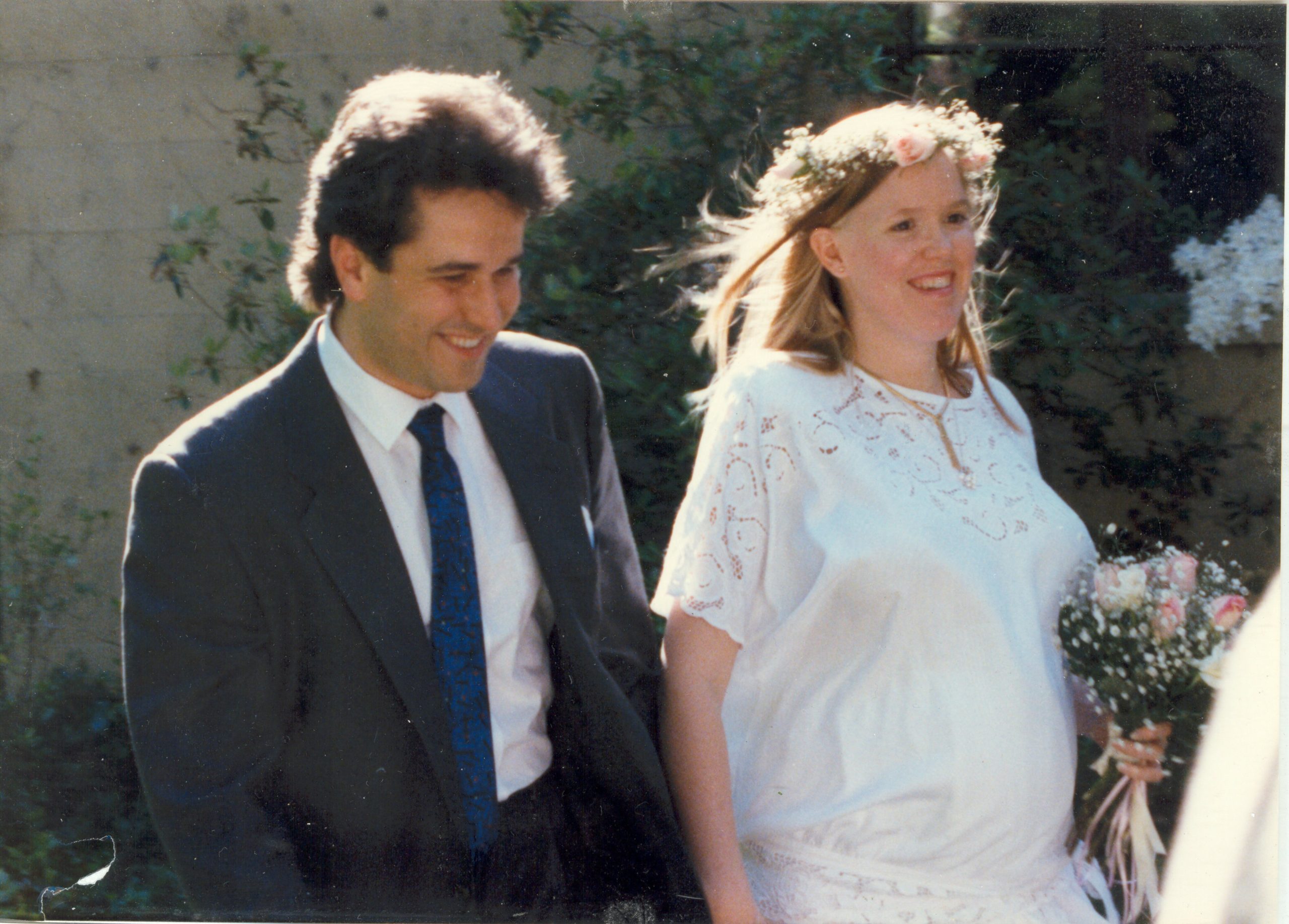
I waited til the last possible minute to buy a dress to wear, since I was visibly more pregnant by the day. (So much for my dreams of a princess waist sleeveless bodice over a long, full skirt.) At an import store I found an elastic-waisted skirt with a loose tunic top, in white with white embroidery. If I remember correctly, it cost $200 – about as much as I’d ever spent on a dress, but far less than a traditional wedding dress would have cost!

I was planning on only two bridesmaids, and certainly wouldn’t ask them to buy those silly dresses that bridesmaids (including me) so often get stuck with. I asked Sue and Steph to coordinate on the color and, in the end, even that didn’t matter since Steph could’t come.

Friends and relatives began arriving days before the wedding. Julia’s father loaned an apartment he had standing empty in New Haven, with not much in it except mattresses – a bunch of our younger friends slept there. Dad and his (then-fiancee now wife) Ruth stayed in a motel out of town (where, unfortunately, their room was broken into and all the new tall people clothes they had painstakingly bought were stolen). My mother and brother stayed at our apartment with Enrico and me. Altogether about 40 people came from all over the world – Dad and Ruth came farthest (from Indonesia, where they were then working) and danced hardest.

Friday evening we had a “rehearsal” dinner, although there was nothing to rehearse. We were already legally married by a justice of the peace, so we decided not to have anyone officiate at this wedding – we would simply make our vows to each other, before witnesses. I had found a small book of wedding vows at the Yale theological library and adapted something from that – leaving out God and wifely obedience, but leaving in “cleave only unto you.”

The pre-wedding dinner was a noisy affair of family and friends held at a local seafood restaurant. My parents, long divorced, managed to be civil to each other (to my great relief – they had not met in years). Most of my friends and relatives were meeting Enrico for the first time; Mom decided she liked him.

My only disappointment was the lack of two important people: Stephanie, my college roommate, was supposed to be my “other best woman” (along with Sue), but at the last moment had to do some work for her lawyer uncle. Aunt Rosie was kept in Austin by my querulous old grandfather who couldn’t bear the idea of her leaving, even for a few days, no matter the occasion. I never forgave him for that.

Everyone else enjoyed each other’s company (even my rancorously-divorced parents managed to be civil to each other). I don’t remember what we did Saturday, except watch the rain. Sunday morning some friends and I went over to East Rock Park to decorate the carriage house. I put up a quilt I’d been making with scenes from my life, along with pictures of our lives (together and apart) and the people in them, and a sort of family tree attempting to explain why all this motley crew of people were there – family relationships, Woodstock relationships, college relationships… We also hung the flags of India and Texas, but couldn’t lay hands on an Italian one. And we blew up dozens of balloons.

In the afternoon we raced back to our apartment, where Enrico and I (and my belly) squeezed into the shower together (there wasn’t time for two showers), and while we were in there rehearsed our vows one more time. We got dressed (Enrico wearing a suit, something he did so rarely that his Italian friends didn’t recognize him in the wedding pictures), and hopped into our separate cars to drive people to our wedding – which is to say I drove my own limo, a Dodge Colt hatchback (at least it was white). We nearly got sideswiped by a Volvo on the way.

The park management had set up rows of chairs with an aisle down the middle, on the lawn facing the carriage house. We had to ask a guy doing t’ai chi to move so we could process properly, Sue leading, followed by me on my dad’s arm. Enrico’s best man, Giorgio, was wearing a tux – which led to more confusion in the wedding pictures as people who didn’t know either of them assumed that Giorgio was the groom!

We got through our vows quickly (so Enrico wouldn’t faint); there was also a response part from the audience that I don’t remember now how we handled – maybe Sue led that. Then Julia (who was studying opera) sang a song she had had composed for us, with text from the Song of Solomon. I recall it as a beautiful song, but unfortunately we have neither a recording nor sheet music to remember it by.

In most sets of wedding pictures I’ve seen, there’s a moment when the bride and groom exit the church (or wherever) together, with a shared look of joy and relief. We didn’t have anywhere to recess to except around some azalea bushes, but someone managed to get there before us and snap a picture of that magic moment; that’s the photo above.

No one had to drive anywhere to the reception. Enrico took off his jacket and tie to play frisbee. Other people sat around, talked, and waited for food. We eventually had dinner, cake, speeches, public present-opening (and appreciation, especially for the children’s-book style Italian vocabulary), bouquet and garter tossing, and lots of conversation, followed by rowdy dancing into the wee hours (with music from our own stereo system, carried over for the occasion, DJed by whoever felt like it). My brother later said that he hadn’t realized that weddings could be fun! Well, this one was. An auspicious start to a marriage, I thought then – and still do.

1 tanzania surprise | 2 coca-cola & an ostrich | 3 justice of the peace

Italian School Culture: Encouraging Unity in the Classroom

One interesting and very successful aspect of Italian schools is how the entire system works to promote social cohesion among the students.

The basic unit at all school levels is the class – not in the sense of year (grade), but subsection of a year. There are usually multiple sections per year, identified by a number and a letter, e.g. Classe I C is section C of the first year. The following year this same group of kids will be section II C.

You are with the same people (including teachers) for all five years of elementary school, then change schools and find yourself in a new group for the three years of middle school. In five-year high schools, the classes stay together for the first two years (biennio), but may change composition for the last three years (triennio) if they subspecialize. For example, at the Liceo Artistico (art high school) that Ross attended, kids going into the third year had to choose between graphic arts, art history and conservation, and two other specializations that I don’t now remember.

There are minor changes to a class population each year because some kids repeat years (this happens frequently in high school) or change schools entirely (rarer) or move to a new town (extremely rare). But basically the same group of kids and teachers can expect to be together for years.

Each class does everything together, all day, staying more or less in the same room; it’s the teachers who go from classroom to classroom, except those whose subjects require labs or other special equipment.

Everyone in a section takes the same courses. There are almost no electives in Italian schools, since, by high school, you have chosen a specialized school and program which is hopefully what you’re interested in (if not, you have to change program or even school – difficult if you lack the prerequisites for the program you’d like to move into).

In public high schools, each class – by law – has two elected representatives, to protect the students’ interests within the institution. Each class may use two class periods per month for a class meeting in which to discuss class business, unencumbered by the presence of teachers. The representatives refer any complaints, troubles, or suggestions to their teacher committee or, if they think they won’t get a fair hearing from their teachers, to the principal. Class representatives meet regularly with their class’ teacher committee, and once each semester there’s an assembly of all class representatives in the school, headed by a pair of “institutional” representatives elected by the entire student body. Class representatives also attend the biannual parent-teacher meetings.

This gives students some direct and useful experience with leadership, representative government, and bureacracy. The elected leaders learn to deal with authority (we hope in a constructive manner). Class government helps to unite the class: they must act together to find solutions to problems, and elect leaders who can carry through those solutions effectively.

All these factors work to bind students into a cohesive social group; I assume that this is one of the basic, if undeclared, aims of the Italian education system.

And there is little going on in Italian schools that would tend to work against class cohesion: very few extra-curricular activities, no school sports except PE class, no band, cheerleaders, chess club, etc. All sports and hobbies are done as after-school lessons and activities (by those who are interested and can afford it). There are no school-sponsored dances or proms – anyone can go to a local disco, not even necessarily with a date.

Italian schools, quite reasonably, concentrate on academics, but not in the fiercely competitive way that seems to be the norm at some American schools. From what Ross tells me, there aren’t any publicly-recognized geniuses in Italian schools. Grading seems rather flat: on a scale of 1 to 10, 5 or lower is a failing grade, 6 is a bare pass, and most grades seem to fall in the 5 to 7 range – few 8s, fewer 9s, and I’ve rarely heard of any of Ross’ classmates (in any of her schools) getting a 10.

Italian schools don’t suffer anything like the clicquishness and bullying that characterize (some? many?) American schools. I won’t claim that no one ever gets teased nor feels excluded in any Italian school, but I have an attentive inside observer in Rossella, and she has never mentioned anything like the miseries that I went through in American elementary and middle schools. (Ross herself is keenly alert to that sort of thing, and works hard to integrate anyone she perceives as being excluded. That, and her let’s-fix-this-attitude, got her elected class rep last year.)

Physical violence and bullying in Italian schools are almost unknown. Rape or sexual harassment are unheard of. An Italian student is more likely to commit suicide (over bad grades) than to try to harm anyone else. They do get up to mischief, but it’s usually the school itself that suffers, in some form of vandalism. Sometimes students go on strike and take over the school completely, running classes themselves. (This seems to have gone out of fashion these days, but it’s an interesting illustration of student social cohesion.)

I’ve written a great deal about what I don’t like about the Italian education system, but when I see American kids passing through metal detectors to get into their schools, I heave a sign of relief and thanks that my daughter isn’t going through THAT.

To Flush or Not to Flush

The local newspapers last week reported with glee that Ken Livingstone, the mayor of London, never flushes the toilet after peeing – he stated this publicly, hoping to increase awareness of the global need for water conservation.

The immediate reaction of a reader of Metro (the freebie paper that I read on the train) was to extrapolate that Livingstone never flushes at all, and express horror at the probable state of his bathroom. Another reader took the argument further, excoriating all environmentalists as stupid. In today’s round of letters, an Italian environmentalist says that Livingstone’s initiative is “exaggerated and unrealistic,” but that we shouldn’t therefore condemn all environmentalist ideas.

Evidently the concept of the no-flush urinal has not reached Italy.

I wrote to Metro myself (it went unpublished) to point out that in many countries there aren’t even toilets, let alone water to flush them with. During my years at Woodstock we had water shortages, sometimes so severe that water had to be carried in buckets from a rainwater storage tank for toilet flushing and everything else. In that situation, you don’t bother to flush every time, nor should you use up scarce water to do so.

David Pollock’s book on third-culture kids recounts the story of a child raised by missionary parents in a water-poor country in Africa, who grew up with the rule: “If it’s yellow, let it mellow; if it’s brown, flush it down” – a habit which horrified his grandmother when he stayed with her in the US!

Italy is rich in water – for now. But when the Alpine glaciers melt away entirely, as they seem likely to do in a few decades, Italians will need to learn to be less fastidious in their bathrooms.

KidSpace: Public Places Where Kids Can Be Kids

If I believe what I read in the media (and some bloggers), American parents are getting hysterical about MySpace. For those not in the know (if you’re over 25 but don’t have a teenage child, that likely includes you), MySpace is an online community with tens of millions of members, most of them adolescents and (very) young adults. MySpace allows every member to maintain a personal blog, post photographs and videos, “share” music (only music already on the MySpace system – it works very well as marketing for little-known bands), and be “friends” with anybody who will agree to be listed as your friend.

Young people seem to use MySpace primarily to communicate by leaving photos and comments on each other’s blogs. Bands and, increasingly, filmmakers, use it to promote themselves to the lucrative youth audience.

As is true with almost every Internet community, anyone can join anonymously or under a pseudonym, or even pretend to be someone else. In other words, it’s easy for a 50-year-old pervert to pretend to be a cute teenager (complete with fake photos) in order to pick up innocent young girls or boys. It’s also easy for a 13-year-old to pretend to be 16 (even with real photographs – the way kids are growing these days, who could tell?) and get herself in over her head with an older guy in a way that neither of them intended.

All this is possible, and no doubt happens; with so many members, you’re statistically bound to have a few really bad apples. Does this mean that MySpace is inherently evil and parents should forbid their kids to use it?

danah boyd, a PhD student at Berkeley and social media researcher at Yahoo, studies online phenomena and writes about her observations with wit and wisdom. She vigorously defends MySpace as one of the few public spaces in which American teenagers can hang out (at least virtually) without overt adult supervision.

I didn’t spend my adolescence in the US and am not raising an adolescent there now, so it had not occurred to me that American kids lacked such spaces in the real world. I figured that the Chock’lit Shoppe of the Archie comics had been replaced by fastfood joints, and/or that kids hang out at malls (and spend money – don’t mall merchants love this demographic?).

Apparently I was wrong. Some convenience stores are experimenting with a sonic device which emits a piercing whine that can be heard by adolescent ears but not by duller adult hearing – so it deters the kids from hanging around in front of the store, without disturbing adult customers. Some malls are also apparently breaking up and moving on idle gangs of teens caught just hanging out.

The kids have nowhere to go after school except home, where they remain alone, in contact with other human beings only via the Internet. Hence their need and desire for MySpace.

What a terribly sad picture of adolescent life. Kids need time to get to know each other and themselves in unsupervised contexts. They need to learn how to evaluate situations and people, without the constant presence of a parent telling them what’s good or bad. They need and deserve privacy.

Perhaps part of the reason Italian teenagers seem more mature than American ones is that Italy leaves real public space for them. An advantage of living in a smallish town in Italy is that it’s completely normal for kids 14 and up to hang out downtown, even into the wee hours of the morning (on weekends), and nobody worries about it. In Lecco, the main teen hangout is a pedestrians-only piazza in the heart of downtown, which is also the site of the bar/café favored by many teens.

This piazza is also usually crowded with people of every other age – adults, seniors, tourists, small kids in strollers or on tricycles. There are restaurants and shops and several bars (NB: Italian bars mostly serve coffee). So there’s always someone around to keep an eye on things, including adults who work there or whose homes overlook the piazza. The kids hanging out are not observed by their own parents (eww – that would be gross!), but are loosely in contact with and supervised by older people; the situation is safe for all concerned.

Given the difficulty of duplicating this in an American suburb, I agree with danah – let the kids have their MySpace! It’s sad that that’s all they have, but it’s better than nothing.

Update

May 21, 2006

I was premature in assuming that “the Mosquito” had already been installed in the US – though it soon may be, since the device first came to public attention last November.

I first heard about it from Boing Boing, and here’s an accessible copy of the article they referred to.

KLM Tries Harder… But Fails

In my Silicon Valley heyday I was a Platinum-level frequent flier on both KLM and British Airways, thanks to business class flights from Italy to San Francisco four or more times a year. When I quit Roxio in 2001, I stopped flying business class (in fact flew far less in any class at all), and was steadily demoted by both airlines.

A couple of years ago, after its merger with Air France, KLM began actively soliciting my custom. They made me a Platinum Plus member for life, and sent me a bottle of champagne to celebrate KLM’s anniversary. BA, on the other hand, eventually dropped me from their list, and I never heard from them again.

I am now planning a trip to Singapore and Malaysia for myself and my daughter in June. KLM not only has the best prices, they’ve kept themselves in the forefront of my attention by letting me know they care to have my custom. I think they’ll get it.

I wrote the above before March 26th. On that date, my beloved aunt died in Texas, and I decided to fly there for the funeral (I had already gone twice in recent years to visit her during hospital stays).

I know that there are, or used to be, special fares offered to airline passengers in cases of emergency or bereavement. I also knew, from recent experience, that some international airlines do not now offer such: I had helped a friend book a flight from Milan to Tel Aviv for a funeral, and Alitalia told me they do not offer bereavement fares.

But I thought I’d give KLM a shot, especially in light of the warm fuzzies mentioned above. I logged into the special frequent fliers area on their website and searched for any information on bereavement fares. Nothing to be found.

I checked their online booking system to see how things looked for the dates I needed (I had some flexibility – the funeral was scheduled for the following Saturday – but could not stretch things infinitely since I would be missing work and my daughter school). The price wasn’t ultra-low, around 550 euros each was the best I could figure out in the reservation system. I was half out of my head with grief and not sure I could trust myself to book online without messing things up, so I tried calling the (Italian) customer service number listed there for ultra-special Platinum members such as myself. What I got was a phone menu with a lot of choices, none of which seemed to be “talk to an actual human being to book a flight.”

Searching elsewhere on the site, I found a general reservations number for Italy. Called that – closed on Sundays.

I finally found a booking number in the Netherlands, and called that (international long distance call!). Lo and behold, a real human woman answered, so I explained the situation. No, they don’t have bereavement fares, she said. What they do in these cases is book you at the lowest available fare. (Uh, wouldn’t I have done that anyway?) I asked her if she could book the flights for me, just so I wouldn’t make any mistakes in my state of distraction. She quoted me a price of 1100 euros each. I was startled, to say the least.

“But I just saw a fare at half that on your website!”

“It’s a different market. You’re calling Holland, we can’t access the fares available from Italy. Your best course is to book it yourself on the website.”

By now I was getting irritated enough that adrenaline was clearing my head and confusion would no longer be a problem, but I gave her one last chance to do the right thing:

“I’m a Platinum Plus frequent flier with KLM, I have just told you that I am in mourning and making an emergency trip for a funeral, and this is the best you can do to help me?”

“Yes, it is.”

So I booked my flights online. With Continental. Didn’t save much money over what I would have paid KLM (in fact, it was all so expensive that I have had to give up the Malaysia trip), but I got a far more convenient departure time. The six-hour layovers in Newark each way were less welcome, but we used the time to visit with my good friend Mithu (who works near Newark Airport), and have (well-deserved and much-needed) spa treatments at the terminal.

As for KLM, they’re going to have to try a lot harder now.

another airline saga

Share your airline experiences – who do you like (or not), and why (or why not)?

Deirdré Straughan on Italy, India, the Internet, the world, and now Australia