Milan: A Shopping Guide for Teens

^ The sun never sets on Benetton

Last Christmas season (Dec 2004) our teen expert, Ross, took me out to see where the cool young people shop in Milan.

MM Shoes, in via Torino near the Duomo – trendy shoes and boots at very reasonable prices
Calzedonia window, Milan<

The Calzedonia chain features socks, stockings, lingerie, and swimwear. All over the city.
Fornarina shop, Milan

Fornarina – very in, but also expensive (even their graffiti matches).

Porta Ticinese, Milan<

We continued down via Torino, past the Colonne di San Lorenzo, to Porta Ticinese (the big archway you see in this photo – one of the gates to the medieval city).

Beyond is Corso di Porta Ticinese, full of interesting, funky boutiques as well as chain stores. Some of our favorites are the shops featuring hand-made clothing and accessories of bright Asian silks.
AJ Caffe, Milan

Armani Jeans, also in Corso di Porta Ticinese

Milan

Later, we met up with Ross’ friends Ilaria and Filippo in front of the H&M in San Babila…

…and strolled over to the “Golden Quadrilateral” – bounded by via della Spiga and via Montenapoleone, this is the high-end shopping district. It’s fun to look at the gorgeous window displays, even when you can’t afford anything!

Valentino shop, Milan

Valentino
Aprica baby stroller decorated with candies, Milan

Even baby strollers get the star treatment. (The Aprica shop on via Montenapoleone does seasonally-themed displays, you can see another onehere.)

Thoughts on the Futures of India and Italy

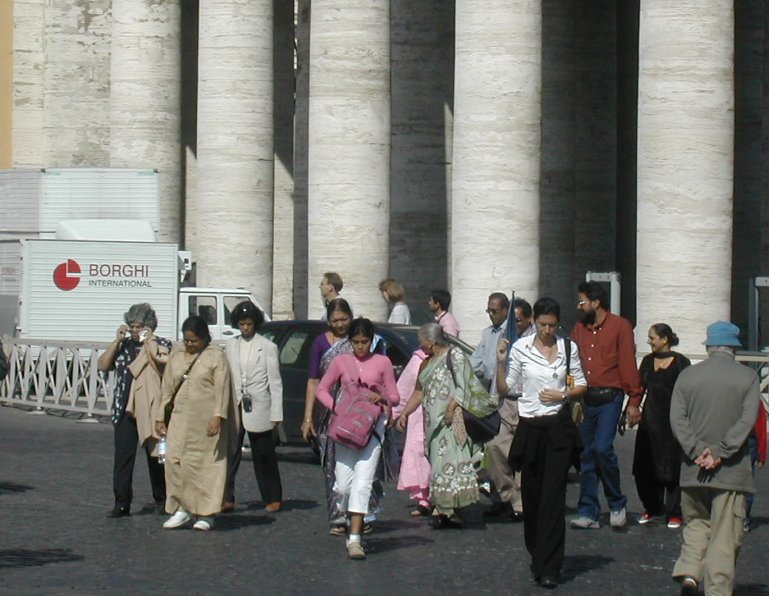
top: a family of Indian tourists at St. Peter’s in Rome

My India travel vlog, from the trip I took with my daughter this summer, is still in progress. There’s more video to edit, more photos (by Ross) to add, and, most of all, more thoughts to share.

What struck me throughout the trip, but especially in Mumbai, was the ferment of growth and change. The atmosphere reminded me of Silicon Valley five years ago: everyone feels that they have a chance to be part of something exciting and rewarding.

My Indian friends and classmates are doing well, which may not seem surprising – most of them came from the elite in the first place (otherwise they could not have afforded to attend Woodstock School). But they, too, have ridden the economic roller coaster over the last 20 years, and the fact that they’re heading up again now is thanks to talent and hard work at least as much as accidents of birth. It’s also thanks to the entrepreneurial energy unleashed in India since the economic reforms instituted in 1991 by then-finance minister (and now prime minister) Manmohan Singh.

India’s economy is growing at 6 to 7 % a year, and anyone who has been observing the country can see the effects. New roads are being built in the major cities, and new highways connecting them that I’m told are as good as American ones (haven’t seen for myself). Delhi is very proud of its rapidly-growing subway system – our travel company driver was eager for me to take a look, in spite of the fact that I was paying him to drive me around in a private car. Traffic is horrendous, but Delhi has cut pollution noticeably by requiring all public transport vehicles (buses, taxis, and scooter taxis) to run on CNG (compressed natural gas), and allowing heavy trucks into the city only late at night.

I don’t actually like Delhi, though; there’s something about its attitude that annoys me. Mumbai is another story. It’s a delightfully insane city, the largest I’ve yet been to (Tokyo, when I visited around 1971, was at the time the world’s most populous city, but I think it had around 8 million inhabitants then; Mumbai today has 15 million*). Yes, there are millions of people living in horrible slums; I did not see those, but I know they exist. What I did see was people living in mile after mile of roadside shacks built against walls and buildings.

Just another slum, you say? Yes, but… these shacks (called “hutments”) are two stories tall, made of plywood with solid wood frames, and roofed in corrugated tin or plastic sheeting. They have doors that can be locked, and many boast television sets inside (running on current pirated from the nearest electric wire) and satellite dishes on the roof. By the standards of the villages their inhabitants came from, this is cushy living. Shilpin explained to me that these people come from the countryside to take contract jobs in the insatiable Mumbai factories, or to earn a good living as day laborers. They leave their aged parents back in the village to protect the family land, and send money home for their upkeep.

The reason they don’t have proper housing is that real estate in Mumbai has become so expensive that no one can afford it. There have been two amnesties in which hut-dwellers were moved into city housing, and took on all the duties of citizenship such as paying taxes and electricity bills. However, there is so much demand to live in Mumbai that the hutments were immediately rebuilt and re-inhabited.

This is all indicative of India’s overall growth. People come to the cities to get jobs, which are plentiful (though not as plentiful as they could be – more economic and labor market reforms are needed), and fewer people are needed on the land as agriculture has become more productive..

It’s an exciting time to be in India, and Indians have much to be proud of. There are still enormous problems, to be sure, but there is also a sense that progress is being made and problems can eventually be solved.

And what of my other “country beginning with i”? Italy… is going nowhere. It experienced heady growth in the 1960s and 70s, culminating in the sorpasso in the early 1980s, when Italy’s economy was declared the world’s fifth largest, surpassing the UK. It’s been mostly downhill from there. Italy did well in skilled manufacturing when those jobs were still in the west, but is now becoming a rust belt of abandoned factories as globalization sweeps manufacturing jobs to the east. Like Americans, Italians bemoan the loss of their manufacturing jobs even as they rush to buy goods made cheaply in China.

The same shift in economic emphasis has happened in the US, of course, but the US as a nation has a broader skill set, so has been able to move up the value chain from manufacturing to services. Now that service jobs are also going overseas, the US can concentrate on R&D. A majority of the world’s scientists and engineers live and work in the US, although many of them were not born American. The next wave of growth will come from intellectual property, and the US will lead that wave (though this source of competitive advantage will also eventually be at risk from the growing pool of intellectual talent in India and China).

Italy (and most of the rest of Europe) is not well positioned to move up the value chain. Italy, in particular, is not supportive of research. As with so much else in Italy, university research centers are fiefdoms controlled by “barons” who give positions as patronage rather than on merit. Corporate R&D is almost non-existent (with notable exceptions such as Fiat, and, on a much smaller scale, the company I work for). Italian scientists and engineers mostly flee to the US if they want to get any serious work done.

Italy’s economy is hostage to entrenched and conflicting interests, with little hope that real and necessary reforms will be carried out by governments of the right or left. Though the need for such reforms is recognized by the Italian public, as I learned in a conversation on the airport shuttle bus the other day, with the bus driver and another passenger.

The passenger (a woman) has two daughters, one working in France and one seeking work in Germany – both having given up on finding decent jobs in Italy. One had been employed at Malpensa airport, doing customer service (in multiple languages), working shifts at 5 euros an hour, with no permanent contract nor any hope of one, nor any guaranteed minimum of hours. If we assume 40 hours of work per week, that’s only 800 euros a month – not enough to live on in or near Milan. No wonder she gave up after 16 months. “Something’s wrong here,” says her mother. “We slave to put them through school [both her daughters have university degrees], and they can’t find jobs in Italy.”

The bus driver looked in his 30s, and had “immigrated” long ago from Calabria in Italy’s deeply poor south. He’s had this steady job for several years and says the salary is good, but the work is demanding and often keeps him away from home. Home is a 40 square meter (430 sq ft) townhouse out in the country, 16 km from Bergamo, which cost him around 120,000 euros – a price he considered reasonable, since the place will be easily resellable when he is ready to move to something bigger (presumably when he decides to marry). Interestingly, he has no interest in returning to Calabria except for vacations – “life is different there, too slow. I’m used to life up here now.”

Both recognize that something is wrong with the pensions system. “Perhaps we promised too much before,” mused the driver.

Neither expects any of the current crop of politicians (left or right) to do much good.

As Beppe Severgnini says in The Economist‘s The World in 2006, “…the country must decide what it wants to be. It may opt to do nothing, and become an ageing, former manufacturing country, where local lobbies and special interests can gorge until the money runs out. Or Italy can become a welcoming service country, driven by design, tourism, and technology: an accessible land, easy to do business with, confident in its tolerance, creativity and flair.”

Unfortunately, I don’t hold out much hope that Italy is ready to make the big changes needed to attempt Severgnini’s Plan B. When I ask why things are the way they are (in any context), the response is usually a shrug and “It’s always been that way,” even when the person agrees that “the way it’s always been” isn’t necessarily good. As Severgnini puts it, “People are afraid of change.”

Italy can and probably will limp along, with the younger generations living off savings accumulated by their parents and grandparents. To be sure, they can still live a very nice life: sunny beaches in the summer and snowy slopes in winter, eating and drinking well, hanging out with friends they’ve known all their lives. There’s a lot to be said for that, and most of my daughter’s peers aspire to no more. They’ll settle for any job near home that allows them to go on living exactly the way they always have. (They’ll be lucky to find that job, however.)

Maybe it’s the American in me that says: “That isn’t enough. How can you stand to sit around and watch your country slide inexorably into poverty and oblivion? How can you spend your working life doing something you don’t even care about?”

If I was a typical Italian mother, I’d urge my daughter into whatever university course and profession seemed most likely to keep her close to home. Though I’m in no way a typical Italian mother, I adore Ross and would love to live near her for the rest of my life. But, for her own sake, unless something changes drastically, I hope she gets out before she stagnates along with the rest of Italy.

I Did It Again

Apparently, I should be working for the Economist – I publish the same thoughts, before they do. This week’s (Nov 24) edition contains a survey of Italy titled Addio, Dolce Vita, whose leader goes on to say: “For all its attractions, Italy is caught in a long, slow decline. Reversing it will take more courage than its present political leaders seem able to muster…”

Italy in Decline: Umberto Eco Joins the Chorus

Feb 5, 2006

Today’s Corriere della Sera carries an interview with Umberto Eco, whose new book, a collection of essays titled “A Passo di Gambero,” (“Walking Backwards”) debuts Wednesday.

“Guardi, l’Italia nei cinque anni appena trascorsi si è messa sulla strada del declino. Se andiamo avanti così diventiamo definitivamente un Paese da Terzo Mondo.”

“Look, Italy in the last five years has set itself on the road to decline. If this goes on, we will definitively become a Third World country.”

…Da caustico il tono diventa un po’ amareggiato quando il discorso si sposta sull’immagine dell’Italia all’estero: “Mi prende un senso di profonda umiliazione vedendomi fatto segno di tante manifestazioni di affettuoso cordoglio”.

…From caustic his tone becomes somewhat bitter when conversation turns to Italy’s image in the world: “I feel profoundly humiliated to be offered so many expressions of affectionate condolence.”

I’ll be buying the book.

 

La Transumanza: Moving the Herd for the Winter

I usually think we’re living in the suburbs, but every now and then something persuades me that we actually live in the country.

Today, it’s the transumanza – moving the herds from high summer pastures to lower altitudes for winter. I filmed this right out my studio window.

You can hear the herd dog, but not see him – he was in the truck behind.

…One Week Later

Books by Foreigners About Italy

Italian Neighbors – by Tim Parks

Paul gave me this book from my Amazon wish list; I had been meaning to read Parks for quite some time, having heard good things about him.

All the reviews I’d read mentioned his books as being about Verona, but, on the very first page, I laughed out loud: “Italian Neighbors” is set in Montecchio, a small town that I’ve visited several times because Enrico has cousins there (though I don’t know it well enough to recognize the specific places Parks mentions).

This is a different sort of book from the “buy a villa in Tuscany” or “live in a picturesque village” sagas listed below; Parks lives a more ordinary life, he and his Italian wife struggling (as many of us do) to make ends meet with whatever work they can find (in his case, English teaching and translation, and writing). They deal with the hassles and enjoy the pleasures of ordinary Italian life, as Parks observes keenly and reports kindly. Montecchio is not much of a tourist destination nor particularly picturesque, but Parks brings out the small beauties and large charms available in almost every Italian town, if you know how to look. In sum, he reminds me rather of myself writing about Italy: he notices different things, but writes about them much the same way I would. (The big difference is: he’s published!)

Parks’ commentary on Italian social life and customs is dead on, though a bit out of date – the book was originally published in 1992, and even Italy has changed in this last tumultuous decade and a half. In addition to novels, Parks has written several more books about his life in Italy which doubtless bring the story forward and remark on these changes; I’ll let you know when I get around to reading them. His most recent, about the Medicis, was well reviewed in the Economist and elsewhere.

more books by Tim Parks

Books About Living in Italy

Dec 17, 2003

So I’ve been thinking of writing a book about life in Italy (just what the world needs more of). I’ve been checking out some of the competition on Amazon – none of which I have actually read:

“Like many European travel memoirs, Hawes’s work hinges on making the locals appear charming and eccentric, making the food seem sacred and making the countryside’s beauty look dazzling yet unappreciated by those who live there.”

“A sensuous valentine to author Ferenc Máté’s adopted homeland, The Hills of Tuscany brims with lush descriptions of golden dales, scrumptious meals, rich wines, and friendly natives.”“Of all the romantic obsessions in novelist Lisa St Aubin de Teran‘s life, the search for a castle occupied her the longest–until she saw the magnificent Villa Orsola deep in the Umbrian hills. Only after eagerly signing the ownership papers did she and her husband, painter Robbie Duff-Scott, discover they were the owners of a vast ruin lacking windowpanes, parts of the roof, and other essentials. A Valley in Italy recounts its restoration in the grand style of impossible house and the charms of bohemian family life. It also offers a rare portrait of the life of an Italian village, where ‘all things are made to be as enjoyable as possible.'”

“Everywhere hailed for its quirkiness, its hilarity, its charm, Pasquale’s Nose tells the story of a New York City lawyer who runs away to a small Etruscan village with his wife and new baby, and discovers a community of true eccentrics – warring bean growers, vanishing philosophers, a blind bootmaker, a porcupine hunter-among whom he feels unexpectedly at home.”

Okay, clearly I’m unqualified – I don’t live in Tuscany or Umbria or any small village or on a farm, and I haven’t renovated a villa, castle, or farmhouse. (Among other reasons, I don’t have the unlimited funds required to do some of those things.) I do love food and cooking, but my life doesn’t revolve around it. I have Italian friends and neighbors, but they are not friendly peasants or lovable eccentrics. Oh, well. As usual, I will just have to do it my way, and hope that someone wants to buy the result. Anyone know a good literary agent?

Cultural Hegemony: Who’s Dominating Whom?

A popular meme in American consciousness is cultural hegemony: the idea that American culture, as represented in widely-exported American movies, TV shows, fast-food restaurants, and brands, is overwhelming the traditional cultures of other countries. The fear is that this will eventually result in a sadly homogenized world in which everyone abandons their own customary foods and entertainments to eat at MacDonald’s and listen to hip-hop.

This theory seems to be popular on both sides of America’s own cultural divide. The liberal left worries that we are teaching the rest of the world to be destructively, mindlessly capitalistic and individualistic. A more conservative viewpoint worries that we are “exporting the wrong picture” of America, an argument propounded by Martha Bayles of Boston College in a Washington Post editorial (see below).

There are two problems with this theory.

The first is that it’s arrogant. It is true that American popular culture is widely consumed worldwide. This is not simply because American media companies are good at selling their products – no one is forcing people to watch American shows. In many countries, local cinemas and TV stations show American stuff because their customers want to see it. Some governments work hard to censor what their people see, for political or religious/cultural reasons (or both). Nonetheless, their citizens often go to great lengths, sometimes breaking the law, to obtain and consume American media. It’s not being forced on them by those evil capitalists in Hollywood.

The cultural hegemony argument is also a subtle put-down of other cultures: it assumes that they are so weak or ignorant that they cannot be trusted to decide for themselves what they should see and hear. That these people should, “for their own good,” be protected from invasive American culture, so that their “native” cultures will be preserved.

(Aside: Preserved for what? As a quaint playground for American tourists who want the “authentic” experience when they travel in other countries?)

The second problem with the theory of cultural hegemony is that it’s simply not true. I’ve been in many parts of the world and, while you do see signs of American/ Western culture everywhere, most people value their own cultures and work actively to preserve them, consuming local media, food, etc. alongside whatever foreign stuff they like.

India is a great example of a society which needs no special measures to preserve its traditional culture – unlike, say, France (said she mischievously). Indians love TV, and have plenty of it: at least two or three channels for every major language (of which India has 14 or 15, including English), and at least one each for Muslims, Christians, Jains, and Sikhs (probably Buddhists as well, though I didn’t see this), plus one for each of the major branches of Hinduism. In addition to news and worship, there are channels dedicated to Indian-produced TV series and movies, and channels of Indian music videos. A few channels show imported TV, movies, and music, plus CNN International/Asia and BBC World, but these are vastly outnumbered by local fare – no case to be made there for Western culture overwhelming India! Which is hardly surprising: India has been absorbing and subsuming foreign cultures for 3000 years.

If there’s any cultural invasion going on, it’s occurring in the opposite direction. A number of Indian directors are doing well in Hollywood, some with films you can’t tell apart from any other Hollywood product (M. Night Shyamalan), others bringing Indian or cross-cultural themes to Western audiences (Gurinder Chadha), and/or adding Indian spice to otherwise Hollywood-standard movies (Mira Nair’s “Vanity Fair”).

There’s a growing presence of American brands in India, but that doesn’t mean that Indians are adapting to American tastes. Reading a women’s magazine in Mumbai, I saw an ad for a very familiar American brand, Pillsbury. Attempting to sell devil’s food cake mix into India, you wonder? Nope. The ad was for a rice flour mix that could be used to make dosas, idlis, and vadas – distinctly south Indian treats. I’d be surprised if that product ever got to the US, and I didn’t see any ads for Pillsbury brownie mix or refrigerator cookies in India. American companies, far from trying to foist American tastes on Indians, are studying the local market and adapting their products accordingly. You don’t get to be a global brand by expecting everyone to like what Americans like – as most American multinationals are keenly aware, even if the American general public is not.

So, the next time you get worried about American culture taking over the world, look around you. If you can’t get to a foreign country to see what’s actually happening there, just look at your American hometown: how many “ethnic” restaurants do you have? And what is American culture itself, but a rich soup of the many cultures that Americans originally came from?

It’s not just Americans who buy into the “American cultural behemoth” myth: UNESCO has recently passed a resolution supporting nations’ rights to set a protected percentage of “local culture” to be shown in cinemas and aired on TV. Several nations have such laws, which Hollywood has been protesting as protectionist.

(via Jeff Jarvis)


Bayles’ articleso incensed me when I read it that I started to write a reply, then lost it for a month in the swamp of my email box. I don’t think I’ll bother sending it to her now, but here it is for your edification, though it’s slightly repetitive with the above.

Dear Dr. Bayles,

I read with interest your piece in the Washington Post, though not (yet) your book. I’d like to make a few observations.

Though a US citizen, I have lived overseas much of my life. I attended international schools, particularly, for high school, an international boarding school in India with students from all over the world. I did my BA in Asian Studies and Languages (including a study abroad year in Benares), and now live in Italy with my Italian husband and daughter.

In short, I think I’m qualified to comment, from personal experience, on how US popular culture is perceived in some other parts of the world.

I would first take issue with the study you quote:

One of the few efforts to measure the impact of popular culture abroad was made by Louisiana State University researchers Melvin and Margaret DeFleur, who in 2003 polled teenagers in 12 countries: Saudi Arabia, Bahrain, South Korea, Mexico, China, Spain, Taiwan, Lebanon, Pakistan, Nigeria, Italy and Argentina. Their conclusion, while tentative, is nonetheless suggestive: “The depiction of Americans in media content as violent, of American women as sexually immoral and of many Americans engaging in criminal acts has brought many of these 1,313 youthful subjects to hold generally negative attitudes toward people who live in the United States.”

American women living normal American lives as depicted in films and TV are sexually immoral by the standards of some of the cultures mentioned. After all, in Saudi Arabia, it is not only immoral but illegal for a woman to ride unchaperoned in a car with any man who is not her husband or a blood relative. By such standards, almost anything a woman does outside of stay home, or hide her face when she goes out in public, would be immoral. How is the American film industry not to violate those standards and still depict American life as it actually is?

Depicting the freedoms that American women enjoy may be offensive to some cultures, but I would argue that those cultures NEED to be offended. Do you want to help protect cultural norms which oppress women as severely as Saudi Arabia’s does? What about cultures where any grown woman possessing a clitoris and the ability to feel sexual pleasure is considered immoral? Cultural relativism be damned – these women need to be freed, and if American movies help inspire them to fight for their freedom, I say bring on “Thelma & Louise” !

It is true that many American films and movies depict people engaged in criminal acts. Most of the time, these people are “the bad guys” and the plot has to do with bringing them to justice. Although there are films glorifying anti-heroes, I don’t think the majority of American films would lead any sensible viewer to the conclusion that American society condones criminal behavior.

From what I see in Italy, if Italian youngsters have a negative attitude towards Americans, this is more likely the result of America’s foreign policies than what they see in the imported media.

As for the depiction of Americans as violent – Americans ARE violent. As reported by Gregory S. Paul recently in the Journal of Religion & Society, “the U.S. is the only prosperous democracy that retains high homicide rates…” (as compared with other developed nations).

You go on to say:

…The 2003 report of the U.S. House of Representatives Advisory Group on Public Diplomacy for the Arab and Muslim World stated that “Arabs and Muslims are . . . bombarded with American sitcoms, violent films, and other entertainment

I’ve heard this kind of argument many times, and my response is the same response I make to American parents who are “so concerned” about what children see on TV and in the movies: YOU HAVE A CHOICE. No one (outside of a Stanley Kubrick movie) is forced to sit in front of a television set with their eyelids propped open, helplessly absorbing hours of sex and gore. In America it happens because adults choose it for themselves, and don’t control what their children watch. In some countries, where much or most foreign media is censored, people go to great lengths to obtain American films, TV, and music, illegally and sometimes at risk to themselves. This is hardly bombardment on America’s part. The stuff is produced and people who want it, find it. American parents, not the media, are mostly responsible for what their children see and, even more, WHAT THEY LEARN FROM IT. The tendency in America lately is to want government to play parent and protect us from “bad stuff,” and now you want to export that paternalistic model to adults in other countries who, like adult Americans, are mature enough choose what they want to watch.

A final quote:

…much of which distorts the perceptions of viewers. The report made clear that what seems innocuous to Americans can cause problems abroad: ‘A Syrian teacher of English asked us plaintively for help in explaining American family life to her students. She asked, ‘Does “Friends” show a typical family?’

In describing the state of the modern American family, “Friends” is actually a good place to start. A group of young people in and out of relationships (both straight and gay), having children in and out of wedlock – yes, that’s pretty typical. If anything, these friends are fortunate: they form a de facto family that mostly stays together, there to support each other through the vicissitudes of life. Which is more than can be said for many multiply-divorced “traditional” families in America today. This isn’t a happy reflection on American culture, but it’s an honest one.

NB: I did email this letter to Dr. Bayles, but she has not so far (Feb 2006) dignified it with a reply.


Cultural Hegemony?

Oh, those poor Indians – they’ve lost touch with their native culture! <big grin>

Deirdré Straughan on Italy, India, the Internet, the world, and now Australia