Kids These Days: Italy’s Young People, and Their Manners

Lynn Truss, author of Eats Shoots and Leaves has a new rant out about how the world’s manners are going to pot, and her personal crusade to reverse this phenomenon. I totally sympathize.

I ride the schoolbus in the mornings. That is to say, I take the normal bus line that goes down the hill to Lecco’s railway station, but I happen to take the run that’s scheduled for the benefit of kids going to school. It’s a small bus, and fills up quickly.

Six to eight kids get on at the same stop I do. Even when the bus pulls up with its door right in front of me, they crowd in to get on before me and get seats. A couple of unfortunate older women who get on at later stops have no hope of getting seats, nor does it ever occur to the kids to offer them. A 10-year-old boy who gets on at a stop before mine routinely uses his backpack to hold a seat for a friend. One day an older woman got on, and I suggested to the boy that he give this seat to the lady. He just looked at me as if I was from Mars, and did not even answer. Perhaps his mommy told him not to speak to strangers. (I could have offered the lady my own seat, but she was quickly so hemmed in with backpacks that she probably preferred not to struggle through to it).

Another day he went so far as to reserve two seats. I gently suggested that it would be polite of him to offer one seat to the lady. He stared at me as if “good manners” was a novel concept. I asked him what his mother would think of him not offering a seat. He’s still young enough to respond to this sort of guilt trip so, reluctantly, he complied. He was too shy to tell the lady (she was standing by the door facing the other way), so I called her over and said: “This young gentleman would like to offer you a seat.” She and I smiled at each other complicitly. Later, after he got off, we shook our heads sadly together over the shocking behavior of today’s youth.

Older kids are harder to embarrass. One day, when I had had more than enough of the kids trying to climb in front of me, I spread my arms, blocked the door, and said jokingly (but firmly): “Let the old lady [meaning myself] get a seat.” An adolescent boy took exception to this, and afterwards Ross, when travelling alone, often heard him muttering imprecations about me when he thought she had her iPod on and couldn’t hear him (“That’s the daughter of that bitch…”). Ross told me about this; she was touchingly angry about it (I didn’t care), and considered whether to confront him, or maybe have her older friends beat him up.

No need for violence: Ross is quite scary enough all by herself. One day as we got on the bus together, she leaped on and grabbed a seat, right next to this boy. That was the last seat, so she offered it to me, and stood herself. I hadn’t even noticed the boy when Ross said to him, in a loud and dangerous voice: “Well, you’re sitting right next to my mother now. What are you going to do about it?” He just about sank into the floor. Perhaps that will have cured him of making rude remarks about people’s mothers. <smile>

Riding the Bus

Oct 4, 2006

I wrote last year about the irritations of riding the bus with the schoolkids in the morning. They haven’t learned any more manners this year. As always, they gather where they think the bus doors will be when it stops, then elbow each other to get in first. When I see the bus coming I move in that direction, but consider it beneath my dignity to blatantly step in front of them all – someone’s got to set an example of civilized manners. Once the door is open, I let those ahead of me in “line” board, politely but firmly block anyone else from cutting in front of me (provoking some mutters, which I pretend to ignore), and, when finally on the bus, I give the driver an eye-roll about the kids’ lack of manners.

Evidently he agrees with me. The other morning, the bus pulled up very carefully and stopped a meter short of its usual position – right in front of me. I assumed that this was just coincidence, but as I stepped onto the bus, rightfully before everybody, the driver gave me a complicit grin. I smiled sweetly back. We’d pulled one over on the kids for once.

International Manners

Jan 17, 2006

In response to the above, Rick Freeman wrote:

“We were in Bermuda some while ago, and perhaps the most memorable thing about the trip is the way people acted on the bus … it was beyond manners, more of a whole etiquette dance. Every time there was a stop, the people who sat checked to see who came in and how they ranked. Virtually everyone got up at some point and gave their seat to someone else (older, pregnant, etc.).

Not exactly the most interesting place I’ve visited, but certainly lots of people with good manners.”

More Tips on Getting Better Customer Service

If you’ve been reading this newsletter for a while, you’ll know that customer service is one of my pet peeves – and praises, when somebody actually gets it right.

For my upcoming US trip, I need a cellphone. Actually, three, for the three of us going to Las Vegas for CES, so we can keep track of each other during the show. Though we all have tri-band phones that will work in the US, roaming charges from Italy are ridiculous.

I was astonished to find that there seems to be no way to simply buy a SIM card for whatever service and pop it into the phone I already have, as I did in India. Every US carrier wants me to buy an entirely new phone. This is annoying, since I am used to my own phone and have all my numbers on it. But there appears to be no way around it. US consumers sure put up with a lot of rubbish from their cellphone providers.

I consulted with my group of online experts, who concurred in recommending TracFone, and one even sent me a special free minutes offer. So I went straight to the TracFone site and ordered three cheap cellphones. Or tried to.

As I had been expecting – because it happens so often on US sites – it wouldn’t take my foreign-billed credit card. I could buy the phones from Amazon with any credit card, but that would cost a bit more, as would buying them in a shop.

Stubborn creature that I am, I decided to write to TracFone’s customer service about this. What do I have to lose?

But I knew pretty much what to expect from a low-level customer service rep. So I used an old trick (previously mentioned on my site – see below – and sometimes used on me in my Adaptec/Roxio days). I did a search for “Tracfone CEO” and found out his name. (I also saw, from the press releases mentioning him, that TracFone does a lot of socially-conscious stuff. That made a good impression.)

Now I had to figure out his email address. The address I had, customerservice@tracfone-ild.com, did not look like a corporate HQ adress – some sort of service center. CEO not likely to have email there. I sniffed around some more, found a press release with the email address of a company spokeswoman. Her address was formatted first initial-middle initial-lastname@tracfone.com From that, I could guess the format of the CEO’s email. So I copied my email to customer service to a couple of likely addresses for him. I was polite, and pointed out that they were missing potential business from travellers like myself, coming to the US with a need for a phone.

That was about 11:30 yesterday morning. At 1:20, I received an email from the CEO to someone named Steve, cc’d to me, instructing him to assist me in my purchase. I immediately thanked the CEO and said I was sure I would enjoy doing business with his company.

At 4:30 the same afternoon, I received the expected reply from customer service: “It was managements decision to only accept US based Credit Cards for security and business reasons.”

I’ll give them credit for swiftness of response, though a zero on punctuation (and, of course, helpfulness).

I’m now waiting to see whether Steve manages to pull this off for me. Even if he doesn’t, at least the attitude at the top is the correct one. Who knows, maybe they’ll change their credit card policy and find themselves with a whole new income stream.

later – Steve couldn’t come up with a payment method fast enough to solve the problem, so I’ll just have to buy from a store. He did tell me which were likely to have the largest selection of phones, and that the refill cards I want are also available there. That’s enough of a good-faith effort for TracFone to get my business.

The Science Fiction List

An Internet meme I’ve been meaning to get to for a bit:

“Below is a Science Fiction Book Club list most significant SF novels between 1953-2006. The meme part of this works like so: Bold the ones you have read, strike through the ones you read and hated, italicize those you started but never finished and put a star next to the ones you love.”

1The Lord of the Rings*, J.R.R. Tolkien (Read many times, though I always said the girls weren’t having enough fun. Now I like the movies better.)
2. The Foundation Trilogy, Isaac Asimov
3Dune, Frank Herbert (Read the first one, wasn’t impressed, though the discomfort of stillsuits is still vivid in my mind.)
4Stranger in a Strange Land*, Robert A. Heinlein (I was crazy about Heinlein in high school – I think it’s a phase a lot of kids go through. But I preferred “I Will Fear No Evil”)
5. A Wizard of Earthsea*, Ursula K. Le Guin
6. Neuromancer, William Gibson (One Gibson was enough for me – too pessimistic, no sense of humor.)
7. Childhood’s End*, Arthur C. Clarke (I read this over and over again in Bangladesh, partly because I didn’t have many books. The ending creeped me out every time.)
8. Do Androids Dream of Electric Sheep?*, Philip K. Dick (Read it in high school, need to read it again. Very different from the movie.)
9. The Mists of Avalon*, Marion Zimmer Bradley (Though in the Arthurian vein I prefer Mary Stewart.)
10. Fahrenheit 451*, Ray Bradbury
11. The Book of the New Sun, Gene Wolfe
12. A Canticle for Leibowitz*, Walter M. Miller, Jr.
13. The Caves of Steel, Isaac Asimov
14. Children of the Atom, Wilmar Shiras
15. Cities in Flight, James Blish
16. The Colour of Magic, Terry Pratchett
17. Dangerous Visions*, edited by Harlan Ellison
18. Deathbird Stories, Harlan Ellison
19. The Demolished Man, Alfred Bester
20. Dhalgren, Samuel R. Delany
21. Dragonflight*, Anne McCaffrey (One of my all-time favorites from age 12.)
22. Ender’s Game, Orson Scott Card
23. The First Chronicles of Thomas Covenant the Unbeliever, Stephen R. Donaldson (Didn’t care for these; “The Mirror of Her Dreams” is much better.)
24. The Forever War, Joe Haldeman
25. Gateway, Frederik Pohl
26. Harry Potter and the Philosopher’s Stone*, J.K. Rowling
27. The Hitchhiker’s Guide to the Galaxy, Douglas Adams*
28. I Am Legend*, Richard Matheson
29. Interview with the Vampire, Anne Rice (Well, of course.)
30. The Left Hand of Darkness, Ursula K. Le Guin*
31. Little, Big*, John Crowley
32. Lord of Light*, Roger Zelazny
33. The Man in the High Castle, Philip K. Dick
34. Mission of Gravity, Hal Clement
35. More Than Human, Theodore Sturgeon
36. The Rediscovery of Man, Cordwainer Smith*
37. On the Beach, Nevil Shute
38. Rendezvous with Rama, Arthur C. Clarke
39. Ringworld, Larry Niven
40. Rogue Moon, Algis Budrys
41. The Silmarillion, J.R.R. Tolkien
42. Slaughterhouse-5, Kurt Vonnegut
43. Snow Crash*, Neal Stephenson
44. Stand on Zanzibar*, John Brunner (Preferred his “The Shockwave Rider” – has some lessons for today, I think.)
45. The Stars My Destination, Alfred Bester
46. Starship Troopers, Robert A. Heinlein
47. Stormbringer, Michael Moorcock
48. The Sword of Shannara, Terry Brooks
49. Timescape, Gregory Benford
50. To Your Scattered Bodies Go, Philip Jose Farmer

Wait on – what the hell happened to Brin and Spinrad? How could they not be on this list? And Ted Chiang?

“And a similar meme surrounding female sf/f writers:”

Margaret Atwood (The Handmaid’s Tale)*
Diana Wynne Jones (Everything she’s ever written – and I haven’t read nearly all of it. Original, funny.)
Vonda McIntyre (One great book that I know of – Dreamsnake. After that?)
Robin McKinley (Nowadays my favorite fantasy author.)
Connie Willis (Excellent.)

Winter: Italy’s Less-Travelled Season

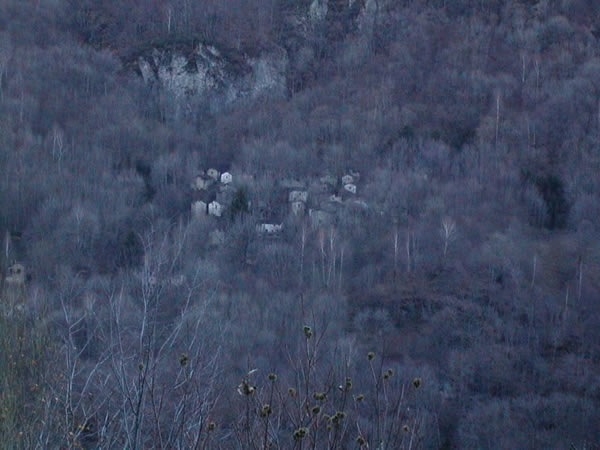
^ Premana, December 2003

A great deal of ink has been expended on the glories of Italy in the summertime. Many tourists never see Italy’s winter, which has its own beauties.

This year, it looks as if we’re in for a severe winter (by Italian standards). The higher peaks we can see from our house were not snow-capped by November 1st as they had been the previous two years: “Ognissanti, neve sui canti” goes a local saying – “By All Saints’ Day (Nov 1), snow on the peaks.” Snow began falling Nov 25th, and went on through the 26th, then again the following weekend (considerably reducing the guest list for our dinner party on Dec 3rd). It’s been clear and bitter cold (freezing or below) since, and the forecast is for even colder; I have put on my nice warm Ugg boots and will not be removing them until April!

Most of the snow at lower elevations has melted in the sunshine, but as my train passes through the farmland between Lecco and Milan, the fields and trees are heavily frosted, where thick fog has turned to ice.

Christmas lights and decorations are already up. I put up some strings of white lights as soon as daylight savings went off, to counter the depression of long, dark nights; everyone else seems to have the same instinct. Colored lights are beginning to appear on trees in people’s yards, and this year’s decorative innovation is Santa Claus dolls dangling on ladders from balconies and windows – trying desperately to deliver gifts, one supposes.

The natural world is winding down; my nasturtiums and morning glory vines have frozen and then thawed into soggy messes – although, weirdly, the daffodils are already sprouting leaves. Many Italian gardens contain persimmon trees (cachi – pronounced KAH-ki), which by now have lost all their leaves, so the round, bright orange fruit stands out sharply against the dark brown branches. The problem withcachi, even if you like them (I don’t), is that they ripen pretty much all at once, so for a few weeks everybody who has a tree is drowning in fruit and trying to give it away to everybody else.

It’s time for winter fruits and vegetables: apples, pears, broccoli, artichokes, pumpkin. For my Indian dinner last weekend I experimented with pumpkin samosas, and they were such a big hit that I’ll have to make them again soon.

In our neighborhood, a clear winter day offers the best views of Lake Como and the surrounding mountains, minus the haze that impedes visibility in summer. My digital camera broke back in October, which is very frustrating now that we’re in the best time of year for photographing.

Dec 5th was the feast of San Nicolo’, patron saint of Lecco; the 7th was the feast of Sant’Ambrogio (Ambrose), patron of Milan, and the 8th the Feast of the Immaculate Conception. Public schools in Lecco gave a three-day holiday in the middle of the week, Milanese schools (and many businesses) are off from the 7th through 11th. Ross’ private school is officially closed only for San Nicolo and the Immacolata, but they’re not bothering much with lessons on the other days because so many kids have gone off skiing for the whole week.

As for me, I’ve been working, since I’ll be taking days off later in the month to go to London for a Woodstock alumni gathering, and then Dec 26th I leave for Arkansas, Austin, and Las Vegas (Vegas for the Consumer Electronics Show again, and this year I have to play booth bunny. I’m more or less looking forward to it, but know it will be shatteringly hard work).

In between, we’ll celebrate Christmas at home with our friends Ravil and Amanda – quite a change from last year when, for the first time ever, we had both sides of the family present. However, as Ravil says, we can be loud enough to make up for this year’s slimmer numbers. Especially him and Amanda, who are opera singers.

Hogwarts Memories

I’ve just re-read the latest Harry Potter book, and am re-watching themovies, in anticipation of seeing the latest movie this week (it’s showing in English in Milan: even if there’s only two seconds of Alan Rickman in it, I want to hear his original voice! And I can’t stand the Italian names of the characters).

It struck me that the experience of going off to boarding school (even a non-wizarding one) must be exotic to many people – but it’s familiar to me. Let me count the ways…

Before heading to Woodstock School in India I, too, received a list of required school supplies, which I was advised to pack into a trunk that could be locked, with my name painted on. I don’t remember all the details of the list now, but I do remember being flummoxed by the requirement for warm clothing: we had been living in mostly-tropical Bangladesh for almost a year, and, even had I brought any winter clothes with me, I was a growing teenager. Fortunately, we discovered an open-air market in Dhaka where second-hand clothing donated worldwide to various relief agencies was resold (with or without the agencies’ knowledge?). There I found a couple of sweaters and a pair of jeans. (Wizard’s robes were not on my school list, though the need for formal attire for church was mentioned.)

So far JK Rowling hasn’t told us how students NOT based in London get to Hogwarts. From the fact that they all meet up on the Hogwarts Express, I deduce that they all go to London first, wherever they’re coming from, and then take the school train.

For Woodstock, the situation was a bit more complex: our school had to deal with students coming from Bangladesh, Thailand, the Middle East, Africa, Nepal, the US, and just about everywhere else you could think of (bit more of a cultural mix than Hogwarts!). They tried to arrange for us to arrive on the same flights, but staff nonetheless spent many sleepless nights in Delhi, meeting group after group off the planes. (In those days, India was considered more a stopover than a destination for airlines, so they mostly landed in the middle of the night on their way from Japan to Europe or vice-versa.)

After gathering us into larger groups, which usually involved a day or two at the YWCA in Delhi, the school also arranged our travel up to Mussoorie. By my day, this was mostly in chartered buses, but there were still groups arriving from all over India by train, as they had since 1900 when the railhead reached Dehra Dun (the town in the valley below). Before that, students had travelled by bullock cart and on horseback. Even in the late 1970s, a few whose parents were missionaries in remote corners of Nepal still made the first part of their journey back to school on their own two feet.

There were no lunch trolleys on our buses. Instead, we stopped at Cheetal Deer Park, which didn’t actually have many deer but could whip up the world’s tastiest cheese pakoras for a busload of students in no time flat.

No matter how you reached Dehra Dun, the final leg of the journey was up the narrow, twisty, switchback road to Mussoorie. There’s a point where the air suddenly changes, becoming fresher and cooler and cleaner after the dust of the plains, and a few curves after that you can see Mussoorie, strung out along the ridge at 6000 feet.

The end of the line for buses was (and still is) Picture Palace bus stand – though the Picture Palace that gave it its name no longer shows films, having been turned into a business complex. At the bus stand, coolies would swarm over the tops of the buses, getting down our trunks and cases, hitching them up onto their backs with ropes slung around their foreheads. Barefoot and bandy-legged (a bit like house elves, now that I think of it), bent nearly double under their loads, they would nonetheless usually beat us down to the dorms, where our trunks were piled along the hallways til we came and dragged them to our rooms, newly-assigned for the year.

Rowling’s living arrangements for Hogwarts students are absolutely shocking: girls and boys living in dorm rooms separated only by a stairwell? Sharing a common room in which they can mingle as late as they like, with no staff supervision? Good heavens! What hanky-panky these young witches and wizards must get up to.

At Woodstock, the girls’ and boys’ dorms were a good 15 minutes’ walk apart, with the girls’ dorm, Midlands, stuck out on a ridge about as far as you could get from anywhere else on campus. Boys were allowed no further in than a sitting room at the entrance, closely (if not always successfully) guarded by a dorm supervisor; the same was true for girls at the boys’ dorm, Hostel.

Except once a year, when each dorm held an “open house” in which visitors from all over the school could stroll around, admire everyone’s creative room decor, eat a “fancy” meal, and the opposite sexes could (gasp!) hang out in each others’ rooms for a few hours. With staff constantly prowling the corridors, of course – the rule was that every bedroom door had to be open, and if two people were sitting on a bed together, three of their feet had to be on the floor.

One huge difference between Hogwarts and Woodstock: the Hogwarts kids eat a lot better than we ever did (even if pumpkin juice actually sounds pretty disgusting). School food was legendarily bad at Woodstock, even worse than institutional cooking usually is. If Rowling ever attended boarding school herself, her descriptions of meals at Hogwarts may well be fantasies left over from her school years. Many teenagers obsess about sex. At Woodstock, much of the time, we were too busy obsessing about food!

There is little mention of between-meals snacking at Hogwarts, whereas at Woodstock we depended heavily on “tuck shops” at school and in the dorms, as well as the baker who would come around at recess and after school with a tin trunk full of home-made cookies, cakes and candy. And we lived for Saturdays, when we could go into the “buzz” (the local bazaar) and gorge ondosas, curries, and Tibetan noodles.

The major point of reference for students at Hogwarts (and, I suspect, at many traditional British boarding schools) is the “house” into which new students are “sorted” at the beginning of each school year. The kids live, go to classes, eat, and study mostly with their house-mates, and are not even allowed into each others’ common rooms (there’s no mention of an annual “open house”). They view members of other houses as rivals or even enemies.

The reference group for Woodstockers is the graduating class. We had houses only for intra-mural sports, to encourage athletic activity among those not good enough for the school teams. No one took the houses seriously enough to care much about Sports Day, except as a day free from lessons. (In earlier decades, Sports Day had been competed between classes, which generated more enthusiasm, although the seniors usually had a decided advantage.)

Our houses had boring names – in our day, simply 1, 2, and 3! Today they’re named after birds (Merlins, Condors, and I forget the third). Nowhere near as compelling and evocative as Gryffindor, Ravenclaw, Hufflepuff, and Slytherin.

The class of ’78 did revive a tradition of the class word, which was supposed to be made up and its definition kept secret, though nowadays they run to the well-defined and obvious (“Intrepid”). My own class of ’81’s word is “Bijplufszkcian” – weird enough for Rowling, I think. No, I’m not going to tell you what it means.

Hogwoods Revisited

Dec 17, 2005

My fellow alumni responded enthusiastically to my article comparing Woodstock with Hogwarts. Stan Brush wrote:

“ONE big difference between your experience and ours pre-1947. We DID come by special trains, reserved compartments on regular trains that converged on Dehra Dun. Complete description inFarewell the Winterline.”

“Farewell the Winterline” is Stan’s engaging account of his childhood in India and Woodstock, and his adventure-filled trip back from India to the US when he graduated from Woodstock during WWII.

Many WS alumni have similarly fascinating stories, some recounted in Living on the Edge, a collection of tales including wonderful (and sometimes hair-raising) descriptions of epic train journeys across India to get back to school each semester.

Other comparisons came up. It’s not uncommon for some Hogwarts students (especially Harry Potter) to stay at school during the shorter vacations (in their case, Christmas and Easter; at Woodstock, the shorter vacation was in the summer). Zafar pointed out that one of his classmates never went home for summer holidays, because her parents were missionaries in such a remote part of Nepal that to get there took two weeks’ walking – the summer break simply wasn’t long enough for her to get home and back.

Eva Schawohl wrote:

“I think one of the big differences between Hogwarts and Woodstock is the monkeys.. I would rather have had to deal with dragons and pixies than those wretched monkeys. Especially the one that got into my room one Saturday morning in 11th grade. My great revenge was that I got one of them in the bottom with a broom… but not before he had gone through all my drawers and eaten a book. Though the vision of a monkey bouncing on my bed with my underwear on his head did keep me laughing for a while.”

[Monkeys as the anti-house elves? – D’]

The one thing we did have similar to Hogwarts is the dungeons, known as the music cells. Does anyone remember those terrible, cold, dark, damp cells with the tiny windows, with the ancient pianos in them? I think Snape would have found those cells more than perfect for Potions or Defence Against the Dark Arts classes. With any luck, he could have petrified the guy who played French horn really badly next to me every day after lunch.

Yes, everyone remembers them, and they were indeed dungeon-like, complete with “jailer” in the form of Mrs. Biswas. Not that anyone thought of her that way – she was well loved at Woodstock for 47 years – but she was a dragon about making us practice music properly during our practice periods. She seemed to know what piece every person in 20+ cells was supposed to be practicing, and could hear from two floors up if you weren’t. The only time we could get away with anything was during the weekly Music Department staff meeting. A group of us who happened to have practice that period would sneak out of the cells to sing pop songs, accompanied by Craig on Mr. Lind’s grand piano. At least it was music!

Today the former music building has been rebuilt into a bright, pleasant business center, and the music cells, in a different building, are new, sound-proofed, and named in honor of Mrs. Biswas.

Perhaps the largest similarity is the fact that no one knows actually where Woodstock is. Just as Hogwarts is not mappable, Woodstock isn’t either. I always had the impression that the school changed position, depending on were you were standing. Besides that, how many people have I met since that have thought the school is in America, on the grounds of the famous festival.

I think it is funny that the food thing really did persist through generations of Woodstock students. I was there from 1988 to 1990 and the rumour was the school spent 7 rupees [~15 cents)] a head on food, am not sure if this was per day or per meal, though I had had better tuck in the bazaar or Cozy Corner for Rs. 7.- than at school. As the saying goes, an army that is fed badly, fights harder, so perhaps there was some morality in serving us Chinese noodles that left a puddle of grease on the tray, or chapattis with the consistency of shoe leather. Toughen us up and then send us to fight in the world!

Kim Shafi ’74:

I can think of the pranks we did, an example specific to Woodstock: when solemnly getting “up to no good” such as setting of big firecrackers with the help of incense sticks set just so on the fuse so that it would be ignited deep within study “hall” time; the secret short cuts that we trod to get to forbidden places unnoticed when we should have been in bed; being selected from among all others for special punishment meted out by Ron Kapadia [Woodstock’s equivalent of Argus Filch, but far more dangerous] and then getting to leave a personal marker – a sort of badge of honor – on that old hard paddle…

Another alumna pointed out other similarities such as the schools’ being perched on high hills, and the kids walking around at night in a forest full of dangerous animals, even when we weren’t supposed to. Yes, dangerous animals. Woodstock is set in thick Himalayan jungle on protected land, and there are still leopards out there, though dogs are at far more risk from them than people.

I noted in the last Harry Potter film (which I saw, and greatly enjoyed, a couple of weeks ago) that the scriptwriter also seems to know something about boarding school. I can’t recall Rowling ever mentioning study hall in the books, but in the film there was a scene of a lot of kids studying together at long tables, whispering and passing notes – when they could get away with it, under the nose of Professor Snape.

Deirdré Straughan on Italy, India, the Internet, the world, and now Australia