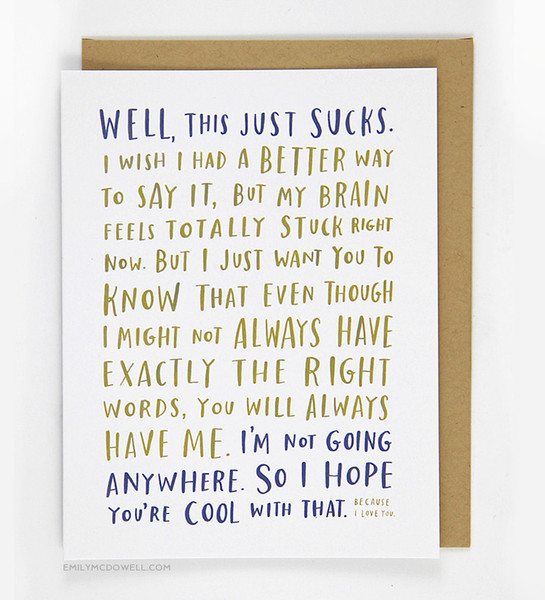
At a loss for words when someone in your life has a serious illness? Yes, I know – it’s really hard for both parties. These cards express some of the best, most honest and loving reactions I’ve seen yet.

The Verdict
I departed the US on December 16th with a huge, dark question hanging over me: would I need to do chemotherapy? My oncologist, Dr L, had explained that the Oncotype Dx test gives a score of the statistical likelihood of your particular cancer’s recurring, and whether chemotherapy and/or radiation will affect that likelihood. If your score is 19 or lower, chemotherapy is not likely to do you much good. 19-30, you’re in a gray zone. Given my relatively young age, I thought I’d probably opt for chemo if my score was in that range. A score of 31 or above is an unequivocal “Yes, you should do chemo.” I was waiting to know that number.
We arrived in Sydney on December 18th (local time), got through immigration and customs, and picked up our rental car. As we drove across the Sydney Harbor bridge, I called Starr, Dr T’s assistant. She had the oncotype results in her hand, about to fax to Dr L. My score was 31, an unambiguous result: I should do chemo.
That news was not how I’d wanted to start my vacation.
Over the following days, I made and received multiple phone calls and emails as I started to understand and organize what would happen to me for the next six months. Here’s what I wrote about it at the time:
Dec 21
We arrive back in the US the morning of Jan 14th. Jan 15th I will have an echocardiogram and then some blood tests and “chemo teach” at Dr L’s office. Sometime that week, Dr T will put a port and catheter into a vein in my chest. There has to be a port, because one of the chemo drugs, Adriamycin, causes bad burns if it comes into contact with skin, so you can’t administer it via a normal I/V. The port needs a few days to heal, then chemo can begin: 8 two-week cycles, followed by 6 weeks of radiation. So I’ll be under treatment until mid-to-late June.
I don’t yet know what to expect from chemo – Dr L doesn’t commit one way or the other, probably because individual reactions are unpredictable. He says I could perhaps work, especially during the second week of each cycle, but I’ll probably get too tired in the last 4 to 6 weeks of the overall chemo program. On the other hand, it doesn’t seem necessary for me to pre-emptively take off the entire 4 months – “Some women have done that, and gone stir crazy.”
For a long time, chemo has been my worst nightmare. I used to think: “I have all this other health crap, but at least I don’t have cancer.” Then, when I had the biopsy in 2007, I didn’t think I would die (if I even had cancer), but I knew I didn’t want to do chemo. With this one, I kept hoping it wouldn’t come to this. But it has.
I’m not any more resigned to it now than I ever was. Maybe it will be less scary once I’m actually in it. So far I’ve survived an awful lot of shit that life has thrown at me, I guess I’ll survive this, too. But… I’m terrified. I finally broke down and cried about that the other night. It helped a bit when Brendan admitted that he’s scared, too. I’m not sure exactly why that was comforting, but it was.
A few people have told me that I’m brave to talk publicly about having cancer. Just as people have previously said that I’m brave to write/talk about other topics. I don’t see what’s brave about talking. I don’t see how I could really hide that I have cancer, so why try? It is indeed very common these days, so maybe the best thing I can do for others is to talk about it.
I have the impression that many people write about their various illnesses, including cancer. But I don’t want my life to be about cancer from here on. There is so much more I want to do. And I’m scared I won’t get the opportunity.
Dec 25
I can’t really concentrate on anything, don’t have the mental stamina to focus. It still takes so much energy, sometimes, to not be screaming with terror.
my breast cancer story (thus far)
You might also like:

After Surgery
I had told a few people privately about my diagnosis, but most of the world did not know when I had the lumpectomy on November 25th (the Tuesday before Thanksgiving; I scheduled it that way so I could recover over the holiday). I didn’t really want to discuss cancer in public just yet – talking about it to the world would make it all feel realer than I was ready for.
But… social media happened. My birthday fell the day after Thanksgiving, a time when a lot of people are diddling around online while “enjoying the family holiday.” 😉 With birthday wishes pouring in on Facebook, it seemed odd to let people unknowingly wish me a great birthday – which I decidedly wasn’t having. So I posted an announcement on Facebook, and then a small blog post. (There’s more to say about handling cancer and other devastating personal topics on social media – another post sometime.)
Meanwhile, I was resting after surgery and observing things happening to my body, such as hot flashes intensifying: since I had gone off the hormone replacement therapy I’d been using for years, I suddenly had to deal with menopause symptoms. Recovery from the surgery and anesthesia was harder and took longer than I’d expected. A lumpectomy is not major surgery, but the effects of general anesthesia can linger for weeks. And I wasn’t sleeping well as I anxiously waited to hear lab results on the tissues that had been removed.
Dec 1: Learned that there was no lymph node involvement and the tumor was completely removed (clean margins), which is the best possible news right now. They’ll do more testing on the removed tumor to see whether chemo may be a good idea – it was a pretty big tumor (25mm). And I’ll certainly need radiation and follow-up hormonal therapy, but in the meantime I can go to Australia as planned, departing Dec 16th. Time to pack!
Dec 4: Saw the oncologist yesterday, awaiting results of the Oncotype Dx test to understand whether chemo would be useful on this particular kind of tumor. He wants to start follow-up treatment, whether chemo or just radiation, the first week in January, because that is within the “2 to 6 weeks after surgery” start date standard in clinical trials. Which would screw up our planned trip to Australia (Dec 16-Jan 14). I really just need to take that vacation and not think about cancer before the next thing begins, especially if it is chemo. I’d need to be semi-isolated at home for months – my immune system is not great to begin with. Being stuck at home scares me almost as much as the side effects of chemo.
My surgeon doesn’t think we need to worry so much about starting “on time” – the tumor is cleanly out and there were no lymph nodes involved. Waiting for her and the oncologist to discuss it, maybe I’ll compromise and come back one week earlier.
The oncologist showed me Adjuvant Online, running the numbers on 10-year relapse rates with various therapies. I wish I could run it myself – I’d like to know 20 years rates* as well, since I’m only 52. I never really expected to live to 90 (my dad died at 72), but 62 is too short a horizon.
Some random things I’ve learned about cancer so far:
Every cancer is individual. Others who have been through it (or supported someone else through it) may be able to provide support and perspective, but no one goes through the exactly the same cancer you’re going through.
No matter how “good” your particular prognosis, cancer is life-changing. Period.
In my particular case, I guess I technically no longer “have” cancer at the moment – the tumor was removed intact from my breast, and there is so far no evidence that it has spread anywhere else.
But there could be a few cells somewhere that wandered off and are sitting around awaiting some further stimulus to multiply, possibly in some worse place than a breast. So I’ll be having follow-up treatment. The question now is: what kind?
Any follow-up treatment will be intended to reduce the odds of any stray cells reproducing later on. I’ve been told I’ll definitely have radiation followed by hormonal treatment for some years. The open question is whether I should (first) have chemotherapy.
Dec 7: I learned that there was a delay getting the Oncotype DX test started, so I wouldn’t have results for perhaps another two weeks, giving me that much longer to wonder about it.
Fortunately, we had already decided to keep our Australia trip as scheduled (Dr T said: “Go away and don’t think about this for a while!”), departing Dec 16th and returning Jan 14th. Trip planning and booking beyond the tickets to get there had been interrupted by diagnosis and surgery, so at that point we had not planned the whole trip. We had rented an apartment on Newcastle beach for Christmas week, and I had just booked to go to Uluru (Ayers Rock) for three days around New Year’s.
Dec 10: I met with the radiation oncologist. More forms to fill in. Blood pressure etc measured yet again. It was 132/80 – high, for me. It’s been around there ever since I got the diagnosis. Sheer stress.
As always, everyone was very nice. The nurse told me: “This isn’t your grandmother’s breast cancer. There has been so much funding poured into breast cancer now that we have a lot of options. In fact, lung cancer is now the biggest killer of women.” (I donated to Planned Parenthood this year, because every woman should have a chance to catch cancer early, as I did.)
We didn’t know yet whether I’d have to do chemo before radiation, so this first was just a meet-and-greet. All preparatory tests will have to be done just before radiation begins, whenever that is.
There was still a big cavity in my breast where the tumor used to be, though it was already starting to close. Ideally, we could have put a catheter in there and done very targeted radiation, dosing the tumor site completely in just a few days. But… even without Australia plans in the way, you can’t do radiation before chemo, and by the time a decision was made about chemo, the site would likely have closed up anyway. So at this point I knew that I’d be in for six weeks of radiation, with or without chemo.
* In a later visit, I asked: “What about 20-year survival rates?” “We don’t know,” replied my onco. “We don’t have the data.”
my breast cancer story (thus far)
You might also like:
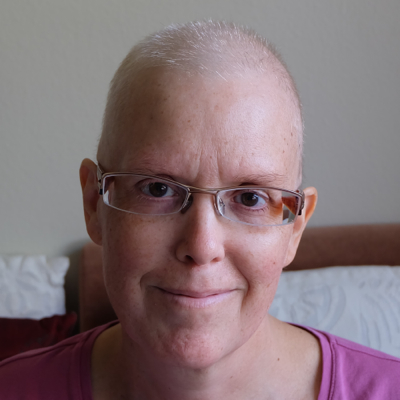
Breast Cancer
Here are the posts I’ve written so far about having breast cancer, arranged roughly in chronological order of the events and feelings they describe (not necessarily the order I posted them). Obviously, this will be updated from time to time.
- The Only Way to Be Sure of Surviving…
- How I Knew I Had Cancer
- Talking About Cancer
- Mean Nasty Ugly Things
- Care
- How Does It Feel to Have Cancer?
- What Happened After Diagnosis
- Beauty and the Breast (lumpectomy)
- Gratitude
- After Surgery
- The Verdict
- Vacation in Australia
- Preparing for Chemo
- Chemo, Round 1
- Brave?
- Chemo Roundup: February
- Hair
- Chemo Roundup: March
- Chemo Roundup: April
- Chemo Roundup: May
- Chemo Roundup: June
- Chemo Done! (and what happens next)
- 7 Horrifying Facts About Chemotherapy
- Radiation Prep: More to Look Forward To
- Chemo and Menopause
- One Month Post-Chemo
- Treatment Roundup: July
- Treatment Roundup: August & September
- In Sickness and in Health (how Ericsson, my employer, reacted to my cancer)
- One Year On
- Cancer: The Aftermath
- Three years post-cancer
Sex and Tech Events
I set the scene in an earlier post: at any conference that I attend, especially when working a booth, I am expending energy every moment to prove that I am there as a technical contributor to my company and the event – a role which, for men, is taken for granted.
Now let’s look at an incident that occurred at a tech event I did not attend, and conjecture about how I might have reacted had I been there. Below is a description from a male attendee of a company-sponsored party at Sun Microsystems’ Java One in 2007:
Continue reading Sex and Tech Events