Tag Archives: DTrace

node.js Community Event: Rough Cut Videos

Joyent hosted a node.js community event at our San Francisco offices the other evening, in which Ryan Dahl announced a new version of node.js, and Brendan Gregg showed some amazing stuff you can do with Joyent Cloud Analytics on your no.de hosted site to understand what’s going on in your node.js app.

For more details on cloud analytics, see Dave’s and Robert’s blogs, and two more hours of video with Bryan and Brendan demoing.

Technical difficulties with UStream meant I didn’t have a stream recorded to their servers that night, technical difficulties with everything else meant I couldn’t get these rough cuts hosted anywhere til now. This is exactly what you would have seen on the stream (and more), including the bad camera angle which was forced by… oh never mind. A better view of cloud analytics will be forthcoming.

(NB: These videos disappeared from Joyent some time ago. Sorry.)

How the DTrace Book Got Done

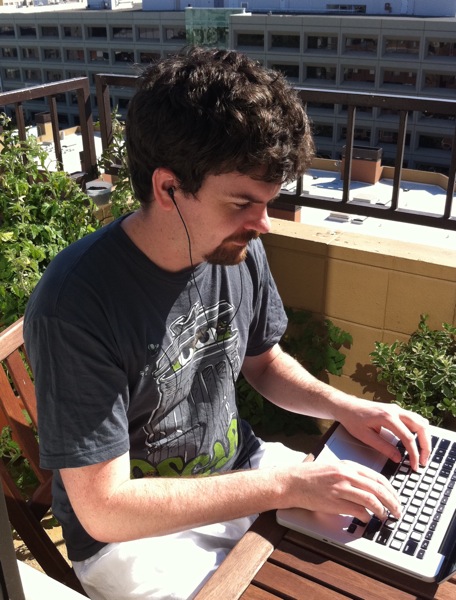
In the last few months, I’ve spent a lot of time on the DTrace book: copy editing, managing the review process, and (ongoing) marketing – keep an eye out for video! Also provided care and feeding and a quiet place to work for one of its authors, Brendan Gregg, shown above.

Brendan and co-author Jim Mauro did an insane amount of work for this book, spending many late nights and long hours to write nearly 1000 pages (before final publishing layout) of mostly original material: 57 topics covered in over 150 new scripts and 150 new one-liners (beyond Brendan’s existing DTrace Toolkit), requiring a lot of new thought and invention. It all adds up to a comprehensive DTrace cookbook that will be useful to sysadmins, developers, students, or anyone needing to provide support and/or performance troubleshooting for systems running Solaris, MacOS X, or FreeBSD.

Here’s the Table of Contents:

1. Introduction
2. The D Language
3. System View
4. Disk I/O
5. File Systems – sample chapter available
6. Network Lower Level Protocols
7. Application Level Protocols
8. Languages
9. Applications
10. Databases
11. Security
12. Kernel
13. Tools
14. Tips and Tricks

Appendices:

A. DTrace Tuneables
B. D Language Reference
C. Provider Args Reference
D. FreeBSD Guide
E. USDT Example
F. Error messages
G. DTrace Cheatsheet
Glossary

The picture below was taken in the final throes of writing, when Brendan got down on the floor to plug in his laptop, and didn’t have time to get up again: he was chatting online with Jim, ironing out last-minute details. The manuscript is now with the publisher for final editing and layout – and we can all breathe a sigh of relief.

NB: This is a companion post to How ZFS Really Gets Done, in what might be an ongoing series about “My Life Among the Geeks” (hey, I’m allowed to use the term – I’m a geek, too).


video: