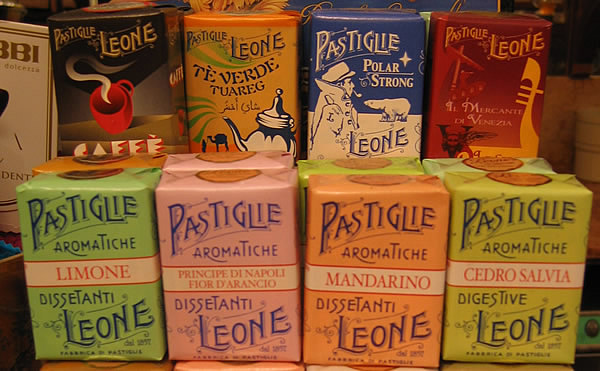
Leone brand candies have been around for a long time in Italy. I love the Art Deco and Art Nouveau package designs. The flavors are interesting, in concept, at least: coffee (I want a poster of this box!), Tuareg green tea, Polar strong, the Merchant of Venice (spices, I’m guessing), Lemon, Prince of Naples Orange Flowers, Mandarin (these three are “thirst-quenching”), and Lime Sage (“digestive”). And this was only half the packages on display. Photo taken at Bar Santa Marta, via Mascari, Lecco (which also features the best breakfast pastry in town).
Tag Archives: Italian food
Italian Milk
It’s the Little Things That Surprise You
When you move to a foreign country, you expect (if you are wise) that the food will be different from what you’re used to. For the adventurous this is a welcome change, a chance to explore new flavors and habits (though sometimes you also crave the taste of home, wherever that is for you).
It takes you by surprise, though, when even the basics are different.
When I was a kid, milk was simple. In Bangkok, the Foremost milk truck came to our house once a week. It was a huge refrigerated vehicle with thick little doors on the sides that opened to disgorge wonderful things: milk in orange and white cartons, ice cream, and fudgesicles. I don’t know if Foremost even had a skimmed milk option in those days; I don’t remember ever seeing it.
In the US, milk came in the same paper cartons and in big white plastic gallon jugs. We always bought gallons, and the jug was always finished before the milk went bad, in part because I drank it so fast. But even as I got older and drank less milk (when I returned to the US for college), I still bought gallons, and it never went bad.
One of the first things that surprised me in Italian food shops was the size of the milk: it came in half-liter or liter Tetra pak bricks, nothing larger. A family of three or four, especially with small kids, would easily go through one or more liters a day, and one of the cliches of Italian family life is someone having to run out to a neighborhood shop early in the morning to get milk for the family breakfast (tall, steaming mugs of hot milk, with the kids having a drop of coffee in it Рcaff̩ latte Рeven from very young ages).
So why wasn’t milk available in larger packages? I soon found out: it goes bad incredibly quickly. Once opened, a carton has to be finished in a day or two, three if you really push it. I initially blamed this on the packaging: the only way to open a Tetra pak brick is to cut or rip a corner off it. This can make for messy pouring (depending on the cut you make and whether you are able to hold the full brick without squeezing), and then the carton can’t be closed again in any meaningful way. At least American-style half-gallon milk cartons fold in on themselves to protect their contents.
A few years after we moved to Milan, innovations in milk packaging began to appear on supermarket shelves: round Tetra pak cartons with screw-on lids, American-style fold-in cartons (though only in a half- or one-liter size, the latter very similar to an American quart carton), and plastic bottles. At least one ecologically-minded company offered returnable glass bottles, but that didn’t last long.
However, even in resealable packaging, the milk still went bad quickly. I guess we drink less than the average Italian family. It tasted different, too. Better, worse, I don’t know – it wasn’t like the American milk I was used to, but it was certainly drinkable, and anyway I was drinking far less than I had in childhood.
But I do like milk in my coffee, and with the cereal I sometimes eat (Ross practically lives on Special K, which tastes far better in Italy than in its native land, interestingly). I’m a disorganized shopper at best, and, especially where we live now, running out in the morning to grab some milk is not an option. So trying to keep fresh milk in the house is a constant irritant.
An alternative you have probably thought of, if you’ve lived anywhere outside the US in your lifetime, is UHT milk: the ultra-high temperature process it’s subjected to gives it a shelf life of months. But it tastes horrid, and some brands worse than others. I know people who drink it all the time and are happy. I could never get used to it.
Lately there’s a new kid on the block, micro-filtered milk. I don’t know what exactly micro-filtering consists in, but the flavor is excellent and it keeps for weeks. (Maybe this is the process they’ve been using in the US all along?) This is now my milk of choice, when I can find it. Stores aren’t stocking it much yet, perhaps because the public is suspicious. Our friend Michele, who used to own a bakery (and bakeries always sell milk for those early morning breakfast emergencies), said his customers wouldn’t buy it.
I do, whenever I can. It’s so nice to be able to stock up and know that I don’t have to think about buying milk for a while!
May 10 – One of the commenters on this article wondered why you can’t buy milk in Italy in a reseable one-gallon plastic jug. Aside from the aforementioned spoilage problem, there’s also a problem of space: Italian refrigerators are much smaller than American ones, reflecting the fact that Italians shop more often, and their homes are smaller. Even in our big new house, the “big” new refrigerator we bought is only 60 cm wide.
Many American fridges these days are built with very deep doors where big beverage bottles and jugs can be stored for easy access. In Italy, it can be difficult to fit a two-liter bottle anywhere at all.
What food surprises have you encountered in a new country?



Why Italians Drink Bottled Water
From time to time in the travel forums, I run across people complaining about the added expense of bottled water at restaurants in Italy. It is possible to drink tap water at any restaurant in Italy, and in some areas it’s the norm, but in many places the request is considered unusual.
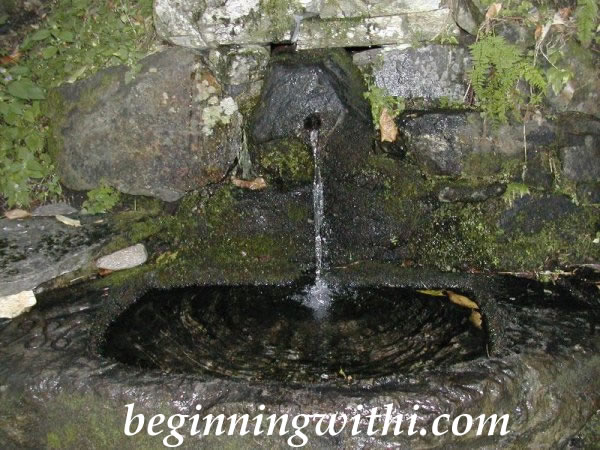
Although the water that comes out of our taps is perfectly potable, urban Italians drink almost exclusively bottled water. Not because it’s bottled, but because it comes from real mountain springs (like the one pictured above), and simply tastes better.
City tap water in most parts of Italy that I’ve experienced has a heavily chemical taste – lord knows where they get it from, or what they do to it in purifying. It is also very “hard” – full of calcium. When you see how quickly the inside of your teakettle furs up from boiling tap water, you have second thoughts about trying to process that stuff through your kidneys every day. (Although the technology is available here, very few households have installed the water softening systems that are so common in the US.)
The further you get out into the country, and particularly into the mountains, the better the tap water is: it’s often piped, unprocessed, directly from mountain springs into homes. Many town squares still feature the municipal fountains where people used to get their water before indoor plumbing became common. (In some places, water is so abundant that these can’t be turned off: they simply run, all the time, a waste which always disturbs me.) In communities that have particularly good water, restaurants will put a carafe of the local water on the table before offering you the bottled.
For home consumption, most city households buy bottled water in six packs of 1.5 liter bottles. There are dozens of brands, some local, some national. San Pellegrino is a national brand in Italy – in fact, the town and springs of San Pellegrino are not far from where we live. Most Italian bottled waters actually come from mountain springs in specific locations, and are bottled near the sources for which they’re named. Most come in fizzy and non-fizzy varieties, with the fizzy ones being artificially carbonated, but a few, such as Ferrarelle, are naturally fizzy. Some have recognizable flavors, and after a while you develop preferences (I, for example, can’t stand Ferrarelle).
There is lots of competition between brands, with ads touting their supposed health-giving properties (especially for the house brands at the terme – traditional health spas), low sodium, etc. I don’t take these claims seriously, but it is indisputable that water (bottled or not) is the healthiest thing you can drink – no calories, for starters, and one of the few health statements that most experts seem to agree on is that everyone should drink lots of it. In Italy, this is no problem: not many households keep soft drinks or beer ready in the fridge, but everyone’s always got water. The only two beverages that you see on most Italian tables are water and wine.
You don’t always have to pay for good water in Italy. Enrico and I routinely recycle plastic bottles by taking them to the mountains and refilling them with good spring water:

You might also like:

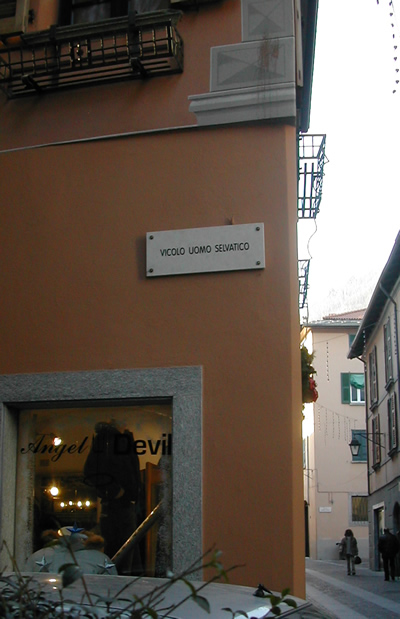
Funny Italian Street Names
above: “Wild man alley” – with a shop called Angel Devil on the corner. Chiavenna
The US is full of streets named after trees, or simply called “Main,” or given numbers or letters. Washington DC is built on a grid of numbers and letters of the alphabet. I won’t even attempt to explain Salt Lake City. These two schemes reflect an extreme tidiness of mind, but have the disadvantage that they’re easy to mix up or mis-type, no doubt causing the postal service all kinds of headaches.
Italian street names can be repetitive, but at least they’re not boring. They generally fall into two major categories: history and geography. Geographic names can be of towns or geographic features in Italy or in other countries; Milan has a Corso Buenos Aires and a Piazza Lima, every town in Italy has a via Roma and probably a via Milano. There are also streets named after important dates, such as Piazza XXV Aprile, commemorating the official day that Italy was liberated from the Nazis. (In these cases, the date is always given in Roman numerals, which are also used in print to refer to centuries.)
Don’t look for Italian street signs stuck up on a pole on the corner, as you see in the US. In the cities, street signs are marble plaques cemented to the corners of buildings. When the street is named for a person, the plaque often includes his dates of birth and death and what he was famous for, so you can have a history lesson just walking around. Somehow it had never occurred to me that the Falloppian tubes were named for somebody, until I saw a street sign with the name Antonio Falloppio and the tag “anatomist.”
The historical figures named run the gamut from ancient Rome to Aldo Moro, but most of them are men. The few women I’ve noticed are queens, saints, and Maria Montessori (whose image was also on the last 1000-lire note).
The older streets nearer the city centers are generally named for older historic figures. The further you get out into the suburbs, the more modern the names, including some non-Italians. There is a via Washington in Milan, and I have seen several via Kennedys in various towns, and even a via Fratelli Kennedy (Kennedy brothers). Still further out in expanding city suburbs, recently-created streets have been named for Gandhi and Salvatore Allende.
Some streets are named for items of strictly local importance. Lecco’s most famous son was Alessandro Manzoni, author of I Promessi Sposi (The Betrothed), considered the first modern Italian novel. So in Lecco proper we have a Piazza Manzoni and Ospedale Manzoni, and every town in the province of Lecco seems to have streets named for his characters: Renzo, Lucia, i Bravi, Don Abbondio…
Funny Italian Street Signs
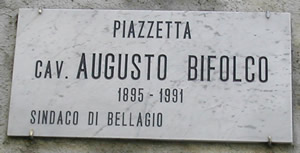
This piazzetta in Bellagio honors a former mayor, whose name”Bifolco” literally means “peasant”, but also carries the connotation of “yokel” or “bumpkin.” Evidently the man outshone his name, being named a Cavaliere (knight, an honorific title nowadays), as well as elected mayor.
I’ve found unusual street names in the historical parts of some towns:
Viterbo
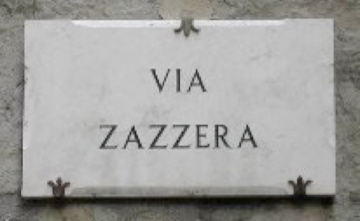
^ “Mane,” in the sense of a big head of hair.
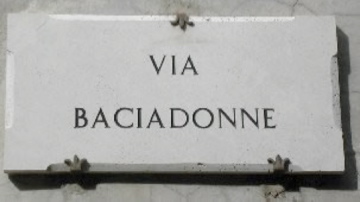
“Kiss(es) Women”
Pitigliano
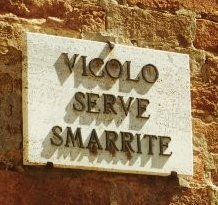
“Street of the Lost Maidservants.” ???
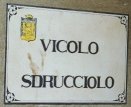
“Slippery Lane”
Volterra
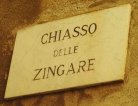
“Narrow Alley of the Gypsy Women.” I was misled by this at first, because in modern Italian chiasso means “noise,” but a reader corrected me.
Pienza
And here’s an interesting sequence (yes, these streets actually are adjacent to each other).
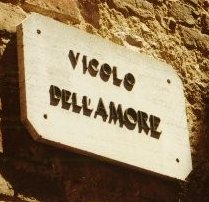
First comes love..
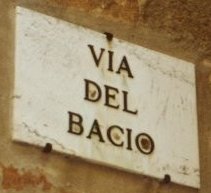
…then a kiss…
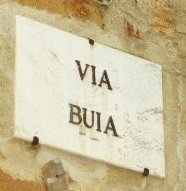
…and over the rest we draw a veil of darkness…
What’s the funniest street name you’ve ever seen (anywhere)?
Sweetness and Dark on Lake Como
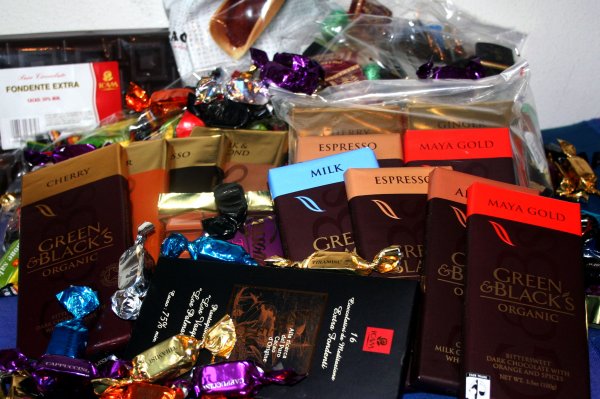
Some evenings, stepping off the train as it arrives in Lecco, there’s a slightly toasted, coffeeish scent of rich, dark chocolate in the air. It’s not a hallucination: Lecco is the home of Icam, one of the world’s largest manufacturers of organic chocolate. They process 6000 tons of raw cocoa beans per year, and when those beans get to cookin’, the whole town is wrapped in a sensuous fog of aroma.
I had long been aware of Icam as a purely local phenomenon – Icam-branded chocolate doesn’t even show up much in Italian stores, though some friends had proved to us that Icam’s chocolate-hazelnut spread was far superior to Nutella. I knew that Icam had a spaccio (outlet store) at the factory down in Pescarenico, but I never managed to get there until we’d been in Lecco for a while, and then only because they ran extended hours during the Christmas season.
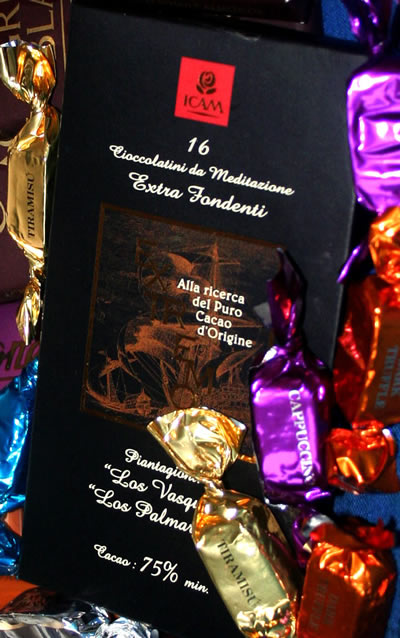
I discovered one Christmas that they make very good “cru” (single-origin) tasting squares of “Extremo” 75% dark chocolate – I bought some for family Christmas presents.
More recently, I was surprised to notice that our friend Michele was selling Green & Black’s, the famed UK brand of organic chocolate, at his bakery in Lecco.
“Where did you get that?” I asked.
“They make it right here in Lecco!”
He told me that a British couple had stopped for a chat at his shop. Turns out the man was a financial officer with Green & Black’s, in town to visit their production partner. He told Michele that some (surprisingly large) percentage of Europe’s chocolate, including much of Green & Black’s, is made by Icam – exactly how much I have not been able to confirm. He may have been referring specifically to the organic chocolate market – I have not so far located any definitive figures on European chocolate production, though I did find a list placing Icam as number 89 among the Top 100 Global Confectionery Companies. They evidently manufacture for others who sell organic chocolate, such as Seeds of Change.
So Icam was on my Christmas shopping list again last December. I came away with:
- three half-kilo bags of mixed chocolates (many of them Green & Black’s), at 5 euros each
- two bags each containing ten bars of Green & Black’s
- one bag of non-chocolate candies
- a 1-kilo bar of dark chocolate for cooking
- a 1-kilo bag of unsweetened cocoa powder for cooking
- a half-kilo tub of “Icam-ella” or whatever they call their spread
- a sampler box of the Extremo (pictured above)
Yes, it was a lot to carry! But I couldn’t resist – the bill for all this was only about 50 euros. Both at home and at the office, we had a very sweet Christmas.
Icam is doing so well that it needs to expand, but apparently is not finding encouragement to do so in Lecco. However, last I heard, their efforts to build a new factory in a nearby town were also frustrated by some strange local resistance.
<sigh> It can be inexplicably difficult to do business in Italy. Icam would probably have fewer hassles and lower costs if they moved their operation to some other part of Europe. But Icam is a family-owned business, and we can all be thankful that Italian families and businesses are stubborn about sticking to their roots!
You can visit Icam’s factory outlet store during the hours 8.30-13.00/14.00-17.00, Monday through Friday.