Tag Archives: living in Italy

Scenes from Italian Politics

I was, unusually, in Milan yesterday (a Saturday), working at my office with Sean Carlos (who’s teaching me cool new website tricks, more on that later). We went out for lunch, and were just getting ready to leave the restaurant when three young guys came in, whom we noticed particularly because one had hair in dreadlocks down to his waist, the second had a nearly shaved head, while the third was normal-looking, at least as far as haircut goes. They asked the restaurant owner for plastic bags, apparently to carry their jackets and motorcycle helmets in. His attitude towards them was puzzling; all I could think was that he disliked being asked for bags when they hadn’t even bought anything.

We walked a couple of blocks to my usual coffee bar, where everybody seemed completely freaked out, looking out the windows nervously. The barista explained that there had been some kind of demonstration on Corso Buenos Aires, the big shopping street a few blocks away, and something had gone wrong – gunshots had been heard, and there were police helicopters hovering over the neighborhood.

When we went to take the metro to our respective destinations later that afternoon, there was an announcement that the trains were not stopping at the Porta Venezia and Palestro stations “for public security reasons.”

The evening news was full of it. A (legally-organized) parade was planned by the “Fiamma Tricolore” (Tricolor Flame), a neo-Fascist organization. This was considered by the extreme leftists to be a deliberate provocation, and may well have been, given that the Fiamma guys had to be forcibly dissuaded by the police from marching under banners with swastikas and other Fascist symbols – which are illegal to display in Italy. So the lefties organized an illegal (because no permission was applied for) counter-demonstration, which, although it took place hours before the Fiamme arrived, quickly turned to violent chaos. They torched cars and shops, and set off nailbombs and firebombs. The photos are horrific, considering that this is, for heaven’s sake, Milan!

The good citizens of Milan, in fact, were so angry that some demonstrators had to be rescued by the police to prevent them being lynched by local residents. Almost 50 demonstrators were arrested, and nine police injured, though thankfully none seriously.

I guess that, because no one got killed, it isn’t news – I can only find one reference in the press anywhere in the world outside of Italy, and that was in New Zealand – at least our friends in the Antipodes are paying attention.

It seems to be an Italian cultural trait to leap immediately to conspiracy theories, but in this case they may be right. We’re in the midst of a closely-fought and increasingly acrimonious election, in which it’s hard to tell which side is being more stupid. It is entirely possible that someone on the right hired provocateurs to ensure that the counter-demonstration got out of hand. It’s equally possible that the extreme leftists are stupid enough to do that on their own, without considering that they are losing votes for the left and playing into the hands of the right (with friends like these…).

The comedy of errors rolls on. After much discussion, Berlusconi and Prodi (the leader of the loose and fractious coalition of the left) finally agreed terms for an American-style TV debate, which will take place on Tuesday night (our beloved Montalbano got moved to Monday, otherwise the public would have faced a truly difficult choice).

Now that we are officially in campaign season, the rules on par condicio (equal access to the media) have set in, so Berlusconi’s access is theoretically limited. Today he wasted ten minutes of a 30-minute interview with TV journalist Lucia Annunziata, walking off the set because he didn’t like her questions. When he kept evading a straight answer, and she kept insisting on one, he said: “You are violent, you should be ashamed of yourself.” “You don’t know how to talk with journalists,” she snapped back.

Let’s see, what else… one minister in Berlusconi’s cabinet left office a couple of weeks ago after wearing on TV a t-shirt printed with some of the famously offensive Mohammed cartoons, provoking riots in Libya in which some demonstrators were killed by the police. This ex-minister may face charges under Article 404.

Then a few days ago the minister for health found himself under investigation for Watergate-like spying on political rivals. He proclaims his innocence, but has resigned so as not to further tarnish his party.

We await developments to see what the next damn silly gaffe from either side may be. Hopefully no more violent demonstrations, but at this point I fear that anything is possible.

Unusual Italian Baby Names

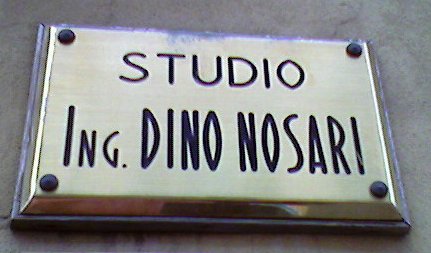
photo taken in Mantova

Dino [DEEN-oh] is a common nickname for a number of names. This guy must have a sense of humor: “Dino Nosari” sounds like dinosauri – dinosaurs.

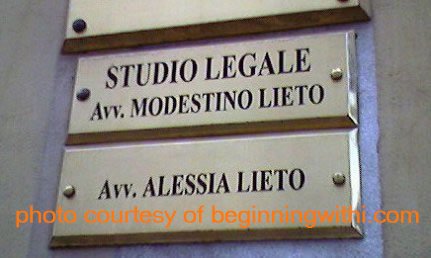
photo taken in Mantova

I’d never heard the name Modestino [mod-ess-TEEN-oh] (literally “little modest one”), but it’s rather sweet, especially in combination with his surname, Lieto [lee-AY-toh] – Happy.

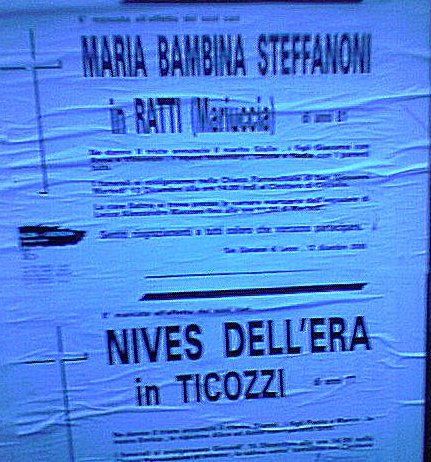
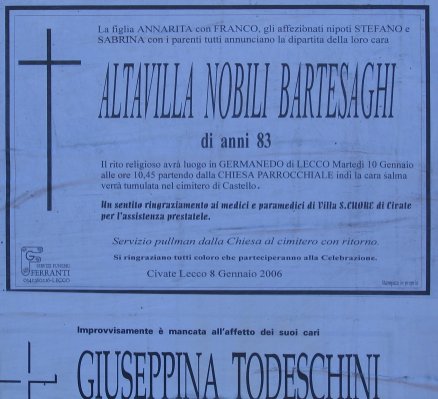
photo taken in Lecco

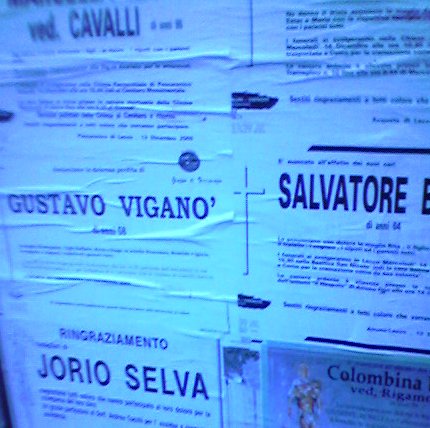
More names from death announcements.

“Maria Bambina” I suppose refers to the childhood of the Virgin Mary, but seems an odd choice of name. No wonder she was nicknamed Mariuccia [mahr-ee-OOCH-ah] (“cute little Mary”). Then she married into the Rats (Ratti).

Nives I’ve heard before, but would have thought it a Spanish name.

Upper left: somebody, widow of Horses

Gustavo is an old-fashioned name, Jorio I’ve never seen before [YOR-ee-oh], Salvatore [sahl-vah-TORE-ay] is very southern Italian, and… Colombina [col-om-BEAN-uh] – Little dove

Heavens, what a name! Altavilla (high villa) Nobili (nobles). At least he gave his kids fairly normal names (Annarita and Franco).


Marshall reminded me of a very funny and supposedly true case in Italy. It requires some explanation: When a woman marries, she is formally known as “Maidenname Firstname in Husband’s Surname,” I guess “in” signifies that she has married into the husband’s family (though I’ve only seen this construction used in death announcements). So there was a lady with the surname Milolava (“I’ll wash it”) whose parents rather cruelly named her Domenica (Sunday). She married a Signor Piazza, so she became “Sunday I’ll wash it in the piazza.” What “it” may signify is up to your imagination.

Really, some parents ought to be shot for how they name their kids. Years ago, in Washington, I had a data entry temp job for an insurance company. One of the records I entered was for a woman named Candy Caine. Evidently her parents wanted her to grow up to be a Playboy Bunny.


Jan 19, 2004

Ivo wrote me about his friends, interestingly surnamed “Della Bella” (of the beauty), who have relatives with the unhappy surname “Della Morte” (of death). So what did these sadistic parents name their child? Angelo.


And another in the series: “What were your parents thinking?!?”

In the Italian online white pages, you can do a reverse lookup (when you know the number, get the name). Some time ago, the following Internet meme was circulating: go to the white pages and look up a certain number. The resulting name, presumably someone’s legal name, was Bocchino Generoso (Bocchino being the surname – names are listed surname first). Bocchino is slang for fellatio, Generoso… well, you can guess. Unless this is the stage name of a gay porn artist, this guy must hate his parents. Interestingly, when I went back to check a few weeks later, the number was no longer listed.


Crimes of Opinion

Italy’s Laws on Opinions You’re Not Free to State

Italian law on “crimes of opinion” has recently (Jan 25th) been revised as follows (excerpted and translated from here):

“…Safeguarding of [all] faiths, instead of [just] the state religion [i.e., Catholicism] …Article 404 – (Offenses against a religious faith by means of vilipendio [~insult] or damage to property) – Anyone who, in a place designated for worship or in a public place or place open to the public, offends a religious faith, insults… things which are considered sacred or consacrated to a faith, or are used in the exercise of faith, or commits such acts during a religious function held by a minister of the faith in a private place, is punished with a fine of 1,000 to 5,000 euros.” (NB: Previously, the punishment was up to three years in jail, though I don’t know whether this was ever applied.)

“…Changes also to the Mancino law on racism, with punishment taking the form either of a fine or up to 18 months in prison for propaganda of ideas based on racial or ethnic superiority or hatred, and the instigation to commit acts of discrimination for racial, ethnic, national, or religious reasons. However, jail sentences of six months to four years are prescribed for anyone who instigates or commits acts of violence or provocation to violence for racial, ethnic, national, or religious motives.”

Hmm. How to reconcile the fact that inherent in some religions are bald statements of racial, ethnic, or sectarian superiority? Classical Hinduism encodes the idea that Brahmins are superior and Untouchables inferior to every other caste. A Brahmin’s forbidding his daughter to marry an Untouchable might therefore be punishable by law in Italy.

A “crime of opinion” seems to me a dangerous concept in itself. Who’s to decide what is and is not a reasonable opinion? Not so long ago, the idea that women should be allowed to work outside the home for equal wages as men was considered ridiculous in Europe – and is still considered ridiculous, if not illegal, in some countries.

Several European countries have laws against Holocaust denial, as recently applied in Austria to British “historian” David Irving. That, like the Italian laws about religion quoted above, is going too far. No country can (or should) make enough laws to explicitly protect against every possible kind of hurtful speech. People should be free to state whatever wacky stupidity they believe in, and other people should be free to refute it. If a nut job like Irving had a job in a reputable university, I’d be worried. But his views are anathema to most people; the resulting social and professional shunning should be sufficient punishment for him. To draw a parallel, there are white supremacists in the US who state that black people are genetically inferior to whites. They are free to state those opinions, but they don’t get hired as professors of biology (or anything else).

Trying to keep such beliefs down by law tends to be counter-productive: the believers can then present themselves as martyrs for their faith, attracting more adherents. Children raised to think for themselves will become adults who laugh at such views. Children raised to blindly follow the dictates of another person, or a book, or a way of life, are less likely to have the critical faculties needed to evaluate every opinion that comes their way.

Would You Like an Encyclopedia with That?

In Italy, for reasons that I will go into some other time, most shops are closed on Sundays. You can go to a restaurant or bar, sometimes you can buy fresh bread in the morning, and there’s always one pharmacy open somewhere (though you may have to hunt for it). But, even if you’ve been working or going to school Monday through Saturday, you can’t do any shopping on Sunday.

This is a sin and a shame. Shopping is a basic human instinct; it is cruel to give people a day of leisure, and deny them the opportunity to spend money during that day.

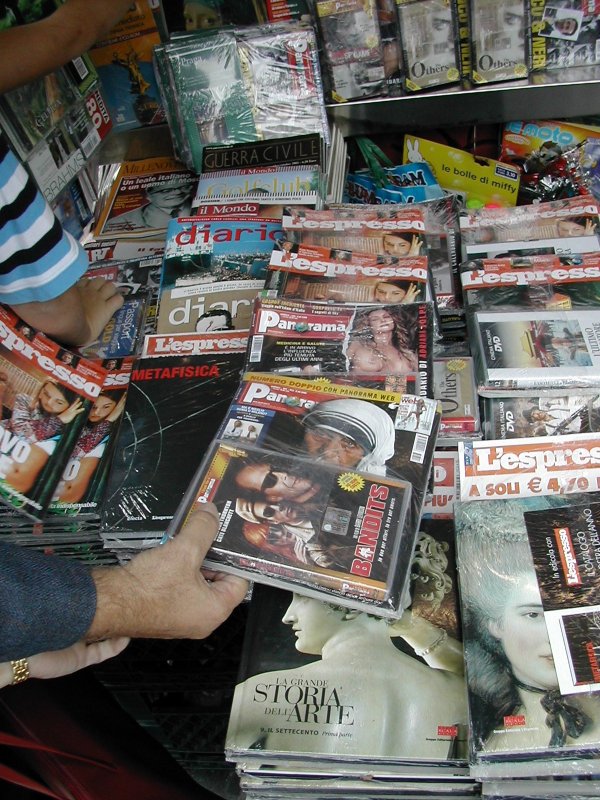
It is my firm belief that the Italian newsstand (edicola) exists for this reason. “Newsstand?” you may be wondering. “What kind of shopping can you do at a newsstand?”

Magazines and newspapers, of course, but not only. Italians don’t read much (according to laments from the Italian publishing industry), so they cannot be enticed to buy much for the mere sake of words printed on paper. There has to be a “gift” as well, sometimes included in the cover price, sometimes at a “special discount” if you also buy the newspaper or magazine.

Often this gift is more print, preferably in large series to encourage you to keep buying. Books published this way have run the gamut from classics to encyclopedias to comics. In the last couple of years I’ve seen two or three different gorgeous series of art books, and several of cookbooks (first by ingredient, then by region). Now we seem to be moving on to religion, with a newly-advertised series of “the great religious books, lavishly illustrated.”

A popular enclosure nowadays is a DVD, cheap at 5 to 10 euros. The great thing for us foreigners is that, unlike their VHS predecessors, these include the original-language soundtrack as well as the dubbed Italian – and it used to be so hard to find films in English!

Films, too, run in series e.g., the complete Woody Allen. Themed film collections distributed in this way can mix and match from various film studios, so you can collect (starting now) every film ever made based on a comic book. This follows two different print series of comics published in the last two years. I bought some of those, to add to my already eclectic comic collection; it was a nice, cheap way to get acquainted with some artists unfamiliar to me.

Some publishing houses baldly cash in on the human instinct to collect, dispensing with newspapers and magazines altogether. Each year brings new sets of “collectibles,” in monthly editions. “Accurate reproductions” of timepieces, or toy cars, or kitchen utensils, each with an explanatory pamphlet (I guess they have to include some paper, to qualify these items to be sold at the edicola).

So Italians out on their passeggiata (a leisurely stroll after a heavy Sunday lunch) can satisfy their shopping instinct at the edicola. Maybe it’s all a government plot to get people to read?

La Transumanza: Moving the Herd for the Winter

I usually think we’re living in the suburbs, but every now and then something persuades me that we actually live in the country.

Today, it’s the transumanza – moving the herds from high summer pastures to lower altitudes for winter. I filmed this right out my studio window.

You can hear the herd dog, but not see him – he was in the truck behind.

…One Week Later