Category Archives: bio

Long-Distance Working – A Tale of Two Companies

Old Days, Old Ways: Adaptec

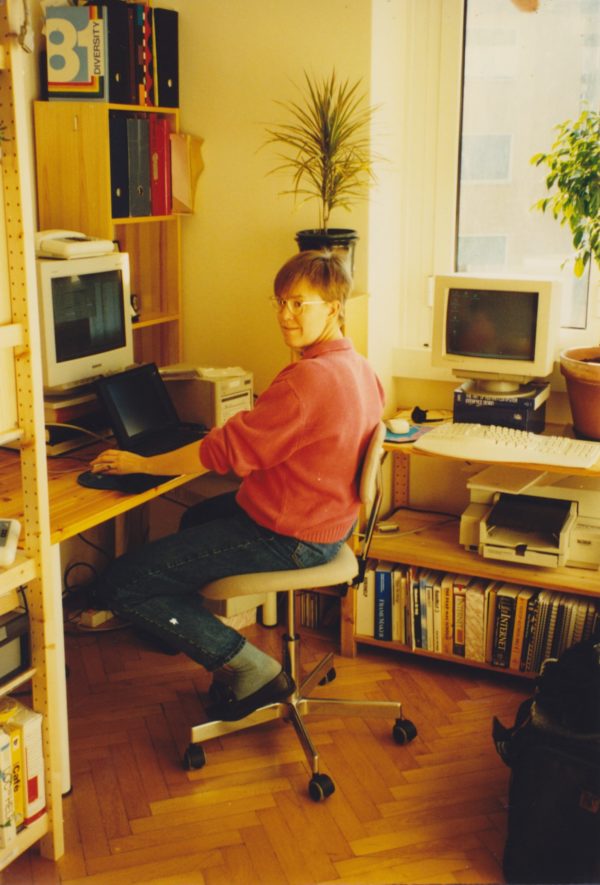
When I began working for Adaptec in 1995 (as a result of their acquisition of Incat Systems, the company which created Easy CD), I was already a remote worker. Fabrizio Caffarelli, who had founded Incat in Milan, had moved himself and the engineering staff to California in late 1993 with the goal of selling the company. In the meantime, though still living in Milan, I needed to work closely with engineering staff to document, test, and help to improve our software products. I began traveling to California regularly, but most of the time I worked from home, keeping in touch by phone and email.

Nobody at Incat had a problem with this, but the concept was foreign to Adaptec back then. In 1995, they had not even had email for very long because (so I was told) the company’s executives had resisted, fearing it would be “a distraction” (they may have had a point).

Adaptec at the time did not have any employees working permanently offsite, and they were not about to make exceptions for an unknown quantity like me so, in spite of my clearly-stated preference to become a “regular” Adaptec employee, I was taken on only as a contractor.

Adaptec’s employee benefits would not actually have been all that interesting or useful to me (e.g., I didn’t need US health insurance). However, although even the regular employees had California-standard “at will” contracts, I suspected that, as a contractor, I was more vulnerable than they to cyclical layoffs.

Some people at Adaptec even treated me as an outsider – not realizing (or perhaps resenting) that, to the CD-recording world, I was the face of Adaptec online.

On one memorable occasion, a customer reported to me that he had phoned tech support, quoting me on some technical question.

“Oh, she doesn’t know what she’s talking about,” responded the tech. “She’s just a consultant.”

I also had the uneasy feeling that, even among some of the people I worked most closely with, I wasn’t perceived as being part of the team, nor as being serious about my career. Part of the reason I started an MBA (via distance learning, of course!) was to demonstrate my seriousness – had I had to apply for the job I was already doing, the job description would have included “MBA strongly preferred.”

While I was doing one of my first MBA courses, an engineering colleague from Adaptec’s Longmont, CO office, Dan Maslowski, came up against a personal situation: he was perfectly happy in his job, but his wife had been offered the opportunity to open the European offices of the (Web) company she was working for.

Dan’s boss didn’t want to lose him, but wasn’t sure how to deal with a remote employee. So they talked to me, as an example of how it could be done, and Dan eventually moved to the Hague while still working for Adaptec. We were a mutual support society of two, commiserating on how difficult it was (and still is) to schedule phone conferences when you’re eight or nine time zones away from everyone else. I even wrote him up as a case study for my MBA course.

My own situation with Adaptec endured, but several changes of manager back at headquarters increased my sense of vulnerability, frustration, and alienation. From some perspectives, I had an ideal job: I could set my own hours (as long as those included lots of late-night phone conferences), and was largely managing my own work and that of two other contractors, all of us working from our respective homes.

But I was at a career dead-end. It was clear that, with Adaptec, I could never become a regular employee, let alone have a career path, as long as I was off-site. I was good at what I was doing, but had been doing it long enough to be getting bored. I could see things that (desperately) needed changing to make life better for Adaptec’s customers, but I would never be in a position to make those changes happen.

Hence my attempted move to California in 2000-2001, to participate in the Roxio spin-off. I wanted to help define, from the ground up, how a new company would deal with its customers, using the Internet as a tool for support, marketing, and relationship-building via customer communities.

I planned to move my family to the US for a year or two – long enough, I hoped, for me to launch a career and then find a way to move back to Italy, where my husband had his own career that he was not willing to give up.

That didn’t quite work out. The whole Roxio situation went sour for me, and I returned to Milan in March, 2001 – back to the same situation in which I had previously felt so vulnerable, alienated, and frustrated.

All those same adjectives still obtained, redoubled. The (ridiculously good) money was not enough to overcome my misery, especially when my mother-in-law was diagnosed with breast cancer. I didn’t think I could handle a major family crisis while hating my job every day. I quit in July, 2001. (My mother-in-law was successfully treated for the cancer and is still living; Roxio is no longer with us).

A New Dawn: Sun Microsystems

Corporate practice and technology have naturally moved on, and working remotely no longer seems as strange or difficult as it did ten years ago (although in Italy it’s still highly unusual). Having suffered through the early days with a resistant employer, I am now delighted to find myself working with a company that gets it.

Remember Dan? He ended up working for Sun Microsystems, where he’s currently a Senior Engineering Manager. When he realized in February that the new position he had just taken on entailed responsibilities for part of a website, he thought of me.

I knew nothing about Sun, except that Dan worked there and I liked what I could see of his management style. He had even left Sun for AMD, then gone back to Sun, and they’d kept his company blog waiting for him. This is standard practice at Sun (10% of whose ~33,000 employees have blogs open to the public), and is a subtle indicator of the company’s relationship with its people.

Obviously, Dan was asking me to join him knowing that I live in Italy and, though very willing to travel, this is where I’ll be staying. It didn’t occur to me to ask whether this would be a problem; his answer would have been: Of course not. His team was already spread across time zones from Silicon Valley to Beijing, so managing one more person in one more location wasn’t going to make much difference to him.

Arriving at Sun’s offices in Broomfield, CO for a first meet-and-greet visit in March, I astonished to learn that practically all of Sun is like this: teams seem to be formed on no geographical basis whatsoever, and many Sun employees work from home, wherever home may be. According to an official company statement I heard in an online presentation for newbies, at least 50% of Sun employees work from home at least one or two days a week.

This point was made most forcefully for me when I read the first blog post from Deb Smith, a Director in the software group I’m working for. Go read that now and you’ll see what I mean. As soon as I read it, I thought: I’m in the right place. The whole company is built for what they call OpenWork, with all the right systems – and, more importantly, attitudes – in place to make it work well both for the company and its employees.

This is probably a factor in the large proportion of women who stay with Sun – I’ve never seen so many women in an engineering organization!

And it’s not just the women: practically everyone at Sun seems to have been there for at least ten years (the company celebrates its 25th anniversary this year), with no intention of leaving. Upon getting to know Sun a little better, this does not surprise me at all. Sun demonstrates that it values its people, and understands the importance to those people of all aspects of their lives, not just their careers. That sounds like an organization I’d like to stick with.
what qualities do you look for in an employer?

Six Degrees from Disaster

Massacre at VA Tech – Malaysian Students Safe read a headline I spotted via Google News this morning. Naturally, it came from Malaysia’s Straits Times newspaper.

It’s facile to say that the global is local and the local is global. But there’s more to this particular phenomenon. When we hear about horror anywhere in the world, the natural human instinct is to want to make sure our own loved ones are safe. But we also nurture a sneaky desire, hidden even from ourselves, to have some connection to the news, to somehow feel we are participants, not just audience, in a great world drama.

Of course, no one wants to be directly affected – to be killed or wounded, or have that happen to someone we know and love. But to be able to say that we were somehow part of the larger story – it’s only human to enjoy that.

This is the bread and butter of local newspapers, as I see constantly illustrated in the posters advertising Lecco’s local and regional papers. “So-and-so disaster elsewhere in the world: no Lecchese hurt”. But sometimes they are: “Lecchese drowns swimming in Rimini” appeared a year or so ago – this would hardly be local news (Rimini is on the Adriatic coast, nowhere near Lecco) except that a local man died.

As soon as something dramatic happens anywhere in the world, we would all like to be able to say whether or not we are connected with it or hurt by it. An ideal headline would read: [disaster] strikes [someplace else], hundreds dead – but no one you know.

Hence this modest (and ironic) proposal to some entrepreneur who’s got the technical skills: find a way to combine (mash up) Google News with all my social networks, so that I can immediately know whether the horrible (or good) events of the day hit me close to home. Call it “Six Degrees from Disaster,” because, as John Guare illustrated, we are all at most six “links” away from anyone in the world – in tragedy or in triumph.

Shut Up or Go Home – No Culture Likes a Kibitzer

I was recently interviewed for an article about third-culture kids, to be published in the Christian Science Monitor. In an hour,s taped phone conversation, Erik Olsen asked many questions, including: “Being an outsider in all cultures, how does that make you feel?” I thought for a moment, and said: “Superior.”

No doubt that statement will be quoted in the article. <wry grin> I tried to explain that, as outsiders in every culture, we TCKs see things with a more objective eye than insiders who are familiar only with their own culture*. This doesn’t mean that we despise every culture we encounter, or have nothing but criticism to offer. But it’s common for a TCK to think: “In country X they do this differently, and it seems to have certain advantages. Why couldn’t it be done that way here?” This is NOT the stereotypical case of ugly Americans who think that everything is better in America. In fact, most TCKs, including American ones, tend to criticize their “home” culture more than any other.

The problem is: no one wants to hear it. Cultures and countries often suffer from a form of groupthink in which “our way is best” or “we’ve always done it this way, why should we change?”And people resent criticism of their culture, however well-intended, from outsiders.

I was reminded of this when last week’s article about Italian Freedom Fighters got a few Italian backs up. I was accused (justifiably, for that article) of stereotyping Italians as a race of unrepentant scofflaws. Of course I don’t really believe that ALL Italians routinely break the law, though I do feel safe in asserting that a larger proportion of Italians than, say, Americans or Germans or Swiss, are inclined to disregard or evade laws that are inconvenient to them individually, such as those regarding taxes. This attitude goes all the way to the top in Italy, with consequences far beyond the embarrassment of having people in high government posts under indictment for tax evasion, bribery, and fraud.

I can take some ironic consolation in knowing that, if that article had been written by an Italian, many Italians would have leaped to agree with it. Italians (as they themselves have told me) are very fond of criticizing themselves and their country – but apparently it’s not okay for me to do it.

Then I received an irate email from an Italian woman living in England. She took exception to a number of my statements about the Italian education system, and pointed out how much better it is than the British or American systems. I will certainly grant that for the average American public school (I don’t know enough about the British to comment), but the point of most of my articles was not to compare the Italian system (favorably or un-) with other systems. We’re in Italy, and can’t afford the international schools even if we wanted to, so our daughter goes to Italian public schools which, while they have pluses, also have minuses – as is true of ANY school system.

What got to me about this lady’s email was her concluding sentence (originally in Italian): “Don’t denigrate the country in which you are a guest. As they tell me and my kids when we comment on England: ‘If you do’t like it, go back to your own country.’ ”

This isn’t the first time I’ve heard this sort of statement, though it is a first for me in Italy. It raises some questions: At what point will I have a “right” to criticize? How long does it take to no longer be a “guest” but a member of the community? I’ve been in Italy for 14 years, my husband and daughter are Italian, I work for an Italian company. All that’s lacking is citizenship, and I could have that if I bothered to do the paperwork. At the very least, as a payer of Italian taxes, I have a right to complain when I’m not getting my money’s worth from state services – perhaps more so than the many Italians who evade taxes!

But, no matter how long I live here, there will always be Italians who will resent anything negative I have to say about Italy, and will invite me to “go home.” The sad irony is that the same thing happens at “home“ Americans are, on average, the LEAST tolerant of criticism of their culture, from insiders or outsiders. Many’s the time I was told: “If you don’t like it, you can just leave.” So I did.

And you still can hear me singin’ to the people who don’t listen,
To the things that I am sayin’, prayin’ someone’s gonna hear.
And I guess I’ll die explaining how the things that they complain about,
Are things they could be changin’, hopin’ someone’s gonna care.

I was born a lonely singer, and I’m bound to die the same,
But I’ve got to feed the hunger in my soul.
And if I never have a nickel, I won’t ever die ashamed,
‘Cause I don’t believe that no one wants to know.

Kris Kristofferson “To Beat the Devil”

Note: The term “culture,” as used by anthropologists, means (definition Webster’s): “the ideas, customs, skills, arts, etc. of a people or group, that are transferred, communicated, or passed along, as in or to succeeding generations.” Culture, in this sense, is a shared set of beliefs and behaviors, and does NOT refer to so-called “high culture,” e.g. art and music.

Share your own cultural kibitzes below.

Il Popolo della Rete – Italy’s Internet People

Four years ago, I wrote about the difficulties of making friends with Italians. I already had online (and offline) friends in Italy, but most of them were expats. I have Italian colleagues with whom I get along well at the office, but we don’t socialize outside (quite the opposite of my experience in American companies).

Turns out I was looking in the wrong places: I should have been seeking Italian friends in my other country beginning with I, the Internet.

I had one Internet-derived Italian friend, Alice Twain, but I didn’t start reading Italian blogs until last December, when I met Lele Dainese and, through him, various other Italian bloggers. Not surprisingly, the number of Italian blogs that I read jumped after barCamp Roma, and again after the Girl Geeks Dinner and rItaliaCamp.

I didn’t need more reading material, but these people are now friends, or on the way to becoming friends, so I’m genuinely interested in what they have to say. And I’m attending every offline get-together I can manage, to see the people I already know, and meet new ones.

Last night in Milan we had a Pandecena (see video) – so named because organized by Luca Conti, whose main blog is called Pandemia (cena = dinner). Italian netizens gather around Luca because he’s a highly influential and well-known Italian blogger, so a bunch of people who mostly had no previous acquaintance were happy to turn up at a dinner to meet him and each other. (NB: Upon meeting Luca, one also learns that he’s a thoroughly nice human being, so seeing him again is always a pleasure.)

To save me the hassle of commuting back to Lecco late at night after a long day (I had come in to the office early to avoid a train strike), Sara/Piperita had invited me to stay at her home in Milan. She issued this invitation although our acquaintance to date extended only to chatting briefly at the Girl Geeks dinner, and then some emails to organize a LikeMind event in Milan next Friday. This is extremely unusual behavior for an Italian: you just don’t up and invite strangers to stay at your house! (Well, I do, but I’m a weirdo and I’m not Italian.)

So I went over to Sara’s place after work to drop off my backpack, and spent an enjoyable couple of hours talking with her and her French husband. Aside: We could have spoken Italian or English equally comfortably – they have both spent a lot of time in England and are fluent in English as well as, of course, French (I don’t speak French, but can follow a lot of it).

I already knew that Italians who have travelled and lived outside Italy are generally more open to new people and experiences (this is also true of Americans and others who travel). It had not occurred to me (duh!) that there is naturally a strong correlation between Italians who have an active online life and Italians who travel. Like me, they have friends in other parts of the world, whom they keep up with via the Internet.

Which is not to say that every Italian online has travelled. But even those who have not exhibit a wide-eyed curiosity about the world very different from the average Italian attitude. Italy has one of the lowest rates of Internet use in the developed world (fewer than 50% of the population), because many Italians see no use in it except perhaps to buy cheap airline tickets. Most Italians are uninterested in making new friends after their school years, and, to these, the idea of making friends via the Internet is completely outlandish.

The Italians who are online, however, are open to – indeed, actively seek – new ideas and people. They’re the kind of people I enjoy knowing, and who enjoy knowing me.

Of course there’s the geek angle. People who show up to barCamps and so on are generally techies one way or another, or at least bloggers, so they find plenty of geek stuff to talk about. At last night’s dinner I heard far more about Python (a programming language) than I needed to know, and may have got myself into interpreting a speech (via video link) to be given by Alan Kay at Italy’s first PyCon, to be held in Firenze in June. (Modestamente parlando, they would have a hard time finding anyone better qualified than myself to do it. <grin>)

On the whole, it was a very enjoyable evening with a nice group of people, all of them Italian except me, some of whom are destined to become friends (not that I disliked anyone there – just talked to some more than others).

Two of my countries beginning with I, Italy and the Internet, are coming together – an unexpected but very happy development.


How do you make new friends in Italy?

The Italian Blogosphere Takes Action on Italia.It

above: Frieda Brioschi makes a point

(Unfinished article, and I don’t know when I’ll have time to finish it…)

The Italian government has spent 9 million euros (of an allocated 45, or maybe 54) on a new tourism portal, Italia.it, which has been the subject of a great hue and cry among the Italian blogosphere. ScandaloItaliano provides a quickrecap of this site’s dubious history (in English).

So far, business as usual for Italy: in decades of corrupt government and ever-increasing pressure from organized crime, far greater sums of public money have been far more egregiously wasted. No Italian is surprised. Disappointed, yes, but not surprised.

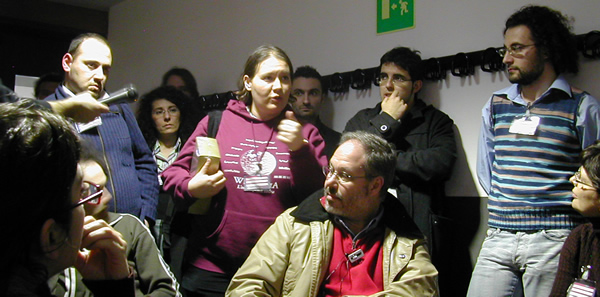
But, this time, something’s different. Some Italians aren’t just complaining, or shrugging their shoulders and saying: “That’s the way things go here.” Instead, they are asking themselves and each other: “What can we do about it?” And on Saturday, March 31st, they got together to talk about that at rItaliaCamp.

ric goetz

Robin Good

Robin Good captures it all for you.

ricwaving

^ Marco Ottolini drowning, not waving

This lady was extremely pissed off, for reasons that eluded the rest of us. For some reason she thought the event had been touted as an opportunity for tour operators to talk about drumming up business…? She left in a huff. I don’t think anyone figured out who she was.

ricpissedlady

ricibm

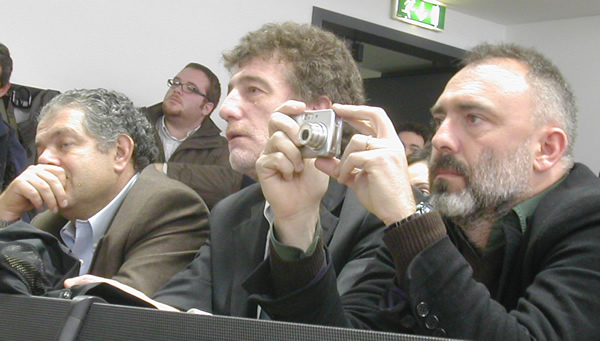
^ The IBM contingent, expressing varying degrees of interest.

Can the “private sector” and open source cooperate, without either side feeling exploited?

Content Recommendations
for an Italian Tourism Portal

Input from Tourism Operators

The crux of any such project is the content. To be a truly comprehensive national showcase for Italy, the portal must include information about the hundreds of primary and secondary destinations, events, sights, and activities that Italy offers. Gathering such information is a daunting and potentially very expensive task.

Even supposing that an accurate and complete database could be gathered in the first place, it would need to be updated regularly to account for changes in everything from hotel prices to train schedules to museum opening times. Realistically, the information can only be kept up to date by those most directly interested: the hotel and restaurant owners, museum managers, local and regional tourism officials whose attractions are listed.

This creates a chicken-and-egg problem: in order to get people and organizations to participate in a listing, they must perceive enough value in being part of it to offset whatever time and effort they must spend entering and updating their information. The more information the catalog holds, the more valuable it is to its users (tourists) and, therefore, to the data providers (tourism operators).

Input from Tourists

Beyond the hard facts of what is where and how much it costs, a would-be tourist is also interested in a great deal of subjective information: what will I see (or eat), and how much will I like it? To add this dimension requires the participation of other tourists who have already had the experience.

A tremendous amount of this kind of information about Italy is already available online: the Italy boards are among the busiest on travel forums such as Frommer’s and Fodor’s. There are thousands of blog posts about Italy from both residents and visitors. There are thousands of Flickr photos and hundreds of videos.

Robin Good interviews Amanda and me (scroll down the page – the video of us is below where our names appear)

Robin Good & Luca Conti

^ Robin Good and Luca Conti

http://wiki.bzaar.net/RItaliaCamp

rItaliaCamp agenda in English

ScandaloItaliano in English

What’s Next?

Because my readership is largely English-speaking, I’m only including the few pieces I find in English (tell me if you know of more!). A Technorati search will turn up much more in Italian.