Category Archives: bio

A “Typical” Italian Christmas

Of course , our family is far from typically Italian. Even my husband’s family isn’t very typical: his mother moved around a great deal while she was growing up, and had only two brothers (who both died young), and Enrico’s father was an only child – hardly the norm in his day! So the close family isn’t numerous, and what we do have is spread all over northern Italy. (Let’s not even start on my side of the family.)

Enrico and his brother also moved around a lot in their youth (thanks to their parents’ teaching careers), both went to grad school in the US, and Bruno now teaches in Norway. Their mother (widowed two years ago) lives in Abruzzo (Italy’s central east coast). So getting together for the holidays will always involve travel for somebody. And this is the first big difference between us and most Italian families: I need to find some statistics to support this hypothesis, but my hunch is that most Italians marry within their hometown – what choice do they have, since they mostly stay there all their lives!? Extended families don’t have to go far to see each other every day, and getting together for Christmas is no big deal.

Perhaps for this reason, there is no tradition in Italy of sending Christmas cards. Everyone to whom you might want to send holiday greetings is near enough that you can deliver your greetings in person. If you do live far away, there’s not much point in Christmas cards: the Italian post office is historically so unreliable that your Christmas greetings might arrive in time for Easter – if at all.

So, for those of my friends and family who may be wondering why I stopped sending Christmas cards or even letters years ago, that’s the reason – or at least the excuse!

We do try to bring the family together most Christmases. Last weekend Enrico brought his mother up from Abruzzo. This unfortunately meant that she spent a lot of the week alone in our house (though Ross was very good about coming home straight after school to make lunch for her).

Enrico and I had a not-unusually-frantic week before Christmas – final classes for him, for me work as usual including four hours’ commute most days (I stayed home Tuesday, intending to work, but ended up in bed with a migraine instead). We did the usual last-minute shopping for presents and to stock the house with holiday food:
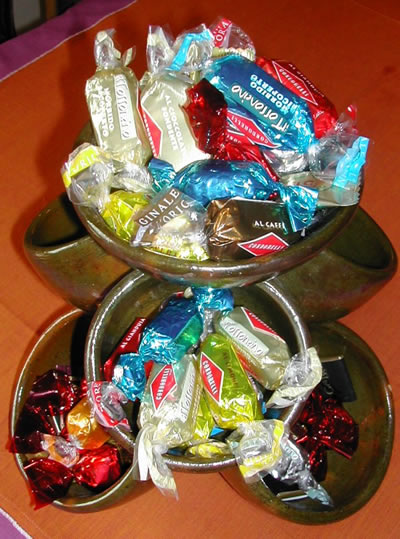
torroncini

Well, sweets are easy. But what to do about our main holiday meal? Do we even have a family tradition? When Enrico’s grandmother was alive, for the Christmas first course she made passatelli in brodo – a tradition from her side of the family, which came from Emilia-Romagna (though she herself was born in Brazil). When, in later years, we had Christmas in Abruzzo, we often had scripelle in brodo, which I adore. But Enrico forgot to get the scripelle (eggy crepes) while he was there, and no one in the family knows how to make them.

During our TVBLOB holiday lunch, I asked some of my colleagues about their family traditions. We have people from all over Italy (as well as the UK, Japan, Israel, Australia, and the US), so there was a wide variety. Italy’s south seems to lean towards various forms of pasta al forno (oven-cooked pasta, e.g. lasagne), while the north, broadly speaking, prefers broth-based first courses. Enrico voted for tortellini in brodo (which a Milanese colleague also told me was traditional in his family), while I was dubious that we needed pasta at all, since I had decided to make turkey with stuffing and mashed potatoes – none of which is part of any Italian tradition. Several colleagues told me that their families eat agnello (lamb) for their Christmas main course. I like agnello, but don’t know how to cook it, while I do know how to cook turkey.

My colleagues are mostly much younger than I am, and still have Christmas at their parents’ homes with Mamma to do the cooking. In our family, I am the lady of the house, and in charge of the holiday cheer – a responsibility not to be taken lightly.

Friday evening Enrico and I managed to meet up in Lecco to do some food shopping, including a stop at Rusconi, Lecco’s finest macelleria (butcher). We bought a piece of beef for brodo (broth), and a beautiful rolled roast of veal with chestnuts and lard, which I planned to make for Saturday dinner when Bruno and Ingvild arrived from Norway (where they get lots of great fish, of course, but meat is expensive).

Also traditional during the Christmas season are Italian winter fruits (apples, pears, mandarin oranges) and exotic fruits from all over the world. I’m not sure why the exotics, but it means that our fruttivendolo (greengrocer) had stuff that even I’ve never seen, from South America I guess, as well as the more familiar mangoes, papayas, and lichis.

My coup for Friday was getting Rossella‘s big Christmas present: a pair of shoes she had told us she lusted for. Ross every year well before Christmas starts telling us about all sorts of gifts she’d like – just in case we didn’t have any ideas of our own. This gives us plenty of scope to surprise her – she doesn’t know which, if any, of the requested items she will receive (certainly not all, given her expensive tastes and our limited budget).

She had described these shoes in loving detail, along with where to get them, and mentioned that they were the last pair in the store. When I arrived, the owner remembered her trying them on the day before, and was surprised at my attempt to make a surprise of the gift: I refused to have it “wrapped” in a bag with the name of the store on, and didn’t even let them put their sticker on the anonymous gift wrapping they did.

Of course I ran into Ross on the street in Lecco five minutes later. “Did you get me something?” she asked mischievously. “Nope,” I said, pressing my anonymous cloth shopping bag under my elbow. “I’m just going to give you money, and you can buy what you want.” Later we passed by the shoe store window together and Ross gasped: “They’re gone!” “Oh, were they there? I guess I missed them. These other ones are cute…” I can’t believe she fell for it – I’m not that good an actor. But she claims that she was genuinely surprised on Christmas morning, and she certainly was genuinely delighted.

Saturday morning Enrico and I did more shopping, finally managing to find the fresh chestnuts that I needed to make stuffing. I use a recipe from Martha Stewart, but Martha has it easy: she can buy chestnuts frozen or canned. I have to buy them fresh, then roast and peel them myself. Here they are just before roasting:
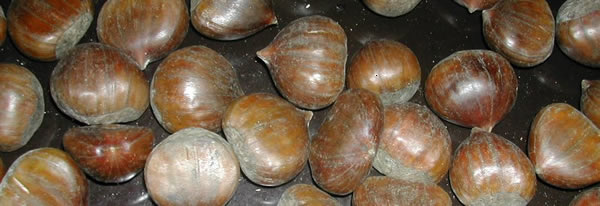
castagne - chestnuts

Each one had to be pricked with a knife so that it wouldn’t explode in the oven. It took me halfway through Sunday to get them all ready to be added to the stuffing.

Our plan to have the veal roast for Bruno and Ingvild’s welcome dinner was thrown off: they arrived very late Saturday night after a horrendous day of travel (Denver and Heathrow weren’t the only airports having weather problems). So we had to eat the roast on Sunday, although Christmas Eve (la vigilia di Natale) is traditionally a day of “fasting” – or at least, in modern times, light eating in preparation for the feast to follow. And we did have the tortellini in brodo that Enrico wanted, for Sunday lunch. (The leftover homemade broth was used in risotto last night.)
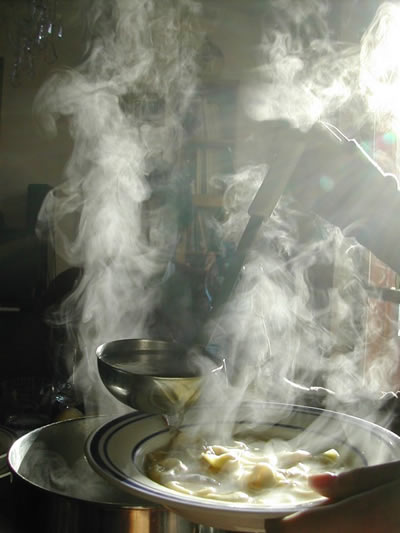
tortellini in brodo

On Sunday I made the cornbread and did everything else needed for the stuffing – had to make cornbread from scratch since I can’t get cornbread mix here. Someone on the Expats in Italy forum gave me a localized recipe using polenta. The result is not so great that I’d really enjoy eating the cornbread on its own, but it’s fine for use in stuffing, with a pleasantly gritty texture.

Some regions and families in Italy celebrate (with a big meal) right after midnight mass on Christmas Eve (which, once midnight has passed, is Christmas morning, I guess). Here in Lecco it seems that everyone goes to mass: Ross and her friends stopped in at Lecco’s main church at midnight with the idea of attending mass, but found it too crowded to hang around. Instead, they had their own version of Christmas eve dinner.

I think the Lecchesi after mass generally go home and to bed, waiting to open presents the next morning, as we did. Ross is now old enough, and stays out late enough, that we actually had to wake her for this! While I was waiting, I put the stuffing into the oven to bake, and started preparing the herb mixture for the turkey.

Our oven isn’t big enough to fit an entire turkey: I cook a turkey breast, using a recipe that calls for putting a mixture of herbs, onions, and lemon zest under the skin. Italian turkey breasts are packaged without the skin, so I spread the herb etc. paste over the bare breast and then layer on slices of pancetta (bacon):
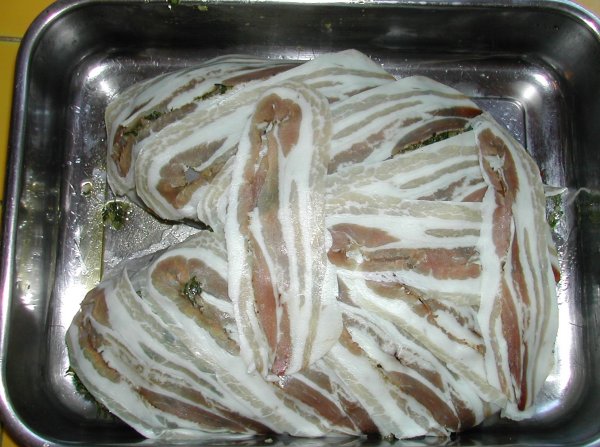
turkey wrapped in pancetta

Then we went to open presents, as you might guess by the shapes: lots of books! (The amount of reading we do is also NOT typical of Italian families.)

We drag out present-opening as long as possible, taking time to enjoy each others’ gifts (and reactions). By the time we got through the pile, the stuffing was cooked and it was time to put the turkey in.

Italian poultry always takes a lot longer to cook than American recipes expect – maybe there’s less water in the meat? The recipe wanted me to cook the turkey for less than an hour, but it took more than two before the meat thermometer registered done.

We didn’t just sit there hungry and waiting, however: we had a wonderful antipasto. Bruno and Ingvild always bring lots of yummy salmon with them (they say it’s the only thing that’s relatively cheap in Norway). Salmon can be found year-round in Italy, but a lot of it is sold at Christmas: it has become a standard holiday luxury item. We ate two types (one smoked, one marinated) with toast, butter, and mustard sauce, which was plenty to hold us until the rest of the meal was ready. After the antipasto everyone drifted away from the table again, browsing through their Christmas books, drinking prosecco, and (in my case) checking email.

We re-set the table and got lunch onto it by around 2 pm. I have finally learned how to make mashed potatoes from scratch really well: the trick (thanks to the Silver Palate cookbook) is to cook the potatoes very soft, drain them, heat a mixture of milk and cream separately, then beat the two together with a hand mixer.

After lunch, I took a nap.

In the evening, we noshed some more on salmon and turkey, then watched “Brokeback Mountain” – not very Christmassy, I know, but I had got it for Ross for Christmas because she loved it, but I had never seen it myself. Wow. Amazing movie. I dreamed about it afterwards.

Today is Santo Stefano, St. Stephen’s day, also a national holiday in Italy – a wise tradition, I think, as we all need time to recover from holiday excesses. This is the day when families traditionally go on a gita (daytrip), but I let Enrico go with the in-laws – after a frantic week, I’m enjoying the peace and quiet at home. Ross has left for Bormio where she and a bunch of friends are renting a house together for a week. Their original idea was to ski, but there’s no snow (this winter so far has been unusually warm and dry) – the poor dears will have to make do with the hot springs.

* A Note on Panettone

I actually don’t like panettone all that much. But we learned a trick from Julia while we were staying with her and Dani back in April (for Rosie’s funeral). At the time, Italy’s traditional Easter cake, colomba (shaped like a dove, sort of) was already available in stores. I brought one as a gift for Julia and Dani. Julia said it was similar to Mexican pan dulce, and treated it the same: sauteed in a pan with lots of butter. Yum!

This turns out to work very well with panettone, too: the warmth and slight crispness make it much more interesting.

What (and from where) are your holiday traditions?
Tag, I’m It! – Five Things Not Many People Know About Me

Jeff Pulver said:

As a blogger, people may know you, but how good does anyone ever really know anyone? …

Turns out there is a game of Blog-Tag going around the blogosphere in which bloggers are sharing five things about themselves that relatively few people know, and then tagging five other bloggers to be “it.”

Interesting idea. I’m sometimes a bit startled at how much people know about me, especially friends and acquaintances whom I hadn’t realized were reading up on me. But there are always more stories to tell! And now Bill Streeter has tagged me.

Umm,  um, five things that relatively few people, know about me:

  1. I played D&D for a couple of years in college. My character was a centaur ranger who got pregnant within the first day’s play, and eventually became very hard to maneuver in tight dungeons. (My zodiac sign is Sagittarius, and I had always thought it would be cool to be a centaur. For that matter, I still think it would be cool to be a centaur. Except that the stairs in our house would be impossible.)
  2. I am the least athletic person in the world. In 6th grade I once served a volleyball into my own face.
  3. While attending the University of Texas, I was in Navy ROTC for about six weeks. (My dad was worried about my future and wanted someone to look after me.) If I had been assigned to the group of the cool Navy guy who interviewed me, I might be in the Navy today. But I was assigned to a Marine gunnery sergeant who looked like Hitler (really! mustache and all!) and tried to act like him. So much for my military career.
  4. In high school, and even once or twice in college, I wrote teenage angsty poetry at least as bad as anyone else’s. Good thing I didn’t start blogging back then.
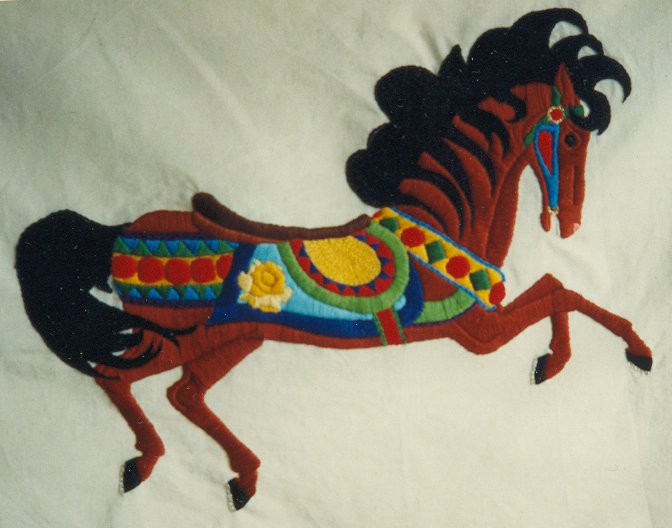
  5. I used to do fine embroidery like the above, which I made for a friend, but no longer had time for it after I had a baby – and now no longer have the eyesight for it.

Living in Italy: Personal Reflections of a Long-Time Foreign Resident

If You’re Thinking of Moving to Italy…

Many foreigners dream of living in Italy, and some manage to make that dream come true – and then may find it’s not so dreamy after all. This is my personal experience of living in Italy – the good and the bad. Your mileage may vary.

Also see my pieces about living in Italy.

And read Rebecca’s View – sharp, real, and extremely funny reflections on life on a farm in Umbria.

Exchange Student Programs

If you are interested in coming to Italy as an exchange student (high school), here are some resources, try Intercultura (based in Italy, does exchanges both ways). NB: I have no affiliation with this organization and know very little about it! But they certainly know more about student exchanges in Italy than I do.

Want to Come to Italy as an au Pair?

Ask my friends over at Euro-Placements

Got Any Good Tips or Links for Living in Italy?

vlogEurope 2006: A Horde of Vloggers Descends on Italy

NB: The links on this page are mostly to video, of course! There are also lots of photos. Be aware that some of the language in the videos is Not Safe for Work.

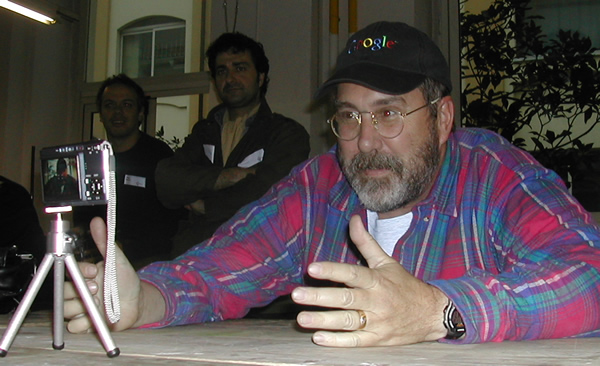
What did I do at vlogEurope? I barely participated in the conference, and didn’t film a thing – some videoblogger! But I organized, organized, and organized some more. Here’s a mini-diary:

Monday or Tuesday: Found out there would be a national transport strike on Friday, when we were expecting the bulk of our foreign guests to arrive. Had no way of knowing how airports would be affected. Public transport in Milan was expected to strike from 6 to 10 pm – right when many would be arriving from other countries. I scrambled to let everyone know and make suggestions on how they could get where they were going.

Tuesday evening, while my daughter was in theater class in Milan, met with the Nodehouse landlord to make another payment and get keys.

Wednesday: Andreas and Anders arrived on the same flight from Copenhagen and came to meet me at my office. We had lunch together, then they wandered Milan while I kept working and organizing. Questions, questions: Did we need to set up anything at the conference venue? If so, when would we do it, given the transport strike Friday evening – the only time the place would be available to us? (We decided we wouldn’t need that much setup, just go give the place a look-over and be prepared for whatever we would have to do to make it ready early Saturday.)

I called Taverna ai Poggi, the restaurant in Lecco, to confirm probable numbers for the Sunday night dinner – 26 people, as it then seemed. I also told them we’d be wanting to revise the wine list – we had had a substantial donation earmarked specifically for wine!

I worried about the weather – would it be good for our outing on Lake Como Sunday? Not that I had any control over that…

Alberto and Schlomo also arrived. They spent the night at the Nodehouse while Andreas and Anders came back to Lecco with me on the train, and had dinner with my family.

Thursday: Up at dawn to go back to Milan at my usual work time, on the 8:17 train. Everyone who was already in Milan met up at TVBLOB again and had an informal demo of (and debate about) what we’re doing, then we all ate lunch at my boss’ usual lunch place, before they all took off to drink and eat and talk all over Milan – I stayed at the office, working and organizing (more).

In the evening, Andreas and I met Arianna of TheBlogTV and Maria Giovanna of Digital Magics, our hardworking co-organizers,at IED, the conference venue. Roberta of IED showed us the spaces we’d be using and we agreed on how to set them up, including projectors for laptops, mics, etc. Being Italy, this all took a great deal more discussion than Andreas and I thought strictly necessary, especially as we were tired and hungry and wanted to meet up with the gang.

When we got out, we planned to take a taxi to the Nodehouse, but there were none to be found (as we learned later, this was because of the big motorcycle show going on elsewhere in town – attendees of the big business shows all take taxis, being unable or unwilling to figure out the local transport system).

It was getting so late that we hopped on a tram heading downtown, and got off as soon as I saw a restaurant I was familiar with. We told Anders to eat with the others and then meet us at the Porta Garibaldi train station in time for a 9:40 train, but he went there a good deal earlier, so we finished up our meal and got there ourselves by 9, then we all sat on the train and waited for it to depart. Poor Anders only had a vending machine sandwich for dinner. Enrico picked us up at the station in Lecco and drove us home. I think. It’s all rather blurry in my mind by now.

People kept piling into the Nodehouse, being willing to sleep on (hard, cold, marble) floors rather than give up the camaraderie – some nostalgia for college dorm life, I guess. (For some, that willingness only lasted one night on that floor!)

Friday: Groups of videobloggers roamed randomly in and out of my office and all over Milan. I kept in touch by phone, SMS, and email, trying to herd the cats to their respective destinations.

Alberto got up before everybody in the Nodehouse and called saying he had something to discuss with me in person. He sounded so anxious that I was afraid something dreadful had happened, some horrible cultural misunderstanding or breach of manners that I would be called upon to resolve. I couldn’t begin to imagine what it could be, or how I would fix it.

He came to the office and told me his dilemma: he had found out on Monday that he had won an award (with a nice cash prize) from the Tuscany regional government, for a short documentary he had made. He was the first-place winner, so the organizers insisted that he show up in Carrara to be feted on Saturday – the very day of the vlogEurope conference he had been so looking forward to. He was devastated, but I assured him over and over that the conference was only a small part of the experience (which was true), and he should definitely go to collect his prize!

Aske Dam arrived at TVBLOB’s offices after lunch and we were pleased to give him a long demo – he was gratifyingly excited about what we’re doing. In fact, he arrived excited (having heard about it from Andreas), which is an unusual treat for us: a lot of people don’t get it until they’ve seen it in action (and some not even then).

Duncan also arrived in the afternoon. I fed him my last banana because he hadn’t eaten all day, then sent him to join the others.

I had suggested that everyone meet at the Duomo before six, and reserved a restaurant within walking distance so that the transport strike would not keep us from our dinner. I ended up staying in the office til 7 pm myself, to help my colleague Pancrazio script and shoot the new TVBLOB demo video.

Assuming the strike had started, I walked from my office to the Duomo, in the rain, exchanging rapid-fire SMS with Jeffrey to keep updated on the status of Steve, Mark, Richard, and Miguel.

I was the first to arrive at Ristorante da Bruno, a family favorite of ours for years (most of the waiters have been there forever and remember my daughter at age three). I gossiped a bit with the owner (son of the founder, I guess), who now has two young daughters of his own.

Eventually people began arriving in clumps, some very late as they were waiting for a taxi. I felt incredibly stupid when I found out that the local transport strike had been called off at the last minute and they could have taken the metro! (Which explained why I saw people going down into the metro stations on Corso Buenos Aires – I had wondered at that, then figured that they were using the metro to cross under the street rather than wait for a light to change – that’s something I would do…)

We had a great dinner at da Bruno, though I winced at the prices, which had gone up since I was last there. I had been aiming for something less expensive; I knew some of the visitors were on tight budgets. But everyone tucked in happily – I moved back and forth between our two long tables, sorting out dietary needs and preferences. The waiter worked hard that night, and I tipped him 30 euros when we left (by American standards, this would have been low given the size of the final bill, but it was very high for Italy – he was delighted). I had some budget leeway for things like this thanks to some other donations.

Because I had anticipated trouble getting from the restaurant to the railway station Friday (due to the now-cancelled strike), I had asked my friend Antonello to come pick us up in his big van – splitting the cost between 6 or 7 people, Milan to Lecco in a taxi is almost reasonable (150 to 170 euros total, depending where in Milan). A bunch of people came back to Lecco that night; our family room began to resemble a men’s barracks. It’s a good thing I had the whole house wired for Internet a year ago – they plugged in a switch so everyone had their own wired access (our wireless doesn’t get that far from the router on the 2nd floor), and many stayed up late using it – among other things, video and text chatting with the group back at the Nodehouse.

Saturday: We all (Andreas, Anders, Bicycle Mark, Richard Hall) got up even earlier than the previous days so we could catch the bus down the hill and an earlier train into Milan, to prepare for the actual conference before it started at 10.

At the office, we packed up three TVBLOB boxes, a switch, cables, cameras, etc., then called a taxi to take us to IED. I specified a large car with room for five, but that’s not what arrived. So Mark and Richard volunteered to find their own way to the venue (and eventually did).

At IED, I set up the boxes, testing them with a small portable TV monitor while waiting for the kind folks from TheBlogTV to arrive from Rome with three TVs they were lending me for the occasion (which didn’t really make sense – I could have brought them from the office, but when IED was unable to supply them, TheBlogTV folks offered, and it saved me having to haul them back and forth across Milan).

Attendees ambled in. Some on the list never turned up, but we got some walk-ins to replace them – about 50 total attendees in the end. There were several Italian journalists, students of journalism, and bloggers, including my (now) new friend Lele.

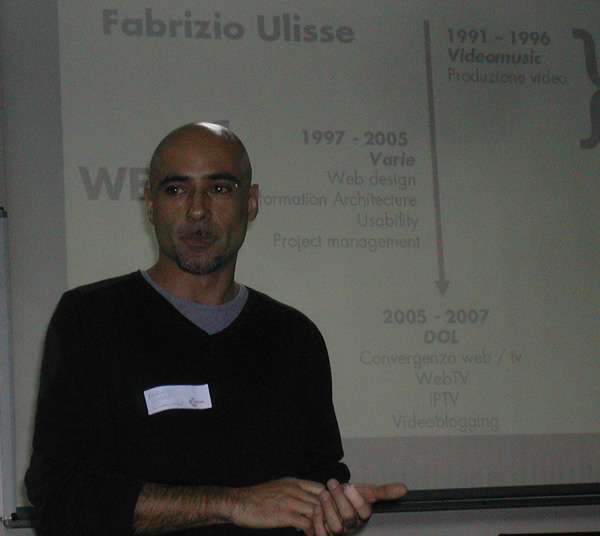
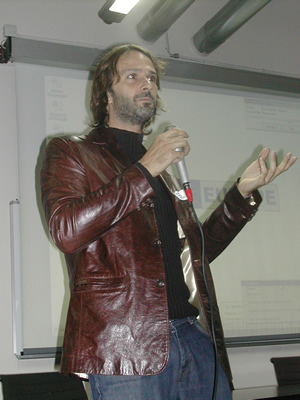
We finally started around 10:30 with a brief introduction by Andreas before the “vortex” sessions began. There were two in Italian: a Node 101-style introduction and how-to by Fabrizio Ulisse

and one on vlogging and TV by Bruno Pellegrini of TheBlogTV.

The Italians mostly attended those, with only a few – Beatrice of Weblogart, Saverio of TheBlogTV, and Diego Bianchi (who had also come from Rome) really making the effort to mix with the international crowd (Alberto also would have, had he not gone off to Carrara to collect his prize). There had been some efforts to overcome language barriers.

Miguel, Joel, Saverio

Another Italian who mixed was Elisabetta, not (yet) a videoblogger herself, but a grad student at Milan’s Catholic university, doing research on new media for her thesis. She had heard about the conference somehow and asked Andreas and me (wholly unnecessary) permission to come gather thesis material.

above – front: Beatrice, Miguel, Anders P, Schlomo, Anders C
back: Joel, Daniel

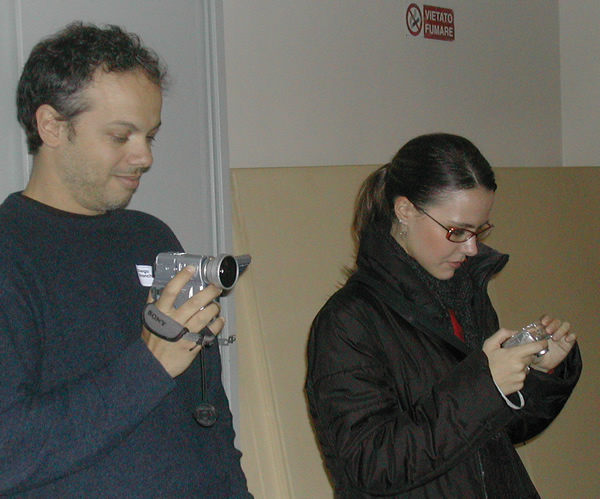
Diego and Elisabetta

The international gang, reasonably enough not expecting to get much out of presentations in Italian, had small and very lively sessions on working under constraints, vlogging and politics, vlogging in context (more here), making money from vlogging (top secret! no filming allowed!), and Aske’s talk looked fascinating.

Richard addresses the camera

I myself didn’t get to see or hear much of any of this – there was always something else to be done, including demoing TVBLOB stuff (keeping recalcitrant beta software alive) to all and sundry. I hadn’t demoed so much since CES in January. It was mostly fun, and the demo-ees were excited by the possibilities.

The audience grew and then shrank over the day, at the end mostly the foreigners were left. We closed with a quick recap from each group of what had been accomplished, bagged up our equipment, and headed out. A few kind volunteers came back to the office with me to help carry stuff, then we went to meet the others at the Nodehouse to see what to do about dinner (Andreas and I, as usual, were very hungry – we’d been working hard all day!).

We found a place near the Nodehouse, Pizzando Grigliando (which, I now realize – and unusually for Italy – appears to be part of a chain). It had a wide enough variety of menu to satisfy everybody, at semi-reasonable prices. Alberto joined us, back from Carrara, as did Diego, to my delight, though I didn’t get to talk to him as he was at the other end of a very long table.

After dinner we went back to the Nodehouse, where Antonello met us at 11 pm with the van. Several more people decided to make the move to Lecco, including Richard Bluestein, who was delighted to take a “lesbian” bath with scented salts, foams, and candles in our master bathroom.

As Enrico and I went to bed, I remarked: “I bet all those guys downstairs are still on their computers.” As confirmed the next day, I was right.

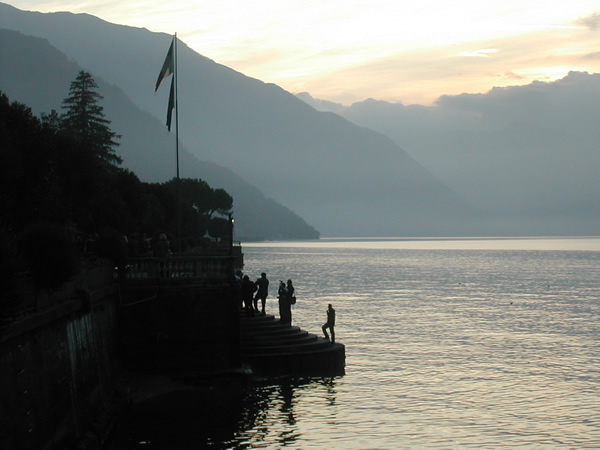
Sunday: We took it easy in the morning. I had provided train and boat schedules so that everyone could make their own way up to Lake Como as and when they pleased. Those of us already in Lecco didn’t need to rush – it was everybody else’s turn to do the commuting (yes, I planned it that way). The weather cooperated: Sunday was partly cloudy and completely gorgeous on the lake.

While still at home, Andreas and I were interviewed by Miguel on the balcony. Eventually we rounded up the gang and walked down to town and caught the train to Varenna.

On the train ride, Mark and I talked about being TCKs, growing up “between worlds”. There are many points of common experience, even when the worlds (New Jersey and Portugal, India and Pittsburgh) are very different. He had had the classic TCK conversation the day before with Arianna:

“Where are you from?”

“Uh…”

“Don’t worry, I get it. Me, too!” (Arianna is an Italian citizen raised in the US and France.)

Elisabetta and her boyfriend Gabriele met us in Varenna, and she began interviewing everyone in sight. We all took the ferry across to Bellagio, with commentary by Madge.

One group had reached Bellagio before us; we found them lazing around drinking coffee at an outdoor table in the sun. As soon as Madge appeared, all cameras were on her– to the great confusion of everyone else in Bellagio. I overheard the following:

Wife: Ma chi e’? (“Who is that?”)

Husband: Che cazzo ne so? (“What the fuck do I know?”)

Those of us arriving from Lecco hadn’t had lunch and were hungry. We sat inside the cafe (no tables left outside) and had coffee, pastries, and sandwiches. Somebody shot footage of the locals’ reactions to Madge, but I haven’t seen that appear online yet.

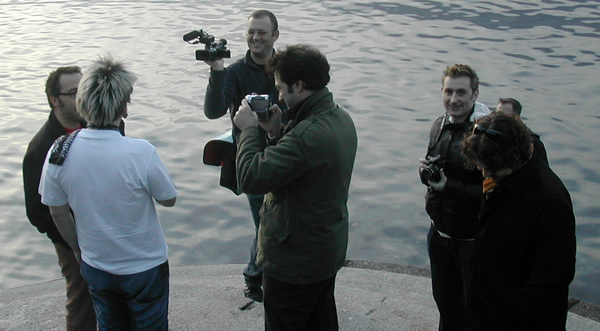
We wandered around in constantly-changing groups, eventually all congregating on the lakeside spot where Madge was interviewing Schlomo.

vlogging off into the sunset

There were so many cameras pointing at each other that the other tourists and residents thought there must be somebody famous around, and gathered to watch.

This is probably what saved Steve’s camera bag. He had put it down somewhere and forgot about it when he moved on, til someone came hurrying along asking who had lost a bag. No one had touched it – when he got there, he found a large group of people gathered around staring at it, each making sure that no one else would steal it!

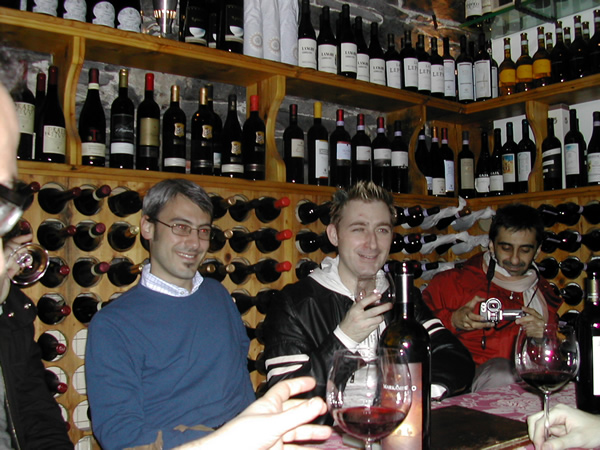
The light was gone, so we gathered in a small wine bar, near the photography shop with photos of famous people on a board outside, for (of course) wine.

Gabriele, Steve, Alberto

It was getting cold and dark. We all piled onto the boat back to Varenna and then the train to Lecco. At the station, I spotted two friends of my daughter – perfect subjects for a Madge interview.

As scheduled, Antonello was there with his van to run people up to the restaurant. I went in the first group so I could give last-minute instructions on food and wine, and be there to direct traffic as people arrived. After some last-minute defections (Lisa’s ride flaked on her), 21 people sat down to eat:

antipasti:
brisaola della Valchiavenna (dried salted beef, typical of this
region), coppa brianza (pork), prosciutto

first course:

  • pizzoccheri – the local specialty, buckwheat pasta boiled with
    potatoes and greens, then baked with cheese, butter, garlic, and sage
  • risotto al Sassella e luganega – rice cooked with a local wine and sausage
  • (for the vegetarians) bigoli di pasta fresca alla crema di taleggio – ravioli-type pasta,
    home-made, with sauce from a local soft cheese

second course: roast suckling pig, with side dishes of polenta and zucchine. There was a veg option but I don’t remember what it was.

dessert: choice of mostly home-made cakes – chocolate with pears, chocolate with strawberry sauce…

water,
coffee, and lots of wine!

Taverna ai Poggi did very well by us. All the food was abundant, the pig tender and sweet, and in the end they charged us only 35 euros a person, including the upgraded wines. And we got a tour of the wine cellar.

When all was eaten and done, Antonello and another driver were waiting with two vans to carry back to Milan all who were going there. Our family room in Lecco was full again, with a slightly different mix of people – all of them, again, were up late playing with their computers.

Monday: We slept late, lazed around the house, and played with the turtles. Except for Raymond and Schlomo, who took off even before I woke up – Raymond had never gone to sleep at all, so he ended up spending the day sleeping in the Nodehouse.

I was interviewed by Madge (with Mark on the camera and Andreas on lighting), we had lunch, then Richard and Bicycle Mark headed back to Milan.

Tuesday: I had to go to work. Andreas and Anders rode in with me, met up with Mark and Richard, and were naughty at the museum of La Scala (filming!). In the evening I dropped Rossella at her theater class and met Andreas and Anders and Enrico at a nearby bar for an aperitivo (the kind that comes with lots of food, though not terribly good in this case). A&A brought me a thank-you gift from Richard and Mark: “lesbian” bath goodies from the Body Shop. Ross finished theater class early, we all went home in the car listening to a strange mix CD I had made years ago.

Wednesday: A&A, our first and last houseguests for vlogEurope, accompanied me to Milan for the last time, and flew out in the evening. Anders had reached the conclusion that, at some point in his life, he needs to live in Italy. Either or both of them can certainly come back here as guests any time – they were great to have around.

Regrets

I didn’t get to talk as much as I’d have liked with a bunch of people. Hopefully next year’s event, which Joel has masochistically volunteered to organize, will give me more opportunities to interact.

There were few women at the conference, and none among the foreign contingent.

Lack of mixing between the Italian and non-Italian crowds, with a few important exceptions.

Raves

I enormously enjoyed all the people I did get to spend time with – it’s not every day I get to hang out with such an intelligent, interesting, motivated group – all at once!

Reviews

“I cannot wait for next year as this was THE new media conference of the year for me.” – Schlomo


^ top: my daily commutes were far more entertaining than usual!

School Cheating in Italy

School continues to be hell, not just for Rossella, but also for her parents. She scraped through her repeat second year at a new (private, Catholic) school with two academic debits (failed classes) – math and physics, as always.

Being in private school has advantages: last year she had private tutoring in math from a retired teacher with whom she got along very well, and even came close to passing a test or two towards the end of the year. Her regular math teacher was pleased with her progress, and actually in tears at losing her to another teacher this year.

This new teacher appears to be… inexperienced. While discounting for Ross’ prejudices against teachers, and especially math teachers, I do suspect there’s a real problem there. Ross’ story is that the teacher can’t keep control of the class or keep their attention; suggestions from the students on how to do so (e.g., have them do problems on the board, as their previous teacher did) were not heeded for long. So the teacher, out of some spirit of revenge, or because she thinks they should know the stuff, gives them long and complex tests which few of the class have any hope of getting through.

One group of students decided to divide up the test, each doing a part, and then swap their results. Those results were not necessarily correct, but at least they got through the whole test, which is more than most of the students toughing it out on their own were able to do.

I don’t know how they are pulling this off under the teacher’s nose – like most teachers in Italy, she seems to be blissfully unaware of (or deliberately ignoring) the massive cheating that goes on in her classroom.

This has long been a mystery to me. Every child and parent you speak to in Italy is well aware that cheating goes on. Many parents will admit to having done it themselves, and tacitly or explicitly condone their own children’s cheating. So how can the teachers not know that it’s occurring? Perhaps those who choose to become teachers were such academic swots (secchioni – big buckets – is the Italian term) in their own schooldays that they never needed or wanted to cheat, and therefore never learned the techniques, and don’t know what to look out for.

This widespread cheating is damaging in so many ways. In situations like the one with the current math teacher, Ross and others who don’t cheat will fail the test – without the cheating, according to Ross, almost all of the class would have failed that particular test. Were that to happen, the teacher and the principal would (I suppose) have to take note. I’m not a strong believer in bell curves, but if 90% of your class fails, something went wrong that you can’t just blame on the students.

However, those who cheated got higher marks than they otherwise would have, skewing the results. Were the teacher to be confronted on her unsuccessful teaching style, she could point to those kids and say: “Some of them obviously succeeded in learning from me.” They didn’t – they cheated. So the teacher can continue to believe that she’s doing a good job. And Ross, and others, will continue to struggle and fail – honestly.

Last year at this school, a girl close to graduating was discovered to have been cheating on her Greek tests for years. She was not allowed to take the maturita’ (school leaving exam), and was forced to repeat the year. But why did it take her teachers so long to catch on?

Jun 26, 2007 – The math teacher finally caught on when, on the last test of the year, 90% of the tests turned in were identical. Only Ross and one other student (out of a class of ~25) had not cheated. The teacher zeroed out the results of that test and gave another one the following week, which was to Ross’ advantage as she had not done well on the first one. But the teacher did not go back and re-evaluate what had happened on the previous tests, nor did she recalculate anyone’s final grades.

To my mind, there should have been a penalty for the cheaters. All these kids have now learned by experience that cheating is fine, as long as you can get away with it, and there are no real penalties even when you do get caught! And this in a class where the physics teacher had earlier been angry over the degree of cheating he observed on one of his tests, and warned them that if it happened again there would be consequences. But when it happened again with a different teacher, there were no consequences. Again, very poor moral lesson: if one "boss" catches you misbehaving, try it on another.

Situations like this make me just want to go and slap somebody.

Your thoughts and experiences on this?