Category Archives: bio

How My Italian Adventure Began

Strangely enough, my Italian adventure began in India. In June, 1986, I finished up my study abroad year in Benares. It had been a fun but intense time, and I looked forward to a vacation in Mussoorie, my “home town,” site of Woodstock School. My dad was supposed to join me, having just finished a contract in Indonesia, and we would travel back to the States together. When I got to Mussoorie, I used most of my remaining rupees to rent a house on the Landour hillside. I was just settling in, organizing food deliveries with the various wallahs, getting scorpions out of the sink, etc., when a telegram arrived from Dad: “Not coming to India. I’m broke. Make your own way back to the US.”

Umm. This presented difficulties. I did have a return ticket, but we were now in the airlines’ peak season, so I’d have to pay a $100 premium to leave right away. Which was a lot of money in India then, and I didn’t have it. There was no prospect of getting the rent money back from the landlord, nor did I have enough cash to stick it out in Mussoorie til the end of peak season. So I went to Delhi, sold my beloved Nikon, and booked a flight out. I used more of my scarce cash to call my friend Julia at Yale. (We had seen each other the summer before, when she was just returning from her own study abroad year, in Italy, and I was just leaving for Benares.)

“I’m arriving in the States flat broke,” I said. “Please rescue me.”

“Of course,” she said. What are friends for?

I flew into New York on July 6th with $32 in my jeans pocket. Julia’s dad picked me up at Kennedy airport and took me to his home, where I stayed for two weeks, doing odd jobs at his printing company in Darien, CT. I figured I should earn enough to get back to Austin, where most of my stuff was, and I could live with my aunt Rosie til I figured out what to do next.

Julia was spending the summer in New Haven, so I took the train up from Darien to visit her. My return to the US had been so abrupt that she already had a full social schedule for the weekend, and all I could do was fall in with that.

“We have to have a picnic with this Italian guy,” she said, “because I told him I would. I think he likes me, but I’m not interested.”

I shrugged. Whatever. But I had time on my hands, Julia being off at an audition, so I baked banana bread. I had missed cooking in Benares.

When Enrico arrived, Julia introduced us, and I was careful to pronounce his name precisely, rolled R and all; it was oddly important to me to get it right. I don’t know what he saw when he looked at me; something exotic, no doubt: my hands were decorated with henna, a parting gift to myself in Delhi. The three of us picnicked in East Rock Park; Enrico loved the banana bread. After lunch he climbed a tall pine tree.

“Do you think he’s doing this to impress me?” asked Julia.

“No, I think he’s doing it because it’s fun,” I replied.

We parted in the afternoon knowing that we’d meet again in the evening; Enrico and Julia had both been invited to a party by a mutual friend. But Julia received a last-minute invitation to a classical music concert that she couldn’t bear to miss.

“Do you mind if I go? You can go to the party with Enrico.”

No, I didn’t mind.

I met other people at the party, but don’t remember them. Susan, now a family friend, years later said about that evening: “I had just broken up with someone, and had my eye on Enrico, but when I saw you two together, I knew there was no chance.”

We left the party for a concert on the New Haven Green, where we ran into Gabriel and Inger, friends of Enrico’s. The four of us went to a disco in Gabriel’s car, and stayed very late – the club provided a breakfast buffet. I kept trying to call Julia to let her know I wouldn’t be back that night, finally reached her around 3. “I’ll just crash at Enrico’s,” I said.

We did more than just crash. I guess I’ll never be able to lecture my daughter about not kissing on the first date. Oh, well. I never did play by The Rules, and look where it’s got me.

The next day I went back to work in Darien, not sure how to regard the events of the weekend. Just a fun fling, I first thought. Then Enrico began calling: “When are you coming back?”

It took several months. I first returned to Austin, where I realized that I actually had enough credits to graduate from the University of Texas with a degree in Asian Studies and Oriental & African Languages & Literatures (double major). I didn’t need to stay in Texas, and the economy was in a slump, so there didn’t seem much point. I might as well be… somewhere on the east coast?

My next port of refuge was with family friend Donna and her teenage daughter, in the Virginia suburbs of Washington, DC. I stayed with them for several months, working temp jobs to stay afloat. I looked for the cheapest possible way to get to New Haven, and found a ride board in one of the Congressional office buildings. A Federal employee with a large car drove every weekend to his other home in New York state, to tend his garden on the Hudson River. For a share of the gas costs, he’d get me as far as NYC, where I could catch a commuter train into Connecticut.

Also riding in the car that Friday was a woman with a wild history that she was eager to share with us. She was an anthropologist who had studied the Coptic Christians in Egypt, and for years had been the mistress of the prince of all the Copts. She told us lots of interesting things. The poor, mild-mannered Federal employee shrank into the leather seat of his Lincoln, turning various shades of crimson.

“So why are you going to New York?” she finally asked me. I explained that I was going to visit a graduate student at Yale with whom I might be starting a relationship.

“Oh, you can do better than that,” she said. “Let me fix you up with a rich man.” I declined, and continued on my way to New Haven.

Some weeks after this, I landed a “permanent” job as an administrative assistant in the political department of the American Consulting Engineers Council. (Which was an instructive look into the workings of K Street, but that’s another story.) The office overlooked a green square, diagonally across from a Washington Metro stop. So, when Enrico came to visit, he took the train to Penn Station, and then the Metro to meet me at the office. I waited eagerly, looking down from our 5th-floor window, and recognized him across the square by his walk. The thought floated into my mind: “That’s the man I’m going to marry.”

And I was right, though it took him another 18 months to figure it out.

How I Became an Italian Journalist

Soon after we moved to Italy in December, 1990, I read an article in Italia Publishers, a magazine about desktop publishing, in which the writer described his difficulties in finding a font for Hindi. Although he had never been to India, he had been studying the language in Milan for fun, and wanted to write the world’s first Hindi-Italian dictionary. “Well,” I thought, “I’m one of the few people in the world qualified to help him: I speak Hindi and Italian, and I know a lot about desktop publishing.” So I wrote him a letter, care of the magazine, proposing to collaborate on the project.

After a few weeks, the writer called me. The dictionary project had never taken off; he couldn’t find a publisher. “But the magazine editor wants to speak with you,” he said. There was a shortage of journalists who could write about computers, and they were willing to try me out. My first piece was a small review of a piece of Macintosh software, I don’t remember the name, it was an organizer/calendar with “personalities” that would talk to you. The editor of Applicando, then the leading Italian Mac magazine, liked this piece, and more work flowed in from him and other magazines in the same publishing stable.

Another early piece was about “The Manhole,” kids’ software for the Macintosh which was more a world to explore than a game. We tested it on Rossella, then only two years old, who had no trouble picking up the concepts of the mouse and pointer. The review included a photo of her in front of the Mac, intent on the screen, with the mouse in one hand and her bottle in the other. NB: The guys who did “The Manhole” later on went on to do Myst.

The writing didn’t pay well, but there were perks. I got to go to Edinburgh on a junket paid by Aldus (the company that created PageMaker desktop publishing software). All I had to do was write an article about their new product announcements. I helped pay a couple of trips to Boston by writing articles about the Seybold Conference, to which I got free entrance as an accredited journalist (though I was badly snubbed by a “real” computer journalist I had idolized, Denise Caruso). And I got into the Microsoft CD-ROM Conference in San Jose the same way; by then, Fabrizio and I were going to the conference for other reasons as well.

One of the CD-ROM conferences I attended took place in the “porno year.” This was when conference organizers in the US finally decided to admit that pornography was a driving force in software and CD-ROM publishing (as it would later be for the Internet), and to allow the porn merchants to attend on almost the same footing as other publishers. There was a whole floor devoted to porn at the big Comdex show in Las Vegas, but I didn’t go to that. The situation at the CD-ROM conference was funny. The pornies had a section of the floor to themselves, carefully draped off with black curtains. There was also a conference session on pornography, held at 9:00 in the evening, well apart from every other session.

Fabrizio was amused by all this. His first big foray into CD-ROM publishing had been “The CD-ROM Unabashed History of Photographic Erotica,” co-edited with a photo archive in Milan, which he had tried to advertise at the conference several years before. He’d been forced to take down his posters, but word got around anyway – back in Milan, Microsoft ordered two copies for somebody high up in the company.

I looked at some of the porno stuff at the conference, brought back lots of samples, and wrote a wry, amused piece about the American reaction to it all. Nino, the magazine editor, was thrilled to include pictures of the products: “Finally, we have tits – just like Panorama and L’Espresso!” (Two Italian news weeklies which often find ways to work naked women into their covers.)

My article also reported on the results of a “test” I had run at the office, where I got the engineering staff and my husband to watch a porn movie on CD with me. The engineers were intrigued by the fact that the disc was “hybrid” – it would run on both Macintosh and PC systems, a technological trick which the porn publishers pioneered. Everyone commented wisely on the jerkiness of the video, although, given the subject matter, perhaps some jerkiness was to be expected.

The American press had noticed the sudden “legitimization” of digital porn, and had a lot to say about it. Stephen Levy, author of “Hackers,” published in MacWorld an interview with a young porn CD publisher, which I happened to read while on a visit to the US.

Levy asked the publisher what his parents thought of his business. “My dad’s okay with it, but my mom’s not too thrilled,” was the reply. “Well, so-and-so,” concluded Levy sententiously, “you should have listened to your mother.” I was infuriated by Levy’s condescending tone towards his interviewee, especially in light of “Hackers,” where he notes that many computer geeks are lonely young men unable to get dates. It seems to me that digital porn is a sevice to those guys.

Not having a computer available, I scrawled off a furious note in my terrible handwriting, and sent it to MacWorld. Months later, at the SMAU computer show in Milan, I ran into a magazine editor I knew. “Hey, I saw your piece in MacWorld!” he said excitedly. They had published the letter, but since I was not a regular reader of MacWorld I hadn’t noticed. I’ll have to go dig that up someday to remember what exactly I wrote to Stephen Levy. I don’t know whether he ever replied.

Imaging in Italy: A Photographic Walking Tour of Rome

I spent the week of October 12-18 in Rome, on Tony Boccaccio’s Imaging inItaly course, a wonderful, fun experience that I heartily recommend to anyone wishing to improve photography skills OR, even if you’re not an experienced photographer, if you want to do something completely different in Rome – and bring home some amazing photographs of your very own.

NB: The tour when I did it was a week long, but Imaging in Italy now offers shorter sessions. Contact Tony for more information.

I was supposed to arrive Sunday afternoon for an introductory session and dinner. Upon reaching Lecco station at 6:30 am, I learned that there was a railway strike, and my train to Milan was two hours late – no chance of making the connection for the Eurostar from Milan to Rome. So I rebooked for the next day, arriving Monday at noon (which required waking up at 4:30 am). Two other course participants had been held up trying to get to Rome from Venezia, so the welcome dinner Sunday was postponed to a welcome lunch on Monday.

Day 1

I got to Hotel Alessandrino just in time for the end of a morning session on Visual Thinking. Then we all picked up our cameras (mine is a Nikon Coolpix 775 digital) and walked down to Saint Peter’s. Along the way, I grabbed this shot:

Rome

Piazza San Pietro was being decorated and filled with chairs for the Pope’s 25th anniversary bash. This was not a problem, as we wereavoiding standing in the middle of the circle and taking postcard shots. Instead, we first walked around the colonnade, looking for different ways of seeing and showing what we saw, with Tony offering suggestions, and taking pictures of us taking pictures. I was fascinated with architecture and geometry, so there was plenty to keep me busy.

Colonnade of Saint Peter's

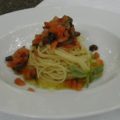
We finally got our welcome lunch, at the Antica Taverna (via Monte Giordano 12). The antipasti were excellent, and, of the three pasta dishes we tried, my favorite were the orecchiette (“little ears”) with a sauce made from sweet bell peppers.

Italian dinner - 3 pastas

When we finally staggered away from the table, I accompanied my coursemates to the Spanish Steps, the Keats museum, and on other wanderings.

next day

Italian School Schedules and Calendars

Rossella is in her first year at Liceo Artistico (art high school), and we’re all struggling to adjust to her new pace of education. We didn’t know that Artistico requires more hours in the classroom than probably any other school: 4 days @ 5 hours plus 2 days @ 7 hours equals 34 hours a week, with only brief recess breaks, even on the two days that they have a lunch period. This time is divided into 40 periods of 50 minutes each.

19 periods are spent on standard academic subjects: biology, literature, religion, algebra, physics, grammar, English, history, anthology, and narrative (not sure I see the difference between these two and literature, but it seems to add up to several different kinds of reading each week). Then there are 19 periods of art: technical drawing, “plastic arts” (sculpture), art history, and pictorial arts. Finally, two periods of physical education. All that, and they still have homework most days.

School six days a week, ugh. Not only does Ross have to get up on Saturdays: so do I, to ensure that she does, though this is probably easier for me than for her. I’m the only morning person in this family, though occasionally even I like to have the option to sleep in. And most Sundays we’ll be getting up early as well, so Ross can ride. Groan.

School on Saturdays is traditional in Italy, but many schools in Milan have moved away from it, I suspect because many Milanese like to escape the city on weekends, fleeing to their second homes at the beach, on one of the lakes, or in the mountains (hence traffic is hideous going out of the city Friday night and back in Sunday night). Lecco retains the Saturday tradition, so it’s a good thing we are not in the habit of going away on weekends. On the other hand, who needs to? Lake Como is one of the places the Milanese escape to!

Italian Babies: Why So Few Are Being Born

“How to solve Europe’s pension crisis: Work longer, have more babies”

cover of The Economist, Sept 27, 2003 – with a photo of a rather horrified (and rather Italian) -looking woman

“Sheesh! What is wrong with you Italians?! You inherit one of the most beautiful cultures the world has ever seen and you jeopardize it by refusing to breed.”

Reader comment on an article about Italian birthrates, Zoomata

The Economist speaks somewhat tongue-in-cheek; I’m not sure about Zoomata’s anonymous reader. So, in case you’re wondering, today we will address the question of why Italians don’t have more babies.

To quote an American politician, completely out of context: “It’s the economy, stupid.”

First, real estate costs: Buying a home is expensive in the desirable parts of the country, i.e., those where you can actually find jobs. Rentals are almost non-existent, and also very expensive. Until recently, rent laws so favored the tenant that a landlord could well find himself saddled with a tenant who didn’t pay rent, yet could not be evicted until after a long (ten years!) and expensive court battle. People who own real estate are therefore reluctant to rent it, unless they are large-scale landlords who can afford the risk. There aren’t many of these, so the market is tight, and rents are high.

The high cost of renting or buying is also part of the reason young people don’t move out of their parents’ homes until age 30 or beyond, and/or they marry. You can’t afford a home of your own until there are two of you to contribute to the expenses, and even then you probably need help from one or both sets of parents (as we had).

If you’re living at home and not married yet, you most likely don’t have kids. So, by the time an Italian woman marries, she’s often past 30, with few reproductive years left. This is also about the age that people first begin making decent salaries, and, in spite of fairly liberal maternity laws, Italian women face the same career-vs.-family choices that American women do: being a mother slows you down on the career track, so the choice to have a child is also a choice to lower your lifetime income.

Once you do get married and move into your own place, your first home is probably a small one. Enrico, Rossella, and I lived in a three-room apartment for 12 years. And I do mean three ROOMS (plus bath): two bedrooms and a living/dining room; our kitchen was so tiny (1 x 2 meters) that it didn’t count as a room. The refrigerator had to be in the living room, along with the dining table, TV, sofa, and shelving. Enrico’s piano had to go in Rossella’s room, which began to be a problem as she got older and wanted her privacy. Her room also contained a huge closet/bed/desk unit called a cameretta (used partly for storing off-season clothes and other stuff for the whole family) and a second closet, as well as shelving. Our room contained a large closet, our bed, bookshelves, and one corner was my “office”.

Had we had a second child, where would we have put it? Buy a bigger place in Milan, you say? Couldn’t afford that – that’s part of the reason we moved to Lecco. Where I’m now looking for work. And did I mention how hard it is for anyone to find jobs in Italy, especially outside the big cities?

At least in Italy putting kids through college is not the huge financial burden that it is for Americans. Italian universities are essentially free and open to everybody; a modest tuition fee has been introduced in recent years, but the only other expense is for books – IF you live in or near a city that has the kind of university program your child wants to attend. If not, you’re looking at big-city rents again: say 1000 euros a month for a studio apartment in Milan, maybe you can get it down to 500 if your student shares a small apartment with several others. This obviates any small-town low-rents advantage you might have enjoyed previously.

Then, when your kid finishes college, he is likely to be at home again (or still) while searching for a decent job, and then working his way up to a salary level that would permit him to move out. So you’re still supporting this kid, and you’ve got to keep a home large enough to hold everybody until the he’s finally out in his own place, which you will likely help to finance. Oh, and, by the way, that pension you’re being taxed up the wazoo for? Don’t count on it being there when you retire. Which will be later than your parents did, and you’re still going to get less than they did. Why? Because Italy has been paying over-generous pensions for decades, the system is going bankrupt, and there is no political will to make the necessary reforms (just like in the good ol’ USA). You’d better start saving now for your retirement.

So… are you still surprised that 45% of Italian children have no siblings?

See also: Rebecca’s view