Category Archives: bio

Recycling: A New Italian Tradition

Growing up in Bangladesh and India, I observed that every scrap of paper, or anything else potentially useful, was re-used. Peanuts bought from a roadside stand were given to me in a little bag, carefully handmade from a page of a Singapore telephone directory. At school, the kabadi-wallahs (second-hand men) would come around collecting paper, cloth, and tins, for which they would pay by the kilo. This meant that our school papers and love letters could (embarrassingly) turn up as bags in the bazaar; we took great care to burn anything that we wouldn’t want anyone to read.

Woodstock School and its environment encouraged thrifty habits. There simply wasn’t a lot of stuff to buy, let alone throw away. Sometimes even the basics, like electricity and water, went missing. In a drought year (the spring and summer after a failed monsoon), power frequently went out because there was no water in the mountain rivers to generate hydroelectricity. Studying by candlelight sounds romantic for Abraham Lincoln, isn’t so great in real life. (Woodstock now has generators, and uninterruptible power supplies for its computers.)

Then the local springs dried up, and we had no water to take showers or even flush toilets. Servants would bring up water from a rainwater tank, and we flushed using buckets. Nowadays, although I love taking hot baths, I always wince at the water left in the tub afterwards, wasted. In our previous (small) apartment, the bucket used for mopping the floors lived under the bathroom sink, so I would simply leave the water in the tub, and flush with that water until it ran out or we needed to drain the tub to take showers. I have had to explain this habit to people who couldn’t understand why I do not reflexively pull the plug after a bath. I’d like a house designed to use bath and shower water to flush toilets.

India’s recycling habits meant that there was very little trash on the Mussoorie hillsides, until recent years when plastic shopping bags and packaging became popular. Suddenly, the garbage bloomed. I suppose increasing wealth (for some) also meant that people were less careful, because plastic bags weren’t the only thing being thrown away. Dick Wechter, a Woodstock staff member keenly interested in mountain environmental issues, found a solution. He paid local sweepers (untouchables, the poorest of the poor) to collect trash from the hillsides, which they sold to the kabadi-wallahs, in the end making more than enough money to pay the collectors’ salaries. Dick has also been promoting the use of biodegradable paper bags or reusable cloth bags for shopping, and composting wet waste.

Italy was becoming recycling-conscious just about the time we got here (1991). It started with glass, which you would put into a large plastic bell, usually located on a traffic island or sidewalk within a block or two of your home. The bell had little round portholes near the top, into which you would push one bottle at a time, dropping it with a satisfying crash to the bottom. Once a month or so the glass truck would come along. It had a miniature crane on the back, with a hook which would pick up the bell by a loop of steel cable sticking out of its top. The crane would swing the bell over the open bed of the truck, and then a second hook would pull a second loop which opened the bottom of the bell – MEGA CRASH as hundreds of glass bottles fell. This was a less pleasing sound, especially at 6 am.

A little later, paper recycling bins turned up on the streets as well, though they were sometimes set on fire by vandals. Then plastic. For a while, in Milan, we had to separate out “humid” (organic, compostable) garbage into special containers and biodegradable bags, but the Comune of Milan gave that up when it was found to cost more to make it into fertilizer than farmers were willing to pay for it. A couple of years ago, Milan’s sanitation authority also moved recycling closer to home, by putting bins for paper, plastic, and glass into the courtyards of apartment buildings. This was a good idea, but the execution was confusing. Aluminum (soft drink) cans were supposed to be placed with glass; I never did figure out what to do with other kinds of cans. Some kinds of plastic could be recycled, others not. The city also tried to increase recycling rates by fining anyone who messed up. In a building complex with hundreds of people, this meant fining the entire complex, since no individual culprit could be identified. One irritated resident of a fined building noticed that sometimes the garbage men themselves weren’t fussy: he photographed a truck loading both recyclable and general garbage into the same compartment, clearly wasting the public’s efforts at recycling.

Lecco was up for an award last year as one of the most recycling cities in Italy, and I can see why. We have three bags: umido (compostable “wet” waste), sacchetto viola (violet bag, for plastic, paper, cardboard, wood), and sacchetto trasparente(transparent bag – non-recyclable). I assume that the stuff in the sacchetto viola is hand-sorted somewhere along the way, which is more sensible than trying to make confused old ladies do it at home. I recycle even more paper now that I don’t have to tear the plastic windows out of envelopes and food cartons. We have separate (small) garbage bins under the sink for umido and general garbage. Glass, unfortunately, still has to be carried to a bin down the road. We collect it into a plastic container out on the balcony, and every now and then Enrico takes a walk with a big bag of glass.

The plastic shopping bag problem is somewhat mitigated in Italy by the simple expedient that supermarkets charge 5 cents each for them. So people tend to take fewer of them (I am always left gasping at the profligacy with which American supermarkets bag groceries), and/or bring re-usable bags of their own. Also, kitchen garbage pails are small enough that these bags can be used to line them, saving the expense of buying garbage bags. You have to take the garbage out more often, but you can take it anytime, down to a trash room in your building, where the people responsible for cleaning the building will get it out to the street on the correct day for collection.


Jan 10, 2004

Mike Looijmans writes:

“In Belgium it is very common to collect rain water (usually from the roof) in an underground tank, and use this water for things like flushing toilets, washing and so. In many Belgian places, tap water is not drinking water but usually untreated ground or rain water. ‘Clean’ water for cooking and drinking is usually provided from separate taps.

In the Netherlands, all tap water is drinking water. In the east and south of the country, the water is taken from underground wells and is the same stuff which is sold in bottles at exorbitant prices in supermarkets. In fact, some types of bottled water sold internationally would not pass the Dutch criteria for tap water. Though it sounds like a terrible waste to use this water for car washing and such, the water as it is pumped up from the ground needs very little treatment, just filtering out the sand is usually enough. The water companies use trout to monitor the quality. A trout swimming in the water stream is monitored by a computer system. When the fish makes a sudden movement, alarm bells start ringing as these fish are very sensitive to pollution.”


Waiting for Viggo

Everyone in the world can see The Return of the King now, except us Italians; the film has had a simultaneous worldwide release, except in Italy. According to the New York Times, this is because “in Italy moviegoing is not an ingrained holiday habit.” Wrong! Italian cinemas are more packed at Christmas than any other time of year, although the focus is generally on family movies: Finding Nemo has only recently been released, and the annual Disney film is usually shown at Christmas, even if it was a summer release in the US.

Another holiday movie tradition is the stupid Italian comedy, in recent years dominated by comedians (to use the term loosely) Massimo Boldi and Christian de Sica (the sadly degenerate son of director Vittorio de Sica). These films usually exploit the previous summer’s pop music hits, so an Indian theme this time around was predictable – Panjabi MC hit the Italian airwaves earlier this year. Mr. MC even did a tour of Italian TV shows, being interviewed by dim hosts and hostesses who pretended he spoke Italian (they didn’t bother to provide a translator – maybe they didn’t realize he speaks English?), and ended up looking far stupider than he did even when he had no clue what they were talking about.

Fortuitously for Boldi and de Sica, a recently-popular Italian comic troupe is called “I Fichi d’India.” Neither they nor their name have anything to do with India; “Indian Figs” is the Italian name for the fruit of the prickly-pear cactus, which is popular in Italy, though maybe unknown in India. But any excuse will do to enlarge the cast and add to the stock of fatuous jokes. No doubt there are plenty of scantily-clad women in this one as well, though in the trailer they’re mostly shown dancing. Why any of these women would want to have even movie sex with Massimo Boldi is beyond me.

My husband’s theory is that “The Return of the King” is being delayed in Italy because the Italian distributors know very well that Italians love to go to the cinema at Christmas, and any good film would wipe the floor with this rubbish. So here we are, waiting for Viggo (and Orlando, of course) until January 22nd. Boldi and De Sica are no substitute.

The Perils of Being “Thirteen”

Ross and I went to see the film “Thirteen” last week, and found it deeply disturbing, as I expected. At intermission (there is always an intermission in Italian cinemas), Ross said “It seems exaggerated,” and many of the critics agree with her. “Well, thank god I don’t have to worry about most of that stuff in small-town Italy,” I thought to myself.

Ross was most puzzled by the scenes of the protagonist cutting herself. I couldn’t explain it, so when we got home I looked up “self-mutilation” in Mary Pipher’s “Reviving Ophelia: Saving the Lives of Adolescent Girls,” which I probably need to re-read now. Pipher says that this is a new phenomenon (as of the 1990s), and postulates that it’s a way of releasing powerful emotions that teenage girls don’t otherwise know how to channel.

Then Ross told me she knows someone who does it. For privacy reasons, I won’t go into details, but I can understand why it happens in this particular case. I just wish I knew how to get this girl help.

Ross has an instinct to help people, to be kind, and to offer loyal and supportive friendship. She worries about people in trouble. I understand this: even when I was an outcast geek myself, I wanted to help other outcasts, make friends, be kind, show them that the whole world wasn’t against them – even when, sometimes, I didn’t particularly like them, either. But Ross is facing far scarier problems than I ever did. Was I just oblivious, or is the world really that much worse than it was?

There were drugs when I was a kid – my yearbook from the International School Bangkok for 1971 has an “In Memoriam” page listing about 15 kids, all drug overdoses. Some of my peers began having sex at age 13, though the American norm for my generation seems to have been closer to 15 or 16. So I’m not surprised to hear that some of Ross’ classmates who are dating older boys are feeling pressured to have sex when they’re not ready for it. Fortunately, the Italian average for the “first time” is around 16 or 17, and condoms are very much the norm in Italian culture.

But there’s worse. In 6th and 7th grade, Ross had a classmate who ended up on the street one night. Her parents were divorced, her mother had a relapse into some sort of addiction, and turned on her daughter, threatening her. The girl ran out into the street, snatching up (thank god) her cellphone, from which she was able to call another classmate for help. But that wasn’t the first time. She admitted that there had been several other incidents where she had wandered the streets at night for hours, but had been too ashamed to tell anyone. The mother of course lost custody, but the father didn’t want the girl, so she ended up in an orphanage.

Situations like this are heartbreaking; how is a sensitive, caring teenager like Ross to cope? How do I advise her to even try?


Interesting comment on “Thirteen:” “when i saw this film, i said ‘holy shit’. i’ve been an Evie since i was eleven, my parents were never around so i had to get my attention somehow, you know. god only knows how many girls i’ve ruined. the film is raw, everything in it is possible when you’re eleven or twelve. the only thing bad was that they didn’t show the truth about evie: girls like us always end up alone.”

How to Get (Slightly) Better Customer Service

David Pogue of the New York Times has written a series of articles on “Customer Service Cluelessness,” in which he postulates that the incorrect billing many of us suffer from various companies is actually a money-making stratagem: most of us won’t notice small discrepancies on our bills, or won’t spend the time to communicate with the companies to get them fixed, so the companies get to keep the bulk of their ill-gotten gains.

As I mentioned before, Tiscali, my former ADSL provider, tried to stick me for € 570 back in July, after I had left their service. But that was only the end (I hope) in the Tiscali saga.

That began two years previously, when I was first trying to get ADSL up and running in Milan. I applied online in April, had some paperwork problems, and didn’t actually receive the modem until June. Then there were problems with the line, which would have to be fixed by Telecom Italia, and Tiscali told me that could take weeks – by which time I expected to be out of the country. I told them: “Call me as soon as it’s fixed;” the only other way for me to know it was working would have been to test it myself every day.

I didn’t hear anything. I returned to Milan on September 10th, 2001, and called tech support again the next day.

“Oh, that was fixed back on July 11th,” he said, “Why don’t you try it now?”

I tried to go to to CNN, but couldn’t get through. “Still not working,” I said.

“Try our site,” he said.

I did. It had a news feed. And that was how I found out about the Twin Towers. “Something very bad is happening,” I said, and hung up on him.

The good news was that the line was in fact working. However, when the bill arrived, they had billed me back to July, wanting me to pay for two months in which I had not been using it, because I didn’t know it was working.

I called customer service. “We got it working in July,” they said, “so we began billing in July.”

“I was home and could have used it til August,” I replied, “but you were supposed to TELL me it was working, and you didn’t.”

“The technician tried to call.”

“He must not have tried very hard. We have an answering machine. Or why didn’t he send email?” No satisfactory answer was forthcoming.

I decided to make a formal complaint. The customer service rep said I should write all the details in an email and send it to an anonymous customer service address.

“Fine,” I said. “I’ll copy it to your president. What’s his name?”

“That’s not necessary,” said the lady stiffly. And she refused to tell me the name. I was surfing the net while on the phone with her. A few clicks later, I found Tiscali’s corporate site.

“Ah, here he is: Renato Soru. Okay, let’s try renato.soru@tiscali.com…”

She went into a panic. “He’ll never read it!” she said.

I wrote a long message with all the details, being careful to give praise where that was due (“The customer service rep was very polite, even when I was screaming at her.”) and to explain what went wrong and where, and what kind of restitution I was expecting.

Renato Soru did read it, or at least his secretary did, and she replied politely that Dr. Soru thanked me for letting him know how things were going in customer service. She claimed that I would still have to pay for those two months, but in fact I was never billed for them, either through oversight or because someone realized that I shouldn’t be.

Writing to the big boss is an old trick in the US, but it seems that Italians are not used to it. It will still get results even in many US companies, if nothing else to get you off upper management’s back. Of course the email address of the president/CEO is not going to be posted on the website, but it’s usually pretty easy to guess: try variations on firstname.lastname@companyname.com, firstinitiallastname@, etc.; something is bound to work. webmaster@companyname.com may never answer you, but the president might.

Now we’re having a big hassle with Telecom about overbilling (to the tune of 500 euros). It’s time to write another letter…

Hospital Stay

I have suddenly landed a temporary but demanding job: nursing my daughter. Ross fell off her horse Sunday afternoon, onto hard ground, and broke her humerus just below the shoulder joint.

The emergency room was humming – it was a beautiful day, everyone was out getting hurt. Just before we got there, an ambulance had brought in a young man in motorcycle leathers, who looked pretty severely injured. According to a conversation I heard among the nurses, Lecco gets a lot of motorcyclists – and accidents – on sunny weekends. Another young man had been out hiking in the mountains, slipped on a patch of ice, and banged his head and chin.

They quickly got Ross through an initial examination and x-ray, drew blood, then took us up to a room on the orthopedic ward. Ross was trembling when the anesthesiologist came to talk to her; given recent family horror stories with hospitals, we were all terrified that she had to go under anesthesia. But those stories took place in the US and the UK. So far, I have no complaints about Italian health care. [later on, we had an Italian horror story to add to the family history]

The anesthesiologist gave her a sedative, and off we went to surgery. Ross told me later that, by the time they actually got her into the operating room, she was giggling and wondering why she had been so scared. She lay there looking at all the bustle around her, wondering if they had a machine that goes “ping!”

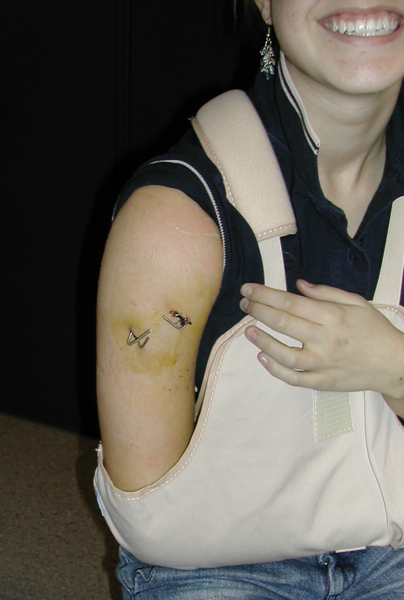
We had arrived at the emergency room at 5:15; by 7:15 she was under. The surgeon had to pull the bone back into place, and then put in three wires to hold it while it heals; Ross is also wearing a sling-and-strap to hold her arm against her body. Her right arm. No drawing in art school for a while.

Giulio (owner of the private stable where we now keep Hamish) and Viola (his daughter, Ross’ classmate and riding buddy) came racing down from their ski weekend to be there, and passed the time during surgery regaling me with stories about their numerous family sports injuries (they ride and ski, Giulio and Viola compete seriously at both). As Giulio pointed out, it’s lucky this happened right before Christmas vacation, so Ross won’t miss too much school.

Giulio also demonstrated the usefulness of the small-town grapevine: when he heard the name of the surgeon, he called his sister-in-law, who happens to work at the hospital as an orthopedic surgical nurse. She said that we were lucky: this surgeon’s a good one. And she came by the next morning to see us in person. If we need any inside information on this case, we’ll know where to get it.

There was a spare bed in Ross’ room, so I was allowed to stay with her. The first night she was in a lot of pain, understandably, but since then has bounced back with most of her usual energy and sense of humor. They let her out yesterday (Tuesday), and today she’s gone back to school (the doctor said there was no reason she shouldn’t, as long as her arm doesn’t get bumped). She’ll need to have the bandage changed every 3 or 4 days, to ensure that no infection enters where the wires are; those will come out after 25 days, and she has to keep wearing the sling til then. So I’ll be accompanying her to doctors a lot, as well as helping her dress, wash her hair, etc. As I said, it’s a job. But that’s what moms are for.

Jan 19, 2004

Rossella‘s arm has healed well. The wounds (from the surgery) were so clean that her bandage needed changing only three or four times over the month. Last Tuesday we went in for a final x-ray and, seeing that everything looked fine, the doctor pulled out the wires, using a pair of common (even somewhat rusty) household pliers. According to Ross, it felt weird, and the idea was gross, but it didn’t actually hurt.

So now she’s down to band-aids over the holes, and only needs to wear the sling at night. We’re trying to schedule physical therapy; in the meantime, she can use her right arm again, as long as she avoids swinging it out from the shoulder – no dancing the Funky Chicken..

The hospital staff were amused: Ross is the only patient in their experience who wanted a picture (while the wires were still sticking out – her arm looked like a construction site), and to keep the wires as a souvenir. But, as they noted, this attitude coincided with the Clockwork Orange t-shirt she was wearing.

Of course she wanted to keep the wires; she couldn’t wait to tell her schoolmates: “Piercing? Hah! I’ll show you REAL piercing.”


Apr 27, 2004

Ross has healed up fine from breaking her arm in December, and is back in the saddle of her beloved Hamish. She’s had some moments of fear, but is gradually feeling comfortable riding again (it was totally up to her to do so; her father and I might have been just as happy for her to give it up now).