Category Archives: Italy travel

Strangers on a Train

A question that often arises in the travel forums is: “What’s it like to travel in Italy with small kids?”

Speaking from my own experience, it’s great. Italians love kids, and, when you enter a train compartment with a child in Italy, you don’t get the suffering looks that you get when boarding a plane with one in the US. Everyone’s ready to ooh and aah and spoil your child rotten. Well, almost everyone.

When Rossella was three or so, we had occasion to go to Rome by train. We ended up in a compartment with four middle-aged ladies. Three of them were travelling together, and were happy to spend the entire five-hour trip entertaining Ross, who laughed and was charming and sat on their laps.

The fourth lady was travelling alone, and seemed to be allergic to children. She would draw away whenever Ross got near her, and throughout the trip showed clearly, by grimaces and sighs, that sharing a train compartment with a child was akin to being in the seventh circle of hell.

Ross, of course, was not oblivious to this. She tried her best to draw the lady out, with all her most adorable three-year-old wiles. Nothing worked, and Ross was disappointed – she was accustomed to wrapping adults around her little finger.

Towards the end of the trip, Ross looked the lady full in the face and said: “Tu sei brutta. E pure antipatica.” – “You’re ugly, and you’re not nice.”

I made all the polite remonstrances that the occasion demanded, but the other three ladies and I had to avoid looking at each other, so as not to burst out laughing. It was hard to fault Ross, who had spoken the truth as she saw it, with brutal three-year-old candor.


Dressing for Italy: Tips for Tourists

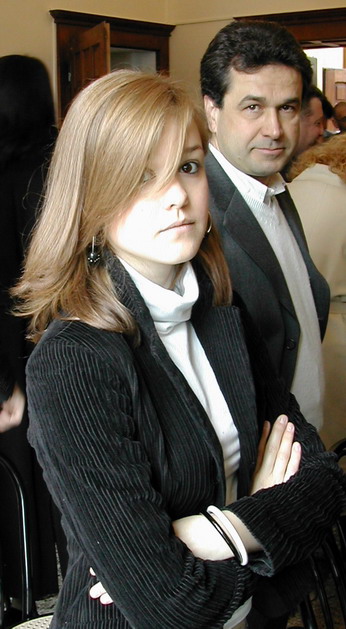
^ top: Ross & Enrico – dressed for a wedding, I admit

Foreign travelers to Italy sometimes ask how to to dress so as not to look out of place among the fashionable Italians. This question is hard to answer; much depends on your sex, age, and personal style.

It’s easiest to start with some fashion don’ts:

  • No track suits, sweat suits, or the like, and no baggy sweatshirts. Well, really, no baggy anything.
  • No fanny packs.
  • No daypacks or backpacks, unless you’re in your 20s or younger.
  • No clunky white sports shoes. Younger Italians do wear sports shoes, even when not doing sports, but these are usually sleek and stylish models (including some brands very familiar to Americans), and are never dirty or scuffed or worn down.
  • No t-shirts, especially not with big pictures or slogans on them, again, unless you’re under 30.
  • No shorts, especially not for men.

Now some do’s:

  • In general, Italians dress more formally than Americans. Blue jeans are fine, as long as they are well-fitting, clean, and in good condition (or any damage is intentional and fashionable) – Levis are very trendy and even expensive in Italy.
  • Men, always wear collared shirts (polos are okay).
  • Wear dark or subdued colors, except in summer. Even then, Italians wear white or pastels, not the bright purples and blues that many Americans like.
  • As a tourist you’ll be walking a lot, so I do recommend very comfortable shoes, even though this seems never to be a consideration for Italians, at least not for women, who routinely walk all over town with things on their feet that I couldn’t even stand up in.
  • Designer labels are always a plus.

Of course, how you dress is always entirely up to you, and no one is going to jeer at you even if you commit every single one of the fashion “sins” listed above. The question I’m responding to came from people who wanted to know how to fit in, and that’s what I’ve done my best to answer, with some expert advice from my Milan-raised, extremely stylish, teenage daughter. (I admit I cheated – in the photo above, my daughter and husband are dressed for a wedding!)

Travelling by Train in Italy

Finding Your Train

In every station in Italy there are posters (printed on yellow paper) of the usual schedules for Partenze (Departures) for that station. Find the time and train you are taking, and the column furthest to the right will show the platform (binario) that that train USUALLY departs from. 99% of the time it will in fact use that platform, unless some other train being late throws things off.

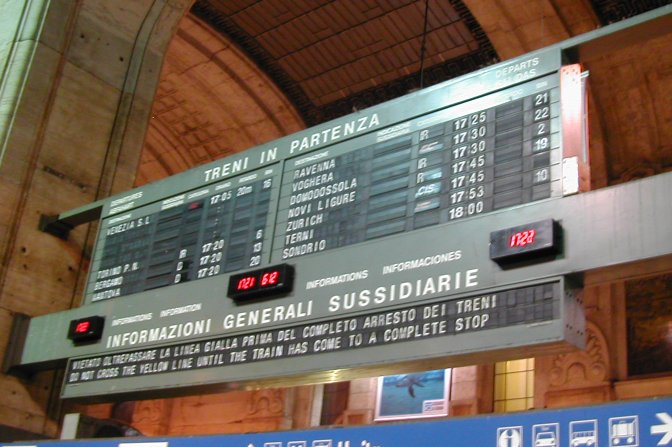
That’s why you need to also keep an eye on the electronic departures board, usually large and centrally located (shown is a departures board at Milan’s Central Station). Most of the time, if there is a change of track, it will be to a track near the usual one, so if you position yourself near the usual track but where you can still see the board, you’ll be in plenty of time to move to the new track.

In larger stations, there is also a rolling display and/or a TV screen at the head of the track which will update as soon as new info for that track is posted.

And don’t be afraid to ask – even the Italians are left wondering sometimes, so you won’t look any stupider than anybody else.

If you are going to the station to meet somebody, look for the analogous Arrivi(Arrivals) poster, printed on white paper. There is also an electronic Arrivals board updated in real-time. Both arrivals and departures are usually announced via loudspeaker as well, but these can be hard to understand in the bustle of a busy station.

Don’t Forget to Stamp Your Ticket!

No matter what kind of ticket you have, you must stamp it before getting on the train. Look for a little yellow machine like this one, positioned at the head of or alongside the track, as you enter the station, and usually in any underpass tunnels in the station.

If you forget to stamp the ticket or can’t find a machine that works (this happens), as soon as you get on the train, look for the conductor (at the beginning of the journey, they’re usually in the first car) and explain the situation; he will hand stamp it for you. 

The Italian Holiday Season Begins

The Christmas season is upon us; here in Lecco, holiday lights are already up over some of the main streets, though they have not yet been lit, and shopkeepers are busy decorating. At least Italian merchants aren’t quite as overeager as some others. In the US, some Christmas displays go up right after Halloween. When I was in England in early October, one department store (John Lewis) already had Christmas decorations up!

The run-up to Christmas is the only time when it’s almost as easy to shop in Italy as it is in the US. Stores, especially big ones, are open on Sundays starting next weekend; Sunday openings are a rarity at other times of year, though they are becoming more common with suburban “big box” stores. As we get closer to Christmas, shops will also stay open later, to around 10 pm.

Most small shops are owned by individuals or families, and I’ve always wondered when they get their holiday shopping done, since they are open seven days a week from late November through December 24th. They must be more organized than they expect us to be, and get it all done beforehand. In the last two or three weeks before Christmas, even food stores are open on Sundays. This would seem unnecessary, except for the last Sunday before Christmas when everyone is preparing for a feast. But there is a reason: one fine Italian Christmas tradition is gift baskets of food and wine, generally sent to professional acquaintances or employees, and sometimes to teachers. Enrico’s parents, both well-loved professors at the University of Rome, used to receive amazing baskets every year of fruit, nuts, wine, and Christmas sweets. I eagerly await the day when Enrico’s students take up this habit!

tell us about your winter travel experiences in Italy

Winter Holidays: A Good Time to Visit Italy

While many people dream of Italy, it seems that most can’t picture it outside the summer season. I’ve seen messages on the Lonely Planet boards asking: “Is it worthwhile to even go to Italy in winter?”

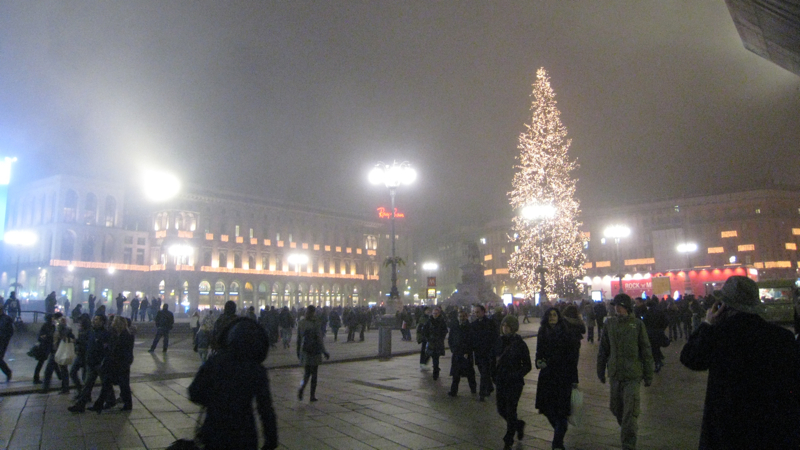
Well, yes, it is, especially around the Christmas season. As elsewhere in the Christian world, this is Italy’s biggest holiday. In the days before Christmas, shops will be open late at night, decorated in gold and silver, red and white, with lights everywhere, and the sidewalks are literally red-carpeted. There are concerts and events, street fairs and markets, and everyone is cheerful, perhaps because for once we’re all thinking about other people (i.e., what to get them for presents).

You probably don’t want to be on the road, though. Extended families travel to be together for the holiday. It’s rare for anyone to go elsewhere on vacation at Christmas; the proverb says: “Natale con i tuoi, Pasqua dove vuoi.” (“Christmas with your parents, Easter where you like.”) Millions of people travel by car (all those presents to carry!), so holiday highway traffic in Italy is horrible in the days just before Christmas and for the re-entry around the Epiphany.
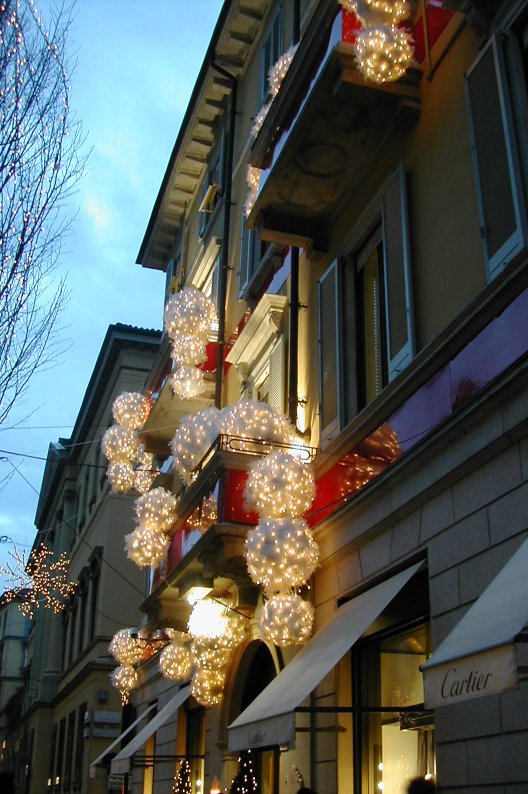
Cartier - Milan
Shops are open until late on Christmas Eve, then everything shuts down for Christmas day. Except bars – you can always get coffee in Italy. Shops are also all closed on December 26th, the festa di Santo Stefano, but restaurants and at least some tourist sites are open, because that’s the day when families traditionally go on a gita (a daytrip) together. The weather usually cooperates, too. Again, lots of traffic.

From the 27th to the 31st, most shops run normal schedules. Shop windows of all kinds are suddenly full of red underwear, because wearing red underwear on New Year’s eve brings good luck for the new year. Plebeian cotton or sexy silk: doesn’t matter, as long as it’s red. I’m not sure whether it’s also required to be new, but undoubtedly the shopkeepers would tell me that it is!

New Year’s is party time, often in large gatherings of friends or, if you’ve gone off skiing or something, in paid large parties at hotels, restaurants, etc. An Italian New Year’s Eve party usually involves talking, dancing, drinking (though rarely to excess), and continuous eating, with a big feast after the stroke of midnight. This feast always includes lentils because, the more lentils you eat, the more money you will earn in the new year.

Another holiday tradition in Italy is gambling. This is about the only time of year that I see Italian families play cards or table games. The traditional games are mercante in fiera (“The merchant at the fair,” a card game about trading for goods), briscola (another card game), and tombola (bingo), all usually played for small sums of money.

For a big party one year, our friend Sandro created a quiz-show style game with questions in categories (history, sports, etc.), played in teams of four. Because he’s an ex-seminarian, one of Sandro’s categories was “religion.” Enrico and I are both unrepentant and unconverted survivors of religious schools. Much to our surprise, we won the whole game. We didn’t know anything about sports, but we were the only ones who could answer anything in the religion category (even though everyone else in the room would probably have claimed to be Catholic, if asked).

Everything is closed again on January 1st, and more or less back to normal on the 2nd. Then closed again on the 6th, the Feast of the Epiphany, the day that the magi arrived in Bethlehem bearing gifts. In Italian tradition, the Befana, a witchy-looking old crone, brings presents to the good kids and carbone (coal) to the bad ones. That is why you’ll see shops and stalls selling witches alongside Santa Clauses (an import) and lumps of black sugar “carbone.” These days, the Befana is an excuse for kids to extort yet more presents from everybody. Perhaps this is forgivable, since the Epiphany is the end of the holiday season; school starts again on the 7th.