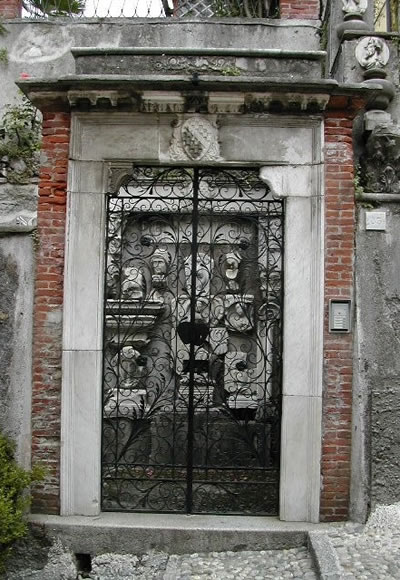
For more information, see the website of the Castello di Vezio.
photo gallery Castello di Vezio

For more information, see the website of the Castello di Vezio.
photo gallery Castello di Vezio
The Italian government (just before it fell) launched with great fanfare italia.it, the country’s new tourism portal, along with a logo which:
As for the website… oh, dear god. They reportedly spent 45 MILLION euros for a site that lacks basic features (such as an RSS feed) that we have come to expect from a modern website. It has technical problems which anyone in Italy who knows anything about the web (and that’s a lot of us) is gleefully (and ruefully – our tax euros wasted!) tearing to bits.
Given my own skills and biases, what I first noticed was the English translation. Here’s a sample paragraph which I did not have to look hard to find:
For having more precise vision click on “+”: in this way it will be visualized an historical period in the detail.
For having, instead, one vision of entirety click on “-” and the period will be visualized a large historical period contain more events. The period comes shown in the Timeline to the right of the zoom: the blue bar will increase or decrease the dimension based on your choice.
This kind of laughably bad translation, like the manuals we so often see with Chinese electronics, gives the consumer no reassurance that there is anyone competent standing behind the product (the product, in this case, being Italy).
^ Someone else in need of a good translation service. The title on this clip in YouTube is "Rutelli inglese maccheronico" – Rutelli’s maccaronic English. Maccheronico (maccaroni-like) is the term Italians themselves use for heavily Italianized English (or other language).
Until a few weeks ago, I might have said that my Italian was good enough that I could translate an English text into decent Italian – not quickly, but I could do it, in fact had been asked to do it several times at the office (we have an office full of Italians, why ask me?).
Then we put this supposed skill of mine to the test. Ross is applying to attend Woodstock School next year. The application form includes recommendations to be done by various teachers and other people at her current school, none of whom (except the English teacher) reads or writes comfortably in English. So the form needed to be translated into Italian.
I took a first cut at it, and thought I had done a reasonably creditable job. Then Ross took it in hand, and came out with something completely different. I realized that my translation had been understandable, and grammatically fairly correct, but probably about as funny to a native Italian speaker as the text above is to a native English speaker.
Around the same time, Antonio, one of the delightful people I met at barCamp Roma, commented about me on his blog: Cavolo l’ho sentita zittire e mettere in riga decine di uomini con un italiano corretto, ma inglesissimo! – "Cavolo! I heard her shut up and straighten out dozens of men in very correct – but very English – Italian." Okay, I’m slightly embarassed about the shutting up and straightening out (not exactly my intention, but definitely my character). But the very correct and very English Italian… hmm.
I stand before you now, chastened and humbled: my Italian is good, but I sure as hell don’t speak or write like a native.
And this is a lesson that many Italians have yet to learn. Just because you can read and understand another language well, and maybe even translate well from that into your mother tongue, does not mean that you can translate in the other direction with comparable competence. If you need a text to sound professional and persuasive, leave it to an expert.
So… I’m looking for someone to translate my resumé into Italian…
Bellagio, Lake Como’s best-known tourist destination, lies at the tip of the triangle between the two southern branches of the lake. You can get there by road or get there by boat from Menaggio or Varenna.
Personally, I find Bellagio a bit overrated. During the season it’s overrun with tourists, and the shops are accordingly filled with overpriced souvenirs, most of which have nothing to do with the region (okay, I’m a souvenir snob – I only want something that authentically represents the place).
I concede that the views are stunning – but there are views at least equally stunning from other points on the lake.
But I end up in Bellagio a lot whether I want to or not, because our foreign visitors usually want to see it. My favorite way, during the summer, is to take the slow boat from Lecco.
Bellagio’s charm, for me, is in its verticals – everything runs uphill from the lakefront. (Which means that, to really appreciate it, you must be prepared to walk.)Above is a view up Bellagio’s main salita, with the (justly) famous Bilacus restaurant on the right. Below is a shop whose sign I’m fond of – I love the antique typography you can still find on many shop signs in Italy.

On a sunny Sunday in January, we drove up to the triangolo Lariano – the peninsula jutting into y-shaped Lake Como, whose tip is Bellagio. It’s an area famous in Italian bike racing history (there’s even a church dedicated to cycling, with relics of famous racers – including their bikes) As we drove, part of the road was stencilled with Muro di Sormano, over and over again. We had never heard of this, and thought it must refer to some ancient ruin of a Roman or medieval wall.
After lunch at the top of the hill in Colma, we noticed a tourism signpost for “Muro di Sormano – 2 km” with an estimated walking time of two hours. This seemed like a lot of time to cover two kilometers. So we started walking down the very steep slope of a newly-paved road, which was painted with altitude markers and stencils of local plants, and viewing spots where you could look out and identify the mountain peaks all around. More mysterious were the large quotations from Italian cyclists, painted on the ground so as to be read from the bottom up.
We ran into a local couple who were happy to tell us all about it. I love hearing stories from people like this, who have been in a place forever and known every inch of it for decades. Myself, I have a breadth of knowledge about many parts of the world, but I will never have the depth of knowledge that comes with being deeply, permanently rooted in your native soil. I’m not sure I would trade, but I do enjoy seeing the other side.
As they explained, the “wall” of Sormano is the road itself. It used to be part of the Giro di Lombardia (and maybe the Giro d’Italia). Because of its steep grade, the cyclists perceived it as a wall. Which doesn’t appear to have stopped them – in one part of the video you can see what are apparently the record times for covering this damn-near-vertical distance.
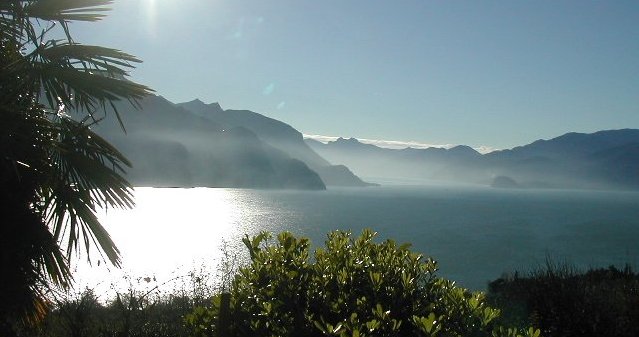
^ above: View from the central western shore, above and north of Menaggio. Want to enjoy this view during your Italian vacation? You can rent the place where I took this photo
Lake Como, shaped like an upside-down Y, is easily reached from Milan by car or train. You can take the train to Lecco (on the eastern tip of the Y), Como (on the western tip), or Varenna (on the east side of the center of the lake, opposite Bellagio in the crotch of the Y). From any of these places you can take commuter boats all over the lake. Go here for video of the ferry ride.
Some places to visit on and near Lake Como:
My videos of Lake Como: