Category Archives: Italy

Castelli: Traditional Ceramics from the Hills of Abruzzo

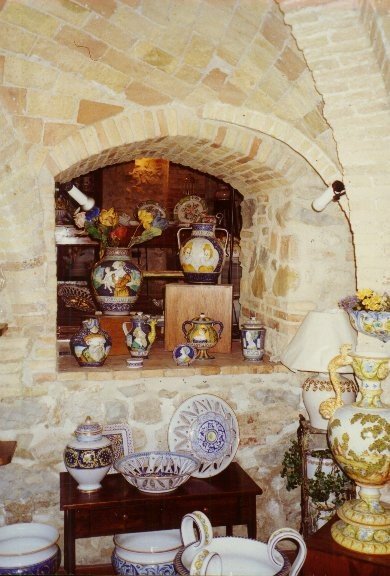
Castelli is a small town in the hills of Abruzzo (the region on the east coast of central Italy, on the Adriatic sea), famous for its hand-painted ceramics – a centuries-old tradition in the area thanks to its local deposits of clay.

You start to see shops along the road kilometers before you get there, and the town is full of shops with wares ranging from the cheap and tacky to ornate, elegant, and expensive.

The traditional designs are rich floral themes, landscapes, portraits, and animals. The people and animals are mostly copied from/inspired by San Donato, a tiny church on the outskirts of Castelli whose ceiling is entirely covered with thick, decorated ceramic “bricks”, created centuries ago as votive offerings by local families.
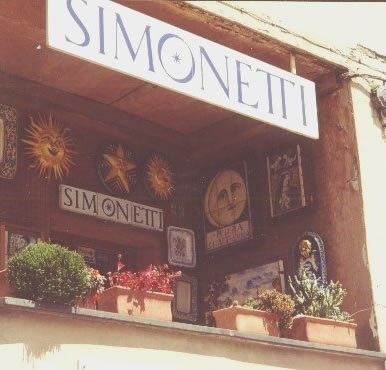
Simonetti ceramics shop, Castelli, Abruzzo, Italy

Those traditional designs are very busy, so if you prefer simple dinnerware, the Castelli style is not for you. The more elaborate pieces are better suited to hanging up as art than eating from. They are also fragile: after some years, the glaze on my serving bowl cracked when I put hot pasta sauce into it! (I still use it for salads.)

A few artisans are breaking with tradition and trying innovative, modern designs, but, at the time we visited, we didn’t see anything terribly exciting in this vein.

After extensive searching, we found a couple of simple pieces to “match” our eclectic collection of china. Then, having done enough shopping to work up an appetite, we decided it was time for lunch.

Tip: Although it’s almost impossible to eat badly in Italy, you can eat really well by asking local people for recommendations. Avoid the places advertising “tourist menus.” The food there will likely be cheap and decent, but, in Italy, you can do a lot better than decent!

We asked a shop owner to recommend a place. She sent us to Ristorante Tortella, where, she said, the Castellani themselves go when they eat out.
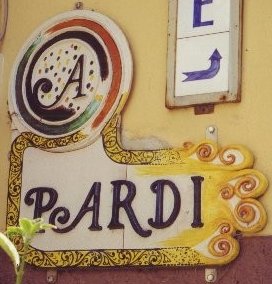
sign for Pardi ceramics shop, Castelli, Abruzzo, Italy

Lunch was indeed excellent: samples of several kinds of pasta, including maltagliati (“badly cut” – sheets of homemade pasta sliced into long triangles and rhomboids) with spinach and herbs; followed by grilled local lamb, washed down with a cheap but good local vintage of Montepulciano d’Abruzzo.

Tip: Wherever and whenever you travel in Italy, eat the local and seasonal specialties; these are almost always the tastiest items on the menu.
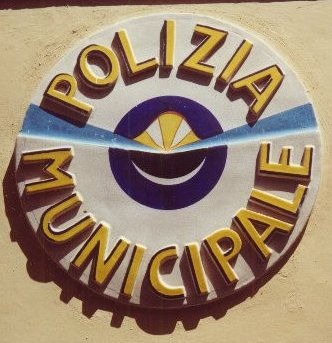
ceramic police sign, Castelli, Abruzzo, Italy

Reflections on Machismo: “Fierce Invalids Home from Hot Climates”

Tom Robbins has long been one of my favorite authors; every one of his seven novels is a gem, infused with his uniquely loopy sensibility and style. This novel (Amazon UK | US), published in May, 2000, was eerily timely in its discussion of West vs. East and Muslim vs. Christian, in the context of a story about a renegade CIA agent, an Amazonian curse, the third prophecy of Fatima, and a band of excommunicated nuns in the Syrian desert. Among many other things, Robbins glances at a topic which has long puzzled me:

“…the sexual insecurities that among men of the Middle East achieved titanic, even earth-changing proportions; insecurities that had spawned veils, shaven heads, clitoridectomies, house arrest, segregation, macho posturing, and three major religions.”

Many of the world’s cultures and religions focus to an amazing degree on controlling women, and especially women’s sexuality. (As Robbins points out, it’s a global phenomenon: “The Levant had no monopoly on penile insecurity.”) It is true that much of this nastiness is enforced by women themselves upon their daughters unto the nth generation, but it’s all intended to “benefit” the men.

For example, the “logic” behind clitoridectomy is that, if a woman can’t enjoy sex, she won’t go looking for it outside of marriage. Less brutal methods for ensuring fidelity include covering her up so no one sees her, and and locking her up so she never gets the chance. In many cultures, the punishments for a woman’s infidelity (or even imagined infidelity) are far more severe than for men: death by stoning, murder by the husband and his family, or societally-condoned mutilation.

I guess these men are all afraid that they just aren’t man enough to keep their women satisfied.

Italy has a reputation (in America, at least) as having a “macho” culture, but this doesn’t work the way macho does in other places. Most Italian men would rather prove their virility by seduction than by force. Every now and then some silly pollster does a Europe-wide or worldwide survey on “who’s the best at…” Italians are generally rated the best lovers, a result widely reported in the Italian press. ; )

I’ve met a young Irish woman working in Milan as an au pair. Recently she and three friends were out drinking at a bar. One was mildly propositioned by a man, whom she turned down. Later, apparently, something was slipped into their drinks. The woman who had been propositioned has confused memories of winding up somewhere with the guy, with her pants off, but when she said “No,” he desisted. She and another of the women then slept all weekend, leading them to believe they had been drugged. When they confronted the man a few days later, he looked guilty, but pointed out that they couldn’t prove anything.

I’d never heard of this “date rape drug,” though it’s apparently well known elsewhere, and a fairly common danger in some parts of the world. The Irish woman told me that, home in Ireland, she would never touch a drink in a pub or disco unless she’s seen it poured and picked it up from the bar herself.

I told the story to some Italian women, and they agreed that this is a highly unusual event in Italy. The reason they gave was an insight into the culture: “No Italian man would want to go to bed with a woman unless he’d earned her.”

Pope-O-Vision

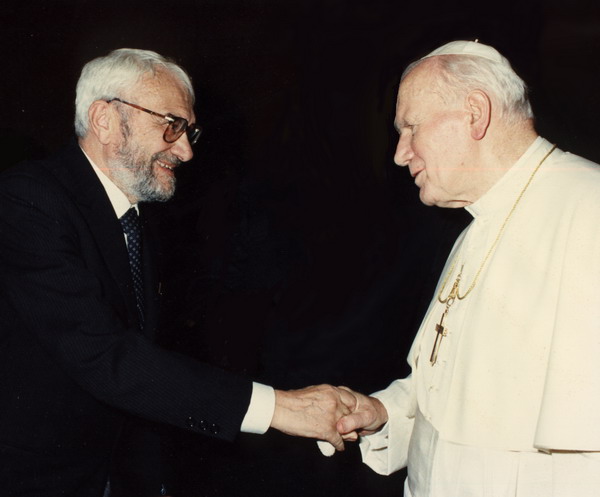
As popes go, John Paul II is certainly one of the best there’s ever been: he is truly upright and deeply religious, and he has tried to use his position to be a force for good in the world. I respect that, even though I’m not Catholic and don’t agree with everything he says.

But in Italy (as I often joke) we don’t have television, we have Pope-o-vision. Every day the news wires and TV report what the Pope is doing, or what he has to say about the global crisis or disaster of the day. But what he says is usually so predictable! Of course he’s going to pray for peace between the warring factions, for international understanding, for aid to the afflicted, etc. While kind and worthy, this is hardly news: he’s the Pope – what else would we expect him to say?

Occasionally he does come out with something surprising. For example: In Italy, many couples split up without officially filing for divorce (because it’s a huge, expensive hassle), and often the ex-partners end up living and even having children with someone new. The Pope declared that it was all right for these de facto new couples to take communion – as long as they weren’t actually having sex.

The Italian media’s obsession with the Pope is baffling, because so few Italians today are devoutly practicing Catholics. Evidence: The vast majority of Italians are nominally Catholic, and the Church does not believe in “unnatural” forms of birth control, yet Italy has one of the world’s lowest birthrates. (Followed closely by that other very Catholic country, Spain.)

Italy’s shift to secularity is recent. Divorce became legal only in 1970, in a parliamentary decision which the Vatican attempted to overturn by a national referendum in 1974. To the shock of the Church, 60% of the Italian people voted in favor of keeping divorce legal. Similarly, and even more strikingly, a 1978 law making abortion legal was brought to referendum in 1981, and again the Church and its political friends failed: the right to abortion was sustained by 68% of Italians. Since then, abortion has never been a serious political issue in Italy.

Returning to my original topic: My irreverence towards the Church (and indeed all religious institutions) is partly my own, but I’ve also absorbed it from the Italians, many of whom, in spite of their media’s obsessions, don’t take Catholicism as an institution very seriously. They’ve had a ringside seat on the Vatican’s activities for most of 2000 years, and they know how little the Church-with-a-capital-C has had to do with religion for much of that time.

Campo Imperatore – Home of the Spaghetti Western

boss stallion

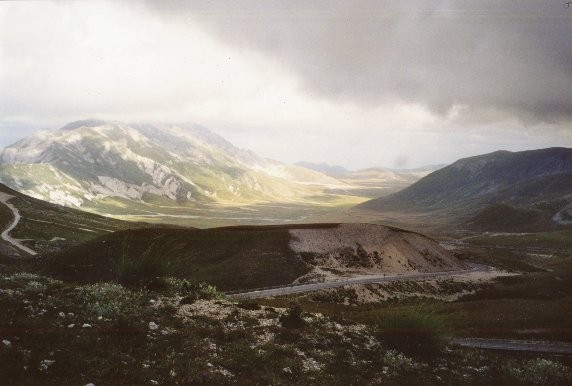
Looks kinda like Montana, doesn’t it? As a matter of fact, many “Spaghetti Westerns” were filmed here. The scenery comes complete with cattle, horses, and sheep, brought here to graze during the warm months.

Campo Imperatore

The latest movie to be filmed in Campo Imperatore is White Hell (Inferno Bianco), a low-budget horror Western, available on YouTube.

English Not Spoken Here

At least not very well. English is taught in Italian schools from third grade on, but most people who want to learn it properly take courses outside of school and try to do a study tour in the UK or US as well.

Still, things are changing…

When I first arrived in Italy 10 years ago, all film titles were translated into Italian, with sometimes peculiar results. The first James Bond film, known in English as “Dr. No” was translated as “Licenza di Uccidere” (License to Kill). So the film distributors presumably found themselves in difficulties many years later when the English-titled License to Kill (with Timothy Dalton) was released (but I wasn’t in Italy at the time, so I don’t know what they did about that).

Almost all films are still dubbed into Italian; in Milan, you can see English-language films only in selected cinemas on certain nights of the week (one film per week). Personally I find this annoying – I like to hear the original voices. But they do it extraordinarily well. The same doppiatori (dubbing actors) tend to dub the same actors year after year, film after film, and some of them are prodigiously good – especially the guy who does Woody Allen – sounds just like him, if Woody Allen spoke Italian that well (for all I know, he may – he spends a lot of time in Venice).

What’s annoying, however, is the insistence on dubbing even the songs in musicals – it’s very difficult to translate a song so that it maintains the meter and rhyme scheme of the original, especially when it also has to maintain exact meaning in places where a song is accompanied by action. So most of these translations are abject failures.

Fortunately, this is no longer done for the few non-animated musicals that Hollywood still produces; Evita was entirely subtitled. But it’s done to all cartoon musicals, presumably because kids aren’t expected to be able to follow subtitles. So, much as I love Disney movies, I either see them in an English-speaking country, or wait til I can get them on DVD.

Dec 3, 2003

Since I wrote the above, I’ve grown less tolerant of dubbing. Perhaps I’m spoiled now by the greater availability of English-language films: at my local Blockbuster, via Amazon, via cable TV (if we had it), and occasionally even at the cinema. The few times we have seen dubbed films at the cinema recently, I’ve found them hard to follow, although I have no difficulty following Italian film or TV. I suppose the difficulty of dubbing dialog that makes sense and suits the mouth movements in the original language makes for some occasionally convoluted phrasing that is simply harder to understand. And, some of the time, half of my brain is busy wondering what the original line in English was, which distracts me from the next line.

There is a growing tendency, in Milan at least, to show some big movies in English for a week or so, I suppose for the benefit of a fairly large non-local audience. We can be confident that The Return of the King will be shown in English somewhere that we can get to it. However, it is opening in Italy far later than anywhere else in the world ­ late January! Augh!