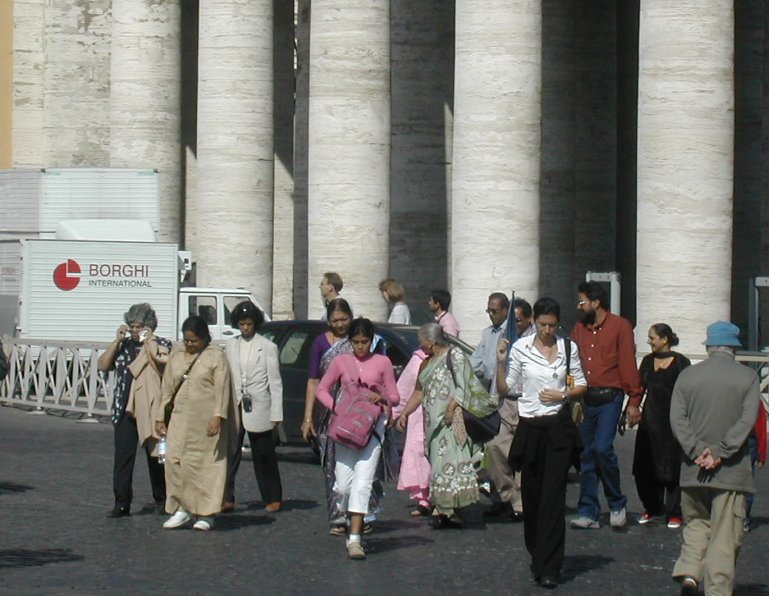
top: a family of Indian tourists at St. Peter’s in Rome
My India travel vlog, from the trip I took with my daughter this summer, is still in progress. There’s more video to edit, more photos (by Ross) to add, and, most of all, more thoughts to share.
What struck me throughout the trip, but especially in Mumbai, was the ferment of growth and change. The atmosphere reminded me of Silicon Valley five years ago: everyone feels that they have a chance to be part of something exciting and rewarding.
My Indian friends and classmates are doing well, which may not seem surprising – most of them came from the elite in the first place (otherwise they could not have afforded to attend Woodstock School). But they, too, have ridden the economic roller coaster over the last 20 years, and the fact that they’re heading up again now is thanks to talent and hard work at least as much as accidents of birth. It’s also thanks to the entrepreneurial energy unleashed in India since the economic reforms instituted in 1991 by then-finance minister (and now prime minister) Manmohan Singh.
India’s economy is growing at 6 to 7 % a year, and anyone who has been observing the country can see the effects. New roads are being built in the major cities, and new highways connecting them that I’m told are as good as American ones (haven’t seen for myself). Delhi is very proud of its rapidly-growing subway system – our travel company driver was eager for me to take a look, in spite of the fact that I was paying him to drive me around in a private car. Traffic is horrendous, but Delhi has cut pollution noticeably by requiring all public transport vehicles (buses, taxis, and scooter taxis) to run on CNG (compressed natural gas), and allowing heavy trucks into the city only late at night.
I don’t actually like Delhi, though; there’s something about its attitude that annoys me. Mumbai is another story. It’s a delightfully insane city, the largest I’ve yet been to (Tokyo, when I visited around 1971, was at the time the world’s most populous city, but I think it had around 8 million inhabitants then; Mumbai today has 15 million*). Yes, there are millions of people living in horrible slums; I did not see those, but I know they exist. What I did see was people living in mile after mile of roadside shacks built against walls and buildings.
Just another slum, you say? Yes, but… these shacks (called “hutments”) are two stories tall, made of plywood with solid wood frames, and roofed in corrugated tin or plastic sheeting. They have doors that can be locked, and many boast television sets inside (running on current pirated from the nearest electric wire) and satellite dishes on the roof. By the standards of the villages their inhabitants came from, this is cushy living. Shilpin explained to me that these people come from the countryside to take contract jobs in the insatiable Mumbai factories, or to earn a good living as day laborers. They leave their aged parents back in the village to protect the family land, and send money home for their upkeep.
The reason they don’t have proper housing is that real estate in Mumbai has become so expensive that no one can afford it. There have been two amnesties in which hut-dwellers were moved into city housing, and took on all the duties of citizenship such as paying taxes and electricity bills. However, there is so much demand to live in Mumbai that the hutments were immediately rebuilt and re-inhabited.
This is all indicative of India’s overall growth. People come to the cities to get jobs, which are plentiful (though not as plentiful as they could be – more economic and labor market reforms are needed), and fewer people are needed on the land as agriculture has become more productive..
It’s an exciting time to be in India, and Indians have much to be proud of. There are still enormous problems, to be sure, but there is also a sense that progress is being made and problems can eventually be solved.
And what of my other “country beginning with i”? Italy… is going nowhere. It experienced heady growth in the 1960s and 70s, culminating in the sorpasso in the early 1980s, when Italy’s economy was declared the world’s fifth largest, surpassing the UK. It’s been mostly downhill from there. Italy did well in skilled manufacturing when those jobs were still in the west, but is now becoming a rust belt of abandoned factories as globalization sweeps manufacturing jobs to the east. Like Americans, Italians bemoan the loss of their manufacturing jobs even as they rush to buy goods made cheaply in China.
The same shift in economic emphasis has happened in the US, of course, but the US as a nation has a broader skill set, so has been able to move up the value chain from manufacturing to services. Now that service jobs are also going overseas, the US can concentrate on R&D. A majority of the world’s scientists and engineers live and work in the US, although many of them were not born American. The next wave of growth will come from intellectual property, and the US will lead that wave (though this source of competitive advantage will also eventually be at risk from the growing pool of intellectual talent in India and China).
Italy (and most of the rest of Europe) is not well positioned to move up the value chain. Italy, in particular, is not supportive of research. As with so much else in Italy, university research centers are fiefdoms controlled by “barons” who give positions as patronage rather than on merit. Corporate R&D is almost non-existent (with notable exceptions such as Fiat, and, on a much smaller scale, the company I work for). Italian scientists and engineers mostly flee to the US if they want to get any serious work done.
Italy’s economy is hostage to entrenched and conflicting interests, with little hope that real and necessary reforms will be carried out by governments of the right or left. Though the need for such reforms is recognized by the Italian public, as I learned in a conversation on the airport shuttle bus the other day, with the bus driver and another passenger.
The passenger (a woman) has two daughters, one working in France and one seeking work in Germany – both having given up on finding decent jobs in Italy. One had been employed at Malpensa airport, doing customer service (in multiple languages), working shifts at 5 euros an hour, with no permanent contract nor any hope of one, nor any guaranteed minimum of hours. If we assume 40 hours of work per week, that’s only 800 euros a month – not enough to live on in or near Milan. No wonder she gave up after 16 months. “Something’s wrong here,” says her mother. “We slave to put them through school [both her daughters have university degrees], and they can’t find jobs in Italy.”
The bus driver looked in his 30s, and had “immigrated” long ago from Calabria in Italy’s deeply poor south. He’s had this steady job for several years and says the salary is good, but the work is demanding and often keeps him away from home. Home is a 40 square meter (430 sq ft) townhouse out in the country, 16 km from Bergamo, which cost him around 120,000 euros – a price he considered reasonable, since the place will be easily resellable when he is ready to move to something bigger (presumably when he decides to marry). Interestingly, he has no interest in returning to Calabria except for vacations – “life is different there, too slow. I’m used to life up here now.”
Both recognize that something is wrong with the pensions system. “Perhaps we promised too much before,” mused the driver.
Neither expects any of the current crop of politicians (left or right) to do much good.
As Beppe Severgnini says in The Economist‘s The World in 2006, “…the country must decide what it wants to be. It may opt to do nothing, and become an ageing, former manufacturing country, where local lobbies and special interests can gorge until the money runs out. Or Italy can become a welcoming service country, driven by design, tourism, and technology: an accessible land, easy to do business with, confident in its tolerance, creativity and flair.”
Unfortunately, I don’t hold out much hope that Italy is ready to make the big changes needed to attempt Severgnini’s Plan B. When I ask why things are the way they are (in any context), the response is usually a shrug and “It’s always been that way,” even when the person agrees that “the way it’s always been” isn’t necessarily good. As Severgnini puts it, “People are afraid of change.”
Italy can and probably will limp along, with the younger generations living off savings accumulated by their parents and grandparents. To be sure, they can still live a very nice life: sunny beaches in the summer and snowy slopes in winter, eating and drinking well, hanging out with friends they’ve known all their lives. There’s a lot to be said for that, and most of my daughter’s peers aspire to no more. They’ll settle for any job near home that allows them to go on living exactly the way they always have. (They’ll be lucky to find that job, however.)
Maybe it’s the American in me that says: “That isn’t enough. How can you stand to sit around and watch your country slide inexorably into poverty and oblivion? How can you spend your working life doing something you don’t even care about?”
If I was a typical Italian mother, I’d urge my daughter into whatever university course and profession seemed most likely to keep her close to home. Though I’m in no way a typical Italian mother, I adore Ross and would love to live near her for the rest of my life. But, for her own sake, unless something changes drastically, I hope she gets out before she stagnates along with the rest of Italy.
I Did It Again
Apparently, I should be working for the Economist – I publish the same thoughts, before they do. This week’s (Nov 24) edition contains a survey of Italy titled Addio, Dolce Vita, whose leader goes on to say: “For all its attractions, Italy is caught in a long, slow decline. Reversing it will take more courage than its present political leaders seem able to muster…”
Italy in Decline: Umberto Eco Joins the Chorus
Feb 5, 2006
Today’s Corriere della Sera carries an interview with Umberto Eco, whose new book, a collection of essays titled “A Passo di Gambero,” (“Walking Backwards”) debuts Wednesday.
“Guardi, l’Italia nei cinque anni appena trascorsi si è messa sulla strada del declino. Se andiamo avanti così diventiamo definitivamente un Paese da Terzo Mondo.”
“Look, Italy in the last five years has set itself on the road to decline. If this goes on, we will definitively become a Third World country.”
…Da caustico il tono diventa un po’ amareggiato quando il discorso si sposta sull’immagine dell’Italia all’estero: “Mi prende un senso di profonda umiliazione vedendomi fatto segno di tante manifestazioni di affettuoso cordoglio”.
…From caustic his tone becomes somewhat bitter when conversation turns to Italy’s image in the world: “I feel profoundly humiliated to be offered so many expressions of affectionate condolence.”
I’ll be buying the book.



 <
<
 <
<