Category Archives: living in the USA

Italian vs. American Diet

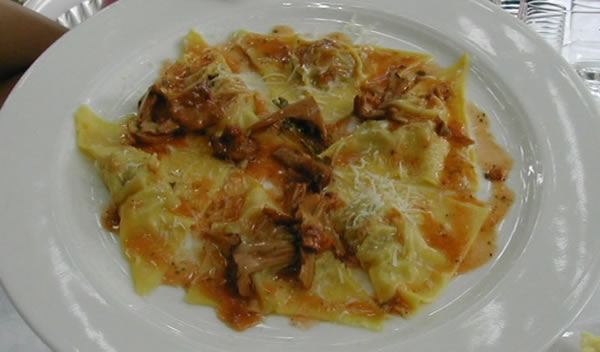
^ ravioli at Lanterna Verde – yum!

One of the most boring things in the world is listening to people talk about their diet (hearing them complain about their weight runs a close second). However, in America today there’s nothing to discuss, because everyone is on the Atkins diet (no carbohydrates, but you can eat as much of anything else as you want).

Food companies and advertisers have been swift to adapt. In the supermarket I saw “low-carbohydrate bread.” I did not read the label to learn how they accomplished this miracle; I had a feeling it would involve chemicals I’d never want to put into my body.

Magazine articles, books, and news items give alarming statistics about obesity, and offer ways to combat it, both in yourself and your children. It seems to me that maintaining a healthy weight is not rocket science, and doesn’t require a diet plan that you have to buy a whole book about, let alone pre-packaged diet meals with counted calories etc. etc. Didn’t we all learn the basics of nutrition in school, the four major food groups and all that? The major lesson I remember is that it never hurts to eat more fruit and vegetables, especially when those replace starches, fats, and sugars in your daily intake.

Perhaps what Americans really need is to revise their attitude towards food. Food seems to occupy two diametrically-opposed places in American consciousness. On the one hand, food is simply fuel – you shovel in whatever comes to hand, to keep you going. It’s this attitude that leads to families rarely eating together, as everyone is rushing off to their extra-curricular activities, grabbing whatever they can to eat along the way.

But food also has a psychological role. Cookbooks, menus, and people tout the concept of “comfort food,” which, when eaten, is supposed to make you feel secure or loved, perhaps by reminding you of your childhood. (Never mind that most of us never had this mythical comforting childhood or that kind of food with it.)

Comfort is a very dangerous role for food to play. You hear the same story over and over again: “I wasn’t overweight, but then I went through a rough patch and felt depressed. I turned to food for comfort, and became a blimp.” At the blimp stage, food is re-cast as the enemy, the secret sin, and the indulgent reward for good behavior (most often, diet-related good behavior: “I was good today, I only had salad for lunch, so I’m entitled to have a brownie now”).

The attitude towards food is one area where Italy really gets it right. This attitude is made explicit by the Slow Food movement, but I think is pervasive throughout Italian culture. In Italy, a meal is neither mere refueling nor comforting self-indulgence. It’s a time for a family to be together, to enjoy good food and each others’ company. It’s not something to be rushed through, neither in preparation nor in consumption. So dinner is eaten far later than in the US, usually around 8 pm. Meals are spread over at least two courses, which also slows you down. You have time to appreciate the food and wine, and to talk to each other. And there’s no rushing through the meal to watch TV afterwards. (I have never heard an Italian, not even a child, leave the table on that pretext.)

The Italian style of family meal has several beneficial side effects. On the nutritional side, everyone tends to eat a more balanced diet, in part because parents are at the table with their kids to ensure that they eat what’s good for them. Taking your time over a meal also ensures that you digest it better. And spending time together is good for families: you know what’s going on with each other.

Needless to say, the Atkins diet is not taking off in Italy, the home of pasta, risotto, polenta, and tasty, crusty bread. Thank god.


“Beautiful”

Ross’ stint at a summer camp in Minnesota (2003) gave her a chance to make comparative observations about US and Italian teen culture. She says that that Cristina Aguilera’s video for her new song Beautiful provokes quite different responses. The gist of the song (quoting the chorus) is: “You are beautiful, no matter what they say.” The video shows several people who might not be perceived by society – or might not perceive themselves – as beautiful: the “98 pound weakling” boy, the anorexic girl who’s convinced she’s fat, the gay men kissing, the man dressing in drag. The video is ultimately affirming: each of the characters rejects what society may think, and sees him- or herself as beautiful.

The reaction of Ross’ friends in Italy was “Eww, gross!” especially about the men kissing. But when she was in camp in Minnesota this summer, the American kids discussing the video there found it – beautiful. Beautiful

Medical Privacy

…One big aspect of Italy’s national health system that I forgot to mention previously: it’s available to EVERYBODY. There’s no nonsense like asking for insurance information while you’re bleeding in the emergency room (they do ask for your national health card, but if you don’t happen to have it on you, no one cares). And there’s no such thing as being uninsurable because of pre-existing conditions. You’re in the system and you get treated, period. Quite a few people not in the system, i.e. illegal immigrants, also get treated.

I met a guy once in Austin, Texas, who was undergoing an extremely expensive experimental treatment for multiple sclerosis. He could not change jobs, because that would force a change in insurer, and no new insurer would take him on, knowing they’d have to take on that expense. There is something very wrong with this picture. You can only be insured if you’re healthy?

This ties in with the privacy concerns that Brin addresses. Medical records stored in electronic format can be hacked into and viewed by people other than our doctors. One risk is that a company might decline to hire you after learning about an expensive medical condition that they wouldn’t want their insurance to have to cover. In America this is a legitimate fear; your career mobility and life could be ruined by leaked information. The answer to this is the Italian (and British, and Canadian, and…) one: a national health system, where you’re covered no matter what you’ve got.

Reflections on Brand and Homogeneity

My daughter’s school year ended in mid-June (with three intense weeks of tests, quizzes, and papers), and we left Milan almost immediately for a trip up the middle of the United States.

We started in Texas, where I have relatives, and pleasant memories from my days at the University of Texas (Austin). I love that part of the country. It’s not stunningly gorgeous, but has a quiet beauty that I find very peaceful. And, our current president notwithstanding, I like the people.

From Austin we flew to Tulsa, Oklahoma, where a dear friend of mine lives, then rented a car and drove to Lawrence, Kansas (high school friend) and then to Decorah, Iowa to visit my mother. We flew out of Minneapolis, staying with another high school friend and his family there on the way out.

I didn’t expect the drive to be particularly scenic, nor was it. What struck me was the sameness not only of the scenery (corn, corn, and more corn), but also of the signs. Everywhere you go it’s the same Wal-Mart, Dairy Queen, McDonald’s, etc.

In 1970, Alvin Toffler in Future Shock predicted that Americans would be increasingly mobile, moving from town to town in pursuit of jobs. One effect of this would be the “plug-in” society, where homes, shopping areas, and even social lives are designed for maximum sameness across the country, so that people could make these moves with minimum psychological impact.

Toffler was right: Americans move far more than anyone else in the world, and much of the country has achieved a dreary and disturbing sameness. I can understand the attraction of brands: you always know exactly what you’re getting, even if it’s not very good. McDonalds’ the world over have roughly the same menus, prices, and levels of cleanliness; there are no surprises. I guess that’s why even in Italy, a country famous for its food, McDonald’s is popular with tourists. Many people prefer a certainty of mediocrity to the risk that something might be worse (or better, or merely different!) than they expected.

So America is indeed a plug-in society, where you can travel or even move from one town to another, and never notice a difference. The same chain stores and restaurants will be present, with the same layouts, products, and menus; you never have to learn anything new, it is all comfortingly the same as what you just left.

I experienced this most strongly some years ago, during a whirlwind trip around various parts of the US. At some point I found myself in a shopping mall, thinking: “Here I am in front of a Banana Republic store in a mall. And I have no idea what city I’m in.” I had to stop and think about it for some very long seconds before I remembered where in the world I was.