Category Archives: opinion

Crawling to Conclusions

I mentioned that I was going to be on TV, part of the audience on the Italian political talk show L’Infedele hosted by Gad Lerner.

Lerner showed far more political bias than he had in the previous show I attended (partly about Microsoft, partly about taxes – two inevitabilities of modern life?). My friend David Callahan and I were flattered to be specially shown to seats in the second row, stage right, until we realized that they had put us on the side of the cattivi (bad guys), as Lerner jokingly remarked. I was seated behind Gianni de Michelis, a long-time bastion of the Italian Socialist Party (abundantly disgraced by the Clean Hands anti-corruption investigations years ago), who had been Italy’s foreign minister for years during his heyday. Staring at the back of his greasy head for hours was not particularly edifying, his political opinions even less so.

The topic of the evening had been changed from “George Bush and Iraq” to “Are we winning the war [on terrorism]?” More broadly, should the war in Iraq ever have been started and have we (the Coalition) won it? There were several videomontages of recent violent events, with disingenuous voiceover narration. And, as I had expected, Giuliana Sgrena took part, remotely from a studio in Rome.

Someone had told me she wasn’t likely to participate, as she hadn’t given any interviews since her disastrous exit from Iraq, and was still recovering from being shot by American troops at a blockade as she was being carried away from her kidnappers (the Italian secret service officer who had secured her release was killed outright). But there she was, and, after so long a silence, she had plenty to say. As did everyone else, though few said anything sensible or surprising. This, too, was disappointing. Lerner picks intelligent guests from both sides of his topics, but these two groups were each entrenched in their own positions, and nobody was listening to anybody else.

The show was being broadcast live, with commercial breaks every 20 minutes. As break time approached, a young producer would hold up a sign for all of us to see: 4 minuti. 2 minuti. 60 secondi. Pubblicita’. These were largely ignored by whoever had the floor at the time, in spite of Lerner’s efforts (more determined in some cases than others) to shut them up. We missed one break by at least 10 minutes. Even on a TV schedule, Italians will be Italians… The show ran overtime by about 15 minutes, as is common for many live shows in Italy. Tivo would have a hard time working correctly here.

The one distinguished guest I felt any sympathy with was Anna Prause, seated on the “good guys” side. She had gone to Iraq with the Red Cross, then was hired by the Iraqi government to help set up the new Ministry of Health. As the situation for foreigners in Iraq deteriorated, she was eventually advised to leave, advice which she took only reluctantly.

When she finally got the floor, she exploded, saying that, while things in Iraq are still bad, and more dangerous than they were before, things are also better in many ways that are not understood or mentioned by the press. She gave an example: one of her tasks for the Ministry of Health had been to set up a new headquarters, planning everything right down to office fixtures and furniture. A year ago, she could not get her Iraqi colleagues to make a decision on anything even as minor as the color of the office furniture. Not because they were stupid or had no opinions, but because they were accustomed to watching carefully to see what opinions they were supposed to have, so that they could parrot those back to their political masters.

A year on, they not only had opinions, but were very happy to argue about them. This, she said, demonstrated an important change for the better in everyday Iraqi life, in spite of the ongoing violence. Is security more important than liberty? That’s a fundamental question which almost every country faces today. Personally, I come down on the side of liberty, but I’d like to hear from Iraqis themselves how they feel about it.

That evening forced me to confront and clarify my own very mixed feelings about what’s going on Iraq and how it all went down.

I always knew (who didn’t?) that Saddam was very bad news for the world and especially for his own people. He was a monster, partly of American creation, so the US had some responsibility to clean him up. The sanctions imposed after the first Gulf War caused tremendous suffering among the Iraqi people, without adversely affecting their “leaders”. I have mentioned my schoolmate who was married to an Iraqi and lived in Baghdad -through two wars – until her death from cancer last year. When I met Shahnaz and Achmed in 1996, Achmed’s salary as a schoolteacher was 3000 dinars a month: just about enough to buy a pack of cigarettes. Of course they couldn’t survive on that; their extended family, like everyone else in Iraq, was scraping along by selling off valuables and assets, and getting poorer all the time.

Yet Saddam seemed to have accomplished a sort of brainwashing (not surprising – as absolute dictator, he controlled all the media). People didn’t like him but, as Shahnaz insisted, “In Iraq we have a saying: better the devil you know than the devil you don’t.”

Post facto, it’s clear that most Iraqis didn’t feel that way, and are relieved to have got rid of the devil they knew for so long. So I can’t regret that the US military went in and removed him. I am, however, furious at how Bush & Co. lied, cheated, and manipulated the American people into agreeing to this, and then managed it so badly. There are plenty of other reasons to be angry at the Bush administration, but on this issue I may come out feeling much as I did about Reagan: I hated his methods and attitudes, but must, however grudgingly, applaud some of his results.

Dec, 2006 – No, never mind. Removing Saddam was never worth what’s happening now.

The Death of Privacy

As you may have noticed, we’re on the verge of a video revolution. Videocameras are cheap, and many technology companies (including mine) are working hard to create products and systems that will make it easy for anyone to distribute video online. The ranks of videobloggers are swelling rapidly.

In the developed world, we are already under surveillance much of the day, by perfectly legal security cameras. We may also be photographed at any moment, with or without our knowledge, by any photo-capable cellphone camera. Or videotaped by anyone carrying a videocamera, some of which are now small enough to carry in a purse, and to casually conceal in the palm of your hand while shooting. Posting a photograph or short video to the Internet where the entire world can see it is only a few minutes’ work.

In other words: anything you do in public, and many occasions you may imagine to be private, could potentially be seen by the entire world. Get used to it, because there’s not a damn thing you can do to prevent it. Your life is now in the public domain.

The laws on privacy vs. the public’s right to know are unclear in most countries, not having been conceived for a world in which everyone is potentially a videojournalist (or paparazzo). Once a photograph or film has reached the Internet, it’s out of everyone’s control: anything sufficiently enticing or appealing, funny or appalling, is going to spread like a virus, and there won’t be anything the “victim” can do about it. Sue the originator, perhaps, assuming that he or she can be identified, but in most cases any lawsuit won would be at best a pyrrhic victory: you might get a few dollars, but the publicity surrounding such a case would only ensure the wider spread of the offending material.

Many humiliating photos and videos already circulate widely. A few humili-ees have become minor celebrities as a result (viz. Gary Brolsma); some will never live down their 15 minutes of “fame.” Undoubtedly some are emotionally scarred, and may even have suffered economic damage. From time to time we all do things, or have things happen to us, that we’d rather no one ever saw, but nowadays the chances are good that, sooner or later, someone will.

This can, of course, be a good thing. The photos of Abu Ghraib surfaced because someone was appalled by what was going on. Light was shed on some very murky corners of American policy, things the American government was (and probably still is) doing that we should all be aware and ashamed of. Releasing those photos to the Internet was someone’s act of whistle-blowing, and we should all be glad that they did it.

As David Brin predicted years ago in The Transparent Society, turning the cameras on authority helps keep authority in line. Cases are now coming to trial of protestors who were arrested during last year’s Republican National Convention in New York city. In one case, the police claimed that the accused had resisted arrest and had to be physically dragged away, and they had video apparently proving this. Several amateur videos of the same scene showed the man peacefully walking away with the police. The police then claimed that their tape had been “inadvertently” edited. Oops. Case dismissed.

So I don’t want the cameras turned off. If the tradeoff is my privacy vs. my right to know what authorities and others in power are doing, I can live with less privacy. Sooner or later, someone will post a picture of me picking my nose on the Internet for all to see. I may be embarassed, even humiliated, but basically I have nothing to hide.

Which is, in the end, the real solution: lead a blameless life. That is, don’t do anything you’d be ashamed to have your neighbors know (life’s too short for shame anyway), or could get into trouble for if the law found out.

I guess your response to this depends on whether you believe that any publicly-available information could be used against you by a totalitarian government. Citizens of China and some other countries currently have good reason to worry. Some Americans also believe that they may, someday, need to take up arms again against a repressive government. Or at least dump some tea in Boston Harbor. More optimistic types like myself believe that truly free information will eventually help to topple the nasties.

Even the oppressive government of China is beginning to feel the power of bloggers with cameras. In a recent New York Times op-ed column, Nicholas D Kristof “says collision between Internet and Chinese authorities is one of grand wrestling matches of history; notes there are four million blogs in China, and 100 million Chinese now surf the Web; says when sites are banned, Chinese get around them with proxy servers; says some sites publish investigative reports of official wrongdoing; says Internet is playing watchdog role in China that press plays in West; says Chinese leadership itself is digging Communist Party’s grave, by giving Chinese people broadband.”

Whatever we believe about the pros or cons, this is one area where technology is steamrolling over law and custom. Privacy is effectively dead. Long live transparency!

The Hundred Years’ War

The Strange Religious History of the Straughans

shot Mar 6, 2005, 7:29 mins

Some of my recent articles have caused some readers to wonder why I have it in for Catholicism. Actually, I am even-handed in my dislike of religion: I don’t like any of them. But, due to family history, I have un dente avvelenato in particular for Catholicism, and for the American Southern Baptist church. My father’s mother was a devout Catholic, my grandfather a born-again Baptist. Why they married in the first place was never clear to me, but the decades-long war that ensued left the rest of the family with an unpleasant taste in the mouth about both their religions (none of their descendants is now Catholic OR Baptist).

While I was visiting my dad in England in March, we started what will doubtless be a very long project: getting his life, and all his stories, on video. One of my questions was: “Why did Mamaw and Pawpaw get married?” Here are his thoughts on that, and on what happened afterwards.

An Unholy Alliance: American Conservatives and the Vatican

I have had it up to here with the media frenzy over the Papal death-and-succession, and can only be relieved that the Conclave only lasted two days (to the disappointment of news crews, no doubt – hang around in Rome and wait for a chimney to smoke? Tough job.)

Though I’m glad it’s over, I’m not at all happy with the results of this “election” – in which only 110 or so of the world’s one billion Catholics had a vote, and women were completely disenfranchised. Catholicism is definitely not for me but, out of respect for my many Catholic friends (some of whom read this newsletter), I will leave that topic alone. I’d only start foaming at the mouth anyway…

I’m not Catholic, so what any Pope says or does shouldn’t matter to me anyway, right? Well, as Richard Cohen of The Washington Post points out, it’s not only Catholics who are affected by Catholic dogma:

“…There are other areas… where John Paul II’s teachings affected non-Catholics. I am referring now to his implacable opposition to birth control – not just abortion, mind you, but the mere use of condoms…

It is the underdeveloped world where birth control is most needed. It is there, where medical services are the most meager, that the AIDS pandemic poses its greatest threat and where condom use is the cheapest and most effective preventative measure. The pope counseled abstinence, a wholly unrealistic piece of advice…” (Indeed, if abstinence was easy for the average human being to achieve, the Catholic Church might not face the severe shortage of priests that it currently does.)

Opposition to birth control is also a Bush administration policy with devastating effects on non-Americans: the US government refuses to fund development agencies or projects where family planning includes so much as a mention of abortion, in spite of the fact that abortion is legal in America. Where American conservatives cannot impose their will by law in America, they are doing it by budget policy in other countries. Catholic dogma lends “moral” support to this stance, and Ratzinger, like Wojtyla before him, will no doubt continue to do so very vocally.

Ratzinger’s virulent anti-gay stance will also reinforce American conservatives in their homophobia. However, the Church’s opposition to the death penalty (and the Iraq war) will be conveniently ignored. Politics and religion make strange bedfellows.

The Papal Funeral Bash

I’m not going to say much about this; I wasn’t there, and ignored it as far as possible. The only footage I actually watched was on the Daily Show. But I do have a few items:

Early last week, I was riding the bus down to Lecco, at my usual time when it’s full of schoolkids. One girl was on her cellphone. “She only goes to mass ogni morte di papa!” she exclaimed, completely without irony, –nd now she wants to go to the funeral!”

Indeed, many of the Italians who traveled to Rome for the funeral probably don’t go regularly to Mass. I won’t presume to comment on why they went to the Pope’s funeral, except that Ross told me that some of her peers came back with cellphone photos of themselves drinking Limoncello (a strong lemon liqueur) in Piazza San Pietro.

I do know a number of serious Catholics – those who truly believe and practice Christianity, e.g., doing volunteer work. Interestingly, none of them went to Rome, and all were nonplussed by the outpouring of whatever this was, and disconcerted by the yells of “Santo subito!” (“Make him a saint immediately!”) As far as I know, it’s not in the church canons to saint somebody just because he was popular.

Rome rose magnificently to the occasion, managing to keep things in order and take care of the crush of people. Every cellphone in Italy received messages from the Protezione Civile (“Civil Protection” – the government emergency-response organization). The first read: “If you go to Rome to pay homage to the Pope, use mass transit and be prepared for organized but very long lines. Hot by day and cool at night. For information, listen to Isoradio [public information radio, mostly used for traffic warnings] 103.3.”

The second message said: “Due to enormous turnout, from Wednesday at 10 pm access is closed to the lines to salute the Pope. Friday for the funeral traffic will be stopped in Rome. The area of San Pietro is full. Large screens will be in the piazzas and at Torvergata” (an area outside Rome where the final rush of pilgrims was told to stop when the city couldn’t take any more).

My friend Alice Twain then sent her own message: “Protezione Civile: Before leaving for Rome, remember to turn off the gas, close the shutters, and water the plants.”


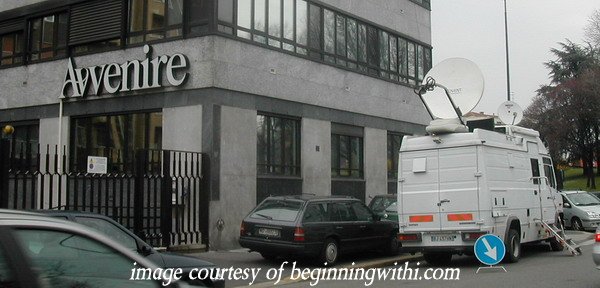
photo above: April 1, 2005 – the Papal Deathwatch. A TV transmission truck (belonging to RAI, Italian state television) parked outside the headquarters of Avvenire, Italy’s Catholic daily newspaper. The vultures are circling…