Category Archives: travel

Dancing Horses: The Lipizzaner Stallions

For Easter vacation we went to Vienna. There’s so much to do there that we barely got started; we’ll definitely have to go again.

The highlight of the trip, fulfilling a 30-year dream for me, was seeing the Lipizzaner stallions perform at the Spanische Hofreitschule. The event fully lived up to my hopes and expectations.

For my non-horsey readers: the Lipizzaners are the famous “dancing” white stallions who perform highly skilled and specialized dressage, in a tradition dating back 400 years.

They generally perform only twice a week, and there aren’t very many places for spectators, so you need to book well in advance – I wandered onto their website in mid-February and snapped up the last three tickets for the Saturday before Easter. The site is confusing; had I realized at the time how much those seats were going to cost, I might not have booked. But then the email confirmation arrived saying that the reservation could not be canceled, so we decided, what the hell – once in a lifetime, it’s bound to be worth it. And it was.

It’s a beautiful show of acrobatics and athletics, but it’s also about the relationship between man and horse. At the Lipizzaner museum and in the show program notes, we learned that riders begin at age 16, first learning to ride on an experienced stallion. After four years or so, when and if he’s judged ready, a rider is given his own young horse to train, which will take another four years. Later still, he will be expected to train other riders and help them train their horses; part of the selection process includes an assessment of the rider’s ability to pass on what he knows. Throughout his career, a rider will be responsible for the same small group of horses ­ ideally, a horse is always ridden by the same rider, for up to 20 years.

So what you see is the result of a long-term partnership in which man and horse know each other very well. So well that the horses appear to perform their magic entirely of their own will ­ the rider’s signals are so subtle that you don’t see him move from his ramrod-straight position in the saddle. The most we observed was a twitch of the heel here and there.

The riders also keep very straight faces, almost never displaying any emotion or even a well-deserved sense of accomplishment. At the end of each exercise, the only sign that anyone’s been working hard (and they have been!) is that the horses are foaming at the mouth and the riders are red in the face.

There was one exception to the poker-face rule, one of the senior riders, who didn’t quite smile, but nonetheless looked kind. And Ross swears that, when his young horse was acting up (slightly) during the show, she saw him giggle. We agreed that he looks like someone you’d want to take riding lessons with.

Unfortunately, that’s a dream that Ross could never live, without a revolution: the Hofreitschule is totally a guy thing. The horses are all stallions, and the riders all men. As far as we could discover, there has never been a female rider. I’ll have to dig a little deeper and see whether the notion has ever crossed anyone’s mind.*

* Aug, 2006 – A reader wrote to point me to an article showing that women do indeed ride Lipizzaners – but in South Africa, not Vienna.

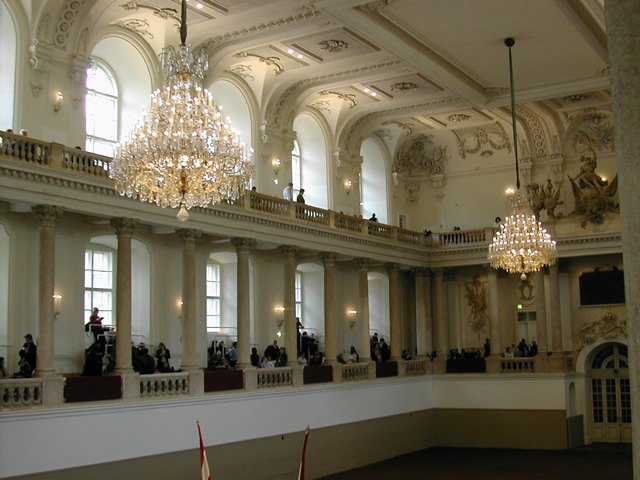
photo above: the performance hall, rightly called the world’s most beautiful manege
Fearsome Flying

“Homeland Security Secretary Tom Ridge said yesterday that he believes security crackdowns over the Christmas holidays, including the cancellation of some passenger flights into the United States, averted a terrorist attack. But intelligence on the threat was so wispy that U.S. officials may never know for sure, he said.”

By John Mintz, Washington Post Staff Writer

Thursday, February 5, 2004; Page A10

It’s not for me to judge the real level of risk, but here’s a thought: al Qaeda doesn’t actually have to get terrorists onto planes now, they only have to make the US government think they will. The flight cancellations and delays cost millions to the airlines and individuals affected, and scrambling US Air Force jets to escort planes is surely also expensive. Maybe all these precautions prevent real threats from being carried out; no one wants to take the chance, of course. But maybe al Qaeda is just toying with us and enjoying the ensuing mess.

Taking It All Off in the Caribbean

A couple of years ago, we were headed for a New Year’s party on St. Barth’s, an affair for which we had had to make reservations in April. As we got closer to the date, it turned out that I was in California and my family in Italy, and we’d be flying from opposite directions to meet in the Caribbean. We had a couple of extra days, right at Christmas, and decided to spend them on Sint Maarten, the next island over, where we had previously had a very pleasant vacation.

When you’re trying to reserve a hotel at the last minute in high season, you take pretty much what you can get. But when my travel agent quoted $500 a night, I winced.

Continue reading Taking It All Off in the Caribbean →

Early Tourist in Nepal

We visited Nepal in 1969 or ’70, when I was about seven years old. The country had only recently been opened to tourism, after a Russian named Boris Lisanevich persuaded the then king that this would be a good source of income for his impoverished country. Boris himself ran the first hotel, called the Palace because it had formerly been one (later, and until his death a few years ago, he ran the famous Yak and Yeti). We were the only guests there in January, so Boris invited us up to his private apartment to celebrate Russian Christmas.

Boris’ apartment was large, with white-uniformed servants everywhere. He had a huge silver artificial Christmas tree loaded with glass ornaments. He also had a snow leopard cub, orphaned by hunters. The cub was small, only about knee-high to me, but well equipped with teeth and claws. It seemed to fear the Nepali servants, perhaps because they reminded it of the hunters who had killed its mother. Because I wasn’t Nepali, or perhaps because I was also small, and generally got along well with cats, it liked me. I spent an ecstatic evening petting and hugging it; it was and probably still is the most beautiful thing I’d ever touched.

The cub only intermittently stayed calmly in my arms, however. At intervals it would go berserk and attack the silver Christmas tree. It would rush up the tree’s skinny metal trunk, so high that the tree would begin to bend under its weight. Then it would knock one of the glass ornaments to the floor, leap down, and eat it. A few minutes later it would vomit up a mess of thin broken glass.

Other memories of Nepal include my first experience of cold weather, and warming up by drinking sweet, milky tea, with arrowroot biscuits dipped in. (Tea seemed to me a very grown-up thing to drink.) And of course I saw Everest – from a distance. I was carsick on the drive up, vomiting out the window all over the side of the black Ambassador car, so I didn’t care very much by the time we got to there. In any case, we could only see a peak like all the others, so far off that it looked disappointingly smaller than many closer peaks.

Years later, in Mussoorie, I met Sir Edmund Hillary, then New Zealand’s Ambassador to India. He had come to see Everest House, a ruin a few kilometers out of town. The house had previously had a different name, but was renamed in honor of George Everest, because he had been living there when he finished the triangulations and calculations to determine that Chomolungma was the world’s highest peak – presumably he then modestly christened it with his own name.

Mar 24, 2004

I later learned that I had unjustly accused George Everest. John Keay’s The Great Arc: The Dramatic Tale of How India was Mapped and Everest was Named, explains that the British government named the mountain Everest to honor George Everest’s achievement in completing the Great Trigonometrical Survey of India. The data from this survey made it possible to identify the mountain as the world’s highest, but it also made many other things possible – and I highly recommend the book.

(Note: I don’t remember when this post was originally published on my old website – given the additional note at the end, it was clearly before 2004. I’m arbitrarily selecting today’s date in 2002, because it’s definitely one of my earliest posts. If there are any surviving photos of this trip, I don’t have them. Definitely none of the snow leopard, sadly.)