Tag Archives: horses

Centro Ippico Lombardo: Gara Sociale 1999

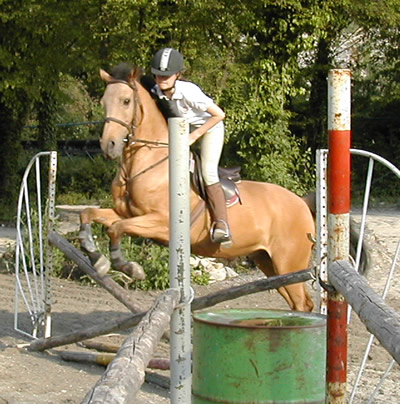
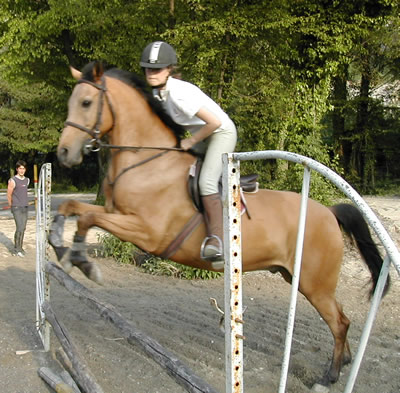
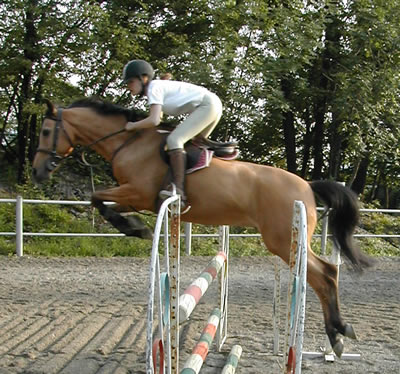
My daughter began riding at age eight at the Centro Ippico Lombardo, a stable and riding school near Milan’s San Siro stadium. This was around the same time I was starting to learn to shoot and edit my own video, so I was able to document some of her earliest events. Some of this old video – in this case an informal “social” competition in 1999 – recently came to light, on some old CD-R discs – which are holding up just fine!

For those who wish to practice conversational Italian, the last clip in this playlist is the dinner we all took part in after the event.

A Home for a Horse

I mentioned long ago that my daughter and I both love horses, and that we’ve had one (for her) since 2001. Now, very sadly, we are having to say goodbye.

Ross had already been riding for about four years when I finally decided (and had the opportunity) to buy her a pony of her own. We went to England to look for one, because ponies are a lot cheaper there – even counting the cost of our trip and then transporting him to Italy, we paid about half what we would have in Milan. But the buying is only a small fraction of the cost of a horse…

In retrospect, it’s a sad irony that we found Hamish and agreed to buy him on September 8th, 2001. We returned to Milan on the 10th and, as everybody knows, the world changed on September 11th. Had I known then what I know now about the world economy and my personal finances, I probably would not have started down the path to horse ownership.

Back then, it didn’t seem so crazy. I had plenty of money in the bank from my Silicon Valley heyday, and the prospect of making more freelancing for my former employer, Roxio, writing manuals for their European software WinOnCD. (In fact I did write manuals for versions 5 and 6, and was set to do that and more for version 7, when Roxio closed its German office. WinOnCD – and many people’s jobs – vanished.)

We kept Hamish expensively at a snobby stable in Milan for two years. Ross rode a lot, but never won any show jumping competitions, in part because Hamish is… difficult. There are ponies that, if you more or less aim them at a jump, will do everything they can to get you over it and win for you, no matter how badly you ride them. Those sorts of ponies cost a lot, and Hamish isn’t one of them. He requires to be ridden very well, which Ross did, but not quite well enough.

We also had some friction with Ross’ riding instructor, I suspect partly motivated by the fact that we had not bought Hamish through her, so she didn’t get the customary cut on the purchase. Whatever the reason, this instructor had no patience with Hamish’s foibles, and kept nagging us to sell him and buy a better. Even had I had that kind of money (oh, say, $15,000), that was not the lesson I wanted my daughter to learn about horses and sportsmanship. To me the point was never “spend as much as it takes to win,” but to develop a loving, trusting relationship with an individual animal, and win whatever you can, together, in harmony and friendship.

God help me now, that loving, trusting relationship is exactly what Ross and Hamish had. She sometimes grew frustrated with his stubbornness, tired of feeling foolish in front of her peers at competitions, but she stuck by him and defended him, and was praised by some other parents tired of their kids’ endless (expensive) litany of “If I only had a better pony.”

By the time we moved to Lecco last summer, financing a horse was becoming a problem, and we all heaved a sigh of relief to be paying far less to keep him, at a place where he could even be out in a field every day. But we couldn’t find near Lecco a reasonably-priced stable which included professional instruction. And, now in high school, Ross has less and less time; as I’ve mentioned, her curriculum at liceo artistico requires a school week of 35 hours, which, along with homework, leaves little time for anything else.

Ross continued to ride as much as she could, until she broke her arm a year ago, falling off Hamish onto frozen ground. That put her out of action for several months. She rode a bit in the spring, then the remainder of the school year was a mess – between extra tutoring and lots of studying, there was simply no time. In the summer she was happily away at theater camp for six weeks, rode a bit when she came back, and then we were in the throes of moving again.

In sum, Hamish has been left largely to his own devices this year, and is now out to pasture, not being ridden, and increasingly unrideable. With the new house, family finances are squeezed to the point that we can’t afford to just keep him (at 12 years, he’s not quite in his prime, but nowhere near retirement, either), nor do we have the time or money to put into riding him the way he should be ridden. So we have come to a parting of the ways.

It’s far easier to acquire a horse than it is to get rid of one, if you care at all about where it ends up. It would be easy enough to sell him to a horse dealer, but he’d probably end up at a slaughterhouse – this is Europe: people eat horses, and wear them.

The solution we have found is a stable on Lago Maggiore, where some friends keep their horses and ride, and we know the owners fairly well. Most importantly, we like their attitude towards and handling of horses. They may eventually sell him (and we might even get a cut), but they won’t sell him off to just anybody. They’ll do their best to find a good home for him and, at worst, they’ll just keep him. Ross can even go and visit from time to time.

Hamish leaves tomorrow morning. It’s a horribly painful loss for Ross and me both. I wish I could spare my child this. I almost wish we’d never started. But, on the other hand, horses have given her so much, and can still give her so much more, and she them. I can’t regret it. I can only hang on, and help her to. This time tomorrow, it will be over, hopefully without any last-minute getting-Hamish-into-the-van traumas. It will be over, and Ross and I will have survived it. Somehow.

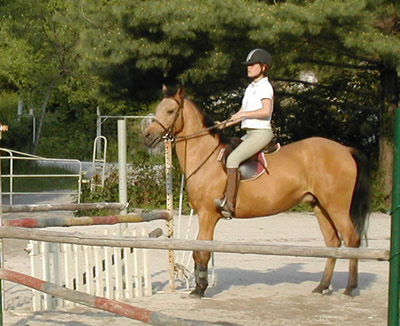
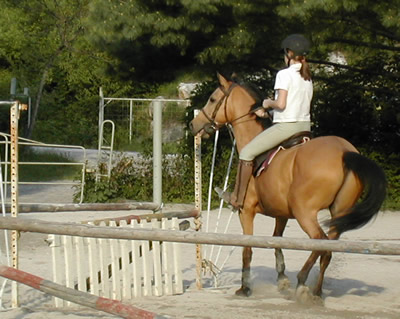
Rossella and Hamish: A Love Story

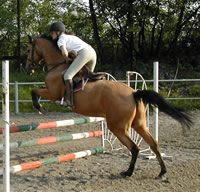
^ above: “Jump? What jump? I don’t see any jump.”

video shot August 14, 2004

music copright Patrick Doyle; buy it here

May 25, 2004

“Okay, I see it. But I ain’t jumping it!”

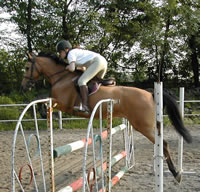
“Whoa, did I jump that?”

“Well, might as well do this one, too.”

“And this one…”

“…and this one and this one and this one…”

girls who love horses | home for a horse

Dancing Horses: The Lipizzaner Stallions

For Easter vacation we went to Vienna. There’s so much to do there that we barely got started; we’ll definitely have to go again.

The highlight of the trip, fulfilling a 30-year dream for me, was seeing the Lipizzaner stallions perform at the Spanische Hofreitschule. The event fully lived up to my hopes and expectations.

For my non-horsey readers: the Lipizzaners are the famous “dancing” white stallions who perform highly skilled and specialized dressage, in a tradition dating back 400 years.

They generally perform only twice a week, and there aren’t very many places for spectators, so you need to book well in advance – I wandered onto their website in mid-February and snapped up the last three tickets for the Saturday before Easter. The site is confusing; had I realized at the time how much those seats were going to cost, I might not have booked. But then the email confirmation arrived saying that the reservation could not be canceled, so we decided, what the hell – once in a lifetime, it’s bound to be worth it. And it was.

It’s a beautiful show of acrobatics and athletics, but it’s also about the relationship between man and horse. At the Lipizzaner museum and in the show program notes, we learned that riders begin at age 16, first learning to ride on an experienced stallion. After four years or so, when and if he’s judged ready, a rider is given his own young horse to train, which will take another four years. Later still, he will be expected to train other riders and help them train their horses; part of the selection process includes an assessment of the rider’s ability to pass on what he knows. Throughout his career, a rider will be responsible for the same small group of horses ­ ideally, a horse is always ridden by the same rider, for up to 20 years.

So what you see is the result of a long-term partnership in which man and horse know each other very well. So well that the horses appear to perform their magic entirely of their own will ­ the rider’s signals are so subtle that you don’t see him move from his ramrod-straight position in the saddle. The most we observed was a twitch of the heel here and there.

The riders also keep very straight faces, almost never displaying any emotion or even a well-deserved sense of accomplishment. At the end of each exercise, the only sign that anyone’s been working hard (and they have been!) is that the horses are foaming at the mouth and the riders are red in the face.

There was one exception to the poker-face rule, one of the senior riders, who didn’t quite smile, but nonetheless looked kind. And Ross swears that, when his young horse was acting up (slightly) during the show, she saw him giggle. We agreed that he looks like someone you’d want to take riding lessons with.

Unfortunately, that’s a dream that Ross could never live, without a revolution: the Hofreitschule is totally a guy thing. The horses are all stallions, and the riders all men. As far as we could discover, there has never been a female rider. I’ll have to dig a little deeper and see whether the notion has ever crossed anyone’s mind.*

* Aug, 2006 – A reader wrote to point me to an article showing that women do indeed ride Lipizzaners – but in South Africa, not Vienna.

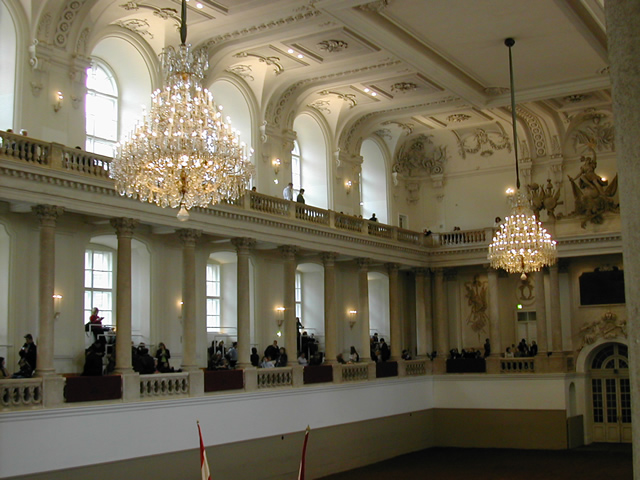
photo above: the performance hall, rightly called the world’s most beautiful manege

Girls Who Love Horses

Actually, my first love was dinosaurs: at age eight, I knew everything about them. I had a set of dinosaur cards which I could put in chronological order, and I knew that a tyrannosaurus could never have eaten a dimetrodon – they lived millions of years apart, in completely different eras.

I don’t remember exactly when or why horses took over in my imagination; perhaps it started with the books. In fourth grade, we moved to the larger campus of the International School of Bangkok, with a much bigger library. I devoured every book I could find about horses, especially those by Marguerite Henry, with beautiful, full-color illustrations by Wesley Dennis (they don’t print them like that anymore). I bought the few horse books available in Bankok’s paltry English-language bookshop; these were classic English girls-and-ponies stories, recounting a life that seemed very exotic: imagine being able to live at a school where you could also keep your very own pony!

I had very little experience of real horses. When we took family trips to Pattaya Beach, my big treat was a half-hour ride, led by the bridle by the horse hire man. I was always frustrated: I wanted him to let go, so the pony and I could gallop on the sand, just like the scenes in my favorite book, Henry’s “King of the Wind.” There was a polo club in or near Bangkok, where we went once a year for the big American Fourth of July bash. It was possible to take riding lessons there, but my parents never offered; I don’t know why.

I rode in my imagination, and I drew horses, practicing constantly, looking at Wesley Dennis’ pictures for reference. If I couldn’t be near horses, I wished I could at least draw them properly. I felt a thrill of pride the day I finally produced something that really looked like a horse.

The summer my dad and I returned to the US, we visited my aunt Rosie and cousin Casey in the Texan countryside where, to my great delight, I got to ride a few times. When we settled in Pittsburgh, I begged to take lessons, but that was more than my dad could afford as a grad student. I kept riding in my dreams, now with Walter Farley in the Black Stallion books. My mother sent from Thailand a Chinese brush-style painting of two black-and-white horses, which had pride of place in my room among my posters and pictures – mostly of horses.

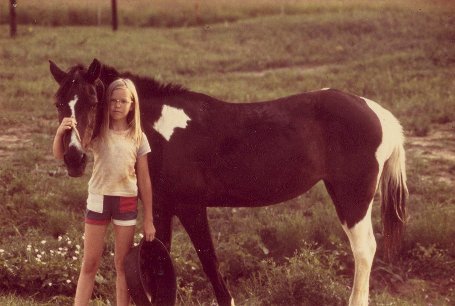
I spent the summer of 1972 with Rosie and Casey again. Casey had her own horse then, a big palomino called Flash, and there was a small horse for me, a docile old pinto mare called Dolly. We rode, though not as much as I would have liked (Casey was a teenager by then, and had other concerns). We often rode bareback, since it seemed cruel to put heavy western saddles on the horses in the Texas heat. We’d canter across the fields, poor old Dolly laboring gallantly to keep up with Flash. At the end of each ride, we’d steer them into the “tank,” an artificial pond full of muddy water, so they could cool off and drink. On the last day of my visit, we were mounting up for a farewell ride when Flash reared, startled by a puppy that suddenly shot out from under the barn. Casey fell and, landing awkwardly, broke her arm.

The following summer I attended a girl scout camp in Pennsylvania whose activities included riding. I was delighted to do everything with “my” own horse: cleaning, tacking up, feeding, and of course riding. It was a glorious two weeks, except for the time a camp counselor tried to make me drink tomato juice.

I don’t remember getting anywhere near horses while we lived in Connecticut. Then we moved to Bangladesh, and eventually I went to Woodstock School in India. It’s possible to hire horses in Mussoorie, but our allowance as students didn’t stretch that far, and these ponies were such sad, skinny little things that I felt more pity than desire to ride them.

I spent my freshman college year at the University of California, Santa Cruz. Alongside formal classes, the university offered short, informal courses, including riding (off campus). So I began to learn English riding, and again took care of my own horse. He was huge, with hooves the size of dinner plates; I affectionately called him “Moose.”

From my sophomore year of college, I transferred to the University of Texas in Austin. Here, again, I looked for opportunities to ride, finally finding a cheap place out of town where you could hire a horse and ride around in barren fields among the mesquite bushes (not a place you’d want to fall off). I was on my way there one day when I ran a red light and wrecked my grandmother’s old car, which put an end to both driving and riding for some time (I wasn’t hurt in the accident, but had no other way to get out there).

Horses vanished from my life after that, except in artwork and in dreams. The last two embroidery projects I did, during pregnancy and early motherhood, were a pair of carousel horses, for my friends Stephanie and Robin. But the Chinese painting still hangs in my home, and, whenever I doodle on paper, horses flow out of my pen. I rarely got to see horses in Milan, but sometimes we’d run across them elsewhere, and I’d stop to gaze.

It’s all Ilaria’s fault that Rossella got the bug. Ilaria had been Ross’ classmate since preschool. When they were eight years old, she began riding at a stable in Milan, and one day took Ross along to try it out. I was travelling, so didn’t get to see Ross’ historic first lesson, but I heard all about it by phone – it took only the one lesson for Ross to fall in love.

I could afford lessons for her, and had a flexible enough schedule that I could accompany her to them two or three times a week. I made good use of the time: while Ross was riding ponies, I took lessons on horses. She progressed faster than I did, partly because I was travelling a lot for work and had to rebuild muscle after each absence. But I finally became comfortable cantering and jumping, and even got a bit cocky. They say you’re not really riding until you start falling off; I was really riding! Ross and I used to keep score; we were neck-and-neck (in number of falls) for about the first year.

I finally got scared the time I fell on my head. It wasn’t the horse’s fault; I lost my balance after a jump, and just tipped off over his shoulder. I remember the trip down, looking at the horse’s hooves and wondering if I was going to fall under them. I don’t remember the impact, nor anything else for 15-20 minutes after that. I was never unconscious, but there’s a blank in my memory: the next thing I knew, I found myself in the clubhouse, talking to someone, having no idea how I got there, though apparently I had done so under my own steam.

I went to the hospital for x-rays, but there was no damage (I had been wearing a proper riding cap, of course), just a fierce headache. But the joy went out of it for me; I was scared of jumping, but bored of trotting around in the manege, and in Milan there’s no place to ride outdoors. So eventually I gave it up, and these days I’m just an observer.

Rossella continued to ride, and to fall, and to love horses madly. She would volunteer to clean the school ponies, which students were not required to do (their groom loved her). We’d spend hours in the stables, just being with horses, which made us both happy.

The riding school in Milan is very competition-oriented, so the usual progression is from the basics and “pony games” competitions on school ponies, to sharing a pony or buying your own, and moving on to higher competitions. Ross began show jumping on a shared pony in 1999, and in 2000 we began looking for one to buy.

The buying project was delayed by our abortive move to California, but when I returned to Milan definitively in 2001, it was time to look again. Ross had attended riding camp at Wellington Riding in England three summers in a row, so we enlisted their aid in finding a pony for her in England (even with travel costs etc., this is cheaper than buying a pony in Italy, where few ponies are bred). We made a special trip up there in September, 2001, and found Hamish. He finally arrived in Milan in November.

…and this is getting long, so I will gush about Hamish some other time!