^ There are a thousand reasons why this photo makes you die laughing.


^ There are a thousand reasons why this photo makes you die laughing.
The Ivaldin year consists of eight months of 45 days, each divided into nine morens of 1, 2, 3,… 9 days:
| Moren 1 Day 1 | ||||||||
| Moren 2 Day 1 | Moren 2 Day 2 | |||||||
| Moren 3 Day 1 | 3-2 | Moren 3 Day 3 | ||||||
| Moren 4 Day 1 | 4-2 | 4-3 | Moren 4 Day 4 | |||||
| Moren 5 Day 1 | 5-2 | 5-3 | 5-4 | Moren 5 Day 5 | ||||
| Moren 6 Day 1 | 6-2 | 6-3 | 6-4 | 6-5 | Moren 6 Day 6 | |||
| Moren 7 Day 1 | 7-2 | 7-3 | 7-4 | 7-5 | 7-6 | Moren 7 Day 7 | ||
| Moren 8 Day 1 | 8-2 | 8-3 | 8-4 | 8-5 | 8-6 | 8-7 | Moren 8 Day 8 | |
| Moren 9 Day 1 | 9-2 | 9-3 | 9-4 | 9-5 | 9-6 | 9-7 | 9-8 | Moren 9 Day 9 |
| High Holiday | |
| Low Holiday |
Two days of every moren are business and school holidays, but most shops remain open for the “low holiday.” Certain other days are sacred to particular gods, when rituals are performed in their honor.
There are four seasons: Bursat (the monsoon), Chhota Garm (warm), Tand (cold) and Bara Garm (hot). Each is two months long (thus, the months are called First Bursat, Second Bursat, First Chhota Garm, etc.). The calendar is adjusted to fit the seasons, with the New Year and the month of First Bursat beginning with the first rainfall. At the end of Second Bursat, when there has been no rain for five days, the rains are considered to be over, and First Chhota Garm begins. After two months, First Tand begins, coincident with the winds’ shift from the eastern sea to the cold northwestern mountains. Bara Garm begins when the wind shifts again, to blow from the warm south.
At the change of months there are five holidays in a row (9-9 to 3-1), to make up for the previous long morens of work. No one remembers how this peculiar calendar came about, but the Ivaldin insist that they like the varied rhythm it gives to their lives.
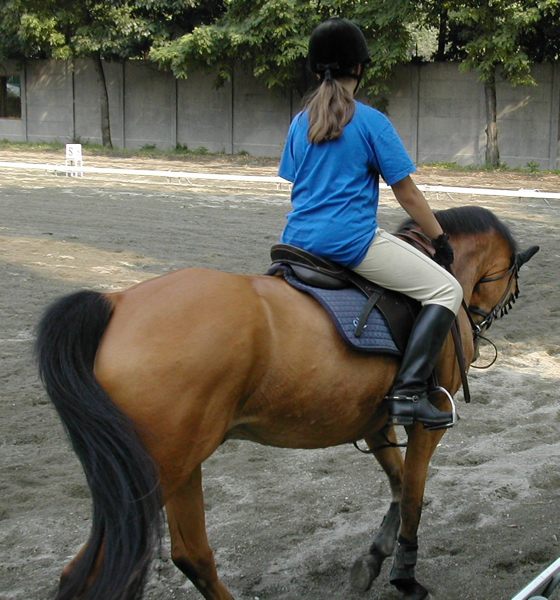
Unless you’re a horsey type, you may never have heard of this sport, though it’s now an Olympic event (in most countries it’s hard to get full TV coverage of equestrian events even at the Olympic level). Classic dressage is so quiet and dignified that you don’t realize how hard it is: the horse walks, trots, and canters precise figures, and shows off fancy paces, while the rider doesn’t appear to be doing much at all.
Dressage to music is an update for our stimulus-craving age. The movements and figures are the same, but are choreographed to music. Choosing the music turns out to be a complicated business: as explained on a site I found (no longer available), you have to find pieces that suit your horse’s paces and your own style, without getting on the judges’ nerves. And you have to put together a medley to cover at least the three basic tempos of walk, trot, and canter. This should ideally be done with some musical judgement and skill, and I found several sites offering to do it as a service. One site comments: “I now do all the mixing on computer and output to CD, which is 100 times easier [than tape] – don’t quite know how I managed before.”
I would love to see a live competition of dressage to music, but so far I have only seen the video of last year’s world championship finals. The athleticism and grace of the pairs was exhilarating to watch, but I was disappointed in the music: mostly tinkly versions of soft pop music (Neil Diamond must make a fortune every year in royalties from sporting events). It’s the kind of music so calculated to offend nobody that it grates considerably on my nerves, and must irritate the judges as well, if they have any musical sensibility at all.
After a number of these irritations, it was the turn of a pair from Germany: a robust gentleman with an impressive mustache, and his muscular stallion. As they entered the arena, a very different music swelled out: Jethro Tull’s “Locomotive Breath”. I would have given them the prize on musical taste alone. The judges, alas, didn’t see it my way: second place went to a jarring mishmash of pseudo-Greek movie tunes (Zorba, Never on Sunday), and the music the first-place winners used was so unmemorable that I’ve completely forgotten what it was!