Category Archives: Woodstock School

Symbols and Connections

A few weeks ago, Ross posted the above picture on her fotolog, of the jewelry she’d been wearing for days, with the caption: “you are what you wear.” A very interesting statement, in light of what she was wearing.

The gemstone is alexandrite, a semi-precious stone that changes colors in different light. My father bought it for me in Delhi in 1977, as my going-to-Woodstock present, and I wore it almost constantly during my first year there. I haven’t worn it much recently (that’s how Ross was able to make off with it) – nowadays I usually wear a golden heart necklace that Enrico gave me, though for Woodstock occasions I wear the silver Woodstock lyre tree pendant that my classmate Sarah got me when I couldn’t attend our class of 81’s 20th-anniversary reunion.

Of course the other pendant is the Om. I think I bought that for Ross on one of my trips to India, or she bought it for herself when we went together in 2005. Or maybe she even bought it in Italy. When she was mad for a tattoo a couple of years ago, she designed her own tattoos based on the om (fortunately, she was still underage, so we were able to veto any tattoo whatsoever!).

Not shown in the photo is another piece of my jewelry that Ross seems intent on keeping: the silver chain bracelet that my classmates gave me at the 2004 reunion, to thank me for 20 years’ service as class secretary.

There’s something beyond mere fashion in all this.

Packing

Just me.

Two suitcases*, max 20 kilos each.

Since this will be a year in India, I was forced to discard low-necked shirts, miniskirts and short-shorts, high heels and wedge sandals: in other words, everything I usually wear!

Put aside is the useless junk, the designer stuff that I’d be ashamed to show off.

I look around, see my usual room – companion of strange moods, breakdowns in front of the mirror, wild dances, and songs at the top of my voice. My bed that creaks, the TV that keeps me company during sleepless nights, old diaries, fashion magazines, Barbies covered in dust, horse models, stuffed animals.

An archive of memories and variegated objects which, up til a little while ago, I was convinced were a big part of who I am.

Every Saturday evening after dinner, I faced my closet with an air of challenge, thinking that, no matter how full it was, it wouldn’t be enough to supply a completely satisfactory outfit that would make me feel beautiful, carefree, and happy.

From the closet I moved to the mirror, to wage battle with my image, my weapons mascara and eyeshadow.

I smile thinking of the usual “stroke of genius” that comes to me every now and then.

Today it was to photograph myself nude.

While I did it I felt beautiful,

carefree,

happy.

Tomorrow I will leave with two suitcases which I hope weight more or less 20 kilos each, filled with the bare necessities.

In any case, I’m always me.

Minus a few costumes to wear.

(However, if I return with my head shaved and converted to some strange religion – hit me!)

*Mom: Well, that turned out to be wrong!

More Reasons to Send Your Child to Woodstock School

I thought of a few more answers to the question: Why send your child to Woodstock School?

The Natural Environment

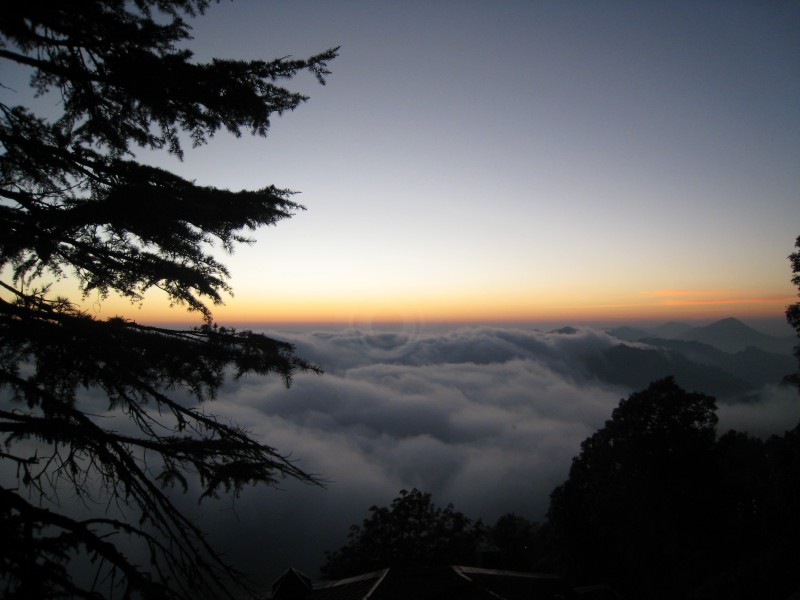
The photo above was taken from the top of the hill above school at dawn on a November morning. Need I say more? Look through the rest of the Woodstock section of this site, as well as the early part of the travel blog from my trip to India with my daughter two years ago, and you’ll see more of the extraordinary beauties of Mussoorie.

People tend to come out of Woodstock with a profound appreciation for – and desire to protect – the beauties of nature. A number have been inspired to make a career of it.

Extraordinary People

Another reason to send your child to Woodstock is that it produces some extraordinary people – and the ones on that page are just (some of) those who have an online presence that I can link to!

International Community

Though the specific demographics have shifted over the years, Woodstock has always been an international community made up of students and staff from dozens of nations, races, traditions, and religions. In such a context, you learn to get along well with everybody, to be sensitive to cultural differences, to find divergences stimulating rather than threatening.

In today’s globalized world, this is perhaps the most important kind of education any school could hope to provide.

You’re an Alum Yourself

A very strong reason to send your child to Woodstock, obviously, is that you yourself went there and loved it. I don’t have exact statistics (have asked the school), but it seems that a large proportion of alumni do send their children (and/or grandchildren, nieces, nephews, children of friends…) to share in this extraordinary experience. Some don’t quite manage to get their kids there for whatever reasons (finance, geography, lack of interest from the kids themselves), but they try, and some regret it all their lives if they don’t succeed.

The case mentioned earlier of the German boy who found Woodstock online and decided to go there is actually very unusual: people most often end up at Woodstock because of word-of-mouth recommendations from alumni and former staff. My husband accuses me, with some justice, of trying to “proselytize” Woodstock to everyone I meet. Well, that’s what I do with things I’m passionate about: I talk (and write) about them.

Now it’s your turn: if you’ve already decided to send your child to Woodstock, why did you? If your child has already gone, did the school fulfill your expectations for him/her? If you’re thinking about sending your child, what else would you like to know?

Papa Fan: A Satirist for the Modern Papacy

Thanks to a tip from Ross, I have for some time been following a very funny fotolog by Francesco Rabaglia, aka Papa Fan (papa is Italian for pope, differentiated from papà – dad – by the stress). It’s hard to see the humor unless you understand Italian well: basically the writer is putting funny captions in heavily “Germanized” Italian on photos of Pope Benedict (also known in Italy as Papa Ratzi).

A few days ago he published an original poem, translated here with permission. Keep in mind that this is not quite normal Italian – there are no Ks in Italian, but they are often used in humor and comics to denote a German accent.

Io zone joseph ratzinger, zon ztate porporato I am Joseph Ratzinger, I was empurpled [made cardinal]
i signori kartinali poi mi hanno kandidato the lord cardinals then made me a candidate
per difentare pape e komandar tutto il papato to become pope and command all the papacy
e per piu’ di tre motivi me lo zone meritato And for more than three reasons I have earned this
il primo è ke ho koperto kolui ke era indagato The first is that I covered he who was under investigation
per motivi di stupro e di abuso reiterato for reasons of rape and repeated abuse
su pimpi e su minori, da parte del prelato of children and minors, on the part of the priesthood
dimentikate tutto: il fatto non c’è ztato Forget all that: the fact never occurred
zekonde: io zono zolo un umìle servitoreh Second: I am a humble servant
nella distesa vigna che zta a kaza del signoreh in the extensive vineyards of the house of the Lord
produce fino autoctono in krante quantitah producing local wines in great quantity
ne bevo fenti litri ad ogni messa qui in cittàh I drink twenty liters at every mass here in town
per terzo poi io kredo ke zi debba ritornare For third, then, I believe we must return
alla messa tridentina abrogando la volgare To the Tridentine mass, abrogating the vulgar / Vulgate
linguaccia italiana ke io ti foglio tagliare horrible Italian language that I want to cut
kozì recito latino e vi pozzo coglionareh So I recite Latin and can make fools of you.

Growing Up in Boarding School

Though Rossella is by and large a wonderful young woman and a joy to be around, she does have her teenage moments and attitudes. She doesn’t like to wake up in the morning, her floor is usually strewn with clothing, she is undisciplined about studying… I sometimes reflect ruefully on the fact that my parents missed out on many of the pains and joys of my adolescence: I spent it most of it away at Woodstock School.

The idea of sending your child away to school is anathema to many parents (and perfectly normal to others, depending on culture, class, and family history), but it can be a fun and useful experience for the teens themselves. They become self-regulating and independent because they simply have no choice. Many common teen habits cannot be tolerated at boarding school – some forms of behavior would simply be impossible to manage en masse.

You Gotta Get Up…

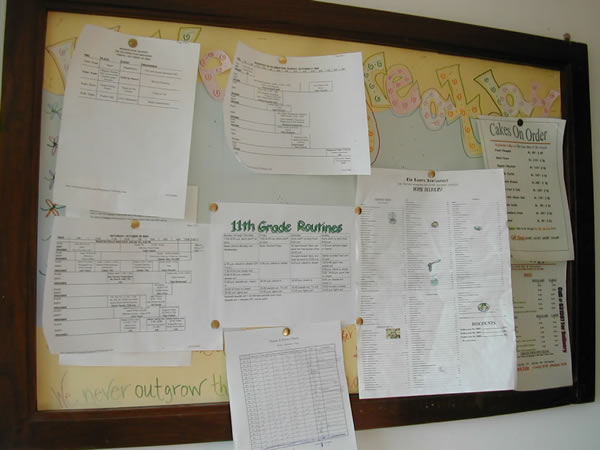
Living in a dorm means responding to bells: bells to wake up, bells to go to meals, bells for showers, bells for lights-out, bells for emergencies, and of course there are the school bells throughout the day. When the morning bell rings, you had better roll out of bed on your own, because there’s no mother there to keep coming back to nag you. If you persist in lying in bed, you’ll miss breakfast, and if you’re late for school, there are consequences. Needless to say, this is useful discipline for later working life.
Midlands bulletin board

the routines of dorm life

Keep Your Room Tidy

When I was at Woodstock, dorm rooms were inspected once or twice weekly and, if we left them messy, we got demerits that could add up to gating (a punishment that meant not being allowed to leave the dorms for anything other than classes for weeks or months) or restricted to campus (no bazaar on Saturday!). Being thus forced to clean up after ourselves was good training for any teenager, especially those who had servants to do everything at home (as was common in Asia at the time).

(Tidiness doesn’t seem to be quite as enforced as it was in my day. At least they matched Ross with an equally messy roommate.)

Manage Your Money

My parents never had to argue with me about pocket money. We had a (very small) set allowance at school – I think the maximum allowed during my senior year was 100 rupees a month. This amount was equal for everybody, and there was (at least in theory) no way to beg parents for extra if we had spent it all before the end of the month. In that situation, you learn to spend carefully – another very useful life lesson.

Manage Your Studies

I suppose all boarding schools have specific times set aside for studying. At Woodstock in my day it was 1.5 or 2 hours after dinner, four nights a week – if I remember correctly, we had a shorter study hall on Wednesdays to allow time for a social activity afterwards. Any free periods during the school day were also designated as study halls, which you did in the library under supervision (it was a Senior priviledge to be allowed to study anywhere on campus).

If you were on the A or B honor roll (3.5 or 4.0 grade point average), you could do evening study hall in your room rather than in the dining hall. A teacher would come around once or twice to check that we were each in our own rooms, but otherwise it was up to us to use the time wisely.

Practicalities

Even if we weren’t used to having chores at home, we had to take care of some things at school ourselves, such as laundry. Not washing it ourselves, but bundling it up each week for the dhobi (washerman), with a checklist of how many of each item we were sending, then checking it in again and chasing down anything that was missing when the bundle came back. If we needed clean clothes next week, we knew to make sure they got into the wash this week. (Or, preferably, the week before – clothing takes a long time to dry in the monsoon.)

We had to take care of our clothes and our possessions, replace things that needed replacing, etc. – again, no mom around to notice that all your socks have holes in them and your t-shirts have all gone gray.

Communal Living

Living in a dormitory with 100+ other kids, well, you’d better learn to get along with people. For starters, we all had at least one roommate, and the rooms weren’t huge, so you had to respect others’ personal space, and learn to find privacy when you could. I tended to need a lot of time to myself, so most days I would go straight down to the dorms after school, when others were off doing sports etc., so I had at least my room to myself.

Survival Skills

Here I’m thinking mainly of food – an obsession of growing teens, the more so in any institutional cooking situation where the meals are… well, probably not like Mom makes. The downside is that you learn to eat fast, so that, if there is anything good on your plate, you can go back for seconds before stocks run out. You can often spot a boarding school survivor by this behavior: he or she is the one waiting impatiently for a post-dinner coffee while the rest of the party are still on their salads!

The upside is that, while you deeply appreciate good food, you’re not a fussy eater, and can survive on just about anything when you have to.

The Rules

Living with parents, teens are always testing boundaries: “Why do I have to be home at a certain time? What do you mean I’m too young to go to the disco?” This struggle for independence is an important part of teen development, but exhausting for parents, who receive conflicting advice from the entire world (“Be stricter! Be more understanding!”) and may not agree even between themselves on what’s to be done.

A boarding school has set rules that everyone knows and must live by. It’s clear why the rules need to exist, even when they are more restrictive than you might have at home: it’s far more difficult to keep track of several hundred teenagers than one or two.

At school, there’s not much leeway to argue about the rules, and the penalties for infractions are clearly stated and (usually) fairly applied. So it’s up to you, the student, to decide whether to risk breaking the rules, and you know exactly what to expect if you get caught. Boarding school in this way is a good introduction to adult life: you learn early that you are responsible for your actions.

The Results

A young person leaving boarding school for college is likely to be far more mature in many practical ways than his or her peers who come straight from home. One Woodstock classmate of mine said that he felt many of his college classmates wasted their first year simply getting accustomed to being on their own, whereas he was able to be productive from Day 1.

Last but not least, boarding school teaches us humility: instead of being Mom and Dad’s pampered darling, we each have to pull our own weight in the community – which includes aiding and comforting our peers when they need it. We learn to take care of those around us, and that it is natural and human and right to do so.

And that’s not a bad lesson to be starting life with.