Thanksgiving 2007: Martha Stewart, Move Over!

I’m leaving for India Wednesday, so we had to have our traditional Thanksgiving dinner early. The first step, which started two days in advance, was to roast and peel the chestnuts for the stuffing – unlike Martha Stewart, I cannot buy them pre-cooked and frozen or canned.

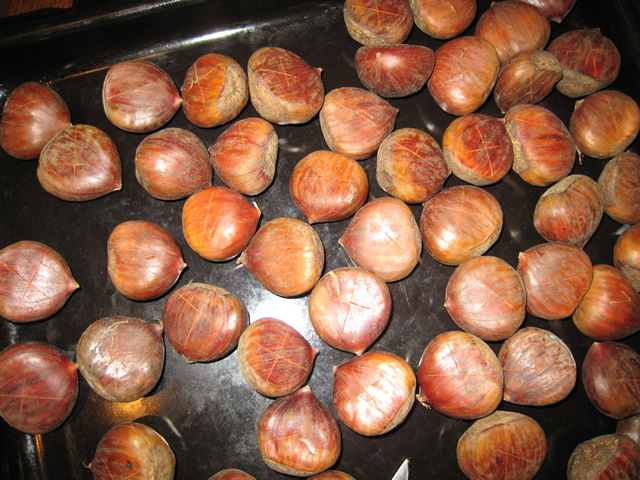
Above you see them ready to go into the oven (I had two oven pans, both almost full), with an x scored across the flat side of each with a knife, as per instructions in the Silver Palate cookbook. They didn’t all have an identifiable flat side, and I was scared of slipping with that sharp little knife and cutting my fingers.

This is how they looked partway through the roasting; it took over an hour to get the last ones done enough to peel relatively easily. Per Italian tradition I should have roasted them over an open flame in a pan with holes in the bottom (which would have been faster), but I don’t own one of those pans. Hmm. Something to get for next year.

Peeling them all took hours. Depending on degree of doneness and other mysterious factors, any given chestnut can be more or less difficult to coax out of its woody outer shell and then the papery inner one. Like walnuts, they have wrinkles and crevices from which any woody bits must be removed so that guests don’t break their teeth – you don’t always get a perfect whole chestnut as shown above.

I no longer have an oven large enough to roast a whole turkey, so in the last few years I’ve had to find another solution. An American recipe for herb-roasted turkey breast expects me to have a turkey breast with the skin still on, something you don’t find in Italy. You can order a whole turkey breast from the butcher, but it arrives skinless.

My solution was to replace the skin with thin-sliced pancetta (Italian bacon). Instead of working the herb mixture under the skin, I just slather it onto the turkey, then lay on the pancetta slices to completely cover the surface. This retains moisture in the meat, adds lots of flavor, and becomes a nice, crispy addition to the dish.

Italian poultry takes longer to cook than the estimates given in American cookbooks. The Joy of Cooking says 10-12 minutes per pound for turkey. By this calculation, this 3.8 kg (8.4 lb) turkey breast should have cooked in less than two hours. But I knew from previous experience that this was not going to happen. The turkey was perfect at three hours – cooked through, but still moist. (I used a meat thermometer, let it reach the “poultry” marking and stay there 10-15 minutes.)

I had so many chestnuts this year that I saved some whole ones out from the stuffing and put them in the roasting pan with the turkey, adding more at the end when the turkey had shrunk and there was more room. They soaked up the gravy deliciously.

Italians don’t make the flour-thickened gravy traditional in America – it’s a lot easier to just use the pan juices as-is (had I thought about it, I should have tried adding Calvados and simmering as the recipe called for – but then there wouldn’t have been enough to go around). I simply poured the juices and chestnuts into a bowl, and people spooned it onto their slices of meat.

The above photo is by Duke, a young fashion photographer trying to make a career in a tough city (Milan). I figure, if I’m going to have my picture taken at all, I should leave it to the most competent person in the room. (He also plays a mean blues guitar.)

I was too busy cooking, serving, eating, and talking to take any pictures of the actual guests – there were about 35 people present, and during the first part of the evening we managed to get them into the taverna (instead of clustering in the dining room and kitchen as people tend to do) by putting all the wine and antipasti down there!

I wasn’t the only cook. Ivo brought his justly-famous cheeseball, plus veggies and dip. Darlene’s American/Asian style cabbage salad was a great accompaniment to the main course. There were many great desserts: Maryellen’s pumpkin pie, Fabrizio and Irene’s ricotta torte, Marianna and Zeno’s apple cake, plus various yummy store-bought sweets. Andrea and Nives also brought us some authentic Genovese pesto which we will have to eat before I leave.

And somehow we always end up with more wine than we started with at these things: I didn’t even buy any, and we have 6-8 bottles left over! We finished off the Franciacorta that San Lorenzo had donated to Web Women Weekend, and I liked very much the 2007 Novello “Falò” that Andrea and Nives brought.

It was our usual mixed crowd: mathematicians, IT geeks/bloggers, neighbors, and various other friends. I was happy they all came and enjoyed themselves and the company, though I didn’t get as much time to talk to most as I would have liked. That’s what happens when you’re the hostess. But it was worth it. Happy Thanksgiving!

KLM Makes Up, and Other Airline Experiences

I wrote 18 months ago about my disappointment with KLM’s poor handling of a bereavement situation (KLM Tries Harder… But Fails). I’m flying a lot again these days (three trips to the US this year, plus several to the UK, and now India). I still receive promotional emails from Flying Blue, the alliance which KLM and Air France have now become, to remind me that they’re waiting to serve me, but it was hard to get over that incident. (NB: I receive nothing from British Airways, with whom I was also a top-level frequent flyer until 2001; perhaps they’ve lost track of me.)

But… I still had all this mileage sitting around with KLM (58,000+), and some flexibility (for once) in planning my upcoming trip to India. So I hopped on the KLM site to see what could be done.

The awards booking process (which gets good marks on usability) informed me that I needed 70,000 miles to go to India – but they would advance me the missing mileage. This was automatic in the system, though it was a little weird – at first it looked as if that offer was only valid if I flew on Tuesday, but when I tried again a few days later, it was offered for Wednesday (my ideal departure date) as well. So I got exactly the flight I wanted for "free" (still had to pay over €200 in "taxes and fees").

In the meantime, researching other airlines, I had learned, to my horror, that the baggage limit of 20 kg from Europe to India now seems to apply to all airlines. I know that on all my previous trips I have carried two heavy suitcases in and out of Delhi, and only one of those trips was business class. I guess this is some new trick of the airlines to squeeze more money out of their hapless passengers. The standard rate for excess baggage is €30 per kilo (!!!) – no less than Air India’s rate that I was screaming about earlier this year.

However… I’m a Platinum member on Flying Blue. Turns out that that entitles me to 20 kg extra baggage – just what I need to bring Ross her winter clothing and the food goodies she craves in boarding school.

The flight I’m booked on is actually Air France, which is a bit disappointing – I much prefer KLM’s home base of Schipol airport to Charles de Gaulle – and we will have to drive to Malpensa at an ungodly hour Wednesday. I reserve judgement on comfort and service til I get there, but remember Air France as being okay (last time I flew they still allowed smoking on board, which tells you how long ago it was).

In short, treating me well as a once and maybe future frequent flyer has won big points for Flying Blue. Let’s see how well they maintain this relationship.

Share your airline experiences – who do you like (or not), and why (or why not)?

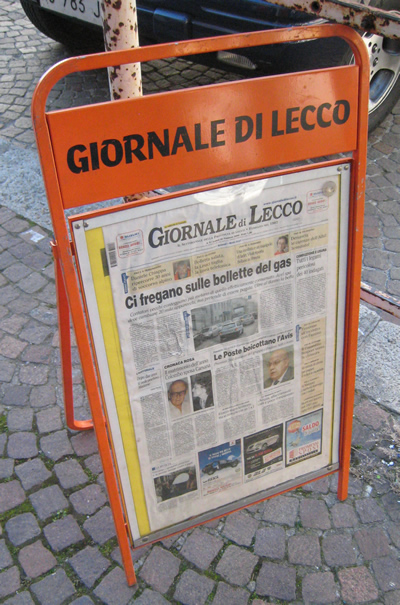
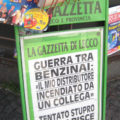
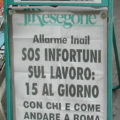
Everyday Italian: Newspaper Headlines 15

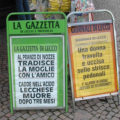
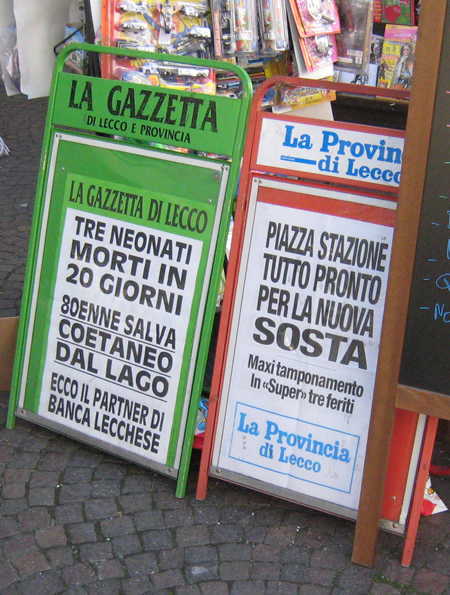
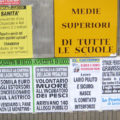
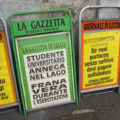
Three newborns dead in 20 days.

80 year old saves a peer [person of the same age] from the lake.

Here is the partner of the Lecchese bank.

Station plaza – all ready for the new parking.

Maxi fender-bender on the “superhighway” – three wounded.

Guests of Conti Sertoli Salis: Part 2, The Palazzo

After an excellent (if somewhat hasty) lunch, the four of us had a private tour of Palazzo Sertoli Salis, which is still the home of the Sertoli Salis family, as well as the headquarters of the winery.

My photos don’t do justice to it: the palazzo is charming, rich with newly-restored tromp l’oeil frescoes cleverly designed to make the ceilings appear far higher than they are.

The paintings and furniture were intended to display wealth, yet the style is somehow appealing and cozy. Some of the family’s collection of antique documents and pictures is displayed museum-style, with (unusually for Italy) explanatory text in several languages.

^ Detail of the saloncello (small salon). Sertoli Salis’ “titled” wines are named after features of the palazzo.

Part 1: Lunch

Part 2: The Palazzo

Part 3: Wine!

Deirdré Straughan on Italy, India, the Internet, the world, and now Australia