Note to the Entertainment Industry: Piracy is Good for You

Not an original proposition, I know. But is it an excuse, a rationalization – or a fact? I can offer some evidence from my own experience:

I used to download music from the Usenet, my favorite newsgroups being those which offered soundtracks and musicals. Contributors to those groups vie with each other to post the strangest and rarest albums, or to be the first to post the latest film soundtrack. For long-distance fans of the Great White Way, it’s a great way to keep up with what’s happening on Broadway. Probably the phenomenon most hated by those in the biz is the people who smuggle tape recorders into shows and upload full bootleg soundtracks, dialog as well as songs. I tried a couple of these, but found them merely annoying: the quality, not surprisingly, is not good (you hear a lot of audience rustles and coughs) and many shows are incomprehensible without seeing what’s going on. But for some show-starved fans far away who will never be able to see a show live, I guess it’s better than nothing.

Since I don’t live in New York (or London) and don’t follow theater news closely, these newsgroups were a way for me to keep up with new musicals and explore less-familiar old ones. I had not known that the John Waters film “Hairspray” was being made into a musical until the soundtrack appeared in a newsgroup. I downloaded it out of idle curiosity, and fell instantly in love with it, as did Ross. We listened to it in the car while visiting friends that weekend, and their teenage daughter also loved it (the girls’ favorite song was: “Mamma, I’m a Big Girl Now”). Both families bought the CD from Amazon, and we all wished that we could see the show in New York. The closest we could get was a New York Times review which included a video clip of one of the musical numbers.

About a year later, our friends got to see the show when a touring company came to Minneapolis. Ross and I saw it, finally, in New York in January, braving the big blizzard to get to the theater. To see a show at all was a last-minute impulse decision, and there were lots of others we could have seen that afternoon for the same price or less, many of them a shorter walk in the snow from where we were. But we chose “Hairspray” because we already knew we’d love it.

So the accounting on my original act of piracy looks awfully good for the show’s producers: an initial illegal download of the soundtrack turned into $40 spent on CDs right away, and $300 or so in theater tickets later on.

I know that not everyone who downloads music (and likes it) will then buy a legal copy and/or see a show (even if they have the opportunity). But a closer look at the behavior of the downloading population might pleasantly surprise the entertainment industry execs who are currently spending so much effort and money sueing people.

In Loco Parentis: Supervising School Trips in Italy

I wrote earlier about the traditional gita scolastica (school trip) which Italian kids take every year throughout their school careers.

This year Ross’ class, along with another class, took a three-day trip to Arezzo (the town in Tuscany where Life is Beautiful was filmed), accompanied by their three favorite teachers. During the day they visited cultural and educational sites, such as a museum of diaries. The evenings, however, became a problem. They couldn’t stay in the hotel, because the hotel owners complained that they were noisy and disturbed other guests (what did they expect when they booked in 50 teenagers?!?). So the kids roamed the town until they found a bar they liked, where they settled in and had drinks. Yes, alcoholic ones.

This isn’t in the least surprising: 15-year-olds are routinely served alcohol in Italian bars, and most of them handle it maturely. But I was surprised when Ross told me that the teachers were with them, also drinking, and everyone got a bit tiddly. I was amused to contemplate the probable results had this happened in the US: arrests and lawsuits for the teachers, and a press siege of the town and the school, with interviews with outraged parents, church leaders, and (especially!) politicians, until some other tempest in a teacup came along to distract the media’s attention.

But it seems to me that the teachers did the right thing: they were with the kids every minute of the evening, on hand in case of trouble. Although most Italian teens aren’t interested in binge drinking, the presence of the teachers undoubtedly curbed anybody who might have been so inclined. Relaxing and enjoying together with the kids, however, their disciplinary presence was low-key, so none of the kids felt any need to sneak away and get into trouble elsewhere. Most of the kids’ parents would have done exactly the same, so the teachers were truly acting “in loco parentis.” It’s amazing how well society can work when you trust to common sense and civility instead of trying to legislate everything.

Meanwhile, America continues to go to the opposite extreme. Trying to drown out distracting noise at the office the other day, I thought I’d listen to some online radio, and chose KGSR, a cool station that John introduced me to in Austin. It was morning news time in Texas, no cure for my distraction problem, especially when the top news item was that the Texas state congress had just passed a law banning “sexually suggestive” cheerleading routines (is there any other kind?) in high schools, and authorizing the Texas Education Agency to “punish” schools that allow such. Many Texans are wondering why their legislature doesn’t concentrate on more urgent and important matters.

Texas does have a common-sense approach to kids and alcohol. Although the drinking age in Texas is 21, as in every other US state, kids can go anywhere and do anything WITH their parents. Ross was allowed to accompany me (and her uncle Ian) into a tapas bar in Austin, and was even given complimentary Valentine’s Day champagne, since I am obviously her mother, and I gave permission.

An Unholy Alliance: American Conservatives and the Vatican

I have had it up to here with the media frenzy over the Papal death-and-succession, and can only be relieved that the Conclave only lasted two days (to the disappointment of news crews, no doubt – hang around in Rome and wait for a chimney to smoke? Tough job.)

Though I’m glad it’s over, I’m not at all happy with the results of this “election” – in which only 110 or so of the world’s one billion Catholics had a vote, and women were completely disenfranchised. Catholicism is definitely not for me but, out of respect for my many Catholic friends (some of whom read this newsletter), I will leave that topic alone. I’d only start foaming at the mouth anyway…

I’m not Catholic, so what any Pope says or does shouldn’t matter to me anyway, right? Well, as Richard Cohen of The Washington Post points out, it’s not only Catholics who are affected by Catholic dogma:

“…There are other areas… where John Paul II’s teachings affected non-Catholics. I am referring now to his implacable opposition to birth control – not just abortion, mind you, but the mere use of condoms…

It is the underdeveloped world where birth control is most needed. It is there, where medical services are the most meager, that the AIDS pandemic poses its greatest threat and where condom use is the cheapest and most effective preventative measure. The pope counseled abstinence, a wholly unrealistic piece of advice…” (Indeed, if abstinence was easy for the average human being to achieve, the Catholic Church might not face the severe shortage of priests that it currently does.)

Opposition to birth control is also a Bush administration policy with devastating effects on non-Americans: the US government refuses to fund development agencies or projects where family planning includes so much as a mention of abortion, in spite of the fact that abortion is legal in America. Where American conservatives cannot impose their will by law in America, they are doing it by budget policy in other countries. Catholic dogma lends “moral” support to this stance, and Ratzinger, like Wojtyla before him, will no doubt continue to do so very vocally.

Ratzinger’s virulent anti-gay stance will also reinforce American conservatives in their homophobia. However, the Church’s opposition to the death penalty (and the Iraq war) will be conveniently ignored. Politics and religion make strange bedfellows.

It. Figures: Dealing with Numbers in Another Language

I suspect that most people, no matter how well they speak a foreign language, find it difficult to deal with numbers in other than their native tongue. I’ve noticed many times that someone has asked me to give them numbers in their own language, “because it’s easier.” I’m no different: if I have to write down a phone number, I prefer to have it recited to me in English.

For starters, Italians have a completely different way of speaking numbers than Americans. Suppose you were reciting out loud the (fictitious) Washington phone number: (202) 123 4567. Most Americans would say: “two oh two, one two three, four five six seven.” Many Italians would say the Italian equivalent of: “Two hundred two, one hundred twenty-three, forty five, sixty seven.” Or, even more confusingly, they will break up the seven-digit number differently than Americans do and come out with: “Two hundred two, twelve, thirty four, five hundred sixty seven.”

Americans do use hundreds and thousands in phone numbers where they are round numbers, e.g. a toll-free number might be given as “one eight hundred four five five three thousand.”

Saying hundreds (never thousands) is more efficient in Italian than English, because the Italian for hundred is “cento”, and you don’t need to say “one” when there’s only one hundred. So “cento ventisette” (127) is quicker to say than “one hundred and twenty seven.” (Yes, we were all taught in grammar school that saying “one hundred AND…” is wrong, but many of us still do it.)

On the other hand, if someone starts saying “cento…” my instinct is to immediately write 100, before I hear that the tens and units columns are also occupied.

What about other kinds of numbers? Take years: the year 1956 is read by English-speakers as “nineteen fifty six” or, if you’re old-fashioned, “nineteen hundred and fifty six.” An Italian would say “mille novecento cinquantasei” (one thousand nine hundred fifty six) – twice as many syllables.

And then there’s the matter of dates. Americans write and say “April 25th, 2005,” or 4/25/05. Italians write and say “25 Aprile 2005” (venticinque aprile, due mila cinque – note that there’s no ordinal: it’s twenty-five, not 25th) or 25/4/05. Most of the rest of the world also abbreviates dates in the day/month/year format. Having lived all over the world, I can never remember which style is used where, so I’m always messing up forms that require me to fill in a date.

The Papal Funeral Bash

I’m not going to say much about this; I wasn’t there, and ignored it as far as possible. The only footage I actually watched was on the Daily Show. But I do have a few items:

Early last week, I was riding the bus down to Lecco, at my usual time when it’s full of schoolkids. One girl was on her cellphone. “She only goes to mass ogni morte di papa!” she exclaimed, completely without irony, –nd now she wants to go to the funeral!”

Indeed, many of the Italians who traveled to Rome for the funeral probably don’t go regularly to Mass. I won’t presume to comment on why they went to the Pope’s funeral, except that Ross told me that some of her peers came back with cellphone photos of themselves drinking Limoncello (a strong lemon liqueur) in Piazza San Pietro.

I do know a number of serious Catholics – those who truly believe and practice Christianity, e.g., doing volunteer work. Interestingly, none of them went to Rome, and all were nonplussed by the outpouring of whatever this was, and disconcerted by the yells of “Santo subito!” (“Make him a saint immediately!”) As far as I know, it’s not in the church canons to saint somebody just because he was popular.

Rome rose magnificently to the occasion, managing to keep things in order and take care of the crush of people. Every cellphone in Italy received messages from the Protezione Civile (“Civil Protection” – the government emergency-response organization). The first read: “If you go to Rome to pay homage to the Pope, use mass transit and be prepared for organized but very long lines. Hot by day and cool at night. For information, listen to Isoradio [public information radio, mostly used for traffic warnings] 103.3.”

The second message said: “Due to enormous turnout, from Wednesday at 10 pm access is closed to the lines to salute the Pope. Friday for the funeral traffic will be stopped in Rome. The area of San Pietro is full. Large screens will be in the piazzas and at Torvergata” (an area outside Rome where the final rush of pilgrims was told to stop when the city couldn’t take any more).

My friend Alice Twain then sent her own message: “Protezione Civile: Before leaving for Rome, remember to turn off the gas, close the shutters, and water the plants.”


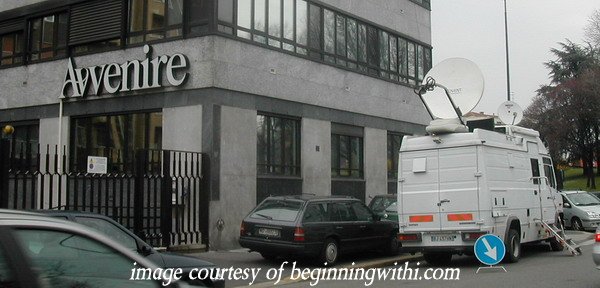
photo above: April 1, 2005 – the Papal Deathwatch. A TV transmission truck (belonging to RAI, Italian state television) parked outside the headquarters of Avvenire, Italy’s Catholic daily newspaper. The vultures are circling…

Deirdré Straughan on Italy, India, the Internet, the world, and now Australia