Tag Archives: bio

That Vampire Thing: Story of an Obsession

I had a thing about vampires long before Buffy the Vampire Slayer came along. It began in the summer of 1978, when I traveled to the US with my folks on home leave. The hit Broadway production of “Dracula” had been made into a movie, with Frank Langella reprising his title role. I was 15 years old, and for the first time in my life got a crush on a movie star. (Of course it’s entirely accidental that the man who later became my husband looked like him!) I saw the movie two or three times, and read the movie tie-in edition of Bram Stoker’s original book. By the time I returned to school, I was hooked on all things vampiric.

When I got to college, I began collecting vampire books. I’ve kept only the best ones over the years, including a complete set of Chelsea Quinn Yarbro’s Saint-Germain series. Saint-Germain is a very sympathetic vampire, who has lived for about four thousand years. This gives Yarbro plenty of scope for the deep historical research she clearly loves; the books are richly detailed snapshots of certain times and places in history, in which the “bloodsucking fiend” is usually the most humane creature around, striving to save those he loves from the cruelty of other humans. I should also mention that Yarbro is a VERY good writer.

Laurell K. Hamilton’s series Anita Blake: Vampire Hunter is also worth a look. I read the first few thanks to a friend from St. Louis, who had them because the writer is from St. Louis and sets her books there. The writing was rough at first, but Ms. Hamilton has improved at her craft over the course of 12 books or so (and a new, different series just started), and the premise is fun: vampires, werewolves, etc., really exist, and have been granted civil rights by the US government – so long as they behave themselves. When they don’t (which is often), bounty hunters like Anita Blake step in to take them out. (2006 – Recent books in the series have become a strange sort of horror-porn – fun, but not exactly high literature… )

I was a big Anne Rice fan, at least for the first three Louis/Lestat books, and was thrilled when “Interview with the Vampire” was made into a movie. Which had its flaws; couldn’t they have gotten anyone but Brad Pitt to play Louis? But Tom Cruise was excellent as Lestat, and one of my favorite film scenes of all time is the final one, with Lestat speeding across the Golden Gate Bridge in a convertible (at night, of course) with “Sympathy for the Devil” blaring out of the radio. I actually never saw the movie til I got it on video. Rossella was young then, and I figured it wasn’t suitable for her, so I watched it when she wasn’t around. But she saw it on the shelf and got curious, and when she was 9 or 10 I let her watch it. Then she got into vampires. I dunno, maybe it’s genetic?

Soon after that I heard about “Buffy.” I only knew vaguely that it was about some sort of female teenage superhero, but I spotted a magazine about the show in the UK, and bought it for Ross. We were both skeptical: we like vampires; would we like a show that seemed, by its title, to be all about killing them? Still, I was curious enough to take up my friend Adrian on his offer to send us the videotapes (then commercially available in the UK, but not the US). As I mentioned, we were hooked within the first five minutes. I’ll spoil things for you a bit by explaining how.

Joss Whedon, the show’s creator, has said that he came up with the vampire slayer concept because he was tired of the many horror movies where a ditzy blonde wanders into a dark alley, is followed by some sort of fiend, and winds up messily dead (okay, I’m paraphrasing). He thought it would be fun to turn the tables, and have the blonde beat up the monster.

I didn’t know that when I saw the first episode. It begins with a small blonde, dressed in a pleated skirt like a Catholic school girl, and a slightly older-looking guy, breaking a window to get into a school at night. Science classroom skeletons and scary music create atmosphere. The girl is nervous. “We’re just gonna get in trouble,” she says. Big macho guy reassures her: Everything’s cool, no one will see them. “I heard a noise,” she says tremulously, looking away, down the dark hall. Scarier music. (And I’m practically hiding under the sofa – I am easily freaked out by horror movies.) The guy leers evilly behind her. “No one here,” he says. The music swells. “Okay,” says the girl. She whips around to face him, and is suddenly transformed, with fangs and yellow eyes. She sinks her teeth into the guy’s neck.

I knew right then, before Buffy herself was anywhere in the picture, that this was a great show. Oh, and it’s still okay to like the vampires. There are some good ones in “Buffy,” and they don’t get slayed. Slain. Whatever.

Martin Baynes as Renfield and Mike Nicklin as Dracula, Jakarta 1984

^ Martin Baynes as Renfield and Mike Nicklin as Dracula, Jakarta 1984

Nov 18, 2003

When I wrote the above, I clean forgot to mention one of the biggest vampire events in my life. In 1984, a brief visit to my dad in Indonesia turned into an extended visit when I couldn’t get a visa to study in India as originally planned. Although Jakarta is a big, bustling city, there wasn’t all that much for foreigners to do there in those days, so the expatriate community had to work to keep itself entertained. One means was amateur theatre, in which my dad and his friend Donna were enthusiastic participants.

While I was stuck in Jakarta, my friend Sue came for an extended visit from the US, and we were both happy to get involved in the Jakarta Players production of “Dracula.” The group was using the script by Hamilton Deane and John L. Balderston, originally produced in the 1930s. This play had been revived in the 1970s, starring Frank Langella on Broadway, in the production which was then adapted into a film in 1979.

Indonesia had never signed the International Copyright Convention, so the Jakarta Players… took some liberties with the script, adding entr’acte vignettes more or less taken from the Frank Langella movie, along with a generally more sexy and romantic atmosphere. We even retitled it “Dracula, a Love Story.”

As you can see in the photo above, we stole the set design from Edward Gorey’s sets for the Broadway show, done in his characteristic macabre cartoon style. We also used music from John Williams’ score for the film for mood-enhancing background, and choreographed a dance for the big seduction scene.

Dracula poster, Jakarta Players, 1984

Sue and I helped out during many weeks of rehearsal, taking the opportunity to flirt with two cast members we liked (one was the British local head of an airline, the other a Scottish engineer working for an oil company). Sue was eventually appointed stage manager, and I was put in charge of sound effects, which I pulled off pretty well except for that one time when the wolves howling got swapped with the screaming loonies … Our friend Julie played the maid, which so thoroughly infected her with the theater bug that she now works at the Kennedy Center in DC.

A team built the 40-foot-high flats for the set, which were supposed to be painted black, white, and grey, just like the Gorey drawings. When we raised the flats on the Jakarta International School stage, however, they were brown and grey. The woman put in charge of set painting had gone to a shop in Jakarta which happened to be out of black paint; the shopkeeper there told her there was none to be had anywhere, here, have some nice brown instead. And she believed him. We all looked at the brown, and it looked pretty stupid. So Sue and I volunteered to repaint the entire set in the week we had left before opening night.

This wasn’t too difficult for the first six feet going up. Then we started standing on furniture and ladders. Then we had to pile things on other things, building up increasingly tall and rickety “scaffolding” so we could paint higher and higher up the set. When we got near the top, there was nothing else we could safely pile up. So the light bars were lowered down to the stage, we sat on them, and were raised 40 feet up so we could paint the top of the set. This was a supreme effort for me, because I am terribly afraid of heights. But we finally got it all done, and it looked good.

The show came together well, and was warmly received by the expatriate and Indonesian audiences. Best of all, it kept us all very happily busy for months. Jakarta Players went on to do still more ambitious productions, including “Cabaret,” “Pajama Game,” and “Greater Tuna.”

Vampire Stuff at Amazon

Saint-German books: Amazon US | UK

Dracula: Original Motion Picture Soundtrack by John Williams (excellent, romantic score)

Anita Blake books: US | UK

Anne Rice’s Louis/Lestat books: US | UK

Interview with the Vampire on DVD: US | UK

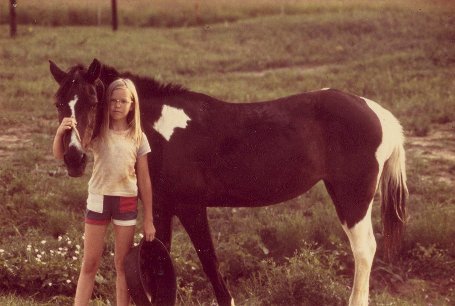
Girls Who Love Horses

Actually, my first love was dinosaurs: at age eight, I knew everything about them. I had a set of dinosaur cards which I could put in chronological order, and I knew that a tyrannosaurus could never have eaten a dimetrodon – they lived millions of years apart, in completely different eras.

I don’t remember exactly when or why horses took over in my imagination; perhaps it started with the books. In fourth grade, we moved to the larger campus of the International School of Bangkok, with a much bigger library. I devoured every book I could find about horses, especially those by Marguerite Henry (Amazon UK | US), with beautiful, full-color illustrations by Wesley Dennis (they don’t print them like that anymore). I bought the few horse books available in Bankok’s paltry English-language bookshop; these were classic English girls-and-ponies stories, recounting a life that seemed very exotic: imagine being able to live at a school where you could also keep your very own pony!

I had very little experience of real horses. When we took family trips to Pattaya Beach, my big treat was a half-hour ride, led by the bridle by the horse hire man. I was always frustrated: I wanted him to let go, so the pony and I could gallop on the sand, just like the scenes in my favorite book, Henry’s “King of the Wind.” There was a polo club in or near Bangkok, where we went once a year for the big American Fourth of July bash. It was possible to take riding lessons there, but my parents never offered; I don’t know why.

I rode in my imagination, and I drew horses, practicing constantly, looking at Wesley Dennis’ pictures for reference. If I couldn’t be near horses, I wished I could at least draw them properly. I felt a thrill of pride the day I finally produced something that really looked like a horse.

The summer my dad and I returned to the US, we visited my aunt Rosie and cousin Casey in the Texan countryside where, to my great delight, I got to ride a few times. When we settled in Pittsburgh, I begged to take lessons, but that was more than my dad could afford as a grad student. I kept riding in my dreams, now with Walter Farley in the Black Stallion books. My mother sent from Thailand a Chinese brush-style painting of two black-and-white horses, which had pride of place in my room among my posters and pictures – mostly of horses.

I spent the summer of 1972 with Rosie and Casey again. Casey had her own horse then, a big palomino called Flash, and there was a small horse for me, a docile old pinto mare called Dolly. We rode, though not as much as I would have liked (Casey was a teenager by then, and had other concerns). We often rode bareback, since it seemed cruel to put heavy western saddles on the horses in the Texas heat. We’d canter across the fields, poor old Dolly laboring gallantly to keep up with Flash. At the end of each ride, we’d steer them into the “tank,” an artificial pond full of muddy water, so they could cool off and drink. On the last day of my visit, we were mounting up for a farewell ride when Flash reared, startled by a puppy that suddenly shot out from under the barn. Casey fell and, landing awkwardly, broke her arm.

The following summer I attended a girl scout camp in Pennsylvania whose activities included riding. I was delighted to do everything with “my” own horse: cleaning, tacking up, feeding, and of course riding. It was a glorious two weeks, except for the time a camp counselor tried to make me drink tomato juice.

I don’t remember getting anywhere near horses while we lived in Connecticut. Then we moved to Bangladesh, and eventually I went to Woodstock School in India. It’s possible to hire horses in Mussoorie, but our allowance as students didn’t stretch that far, and these ponies were such sad, skinny little things that I felt more pity than desire to ride them.

I spent my freshman college year at the University of California, Santa Cruz. Alongside formal classes, the university offered short, informal courses, including riding (off campus). So I began to learn English riding, and again took care of my own horse. He was huge, with hooves the size of dinner plates; I affectionately called him “Moose.”

From my sophomore year of college, I transferred to the University of Texas in Austin. Here, again, I looked for opportunities to ride, finally finding a cheap place out of town where you could hire a horse and ride around in barren fields among the mesquite bushes (not a place you’d want to fall off). I was on my way there one day when I ran a red light and wrecked my grandmother’s old car, which put an end to both driving and riding for some time (I wasn’t hurt in the accident, but had no other way to get out there).

Horses vanished from my life after that, except in artwork and in dreams. The last two embroidery projects I did, during pregnancy and early motherhood, were a pair of carousel horses, for my friends Stephanie and Robin. But the Chinese painting still hangs in my home, and, whenever I doodle on paper, horses flow out of my pen. I rarely got to see horses in Milan, but sometimes we’d run across them elsewhere, and I’d stop to gaze.

It’s all Ilaria’s fault that Rossella got the bug. Ilaria had been Ross’ classmate since preschool. When they were eight years old, she began riding at a stable in Milan, and one day took Ross along to try it out. I was travelling, so didn’t get to see Ross’ historic first lesson, but I heard all about it by phone – it took only the one lesson for Ross to fall in love.

I could afford lessons for her, and had a flexible enough schedule that I could accompany her to them two or three times a week. I made good use of the time: while Ross was riding ponies, I took lessons on horses. She progressed faster than I did, partly because I was travelling a lot for work and had to rebuild muscle after each absence. But I finally became comfortable cantering and jumping, and even got a bit cocky. They say you’re not really riding until you start falling off; I was really riding! Ross and I used to keep score; we were neck-and-neck (in number of falls) for about the first year.

I finally got scared the time I fell on my head. It wasn’t the horse’s fault; I lost my balance after a jump, and just tipped off over his shoulder. I remember the trip down, looking at the horse’s hooves and wondering if I was going to fall under them. I don’t remember the impact, nor anything else for 15-20 minutes after that. I was never unconscious, but there’s a blank in my memory: the next thing I knew, I found myself in the clubhouse, talking to someone, having no idea how I got there, though apparently I had done so under my own steam.

I went to the hospital for x-rays, but there was no damage (I had been wearing a proper riding cap, of course), just a fierce headache. But the joy went out of it for me; I was scared of jumping, but bored of trotting around in the manege, and in Milan there’s no place to ride outdoors. So eventually I gave it up, and these days I’m just an observer.

Rossella continued to ride, and to fall, and to love horses madly. She would volunteer to clean the school ponies, which students were not required to do (their groom loved her). We’d spend hours in the stables, just being with horses, which made us both happy.

The riding school in Milan is very competition-oriented, so the usual progression is from the basics and “pony games” competitions on school ponies, to sharing a pony or buying your own, and moving on to higher competitions. Ross began show jumping on a shared pony in 1999, and in 2000 we began looking for one to buy.

The buying project was delayed by our abortive move to California, but when I returned to Milan definitively in 2001, it was time to look again. Ross had attended riding camp at Wellington Riding in England three summers in a row, so we enlisted their aid in finding a pony for her in England (even with travel costs etc., this is cheaper than buying a pony in Italy, where few ponies are bred). We made a special trip up there in September, 2001, and found Hamish. He finally arrived in Milan in November.

…and this is getting long, so I will gush about Hamish some other time!
Following the War

I’ve read that many Americans, and probably others, are obsessively watching the war coverage on television – and that coverage is closer, more immediate, and probably scarier than we’ve ever seen before.

I’m avoiding the television. I get plenty upset just thinking about it all; I have a vivid imagination and don’t need supplemental images. Instead, I read web news constantly, via several sources. news.google.com is my homepage nowadays. It’s a portal, still in beta testing, which displays several different articles on each top story, refreshing every 5 or 10 minutes. It’s interesting to compare how different sources worldwide cover the same news. I receive the New York Times headlines daily by email, with links to the full articles on their website. You have to register to read the articles, but it’s free, and well worth it.

I check CNN.com now and then just to see the all-American perspective. And I’ve been listening to National Public Radio, an American news source I trust, via their site. I keep open the front page of Il Corriere della Sera, the Italian newspaper, mostly because they have a constantly-updated stream of wire feed headlines. Offline, as always, I read The Economist each week.

When I can’t take any more war news, I go to Slayage for articles about Buffy.


One place to monitor public opinion, strangely enough, is the binaries groups on the Usenet. This is where people post music, movies, TV shows, etc. for others to download, generally the most popular music, TV shows, and movies. But these activities can take on a political flavor. Right now some of the music groups feature collections of American patriotic songs. And, in one of the country music groups, someone is posting Dixie Chicks songs with headings like “music for traitors” and “to oppose the war is to support terrorism.” (These statements don’t go unchallenged.)

In the video groups, people are posting excerpts from American news programs, including one titled “This is why we fight – Iraq executions, 1991.” (No, I didn’t download that.) Only two parts of the Oscars have been posted, the “In Memoriam” section, and Michael Moore’s acceptance speech.

Italian Incidents

Three cars belonging to American personnel have have been burned in Vicenza (near the Aviano airbase). One was a Jeep Wrangler, very obviously the property of an American. (There aren’t many of those in Italy, for good reason: fuel costs four times as much in Italy as in the US, and there are many streets where a car that size simply wouldn’t fit.) A group calling itself “I Nuclei Territoriali Antimperialisti” has claimed responsibility.

Though for thinking people it’s not true, it’s hard not to feel that, for many Europeans, pacifism equals anti-Americanism. The US Embassy emailed yet another warning this week about avoiding demonstrations. I overheard a conversation in our local bar the other day: An American couple living in a nearby building had draped US flags from their balconies. They were asked by their homeowners’ association to remove them, to avoid vandalism to the building.

We’re erring on the side of paranoia, perhaps. Ross bought a trendy new school backpack a few weeks ago. She chose a model with the Union Jack on it, because she’s very fond of England and her relatives there. When the war started, we got a bit worried about that. So she has temporarily traded (for his plain blue model) with a schoolmate who will never be mistaken for a Brit or an American.

News Coverage of the Second Iraq War

I find the news coverage of this war emotionally confusing, when contrasted with my memories. When we returned to the US in 1972, I had my first exposure to television news. At the time, Walter Cronkite closed every evening’s newscast with a list of American and Vietnamese (north and south) casualties – which ran to the hundreds most days, if I remember correctly. I now suppose that it was his way of protesting, but at the time it upset me; I felt he was being callously dismissive of all those deaths. I had a personal stake: my dad had been in Vietnam (as a civilian, with the US Agency for International Development), and could easily have been one of those numbers.

So it feels odd to me that every news source hurries to reports when one or two or a dozen of ours are killed. I want to scream: “It’s a war, people, what did you expect?” I could well be misinterpreting, but I wonder if the Powers That Be, and/or the media, have tried to persuade the American public that you can have a war without any actual casualties on your own side. That you can be a soldier without actually risking your life in combat.

I don’t really even know what I’m saying here, and am very confused about my own feelings. But, for what it’s worth, I’m sharing them with you.

I find it grimly ironic that the American news media are making a big deal over whether or not to show the Al Jazeera footage of captured and killed Americans. I understand the need for delay, of course: their families should not have to learn about it from television. But all this public soul-searching and breast-beating by the news organizations – so that the decision to air or notitself becomes news – is that necessary?

For better or for worse, the Italian media has no qualms: the footage was shown yesterday on TV, and can be viewed on the website of Italy’s major newspaper, Il Corriere della Sera. Apparently the bodies were edited out of this version, but it seems to show the entirety of the interviews.


In Italy, the protests continue, large and small, organized and not. Saturday there was a big demonstration downtown. Ross and I were on the metro when a number of the demonstrators were heading home, with their rainbow peace flags, scarves, etc. (After many visits to San Francisco, I associate the rainbow flag with gay pride. I was confused when I saw the first peace flags weeks ago – it seemed unlikely that so many gays had suddenly come out in our neighborhood!)

One of the protestors was wearing a sweater with a large “Levi’s USA” label. Mixed metaphor?

I wasn’t paying attention to their conversation, until a guy sitting next to me jumped in, saying: “These Americans have it easy against the Iraqis. If they took on the Russians or Chinese, it would be a different story.” Huh? Does he think the US is doing this just to beat up on somebody? Then he added: “I’m a leftist.” Meaning what? That you’re automatically anti-American? But I squelched my combative nature, and kept all these thoughts to myself.

I would have more sympathy with the protestors if I were convinced that more of them actually knew what they were talking about. I am always willing to listen to an intelligent argument on any side of a question. But I suspect that many are anti-war and anti-American simply because it’s trendy and fun to go to peace marches, hang out flags, etc. And, for the schoolkids, it’s a great excuse not to go to classes. But do they really know anything about the issues?


Berlusconi, meanwhile, manages to have his cake and eat it, too. After a vituperative debate in parliament, US airbases in Italy are allowed to be used for logistical support, but not as a point of departure for bombing runs, “because we are a non-belligerent country.” This after Berlusconi’s many eager protestations of support to Bush and Blair over the last few months. Airbases in Germany are being used in exactly the same way.

Here We Go Again: The Beginning of the Second Iraq War

Whatever one’s feelings about the rightness or otherwise of it, war is never a comfortable time. This one in particular is cause for nervousness among Americans overseas. I’ve just received email from the US Embassy in Rome advising “American citizens in Italy to take prudent steps to ensure their personal safety in the coming days. Remain aware of surroundings, avoid crowds and demonstrations, keep a low profile, vary times and routes, and ensure travel documents are current.”

Strangely enough, all this is very familiar to me. In 1984, I made a long visit to my dad in Jakarta, Indonesia, and ended up working in the commercial section of the US Embassy. One of the perks of the job was an Embassy carpool which took us to work and home again every day.

Then the Islamic Jihad issued death threats against US and European citizens in Indonesia (I don’t remember why, if there was any reason other than “We hate you”). The French and British embassies promptly evacuated all diplomats’ families. The US Embassy didn’t send anyone home, but instituted security measures, like varying the times and routes of our daily carpool rides to the office. “Varying times” meant that the car could show up anytime between 6:00 and 9:00 am, and “varying routes” meant that the trip could take even longer than usual. In the event, nothing happened, and after a while life returned to normal, though a year or two later a rocket was fired into the Embassy grounds.

So I am eerily accustomed to this feeling of being under seige, of having to think about where I should and shouldn’t go (no more movies in English at the cinema, maybe no cinema at all). No big change in lifestyle is needed; I rarely find myself among crowds of Americans anyway. A “worldwide caution” also just issued by the Embassy warns of “potential for retaliatory actions to be taken against US citizens and interests throughout the world.” Okay, so I won’t eat at McDonald’s or Burger King — no great loss! (Later: A McDonald’s window was smashed in Milan during peace protests on Saturday, March 22.)

I had much the same feeling of “they’re out to get me” for some time after 9/11, with one big difference: this time, a lot of Italians have it in for me, too. In Italy, as elsewhere in the world, there have been huge peace demonstrations, which the US embassy advised American citizens to avoid: not all the demonstrators would have distinguished between George Bush and Americans in general. There are also a lot of Arabic-speaking and/or Muslim immigrants and businesses in our neighborhood. I’m not sure what to think of them or what they would think of me, especially since Milan was found last year to harbor Al Qaeda’s European headquarters (NOT in our neighborhood).

It’s depressing, this feeling that some people hate me enough to kill me simply because of my citizenship, and wouldn’t bother to find out first what I actually think about things.

And, as is inevitable for Woodstockers, I know people directly endangered by the war: an Indian schoolmate living in Baghdad with her Iraqi husband. Her mother taught me Hindi for several years and was our class homeroom teacher; I worry about her, worrying about her daughter (ironically, her son lives in the US).