Tag Archives: bio

The Nose Knows: Gut-Level Attraction and Repulsion

Kerry Bailey wrote in his blog recently:

…for some reason I can’t quite pin down I hate morbidly obese people. Just something about them fills me with this unexplainable anger. It’s like this weird sort of intolerance or racism that I’m not quite sure how to squelch. …

It’s somewhat ironic that I, as a gay man, have – in those instances – so little tolerance. Anyone got any ideas as to how to defeat those “ARRRRRRRGHGHGHG urges” ?

…which inspired me to write down something I’ve been thinking about for a long time.

It seems (to researchers, not just to me) that our brains subconsciously recognize people who are fit for us to mate with – or not – and we feel attraction accordingly. One instrument of this subconscious evaluation of fitness is the nose. I began wondering about this many years ago, thanks to experiences with my own sense of smell.

In high school I started “going with” Kris, who seemed well suited to me in geekiness, interests, etc. But an incompatibility soon became evident: he smelled wrong. Really bad, in fact. Not as in “didn’t take a shower,” but there was something about his personal smell that was absolutely repellent to me. I told him about it, and he tried new deodorants, colognes, etc., but nothing helped. I finally broke up with him essentially because of this. I felt mean and shallow about it: I liked him otherwise, but just couldn’t bear the smell of him. It seemed so irrational, and he was deeply hurt.

Years later, I met Enrico. We had a picnic together with the friend who introduced us, ended up at a party together the same evening, went to a concert on the green, then to a disco, then to his place and to bed. It was a hot summer night and, as I lay there with my nose literally in his sweaty armpit, I thought: “This guy smells good!” We’ve been together for 20 years now, 17 of them married, and have a gorgeous, healthy daughter. Obviously, he was a good match for me, and my nose knew it instantly. He still smells good to me today.

Some years later I read an article in the Economist on studies showing that humans unconsciously recognize via smell people with whom they are well suited to reproduce (suited in terms of immune factors – the more different these factors are between the parents, the healthier the offspring). In the words of Cole Porter: “It’s a chemical reaction, that’s all.”

An older woman friend to whom I told this story was relieved to hear it. She was dating a man whom her family thought ideal for her (interesting, well-off, etc.). There was no rational reason for her not to like this guy, and in fact she did like him – but not the smell of him, for which she felt the same kind of visceral repulsion I had felt with Kris. She was past reproductive age, but, nonetheless, her nose insisted that something was wrong, and she couldn’t get past this “irrational” reaction.

I stayed in touch with Kris because he was my Woodstock classmate, and saw him a few times after we graduated in 1981. I even hired him for an internship with the (tiny) company I was working for in 1987. But over the years he got weird and weirder, and I was increasingly uncomfortable around him. He died in California in 1999, having lost control of his vehicle on a highway at 2 am and crashed into a bridge support. An autopsy showed that he had had a long-standing brain condition that probably caused a seizure that night. I never got all the details, but another classmate who had stayed close to Kris (and who informed me about his death) was told by the doctors that a symptom of this condition would have been shaky hands – which friends had noted back in high school: we used to tease him about drinking too much coffee. This friend also told me that Kris’ co-workers had once complained to him about Kris’ smell and asked him to tell Kris to shower more often!

So it wasn’t just me, and it wasn’t just “he’s a weirdo” – there was something physically wrong with Kris which eventually killed him, and many people’s noses told us to stay the hell away, even when we liked him as a person and mating wasn’t an issue.

The conclusion I draw from all this is that perhaps we find certain people repellent (odoriferously or visually) because they are unfit for us to mate with, and our brains subconsciously know it and try to surface this knowledge: “No! Stay away!” This reaction is “irrational”: we don’t really expect to reproduce (or even come close) with everybody we meet. But these instincts are very old and ingrained, for good reason. Human beings (like other animals) have been selected by evolution to find attractive those potential mates who are reproductively fit; the traits that make people beautiful to us are (sometimes misleading!) signs of reproductive health.

I suspect that the converse might also be true: that we find certain traits (such as obesity) repellent because we have evolved to perceive those traits as symptoms of underlying problems (genetic or disease) that make a person less fit to reproduce.

This doesn’t mean that I believe obese people are genetically “wrong” or diseased, nor that I condone treating people badly based on their weight or anything else. But perhaps it explains why sometimes, in spite of our best ideals and intentions, we react negatively to some people, and can’t even explain why we do.


Paint It Black

The weekend didn’t turn out as planned. Shortly after I sent my brief newsletter last Friday, my dad called to say that he and Ruth both had a bad flu and I shouldn’t come for the planned visit to them in England, lest I catch it.

Not a dead loss – the weather at home was finally warming up, and I was itching to get to work on my garden, which I did so much on Saturday that my back and knees were aching Saturday night.

Sunday more of the same. I was just coming back into the taverna (our ground/basement floor family room) from the garden when the phone rang. It was my dad, to tell me that my aunt Rosie had died.

It wasn’t unexpected – in fact, when he called Friday, his dolorous tone had me convinced for a moment that he was about to tell me that. Rosie had been in the hospital for about a week this time, with a high fever and at least three different infections. But death, even when expected, comes as a shock. I probably sounded strange and cold to my dad. I hung up the phone, walked towards the door, then crouched on the floor. The most extraordinary sounds started coming out of me. Howls, I guess. I didn’t know I could make noises like that. Even while I was making them, some detached part of my brain was thinking: “Well, at least I still know how to grieve. I guess that’s good.”

I’m still in shock. Sometime later I will explain just why and how Rosie was so important in my life. But I had to deal with practicalities like plane tickets. Which was so frustrating that at some point I said to Enrico: “All this is apparently designed to piss me off and distract me from the pain I’m in.” (I had drafted an article about KLM’s wonderful attention to their customers; as of today, that is due for some radical revision.)

Ross and I will arrive in Austin late Wednesday, the funeral will be held in Taylor on Saturday, and we leave again early Monday morning. Rosie’s daughter Casey and I are looking for a jazz band to play “When the Saints Go Marching In” (Rosie’s request). Casey says the funeral will not be held in the church, “because we wouldn’t be able to have any fun.” And fun, to celebrate a life such as Rosie’s, is absolutely necessary. She was an extraordinary woman, and I owe to her a lot of who I am.

MBA: Collecting My Dues from the Open University

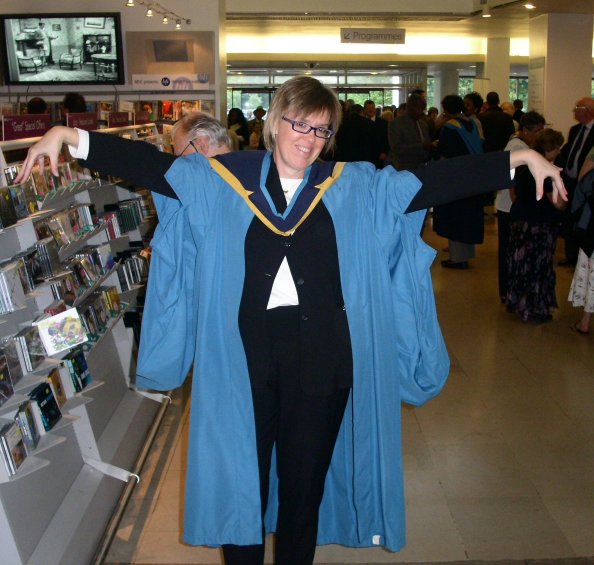
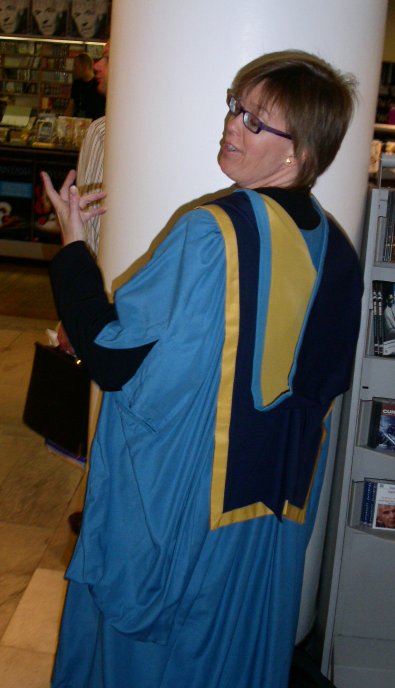
top: The very medieval scholar’s robe. I suppose the bag-like sleeves were originally intended for carrying around one’s scholarly scrolls.

2:57 min – video shot June 10, 2005

I went to London to collect my MBA from the Open University. Attending the ceremony was not obligatory, but I’d missed my BA graduation, and thought it would be fun to do the cap and gown thing.

The ceremony was held at the Royal Festival Hall, where we were supposed to arrive early to collect our (rented) gowns and have official photos taken. The Open University holds around 20 such ceremonies every year, giving graduates a broad choice of places and times to attend. Several hundred people were present that day to collect degrees from BAs to PhDs in every conceivable subject, accompanied by their beaming families.

MBAsm

We were a representative slice of what is probably the world’s most diverse student body. The Open University was founded (in 1967) to open up education to people who otherwise had not had and might never have the opportunity to pursue a university degree. The institution has succeeded wonderfully at this. Few of the graduates were the usual college age; the oldest I saw looked to be well into her 70s, and she wasn’t the only grandma in the group. Many were non-white, with a large contingent from Africa (Somalia and/or Ethiopia, I think), where the OU has been operating for years.

Most of us graduates didn’t know each other, but each had a small cheering section of family, in my case my dad and his wife Ruth, but it was more common for graduates to be attended by their spouses, children, and even grandchildren!

At first we clapped and cheered everybody, but that got tiring. Ruth told me later that she settled on a strategy of applauding the oldest, the least-advantaged, and the handicapped. Judging by the volume, much of the audience made the same choice. An elderly black lady with gray hair got a huge ovation, startling the Dean of Students who was performing handshake-and-congratulations duties. He asked her something, then turned to the audience with a huge grin and shouted: “Five grandchildren!”

About That Gown

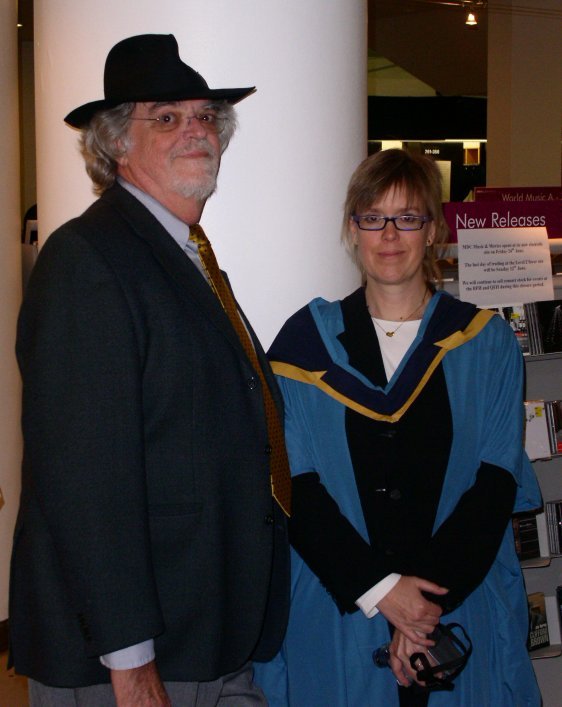
Like everyone else, I rented the gown and hood, and was carefully allocated the items pertaining to my newly-attained qualification. The pale blue robes are for Masters (Bachelors wear dark blue, Doctors shiny electric blue).

Note the carefully-arranged hood, proving to anyone who understands the arcane codes of these things (it depends on the colors and even the width of the trim) that I have an MBA from the Open University. I now have the right to wear this get-up at any future academic “congregation” I attend, until and unless I earn a still higher degree. Of course, I would have to actually buy the thing for any such occasion…

If you’d like to learn more about the Open University, there’s a new site (2014) for students outside the UK and Ireland.

hood

dad at my MBA grad

My very proud Dad.

Licensed to…

Dec 10, 2004

er, do business? I learned this week that I’ve passed the exam for the last course in my MBA from the UK’s Open University. So I can now put “MBA” after my name on my visiting cards, as is the custom in some parts of Europe. (I’m not sure it will do me much good in Italy, where few people know what an MBA is.)

I started this degree in 1999, when I realized that, if I had had to apply for the job I was actually doing at Adaptec, the description would have said “MBA strongly preferred.” My original intent was to show my bosses that I was serious about my career, in spite of the strangeness of my situation (working long-distance from Italy for an American company).

The Hundred Years’ War

The Strange Religious History of the Straughans

shot Mar 6, 2005, 7:29 mins

Some of my recent articles have caused some readers to wonder why I have it in for Catholicism. Actually, I am even-handed in my dislike of religion: I don’t like any of them. But, due to family history, I have un dente avvelenato in particular for Catholicism, and for the American Southern Baptist church. My father’s mother was a devout Catholic, my grandfather a born-again Baptist. Why they married in the first place was never clear to me, but the decades-long war that ensued left the rest of the family with an unpleasant taste in the mouth about both their religions (none of their descendants is now Catholic OR Baptist).

While I was visiting my dad in England in March, we started what will doubtless be a very long project: getting his life, and all his stories, on video. One of my questions was: “Why did Mamaw and Pawpaw get married?” Here are his thoughts on that, and on what happened afterwards.

A Home for a Horse

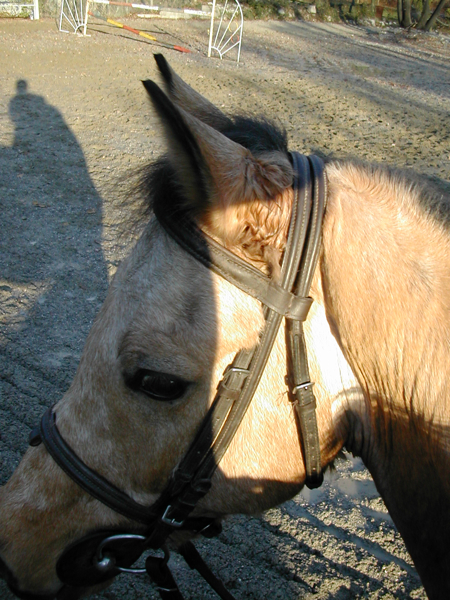
I mentioned long ago that my daughter and I both love horses, and that we’ve had one (for her) since 2001. Now, very sadly, we are having to say goodbye.

Ross had already been riding for about four years when I finally decided (and had the opportunity) to buy her a pony of her own. We went to England to look for one, because ponies are a lot cheaper there – even counting the cost of our trip and then transporting him to Italy, we paid about half what we would have in Milan. But the buying is only a small fraction of the cost of a horse…

In retrospect, it’s a sad irony that we found Hamish and agreed to buy him on September 8th, 2001. We returned to Milan on the 10th and, as everybody knows, the world changed on September 11th. Had I known then what I know now about the world economy and my personal finances, I probably would not have started down the path to horse ownership.

Back then, it didn’t seem so crazy. I had plenty of money in the bank from my Silicon Valley heyday, and the prospect of making more freelancing for my former employer, Roxio, writing manuals for their European software WinOnCD. (In fact I did write manuals for versions 5 and 6, and was set to do that and more for version 7, when Roxio closed its German office. WinOnCD – and many people’s jobs – vanished.)

We kept Hamish expensively at a snobby stable in Milan for two years. Ross rode a lot, but never won any show jumping competitions, in part because Hamish is… difficult. There are ponies that, if you more or less aim them at a jump, will do everything they can to get you over it and win for you, no matter how badly you ride them. Those sorts of ponies cost a lot, and Hamish isn’t one of them. He requires to be ridden very well, which Ross did, but not quite well enough.

We also had some friction with Ross’ riding instructor, I suspect partly motivated by the fact that we had not bought Hamish through her, so she didn’t get the customary cut on the purchase. Whatever the reason, this instructor had no patience with Hamish’s foibles, and kept nagging us to sell him and buy a better. Even had I had that kind of money (oh, say, $15,000), that was not the lesson I wanted my daughter to learn about horses and sportsmanship. To me the point was never “spend as much as it takes to win,” but to develop a loving, trusting relationship with an individual animal, and win whatever you can, together, in harmony and friendship.

God help me now, that loving, trusting relationship is exactly what Ross and Hamish had. She sometimes grew frustrated with his stubbornness, tired of feeling foolish in front of her peers at competitions, but she stuck by him and defended him, and was praised by some other parents tired of their kids’ endless (expensive) litany of “If I only had a better pony.”

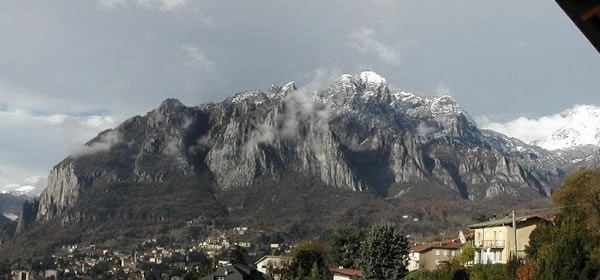
By the time we moved to Lecco last summer, financing a horse was becoming a problem, and we all heaved a sigh of relief to be paying far less to keep him, at a place where he could even be out in a field every day. But we couldn’t find near Lecco a reasonably-priced stable which included professional instruction. And, now in high school, Ross has less and less time; as I’ve mentioned, her curriculum at liceo artistico requires a school week of 35 hours, which, along with homework, leaves little time for anything else.

Ross continued to ride as much as she could, until she broke her arm a year ago, falling off Hamish onto frozen ground. That put her out of action for several months. She rode a bit in the spring, then the remainder of the school year was a mess – between extra tutoring and lots of studying, there was simply no time. In the summer she was happily away at theater camp for six weeks, rode a bit when she came back, and then we were in the throes of moving again.

In sum, Hamish has been left largely to his own devices this year, and is now out to pasture, not being ridden, and increasingly unrideable. With the new house, family finances are squeezed to the point that we can’t afford to just keep him (at 12 years, he’s not quite in his prime, but nowhere near retirement, either), nor do we have the time or money to put into riding him the way he should be ridden. So we have come to a parting of the ways.

It’s far easier to acquire a horse than it is to get rid of one, if you care at all about where it ends up. It would be easy enough to sell him to a horse dealer, but he’d probably end up at a slaughterhouse – this is Europe: people eat horses, and wear them.

The solution we have found is a stable on Lago Maggiore, where some friends keep their horses and ride, and we know the owners fairly well. Most importantly, we like their attitude towards and handling of horses. They may eventually sell him (and we might even get a cut), but they won’t sell him off to just anybody. They’ll do their best to find a good home for him and, at worst, they’ll just keep him. Ross can even go and visit from time to time.

Hamish leaves tomorrow morning. It’s a horribly painful loss for Ross and me both. I wish I could spare my child this. I almost wish we’d never started. But, on the other hand, horses have given her so much, and can still give her so much more, and she them. I can’t regret it. I can only hang on, and help her to. This time tomorrow, it will be over, hopefully without any last-minute getting-Hamish-into-the-van traumas. It will be over, and Ross and I will have survived it. Somehow.