Joyent hosted a node.js community event at our San Francisco offices the other evening, in which Ryan Dahl announced a new version of node.js, and Brendan Gregg showed some amazing stuff you can do with Joyent Cloud Analytics on your no.de hosted site to understand what’s going on in your node.js app.
Technical difficulties with UStream meant I didn’t have a stream recorded to their servers that night, technical difficulties with everything else meant I couldn’t get these rough cuts hosted anywhere til now. This is exactly what you would have seen on the stream (and more), including the bad camera angle which was forced by… oh never mind. A better view of cloud analytics will be forthcoming.
(NB: These videos disappeared from Joyent some time ago. Sorry.)
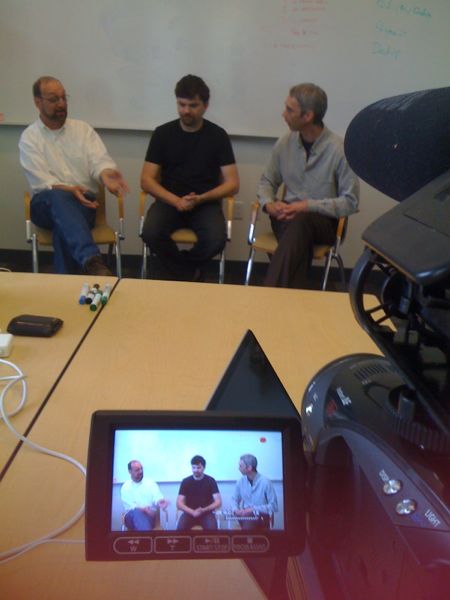
^ top: Ben Rockwood, Deirdré Straughan, Brendan Gregg
I received email from a concerned reader saying: “when a writer stops writing, one of two things is happening:
— you’re blissfully happy, too happy to attempt to put it into words
— you’re utterly miserable, too miserable to find the energy to put it into words”
As I told him, it’s been both. Between health problems and a job/company that were (increasingly clearly) not a good fit for me, I was not in a happy place for quite a while. I returned to work at Oracle in early November after ~5 weeks’ medical leave, but desperately wanted a change.
That change came on December 1st: I began a new job with Joyent, a company which several Sun luminaries (far more luminous than myself) had joined over the previous months. I’m not an engineer, but when big names in Solaris engineering such as Bryan Cantrill, Jerry Jelinek, and Brendan Gregg all head to the same company, it’s time to take a look at what that company might be up to. There were other companies worth looking at for the same reason (and I did), but Joyent won out.
What Joyent does is cloud computing, a buzzword that I suspect even the non-technies among my readers have heard by now. Wikipedia describes it thus: “Cloud computing is Internet-based computing, whereby shared servers provide resources, software, and data to computers and other devices on demand, as with the electricity grid. Cloud computing is a natural evolution of the widespread adoption of virtualization, Service-oriented architecture and utility computing“.
Joyent has been offering cloud computing as a service for over five years: some of your favorite Facebook games run on Joyent infrastructure. But recently Joyent has begun partnering with companies such as Dell to sell our cloud software with their hardware to third parties who want to run data centers and/or sell their own cloud services.
Where do I fit into this? As the new Director of Technical Education, it’s my job to help customers at every level – from end users to service providers to systems integrator partners – learn how to use our stuff. Which means getting highly technical information out of my colleagues and putting it into a format that can be shared with other people: a familiar theme in my working life.
I’ll still be using video, but in this job I will also be designing and likely even personally delivering technical courses, in the classroom as well as via video. This is a return to the early days of my high-tech career, when I designed and taught custom courses in desktop publishing, then installed and trained people to use desktop publishing systems for the World Bank in Cameroon and Tanzania.
As a working environment, Joyent is as different from Oracle as you can get. It’s grown from 22 to 100 employees this year (thanks to some investment, in particular from Intel) and there’s still way too much work for everyone to do. The attitude is very much that things need to get done, and “it’s better to seek forgiveness than ask permission” – which, as old Sun hands know, was once Sun head Scott McNealy‘s mantra. Those who have worked with me or observed me working know that I thrive in this kind of environment, though I’m having to unlearn some Oracle conditioning (amazing what a company can do to you in only nine months).
I was sad to leave my Sun colleagues (those who hadn’t already left themselves), though of course I was rejoining some. I spent Thanksgiving weekend editing The Faces of Sun, a video tribute to some (though nowhere near all) of the amazing people I got to work with and film at Sun.
Since I started at Joyent I’ve been extremely busy (startup hours), and expect that to continue and increase, including some travel. I probably won’t have a lot of time for my site/blog; the best way to keep up with my daily doings will be Twitter @deirdres
Warmest wishes for whatever holiday you celebrate and for a wonderful 2011!
I’ve been meaning for a long time to make a video tribute to the amazing people of Sun Microsystems. It has been my honor and privilege to work with some of the finest minds in this industry (or any industry), many of whom I also got to film at Sun conferences and other events worldwide.
While it’s breaking my heart to witness the diaspora of Sun talent, I take comfort in knowing that, in new companies with new projects, these folks will cause a thousand new technologies to bloom. I look forward to seeing what everyone gets up to – including those who remain at Oracle – and hope you’ll all stay in touch and keep me posted. Though a situation like Sun may be unique and unrepeatable, I expect I’ll work with you again someday.
Most of the footage shown here I shot myself over three years, in varying conditions and with varying equipment. A few of these clips are someone else’s footage that I post-produced or edited. A few of the more engaging clips were created by the teams participating in the Go Game during the OpenSolaris Developers’ Summit held in 2008. Those aren’t my work, but – if you’ve got footage of David Korn dancing, you use it! (No, he was not a Sun employee; there are a few other “friends of” in here as well.)
The photos are mostly mine. I chose the song primarily for its bouncy and variable tempo, so if you find yourself juxtaposed with an unflattering lyric, don’t take it personally – it wasn’t intentional. Apologies to the many who were left out – I have too much material for one three-minute song! If you’re neither in the video nor in the Missing list below, let me know in the comments and I’ll add you.
Dec 28, 2010 – Have started updating the lists below with “where are they now” information – feel free to add comments if you know something I don’t! (And can add people who aren’t on these lists.)
Starring
in order of appearance
(Bruno Souza) at OSCON 2009 – Brazilian government?
Dominic Kay at SNIA SNW 2008 – Oracle
Tim Thomas at Sun’s London office, Jan 2009 – ?
Valerie Bubb Fenwick at OSCON 2009- Oracle
Cindy Swearingen at Sun’s Broomfield campus, Jan 2010- Oracle
John Sonnenschein, Go Game at the Open Solaris Developers’ Summit, Santa Cruz, 2008 – Joyent
John Fowler at SC08, Austin- Oracle
Andy Bechtolsheim at SC08, Austin – Arista
Rick Ramsey & Darren Moffat at OOW10 – Oracle
Rossella Laeng & April Hall at SC08, Austin – n/a
Jeff Jackson celebrating Mardi Gras at Sun’s Menlo Park campus, 2009 – ?
Josh Simons at SC08, Austin – ?
Sara Dornsife at the Open Solaris Developers’ Summit 2008 – PayPal
Sunay Tripathi at the Security Summit at LISA09 – ?
Roch Bourbonnais at Sun’s San Francisco office, March 2010- Oracle
George Wilson in San Francisco, July 2010 – Delphix
Constantin Gonzalez at the Open Solaris Developers’ Summit 2009- Oracle
Niall Power at Sun’s Dublin office, Jan 2009
Dan Templeton, Miha Ahronovitz, Gregory Shirin at SC08, Austin- Oracle
Mike Shapiro & Steve O’Grady in San Francisco, Sept 2008 – ?, still at RedMonk
Alan DuBoff et al Go Game at the Open Solaris Developers’ Summit 2008 – ?
Dan Maslowski & Scott Tracy at CommunityOne 2009- Oracle
Scott Rotondo at OSCON 2009- Oracle
Dennis Maher at the Security Summit at LISA09- Oracle
Ashu Tripathi at the Open Source Grid & Cluster Conference 2008- Oracle
Bruno Souza & Jack Adams at OSCON 2009
Juergen Schleich at home 2009
Simon Phipps, Charlie Boyle, Angel Camacho in Porto Alegre, Brazil 2009 – Forgerock, Oracle, EMC
Java fans with Roger Brinkley at FISL 2009
Teresa Giacomini at FISL 2009- Oracle
Tim Bray & Bryan Cantrill at OOW09 – Google, Joyent
Durjoy Mazumdar at OOW09- Oracle
Joost Pronk at OOW10- Oracle
Darren Moffat at the Security Summit at LISA09- Oracle
Liane Praza, Dave Miner, Bart Smaalders, Dan Price, Dan Roberts at LISA10- Oracle, except for Dan R.
Markus Flierl at the Solaris Summmit at LISA10- Oracle
Liane Praza at the Solaris Summmit at LISA10- Oracle
Glenn Faden at the Solaris Summmit at LISA10- Oracle
Nicolas Droux at the Solaris Summmit at LISA10- Oracle
Ellard Roush at the Security Summit at LISA09- Oracle
Art Licht at the Open Road to Storage, Broomfield, 2009- Oracle
Alex Barclay at the Laureate Institute for Brain Research, Sept 2009
Meenakshi Kaul-Basu at Sun’s Menlo Park campus 2008- Oracle
Gia-Khanh Nguyen at Sun’s Menlo Park campus 2008- Oracle
Graham Scattergood at Sun’s London office 2009
Jim Mauro (stunt) & Dan Price at LISA10- Oracle
Jack Adams & Nick Solter at OSCON 2009 – ?, Context Optional
Diana Wadding at Sun’s Broomfield campus 2009- Oracle
OSUG Leaders, Tim Marsland at CommunityOne 2009 – ?
Kelly Nishimura & Bill Franklin at CommunityOne 2009 – ?, ?
Joy Marshall, Frank Lindquist, Lynn Rohrer at CommunityOne 2009- Oracle, ?, Oracle
Bruno Souza & Aaron Newcomb at FISL 2009 – ?, Oracle
David Gwynne & Garrett D’Amore at the Kernel Conference Australia 2009 – ?, Nexenta
Kris Hake at CommunityOne 2009
Lynn Rohrer at FISL 2009- Oracle
Christoph Schuba at the Security Summit at LISA09- Oracle
Drew Wilson at LISA08- Oracle
Fritz Ferstl at the Open Source Grid & Cluster Conference 2008
Jeff Bonwick & Bill Moore at SNIA 2008, maybe – mystery startup (both of them)
? & David Korn Go Game at the Open Solaris Developers’ Summit 2008
Ben Rockwood & Deirdré Straughan at LISA09 – Joyent
Kuldip Oberoi & Don Kretsch at Sun’s Menlo Park campus 2010- Oracle
Jim Mauro at Sun’s San Francisco office 2010- Oracle
Brendan Gregg at Fishworks 2010 – Joyent
Jeff Cheeney, Jim Grisanzio, Michelle Luna, Chris Baker Go Game at the Open Solaris Developers’ Summit 2008 – ?, Oracle, Oracle, Oracle
Harriet Coverston at the SAM-QFS BoF at SC09 – ?
Brendan Gregg at Sun’s Broomfield campus, FROSUG Oct 2009 – “Who turned out the lights?”
Missing
People I have actually filmed but could not lay hands on the footage, or there just wasn’t room for it (this list is destined to grow). Some of these videos are were for a time available on blogs.sun.com/video, others were lost in the move to Oracle (not by me!). A lot of the video I shot for Sun/Oracle (and more) is on my YouTube channel.
Aaron Dailey- Oracle
John Forte- Oracle
Jim Dunham
Spencer Shepler
Robert Thurlow- Oracle
Mark Carlson- Oracle
…and a bunch of others at SNIA SDC 2007. And 2008.
Stephen S. Teppler Esq.
Glynn Foster- Oracle
the NWAM team- Oracle
Peter Karlsson- Oracle
Philip Torchinsky- Oracle
Bill Nesheim- Oracle
…and several others at Tech Days Hyderabad
Charles Baker- Oracle
Clay Baenziger- Oracle
Arnaud Lacour – ?
…and others at various editions of FROSUG
James McPherson- Oracle
Max Bruning – Joyent
Sherry Moore- Oracle
Gavin Maltby
…and others at the Kernel Conference Australia 2009
In the last few months, I’ve spent a lot of time on the DTrace book: copy editing, managing the review process, and (ongoing) marketing – keep an eye out for video! Also provided care and feeding and a quiet place to work for one of its authors, Brendan Gregg, shown above.
Brendan and co-author Jim Mauro did an insane amount of work for this book, spending many late nights and long hours to write nearly 1000 pages (before final publishing layout) of mostly original material: 57 topics covered in over 150 new scripts and 150 new one-liners (beyond Brendan’s existing DTrace Toolkit), requiring a lot of new thought and invention. It all adds up to a comprehensive DTrace cookbook that will be useful to sysadmins, developers, students, or anyone needing to provide support and/or performance troubleshooting for systems running Solaris, MacOS X, or FreeBSD.
Here’s the Table of Contents:
1. Introduction
2. The D Language
3. System View
4. Disk I/O
5. File Systems – sample chapter available
6. Network Lower Level Protocols
7. Application Level Protocols
8. Languages
9. Applications
10. Databases
11. Security
12. Kernel
13. Tools
14. Tips and Tricks
Appendices:
A. DTrace Tuneables
B. D Language Reference
C. Provider Args Reference
D. FreeBSD Guide
E. USDT Example
F. Error messages
G. DTrace Cheatsheet
Glossary
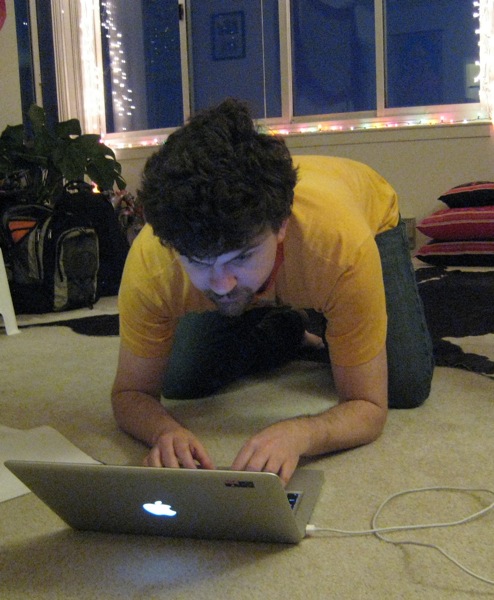
The picture below was taken in the final throes of writing, when Brendan got down on the floor to plug in his laptop, and didn’t have time to get up again: he was chatting online with Jim, ironing out last-minute details. The manuscript is now with the publisher for final editing and layout – and we can all breathe a sigh of relief.
NB: This is a companion post to How ZFS Really Gets Done, in what might be an ongoing series about “My Life Among the Geeks” (hey, I’m allowed to use the term – I’m a geek, too).
In the last three and a half years, working for Sun Microsystems and now Oracle, I have produced over 300 video assets, ranging in length from 10 minutes to 3 hours. Most of this material is software engineers talking about deeply technical topics.
By YouTube standards, our audience isn’t large: my videos have had a few hundred to a few thousand views apiece. So why bother? What’s the ROI?
This breaks down into two underlying questions:
Why share this kind of information at all?
Why do it in the form of video rather than, say, technical white papers?
Why Share Technical Information?
Although most of my videos have a limited potential audience, those who watch them are the system administrators, developers, and other techies who use our technology in jobs revolving around large, complex systems for hugely complex computing and storage tasks. They are influencers, if not direct decision-makers, in major IT purchases. They prefer to get their information from those who know it best – the engineers who create the products – and they don’t want any marketing spin on it. To these folks, great engineers are gurus, and access to our engineers’ knowledge is a selling point. My technical videos never say: “Buy this technology, it’s great!” They don’t need to, because they feature the engineers who designed it telling you why it’s great.
Why Use Video?
More Effective Learning
Although the percentages on the “Cone of Learning” are open to question (in fact, the author of the original, Edgar Dale, disavows any such numbers on his original diagram), the hierarchical concept itself is common sense. Think back to your own education. Most people find it hard to learn simply by reading. (Otherwise, why take notes from textbooks?) You absorb more by seeing and hearing an engaging teacher. Better still are small, seminar-style classes in which you actively participate. Next on the hierarchy is hands-on learning where you do something yourself (how vivid are your memories of dissecting frogs in high school science?).
Seminar-style learning and hands-on training are beyond the scope of my current job (Sun/Oracle offers classes through another department). But we can certainly do more to engage and instruct our audiences than plain old text.
More Efficient Information Transfer
Top engineers are extremely valuable people whose working hours, from their employers’ point of view, are best spent coding. Even those who have the (quite different from coding) skills and inclination to write papers or blog posts, often simply don’t have the time.
It didn’t take me long at Sun to realize that the most efficient way to get information out of engineers was to film them. This was even easier when, as often happened, they were already creating presentations for conferences or internal seminars. It cost them no extra time or effort for me to film, edit, and publish video of that same presentation. (Video also extends the reach of such presentations to people around the world who cannot attend them in person.)
Outside of formal presentations, you can still tap engineering expertise for video. Sometimes it’s just a matter of getting the right people in a room and letting them talk. Back in March, we had a rare confluence of three of our top performance engineers (Jim Mauro, Brendan Gregg, and Roch Bourbonnais) in the same city at the same time. With Dominic Kay chaperoning, we spent about four hours in a conference room, resulting in at least three hours of usable video (not all of it published yet). As Brendan later pointed out, among all possible forms of technical information transfer, this was by far the most efficient return on his time.
You may be wondering how much it cost to produce all this video. I have a very complicated spreadsheet in which I track details on every event I’ve filmed. I determined costs, calculating in my time (shooting, editing, managing) and travel, the cases where I did the shooting but paid someone else to edit, or I received tape that someone else had shot and I did the editing, etc. I then divided by the amount of video finally published from each specific event (some trips/events resulted in hours of published video, some only minutes).
With all the variables calculated for, costs ranged from $150 to $1400 per hour of published video. For comparison, I asked our marketing folks how much they were paying for “professional” video production. Their estimate was $3,000-5,000 per video (talking heads in the studio, usually), none of which was longer than 15 minutes. So figure $12,000 to $20,000 per hour.
Guerrilla video is definitely more cost-effective.
And its reach can be larger than anticipated:
I can’t claim any credit for this (though I did post a making of long after). It was filmed and posted by Bryan Cantrill in about half an hour on New Year’s Eve, 2008. Between the humorous presentation, the technical content and the discussion it raised, this thing went viral in a hurry, becoming the most-viewed video ever made about Sun Microsystems (650,000770,929 over 900k views on YouTube to date). It continues to generate conversation in the market and with current and potential customers – which is, in the end, the real point.
So the major reason to put geeks engineers in front of video cameras is this: IT WORKS.
^ top: The Perf Trio: Jim Mauro, Brendan Gregg, and Roch Bourbonnais





 , and
, and 

 : copy editing, managing the review process, and (ongoing) marketing – keep an eye out for video! Also provided care and feeding and a quiet place to work for one of its authors,
  did an insane amount of work for this book, spending many late nights and long hours to write nearly 1000 pages (before final publishing layout) of mostly original material: 57 topics covered in over 150 new scripts and 150 new one-liners (beyond Brendan’s existing