Tag Archives: India

Thoughts on the Futures of India and Italy

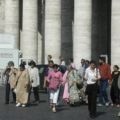
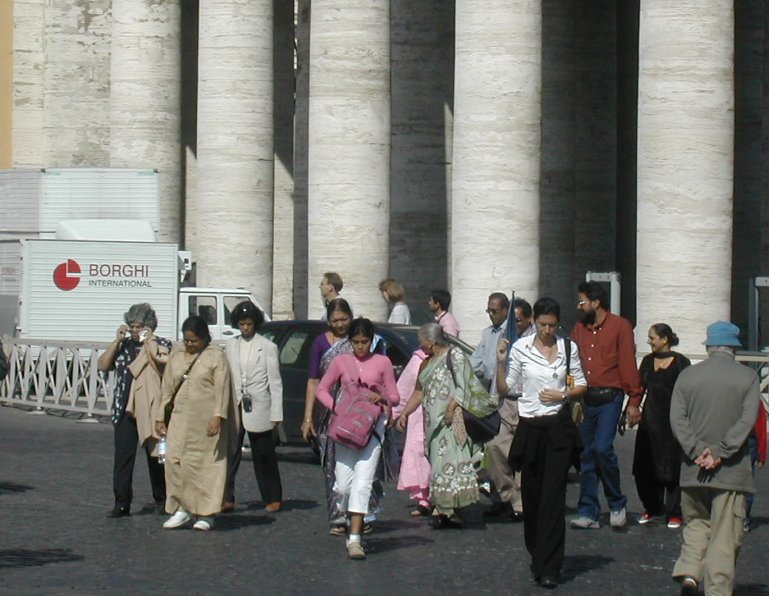
top: a family of Indian tourists at St. Peter’s in Rome

My India travel vlog, from the trip I took with my daughter this summer, is still in progress. There’s more video to edit, more photos (by Ross) to add, and, most of all, more thoughts to share.

What struck me throughout the trip, but especially in Mumbai, was the ferment of growth and change. The atmosphere reminded me of Silicon Valley five years ago: everyone feels that they have a chance to be part of something exciting and rewarding.

My Indian friends and classmates are doing well, which may not seem surprising – most of them came from the elite in the first place (otherwise they could not have afforded to attend Woodstock School). But they, too, have ridden the economic roller coaster over the last 20 years, and the fact that they’re heading up again now is thanks to talent and hard work at least as much as accidents of birth. It’s also thanks to the entrepreneurial energy unleashed in India since the economic reforms instituted in 1991 by then-finance minister (and now prime minister) Manmohan Singh.

India’s economy is growing at 6 to 7 % a year, and anyone who has been observing the country can see the effects. New roads are being built in the major cities, and new highways connecting them that I’m told are as good as American ones (haven’t seen for myself). Delhi is very proud of its rapidly-growing subway system – our travel company driver was eager for me to take a look, in spite of the fact that I was paying him to drive me around in a private car. Traffic is horrendous, but Delhi has cut pollution noticeably by requiring all public transport vehicles (buses, taxis, and scooter taxis) to run on CNG (compressed natural gas), and allowing heavy trucks into the city only late at night.

I don’t actually like Delhi, though; there’s something about its attitude that annoys me. Mumbai is another story. It’s a delightfully insane city, the largest I’ve yet been to (Tokyo, when I visited around 1971, was at the time the world’s most populous city, but I think it had around 8 million inhabitants then; Mumbai today has 15 million*). Yes, there are millions of people living in horrible slums; I did not see those, but I know they exist. What I did see was people living in mile after mile of roadside shacks built against walls and buildings.

Just another slum, you say? Yes, but… these shacks (called “hutments”) are two stories tall, made of plywood with solid wood frames, and roofed in corrugated tin or plastic sheeting. They have doors that can be locked, and many boast television sets inside (running on current pirated from the nearest electric wire) and satellite dishes on the roof. By the standards of the villages their inhabitants came from, this is cushy living. Shilpin explained to me that these people come from the countryside to take contract jobs in the insatiable Mumbai factories, or to earn a good living as day laborers. They leave their aged parents back in the village to protect the family land, and send money home for their upkeep.

The reason they don’t have proper housing is that real estate in Mumbai has become so expensive that no one can afford it. There have been two amnesties in which hut-dwellers were moved into city housing, and took on all the duties of citizenship such as paying taxes and electricity bills. However, there is so much demand to live in Mumbai that the hutments were immediately rebuilt and re-inhabited.

This is all indicative of India’s overall growth. People come to the cities to get jobs, which are plentiful (though not as plentiful as they could be – more economic and labor market reforms are needed), and fewer people are needed on the land as agriculture has become more productive..

It’s an exciting time to be in India, and Indians have much to be proud of. There are still enormous problems, to be sure, but there is also a sense that progress is being made and problems can eventually be solved.

And what of my other “country beginning with i”? Italy… is going nowhere. It experienced heady growth in the 1960s and 70s, culminating in the sorpasso in the early 1980s, when Italy’s economy was declared the world’s fifth largest, surpassing the UK. It’s been mostly downhill from there. Italy did well in skilled manufacturing when those jobs were still in the west, but is now becoming a rust belt of abandoned factories as globalization sweeps manufacturing jobs to the east. Like Americans, Italians bemoan the loss of their manufacturing jobs even as they rush to buy goods made cheaply in China.

The same shift in economic emphasis has happened in the US, of course, but the US as a nation has a broader skill set, so has been able to move up the value chain from manufacturing to services. Now that service jobs are also going overseas, the US can concentrate on R&D. A majority of the world’s scientists and engineers live and work in the US, although many of them were not born American. The next wave of growth will come from intellectual property, and the US will lead that wave (though this source of competitive advantage will also eventually be at risk from the growing pool of intellectual talent in India and China).

Italy (and most of the rest of Europe) is not well positioned to move up the value chain. Italy, in particular, is not supportive of research. As with so much else in Italy, university research centers are fiefdoms controlled by “barons” who give positions as patronage rather than on merit. Corporate R&D is almost non-existent (with notable exceptions such as Fiat, and, on a much smaller scale, the company I work for). Italian scientists and engineers mostly flee to the US if they want to get any serious work done.

Italy’s economy is hostage to entrenched and conflicting interests, with little hope that real and necessary reforms will be carried out by governments of the right or left. Though the need for such reforms is recognized by the Italian public, as I learned in a conversation on the airport shuttle bus the other day, with the bus driver and another passenger.

The passenger (a woman) has two daughters, one working in France and one seeking work in Germany – both having given up on finding decent jobs in Italy. One had been employed at Malpensa airport, doing customer service (in multiple languages), working shifts at 5 euros an hour, with no permanent contract nor any hope of one, nor any guaranteed minimum of hours. If we assume 40 hours of work per week, that’s only 800 euros a month – not enough to live on in or near Milan. No wonder she gave up after 16 months. “Something’s wrong here,” says her mother. “We slave to put them through school [both her daughters have university degrees], and they can’t find jobs in Italy.”

The bus driver looked in his 30s, and had “immigrated” long ago from Calabria in Italy’s deeply poor south. He’s had this steady job for several years and says the salary is good, but the work is demanding and often keeps him away from home. Home is a 40 square meter (430 sq ft) townhouse out in the country, 16 km from Bergamo, which cost him around 120,000 euros – a price he considered reasonable, since the place will be easily resellable when he is ready to move to something bigger (presumably when he decides to marry). Interestingly, he has no interest in returning to Calabria except for vacations – “life is different there, too slow. I’m used to life up here now.”

Both recognize that something is wrong with the pensions system. “Perhaps we promised too much before,” mused the driver.

Neither expects any of the current crop of politicians (left or right) to do much good.

As Beppe Severgnini says in The Economist‘s The World in 2006, “…the country must decide what it wants to be. It may opt to do nothing, and become an ageing, former manufacturing country, where local lobbies and special interests can gorge until the money runs out. Or Italy can become a welcoming service country, driven by design, tourism, and technology: an accessible land, easy to do business with, confident in its tolerance, creativity and flair.”

Unfortunately, I don’t hold out much hope that Italy is ready to make the big changes needed to attempt Severgnini’s Plan B. When I ask why things are the way they are (in any context), the response is usually a shrug and “It’s always been that way,” even when the person agrees that “the way it’s always been” isn’t necessarily good. As Severgnini puts it, “People are afraid of change.”

Italy can and probably will limp along, with the younger generations living off savings accumulated by their parents and grandparents. To be sure, they can still live a very nice life: sunny beaches in the summer and snowy slopes in winter, eating and drinking well, hanging out with friends they’ve known all their lives. There’s a lot to be said for that, and most of my daughter’s peers aspire to no more. They’ll settle for any job near home that allows them to go on living exactly the way they always have. (They’ll be lucky to find that job, however.)

Maybe it’s the American in me that says: “That isn’t enough. How can you stand to sit around and watch your country slide inexorably into poverty and oblivion? How can you spend your working life doing something you don’t even care about?”

If I was a typical Italian mother, I’d urge my daughter into whatever university course and profession seemed most likely to keep her close to home. Though I’m in no way a typical Italian mother, I adore Ross and would love to live near her for the rest of my life. But, for her own sake, unless something changes drastically, I hope she gets out before she stagnates along with the rest of Italy.

I Did It Again

Apparently, I should be working for the Economist – I publish the same thoughts, before they do. This week’s (Nov 24) edition contains a survey of Italy titled Addio, Dolce Vita, whose leader goes on to say: “For all its attractions, Italy is caught in a long, slow decline. Reversing it will take more courage than its present political leaders seem able to muster…”

Italy in Decline: Umberto Eco Joins the Chorus

Feb 5, 2006

Today’s Corriere della Sera carries an interview with Umberto Eco, whose new book, a collection of essays titled “A Passo di Gambero,” (“Walking Backwards”) debuts Wednesday.

“Guardi, l’Italia nei cinque anni appena trascorsi si è messa sulla strada del declino. Se andiamo avanti così diventiamo definitivamente un Paese da Terzo Mondo.”

“Look, Italy in the last five years has set itself on the road to decline. If this goes on, we will definitively become a Third World country.”

…Da caustico il tono diventa un po’ amareggiato quando il discorso si sposta sull’immagine dell’Italia all’estero: “Mi prende un senso di profonda umiliazione vedendomi fatto segno di tante manifestazioni di affettuoso cordoglio”.

…From caustic his tone becomes somewhat bitter when conversation turns to Italy’s image in the world: “I feel profoundly humiliated to be offered so many expressions of affectionate condolence.”

I’ll be buying the book.

 

Mussoorie Monsoon

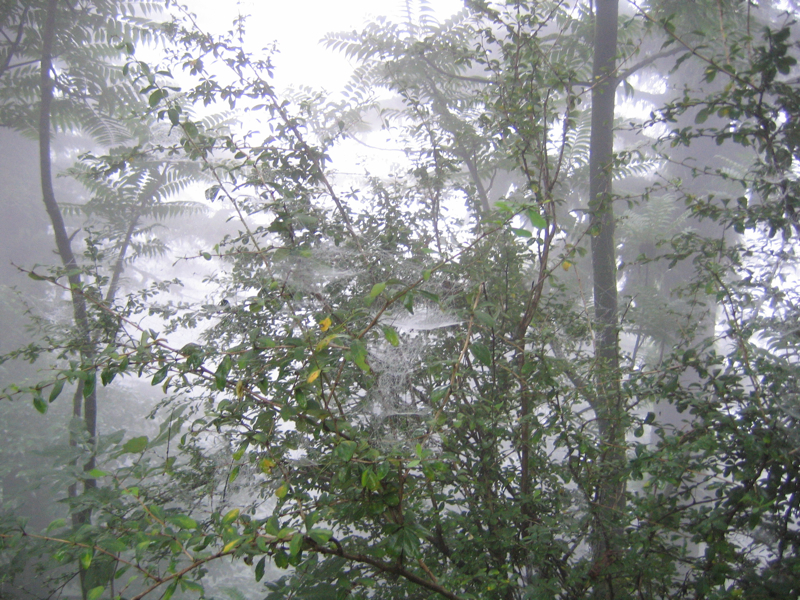
Most Woodstockers are nostalgic about the monsoon, though we’d probably be a lot less so if we had to live through the entire season again!

I had not been to India during the monsoon season since 1981, and had forgotten how beautiful the hills are when they’re lush and green and wet. Every tree is covered in ferns and moss. And, after a while, so are you. Nothing ever dries thoroughly during the monsoon; bedsheets feel damp when you crawl in at night, and you have to keep a strong lightbulb burning in the closet so your shoes don’t go moldy.

Terms of Address: What to Call People in India

In response to my mumblings about “signora” vs “signorina,” Yuti writes:

In India, as you know, we are all related to each other. Kids routinely call complete strangers “Uncle” and “Aunty”, maid-servants call the woman of the house Bhabhi (brother’s wife), and the elderly are instantly your parents or grandparents (Maa-ji, Bapu-ji, etc). And so I have taken particular interest in what appellations complete strangers have used for me over the years.

As a young girl and teenager, I was a Beti (daughter), although I recall at least one occasion on which I was actually called “Daughter” in English by an elderly salesman. As a young “westernized” woman in my 20s, I would be called shishter (sister). If, however, I was dressed in Indian clothes (rather than jeans and t-shirt), I’d be called didi (older sister) if the person was much younger, or behen (sister) if the person was older. In my 30s, I noticed a gradual shift from shishter and didi to bhabi-ji (brother’s wife, with the extra respect of ji thrown in). Now, in my 40s, I am still mostly bhabhi-ji, unless I am accompanied by my children, in which case I graduate to “Aunty-ji”. With men, the shift is more or less parallel, from beta (son) to bhaiyya (brother) to “uncle”. I now await with consternation the day I finally become Maa-ji (mother), or even worse Dadi-ma (grand-mother). That’s when I’ll know I’ve well and truly aged!!

I asked Yuti for some clarification:

But why bhabhi, brother’s wife, instead of (I don’t remember the words) husband’s sister, etc.? And, in India and/or with Indian friends, even I am Deirdré-aunty to my friends’ kids. Which begs another question: why not the Hindi equivalent of aunty?

Yuti answered:

Yes, there are various words that can be and are used… these are just the ones most common in Mumbai, where the local lingo is a mish-mash of Hindi, Gujarati, Marathi and English. In various parts of India you may find Mausi (mother’s sister), Chachi (father’s brother’s wife), etc., but these are generally for older women. For a younger woman, Didi and Bhabhi are more appropriate. Bhabhi also acknowledges your status as a married woman, and therefore, presumably due the “respect” that comes automatically with marriage. Second, it also denotes a direct relationship to a close relative (i.e., the person is saying he is your husband’s brother), so you can trust them. These are just theories from the top of my head, and I seriously doubt such thoughts go through anyone’s head when they call me bhabhi, but that is probably part of the reason for its wide usage. Another possibility could have been wife’s sister, but the word in question (saali) is also used as a swear-word, so that won’t do! Also, words for relations tend to differ in different parts of the country. Bhabhi is one of the few which is more or less the same everywhere and also in languages other than Hindi.

I feel that the reason you are called Aunty rather than any Hindi equivalent – firstly, I think kids probably think it is cool to use English words (especially to a foreigner). Second, kids may not know (at least when they’re very young) that each word denotes a specific relationship, for example, they may know that both “chacha” and “mama” are uncles, but may not know that a chacha is always your father’s brother, whereas a mama is always your mother’s brother. Or, perhaps, even if they DO know, they must wonder as to whom they should relate you to – their mother or their father. So, the neutral Aunty is better!

Zafar adds some more thoughts and experiences on Indian terms of address:

[But why bhabhi, brother’s wife, instead of (I don’t remember the words) husband’s sister etc. etc.?]

Slightly more distant/less familiar? Though I think it’s probably a Bombay thing…in Delhi men shamelessly call women behenji (sisterji) with no thought for propriety.

[And, in India and/or with Indian friends, even I am Deirdre-aunty to my friends’ kids. Which begs another question: why not the Hindi equivalent of aunty?]

The generic thing:

I agree with Yuti that ‘Aunty’ is the generic fall-back. I’s also never used with your actual (biologically related) aunts, who are almost ALWAYS the Hindi (or whatever) word. In my own experience I also used Maasi etc. with very close friends of my parents, while Aunty was for everybody and anybody. (Er… unless they were Uncle, of course.)

The gender aspect:

Those couples who were friends of my parents and who had graduated, so to speak, beyond Uncle/Aunty to the Indian words when addressed, were called:

The men: Chacha (Father’s brother) and
The women: Maasi (Mother’s sister).

While the superficially correct thing to do (since they were married to each other) would have been to call them ‘Chacha and Chachi (father’s brother’s wife)’, the whole point of the exercise was to place these unrelated adults in a family context – at which point it became more ‘proper’ (and completely unconscious) to classify the women as your mother’s sisters and the men as your father’s brothers.

The ethnicity/language aspect:

Oddly enough, language/ethnicity also comes into this. (Which might explain why the instinctive ‘Deirdre Aunty’ in your case.) Sticking to mother’s friends, for the sake of consistency/simplicity, these included:

Devahuti Maasi (Punjabi Hindu)
Suchandra Mashi (Bengali Hindu, hence Maasi transforms to Mashi)
Zehra Khala (Gujarati Muslim, hence the use of the Urdu version, Khala, for Maasi.)

Recycling: A New Italian Tradition

Growing up in Bangladesh and India, I observed that every scrap of paper, or anything else potentially useful, was re-used. Peanuts bought from a roadside stand were given to me in a little bag, carefully handmade from a page of a Singapore telephone directory. At school, the kabadi-wallahs (second-hand men) would come around collecting paper, cloth, and tins, for which they would pay by the kilo. This meant that our school papers and love letters could (embarrassingly) turn up as bags in the bazaar; we took great care to burn anything that we wouldn’t want anyone to read.

Woodstock School and its environment encouraged thrifty habits. There simply wasn’t a lot of stuff to buy, let alone throw away. Sometimes even the basics, like electricity and water, went missing. In a drought year (the spring and summer after a failed monsoon), power frequently went out because there was no water in the mountain rivers to generate hydroelectricity. Studying by candlelight sounds romantic for Abraham Lincoln, isn’t so great in real life. (Woodstock now has generators, and uninterruptible power supplies for its computers.)

Then the local springs dried up, and we had no water to take showers or even flush toilets. Servants would bring up water from a rainwater tank, and we flushed using buckets. Nowadays, although I love taking hot baths, I always wince at the water left in the tub afterwards, wasted. In our previous (small) apartment, the bucket used for mopping the floors lived under the bathroom sink, so I would simply leave the water in the tub, and flush with that water until it ran out or we needed to drain the tub to take showers. I have had to explain this habit to people who couldn’t understand why I do not reflexively pull the plug after a bath. I’d like a house designed to use bath and shower water to flush toilets.

India’s recycling habits meant that there was very little trash on the Mussoorie hillsides, until recent years when plastic shopping bags and packaging became popular. Suddenly, the garbage bloomed. I suppose increasing wealth (for some) also meant that people were less careful, because plastic bags weren’t the only thing being thrown away. Dick Wechter, a Woodstock staff member keenly interested in mountain environmental issues, found a solution. He paid local sweepers (untouchables, the poorest of the poor) to collect trash from the hillsides, which they sold to the kabadi-wallahs, in the end making more than enough money to pay the collectors’ salaries. Dick has also been promoting the use of biodegradable paper bags or reusable cloth bags for shopping, and composting wet waste.

Italy was becoming recycling-conscious just about the time we got here (1991). It started with glass, which you would put into a large plastic bell, usually located on a traffic island or sidewalk within a block or two of your home. The bell had little round portholes near the top, into which you would push one bottle at a time, dropping it with a satisfying crash to the bottom. Once a month or so the glass truck would come along. It had a miniature crane on the back, with a hook which would pick up the bell by a loop of steel cable sticking out of its top. The crane would swing the bell over the open bed of the truck, and then a second hook would pull a second loop which opened the bottom of the bell – MEGA CRASH as hundreds of glass bottles fell. This was a less pleasing sound, especially at 6 am.

A little later, paper recycling bins turned up on the streets as well, though they were sometimes set on fire by vandals. Then plastic. For a while, in Milan, we had to separate out “humid” (organic, compostable) garbage into special containers and biodegradable bags, but the Comune of Milan gave that up when it was found to cost more to make it into fertilizer than farmers were willing to pay for it. A couple of years ago, Milan’s sanitation authority also moved recycling closer to home, by putting bins for paper, plastic, and glass into the courtyards of apartment buildings. This was a good idea, but the execution was confusing. Aluminum (soft drink) cans were supposed to be placed with glass; I never did figure out what to do with other kinds of cans. Some kinds of plastic could be recycled, others not. The city also tried to increase recycling rates by fining anyone who messed up. In a building complex with hundreds of people, this meant fining the entire complex, since no individual culprit could be identified. One irritated resident of a fined building noticed that sometimes the garbage men themselves weren’t fussy: he photographed a truck loading both recyclable and general garbage into the same compartment, clearly wasting the public’s efforts at recycling.

Lecco was up for an award last year as one of the most recycling cities in Italy, and I can see why. We have three bags: umido (compostable “wet” waste), sacchetto viola (violet bag, for plastic, paper, cardboard, wood), and sacchetto trasparente(transparent bag – non-recyclable). I assume that the stuff in the sacchetto viola is hand-sorted somewhere along the way, which is more sensible than trying to make confused old ladies do it at home. I recycle even more paper now that I don’t have to tear the plastic windows out of envelopes and food cartons. We have separate (small) garbage bins under the sink for umido and general garbage. Glass, unfortunately, still has to be carried to a bin down the road. We collect it into a plastic container out on the balcony, and every now and then Enrico takes a walk with a big bag of glass.

The plastic shopping bag problem is somewhat mitigated in Italy by the simple expedient that supermarkets charge 5 cents each for them. So people tend to take fewer of them (I am always left gasping at the profligacy with which American supermarkets bag groceries), and/or bring re-usable bags of their own. Also, kitchen garbage pails are small enough that these bags can be used to line them, saving the expense of buying garbage bags. You have to take the garbage out more often, but you can take it anytime, down to a trash room in your building, where the people responsible for cleaning the building will get it out to the street on the correct day for collection.


Jan 10, 2004

Mike Looijmans writes:

“In Belgium it is very common to collect rain water (usually from the roof) in an underground tank, and use this water for things like flushing toilets, washing and so. In many Belgian places, tap water is not drinking water but usually untreated ground or rain water. ‘Clean’ water for cooking and drinking is usually provided from separate taps.

In the Netherlands, all tap water is drinking water. In the east and south of the country, the water is taken from underground wells and is the same stuff which is sold in bottles at exorbitant prices in supermarkets. In fact, some types of bottled water sold internationally would not pass the Dutch criteria for tap water. Though it sounds like a terrible waste to use this water for car washing and such, the water as it is pumped up from the ground needs very little treatment, just filtering out the sand is usually enough. The water companies use trout to monitor the quality. A trout swimming in the water stream is monitored by a computer system. When the fish makes a sudden movement, alarm bells start ringing as these fish are very sensitive to pollution.”

Paul Hackney: Learning About India

filmed at the Woodstock Old Students’ Association (North America) 2003 reunion

Paul reminisces about what he learned about Indian culture from Indian friends and neighbors.

More Woodstock Videos

Tenzing’s Monkey Tales

Mussoorie Monsoon Melody

Tibetan Prayer Wheels at Happy Valley

Cicadas

Jana Gana Mana