Tag Archives: Italian culture

Everyday Italian: Newspaper Headlines 3

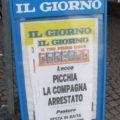
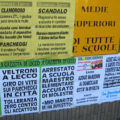
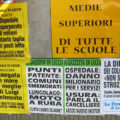
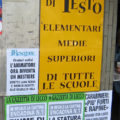
Reader Stefano Tonti sent me this photo. The headline says “Doctor beaten with a shovel”. ata is a suffix you can add to many nouns to create a word meaning “an application of [noun]”. Badile = shovel or spade, so someone applied a shovel to this poor doctor (unfortunately, we didn’t buy the newspaper so we don’t know why). A more common construction is sassata, stoning – as in, throw rocks at – sasso = stone.

Italian newspaper headlines.jpg” alt=”” width=”600″ height=”321″ />

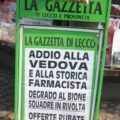
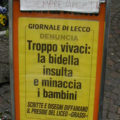
April, 2007 – from left to right:

Usury [loan sharking]: half of Lecco trembles / Motorcycle crash – 20 year old Lecchese without hopes [of living – in fact, she died]

Abusive construction [i.e., without proper building permits] – the beach of the “Bear” [a local disco, Orsa Maggiore – Ursa Major] impounded

Old people, new center at Germanedo

ICI [property tax] and TARSU [some other tax] – The municipality on the hunt for tax evaders: wants to recover two million euros

Forza Italia [political party] at war for the presidency of the “twinnings” [?]

Falls while on motorcycle: grave [seriously hurt] girl of Lecco

The mayor: “We’re looking for the area for the new stadium.”

The case – ALER claims that Bodega [a former mayor] has the right to public housing at 28 euros a month

Soccer: The Lecco [team] goes to Biella with victory in its sights

Learn Italian in Song: Il Ballo del Mattone

recorded by Rita Pavone
Rita Pavone - Rita Pavone: I Grande Successi Originali - Il Ballo del Mattone

Written by Verde / Canfora

Another silly song from the sixties.

Il Ballo del Mattone

The Dance of the Brick/Tile

Non essere geloso se con gli altri ballo il twist, Don’t be jealous if with the others I dance the twist
non essere furioso se con gli altri ballo il rock: Don’t be furious if with the others I dance rock
con te, con te, con te che sei la mia passione With you, with you, with you who are my passion
io ballo il ballo del mattone. I dance the dance of the tile
Non provocar la lite se con gli altri ballo il twist, Don’t provoke a fight if with the others I dance the twist
non provocar scenate se con gli altri ballo il rock: Don’t cause scenes if with the others I dance rock
con te, con te, con te che sei la mia passione With you, with you, with you who are my passion
io ballo il ballo del mattone. I dance the dance of the tile
Lentamente, guancia a guancia, Slowly, cheek to cheek
io ti dico che ti amo I say that I love you
tu mi dici che son bella You tell me that I’m beautiful
dondolando, dondolando sulla stessa mattonella! Rocking, rocking on the same tile!
(ripetere) (repeat)

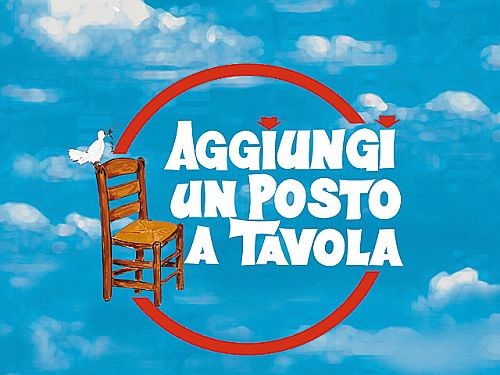
Aggiungi un Posto a Tavola – An Italian Musical

Add Another Place at the Table

I’m a huge fan of musical theater, grew up singing along with The Music Man, Camelot and Oliver. The first show I saw on stage was You’re A Good Man, Charlie Brown, in what must have been a local or travelling production, in San Francisco, when we were on home leave in 1969. I knew all these shows by heart, and by now know (and have seen) many more – most recently, Spamalot.

Continue reading Aggiungi un Posto a Tavola – An Italian Musical →

Funny Italian Street Names

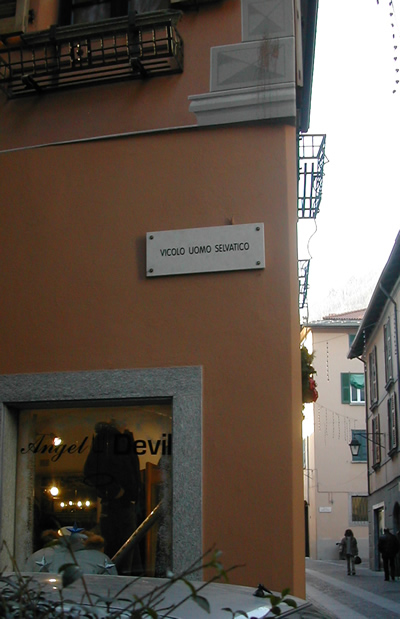
above: “Wild man alley” – with a shop called Angel Devil on the corner. Chiavenna

The US is full of streets named after trees, or simply called “Main,” or given numbers or letters. Washington DC is built on a grid of numbers and letters of the alphabet. I won’t even attempt to explain Salt Lake City. These two schemes reflect an extreme tidiness of mind, but have the disadvantage that they’re easy to mix up or mis-type, no doubt causing the postal service all kinds of headaches.

Italian street names can be repetitive, but at least they’re not boring. They generally fall into two major categories: history and geography. Geographic names can be of towns or geographic features in Italy or in other countries; Milan has a Corso Buenos Aires and a Piazza Lima, every town in Italy has a via Roma and probably a via Milano. There are also streets named after important dates, such as Piazza XXV Aprile, commemorating the official day that Italy was liberated from the Nazis. (In these cases, the date is always given in Roman numerals, which are also used in print to refer to centuries.)

Don’t look for Italian street signs stuck up on a pole on the corner, as you see in the US. In the cities, street signs are marble plaques cemented to the corners of buildings. When the street is named for a person, the plaque often includes his dates of birth and death and what he was famous for, so you can have a history lesson just walking around. Somehow it had never occurred to me that the Falloppian tubes were named for somebody, until I saw a street sign with the name Antonio Falloppio and the tag “anatomist.”

The historical figures named run the gamut from ancient Rome to Aldo Moro, but most of them are men. The few women I’ve noticed are queens, saints, and Maria Montessori (whose image was also on the last 1000-lire note).

The older streets nearer the city centers are generally named for older historic figures. The further you get out into the suburbs, the more modern the names, including some non-Italians. There is a via Washington in Milan, and I have seen several via Kennedys in various towns, and even a via Fratelli Kennedy (Kennedy brothers). Still further out in expanding city suburbs, recently-created streets have been named for Gandhi and Salvatore Allende.

Some streets are named for items of strictly local importance. Lecco’s most famous son was Alessandro Manzoni, author of I Promessi Sposi (The Betrothed), considered the first modern Italian novel. So in Lecco proper we have a Piazza Manzoni and Ospedale Manzoni, and every town in the province of Lecco seems to have streets named for his characters: Renzo, Lucia, i Bravi, Don Abbondio…

Funny Italian Street Signs
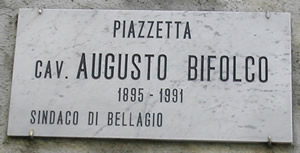
This piazzetta in Bellagio honors a former mayor, whose name”Bifolco” literally means “peasant”, but also carries the connotation of “yokel” or “bumpkin.” Evidently the man outshone his name, being named a Cavaliere (knight, an honorific title nowadays), as well as elected mayor.

I’ve found unusual street names in the historical parts of some towns:

Viterbo
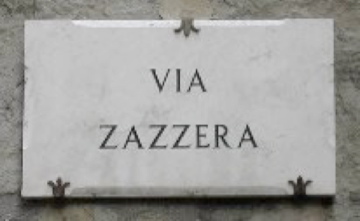
viterbo_oct_15_03_184


^ “Mane,” in the sense of a big head of hair.
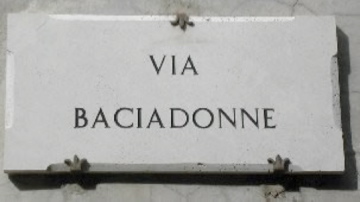
 

viterbo_oct_15_03_183

“Kiss(es) Women”

Pitigliano

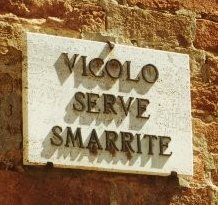
vicolo Serve Smarrite, Pitigliano

“Street of the Lost Maidservants.” ???
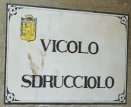
vicolo

“Slippery Lane”

Volterra

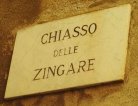
Chiasso delle Zingare, Volterra

“Narrow Alley of the Gypsy Women.” I was misled by this at first, because in modern Italian chiasso means “noise,” but a reader corrected me.

Pienza

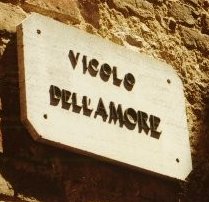
And here’s an interesting sequence (yes, these streets actually are adjacent to each other).
vicolo

First comes love..

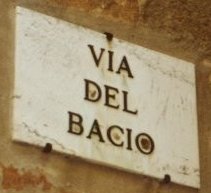
via

…then a kiss…

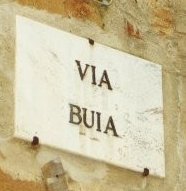
via

…and over the rest we draw a veil of darkness…

What’s the funniest street name you’ve ever seen (anywhere)?

Learn Italian in Song: 7000 Caffé


written, recorded and copyrighted by Alex Britti Alex Britti - '3' (Sanremo 2003) - 7000 Caffé

Here’s another great by Alex Britti – go out and buy his music! Sadly, his own brilliantly original music video has been removed from YouTube, but here’s a version with another fave of mine, Neri Per Caso.

7000 caffé, 7000 coffees
li ho gia’ presi percha’© I’ve already drunk them because
sono stanco di stare al volante I’m tired of being at the wheel
e vorrei arrivare entro sera da te And I would like to arrive [at your home] by this evening
che aspetti me nel castello lassu’¹ Who are waiting for me in the castle up there
con la treccia gia’ sciolta With your braid already undone
affacciata al balcone vestita di blu Looking out from the balcony, dressed in blue
7000 caffé 7000 coffees
é l’effetto che ho is the effect I have
quando arrivo al portone When I arrive at the entry
e ti vedo gridare con gli occhi il mio nome percio’ And I see you call out my name with your eyes [therefore]*
vieni verso di me e io pazzo di te You come towards me, and me crazy for you,
in un attimo ci diamo il bacio piu’dolce, piu’dolce che c’é in a moment we give each other the sweetest, the sweetest kiss there is
Ritornello: Chorus:
Ho bisogno di te perche sei bella e poi I need you because you’re beautiful, and then
Ho bisogno di te come l’acqua il caffé I need you like [water needs coffee / coffee needs water]**
come un mondo che gira e che, amore, se non vuoi, Like a world that turns and that, love, if you don’t want
non finira’ mai Will never end.
Ad esempio lo sai l’altra sera ero a casa For example, you know, the other evening I was at home
cercavo da bere ma il frigo era vuoto I was looking [for something] to drink but the fridge was empty
perché non ho fatto la spesa Because I didn’t do the [grocery] shopping
tu non ci crederai – indovina che c’é You won’t believe it – guess what?
ho trovato una tazza con l’ultimo dei 7000 caffé I found a cup with the last of the 7000 coffees
Ora sto qui da solo e non dormo e non volo Now I’m here alone and I don’t sleep and I don’t fly
mentre tu sei lontana While you’re far away
ripenso a una scena di te senza velo I think again of a scene of you “without veils” [nude]
non so bene cos’é, forse i troppi caffé I don’t know what it is, maybe too many coffees
ma stanotte non riesco a dormire But tonight I can’t sleep
e l’amore lo faccio da me. And I’ll make love by myself.
* This word doesn’t seem to fit here – I suspect he just threw it in to fit the rhyme.** The meaning here is (probably deliberately) ambiguous.
if you find this useful and want more, let me know!