Tag Archives: Italian food

Why Italians Drink Bottled Water

From time to time in the travel forums, I run across people complaining about the added expense of bottled water at restaurants in Italy. It is possible to drink tap water at any restaurant in Italy, and in some areas it’s the norm, but in many places the request is considered unusual.

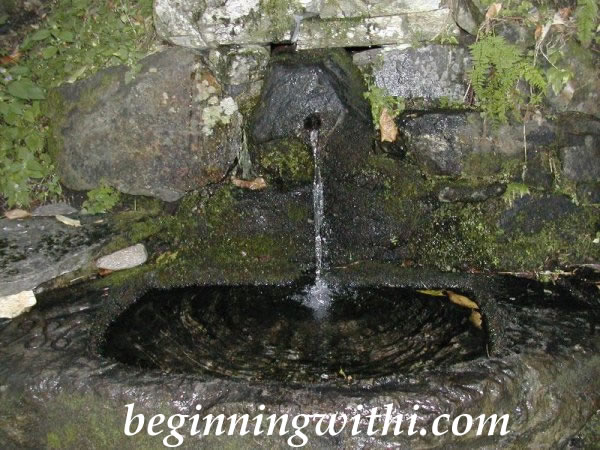
Although the water that comes out of our taps is perfectly potable, urban Italians drink almost exclusively bottled water. Not because it’s bottled, but because it comes from real mountain springs (like the one pictured above), and simply tastes better.

City tap water in most parts of Italy that I’ve experienced has a heavily chemical taste – lord knows where they get it from, or what they do to it in purifying. It is also very “hard” – full of calcium. When you see how quickly the inside of your teakettle furs up from boiling tap water, you have second thoughts about trying to process that stuff through your kidneys every day. (Although the technology is available here, very few households have installed the water softening systems that are so common in the US.)

The further you get out into the country, and particularly into the mountains, the better the tap water is: it’s often piped, unprocessed, directly from mountain springs into homes. Many town squares still feature the municipal fountains where people used to get their water before indoor plumbing became common. (In some places, water is so abundant that these can’t be turned off: they simply run, all the time, a waste which always disturbs me.) In communities that have particularly good water, restaurants will put a carafe of the local water on the table before offering you the bottled.

For home consumption, most city households buy bottled water in six packs of 1.5 liter bottles. There are dozens of brands, some local, some national. San Pellegrino is a national brand in Italy – in fact, the town and springs of San Pellegrino are not far from where we live. Most Italian bottled waters actually come from mountain springs in specific locations, and are bottled near the sources for which they’re named. Most come in fizzy and non-fizzy varieties, with the fizzy ones being artificially carbonated, but a few, such as Ferrarelle, are naturally fizzy. Some have recognizable flavors, and after a while you develop preferences (I, for example, can’t stand Ferrarelle).

There is lots of competition between brands, with ads touting their supposed health-giving properties (especially for the house brands at the terme – traditional health spas), low sodium, etc. I don’t take these claims seriously, but it is indisputable that water (bottled or not) is the healthiest thing you can drink – no calories, for starters, and one of the few health statements that most experts seem to agree on is that everyone should drink lots of it. In Italy, this is no problem: not many households keep soft drinks or beer ready in the fridge, but everyone’s always got water. The only two beverages that you see on most Italian tables are water and wine.

You don’t always have to pay for good water in Italy. Enrico and I routinely recycle plastic bottles by taking them to the mountains and refilling them with good spring water:

Funny Italian Street Names

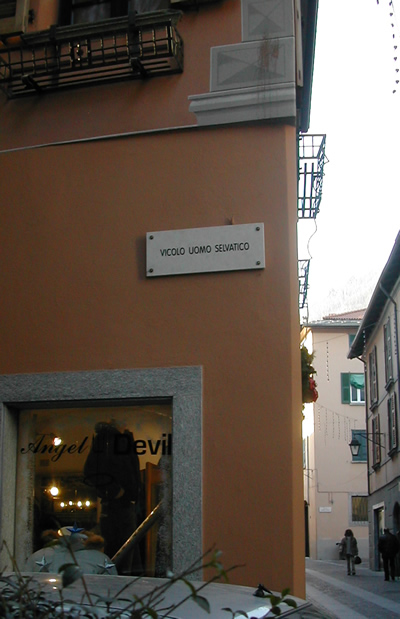
above: “Wild man alley” – with a shop called Angel Devil on the corner. Chiavenna

The US is full of streets named after trees, or simply called “Main,” or given numbers or letters. Washington DC is built on a grid of numbers and letters of the alphabet. I won’t even attempt to explain Salt Lake City. These two schemes reflect an extreme tidiness of mind, but have the disadvantage that they’re easy to mix up or mis-type, no doubt causing the postal service all kinds of headaches.

Italian street names can be repetitive, but at least they’re not boring. They generally fall into two major categories: history and geography. Geographic names can be of towns or geographic features in Italy or in other countries; Milan has a Corso Buenos Aires and a Piazza Lima, every town in Italy has a via Roma and probably a via Milano. There are also streets named after important dates, such as Piazza XXV Aprile, commemorating the official day that Italy was liberated from the Nazis. (In these cases, the date is always given in Roman numerals, which are also used in print to refer to centuries.)

Don’t look for Italian street signs stuck up on a pole on the corner, as you see in the US. In the cities, street signs are marble plaques cemented to the corners of buildings. When the street is named for a person, the plaque often includes his dates of birth and death and what he was famous for, so you can have a history lesson just walking around. Somehow it had never occurred to me that the Falloppian tubes were named for somebody, until I saw a street sign with the name Antonio Falloppio and the tag “anatomist.”

The historical figures named run the gamut from ancient Rome to Aldo Moro, but most of them are men. The few women I’ve noticed are queens, saints, and Maria Montessori (whose image was also on the last 1000-lire note).

The older streets nearer the city centers are generally named for older historic figures. The further you get out into the suburbs, the more modern the names, including some non-Italians. There is a via Washington in Milan, and I have seen several via Kennedys in various towns, and even a via Fratelli Kennedy (Kennedy brothers). Still further out in expanding city suburbs, recently-created streets have been named for Gandhi and Salvatore Allende.

Some streets are named for items of strictly local importance. Lecco’s most famous son was Alessandro Manzoni, author of I Promessi Sposi (The Betrothed), considered the first modern Italian novel. So in Lecco proper we have a Piazza Manzoni and Ospedale Manzoni, and every town in the province of Lecco seems to have streets named for his characters: Renzo, Lucia, i Bravi, Don Abbondio…

Funny Italian Street Signs

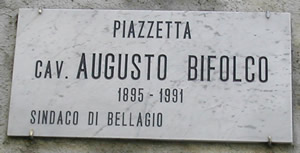
This piazzetta in Bellagio honors a former mayor, whose name”Bifolco” literally means “peasant”, but also carries the connotation of “yokel” or “bumpkin.” Evidently the man outshone his name, being named a Cavaliere (knight, an honorific title nowadays), as well as elected mayor.

I’ve found unusual street names in the historical parts of some towns:

Viterbo

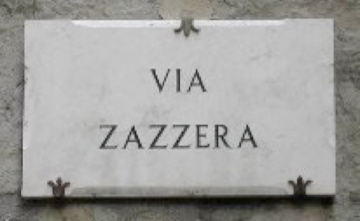
viterbo_oct_15_03_184


^ “Mane,” in the sense of a big head of hair.


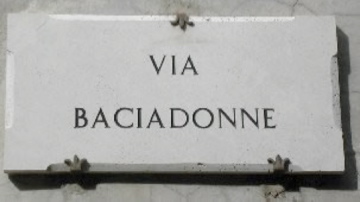
viterbo_oct_15_03_183

“Kiss(es) Women”

Pitigliano

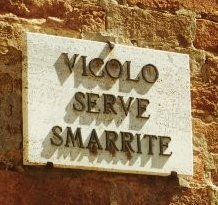
vicolo Serve Smarrite, Pitigliano

“Street of the Lost Maidservants.” ???

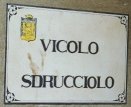
vicolo

“Slippery Lane”

Volterra

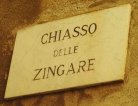
Chiasso delle Zingare, Volterra

“Narrow Alley of the Gypsy Women.” I was misled by this at first, because in modern Italian chiasso means “noise,” but a reader corrected me.

Pienza

And here’s an interesting sequence (yes, these streets actually are adjacent to each other).

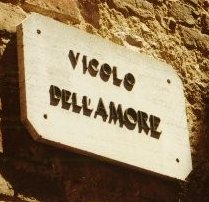
vicolo

First comes love..

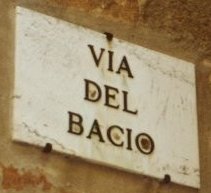
via

…then a kiss…

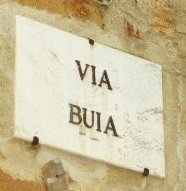
via

…and over the rest we draw a veil of darkness…

What’s the funniest street name you’ve ever seen (anywhere)?

Sweetness and Dark on Lake Como

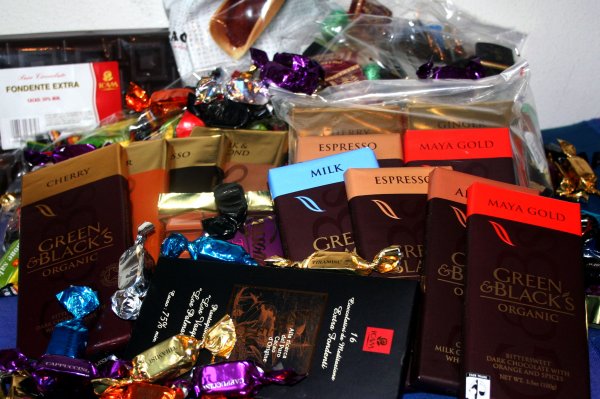
Some evenings, stepping off the train as it arrives in Lecco, there’s a slightly toasted, coffeeish scent of rich, dark chocolate in the air. It’s not a hallucination: Lecco is the home of Icam, one of the world’s largest manufacturers of organic chocolate. They process 6000 tons of raw cocoa beans per year, and when those beans get to cookin’, the whole town is wrapped in a sensuous fog of aroma.

I had long been aware of Icam as a purely local phenomenon – Icam-branded chocolate doesn’t even show up much in Italian stores, though some friends had proved to us that Icam’s chocolate-hazelnut spread was far superior to Nutella. I knew that Icam had a spaccio (outlet store) at the factory down in Pescarenico, but I never managed to get there until we’d been in Lecco for a while, and then only because they ran extended hours during the Christmas season.

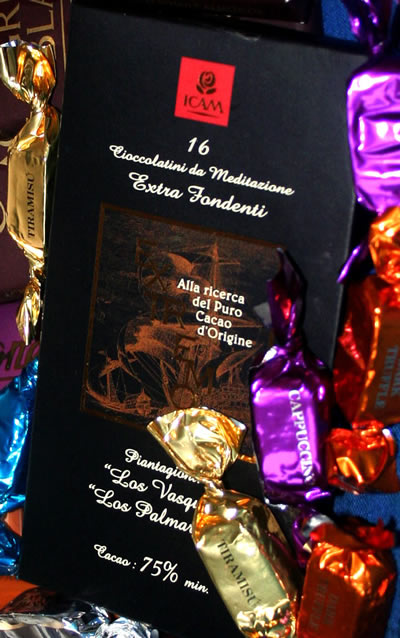
I discovered one Christmas that they make very good “cru” (single-origin) tasting squares of “Extremo” 75% dark chocolate – I bought some for family Christmas presents.

More recently, I was surprised to notice that our friend Michele was selling Green & Black’s, the famed UK brand of organic chocolate, at his bakery in Lecco.

“Where did you get that?” I asked.

“They make it right here in Lecco!”

He told me that a British couple had stopped for a chat at his shop. Turns out the man was a financial officer with Green & Black’s, in town to visit their production partner. He told Michele that some (surprisingly large) percentage of Europe’s chocolate, including much of Green & Black’s, is made by Icam – exactly how much I have not been able to confirm. He may have been referring specifically to the organic chocolate market – I have not so far located any definitive figures on European chocolate production, though I did find a list placing Icam as number 89 among the Top 100 Global Confectionery Companies. They evidently manufacture for others who sell organic chocolate, such as Seeds of Change.

So Icam was on my Christmas shopping list again last December. I came away with:

  • three half-kilo bags of mixed chocolates (many of them Green & Black’s), at 5 euros each
  • two bags each containing ten bars of Green & Black’s
  • one bag of non-chocolate candies
  • a 1-kilo bar of dark chocolate for cooking
  • a 1-kilo bag of unsweetened cocoa powder for cooking
  • a half-kilo tub of “Icam-ella” or whatever they call their spread
  • a sampler box of the Extremo (pictured above)

Yes, it was a lot to carry! But I couldn’t resist – the bill for all this was only about 50 euros. Both at home and at the office, we had a very sweet Christmas.

Icam is doing so well that it needs to expand, but apparently is not finding encouragement to do so in Lecco. However, last I heard, their efforts to build a new factory in a nearby town were also frustrated by some strange local resistance.

<sigh> It can be inexplicably difficult to do business in Italy. Icam would probably have fewer hassles and lower costs if they moved their operation to some other part of Europe. But Icam is a family-owned business, and we can all be thankful that Italian families and businesses are stubborn about sticking to their roots!

You can visit Icam’s factory outlet store during the hours 8.30-13.00/14.00-17.00, Monday through Friday.

Oh, My Darling Clementine

The fresh fruits and vegetables section of a standard American supermarket looks much the same all year round. There is no seasonal variance in the availability of any common foodstuff: you see the same tomatoes, lettuce, broccoli etc., even when they have to be imported from someplace far away where the weather is right for growing them. This everyday "luxury" is so ingrained into American habits that, when I first moved to Italy, it never occurred to me that certain items might simply not be available at some times of year. "What do you mean, it’s not the season?"

Italian fruttivendoli (greengrocers) and their customers favor the fruits and vegetables of the season. You can certainly buy, e.g., greenhouse strawberries in winter, but they’re much more expensive, and not nearly as tasty, as the ones grown outdoors in their proper time. The most flavorful foods are grown "locally" and are bought at the peak of their season, when, due to their abundance, they’re also cheapest.

Right now it’s winter and we’re flooded with agrumi (citrus) from Sicily and other southern parts of Italy (and Spain). You can get some sort of oranges (arance [ah-RAHN-chay]) all year round, but at this time of year they’re huge and juicy, a colorful antidote to the gray weather. Blood oranges – my favorites – don’t look much different from any other kind on the outside, but inside: red red red! Squeeze them to obtain a thick, syrupy juice that looks like a vampire’s breakfast.

even the packing is gorgeous! – blood oranges

My favorite citrus, however, are clementines. I guess these are what Americans call tangerines: smaller than oranges, when ripe they are loose in their skins and easy to peel. They break apart neatly into bite-sized sections that you can pop into your mouth and enjoy a squirt of juicy sweetness, without getting it all over your hands and face. Actually, clementine [cleh-men-TEEN-ay] are usually so small that you can eat half of one in a single mouthful.

These (along with Glucose biscuits) were my favorite winter travelling food in India, and are just as handy on Italian trains: I can pop a few into my backpack, peel and eat at will. If they get a little mushed, it’s no matter – a section or two may be squished, but they don’t turn black like bananas, and the rest is perfectly edible. I also keep some on my desk for mid-morning and mid-afternoon snacks. A golden pyramid of clementine offered to guests after dinner will disappear entirely as people talk and nibble, easily downing five or six each.

There are several varieties. There are clementine con o senza semi (with or without seeds), pictured at top. There are mandarini, which are tiny, with a smooth, shiny skin that fits tightly and can be difficult to peel. There are mandaranci, which I take (from the name) to be a hybrid of oranges and mandarins. There’s a larger variety of clementine which is closer to what I remember from India – not as sweet and juicy as the standard Italian version.

I don’t buy late-season fruit: it’s always disappointing after the wonders of a fine fruit at the height of its glory. I’ll enjoy the clementine while they last. Then they will slowly disappear from the shops, and we’ll have to survive on pears and apples until the early summer fruits (cherries!) start coming in.

photos shot at Il Fruttorto, Lecco

A “Typical” Italian Christmas

Of course , our family is far from typically Italian. Even my husband’s family isn’t very typical: his mother moved around a great deal while she was growing up, and had only two brothers (who both died young), and Enrico’s father was an only child – hardly the norm in his day! So the close family isn’t numerous, and what we do have is spread all over northern Italy. (Let’s not even start on my side of the family.)

Enrico and his brother also moved around a lot in their youth (thanks to their parents’ teaching careers), both went to grad school in the US, and Bruno now teaches in Norway. Their mother (widowed two years ago) lives in Abruzzo (Italy’s central east coast). So getting together for the holidays will always involve travel for somebody. And this is the first big difference between us and most Italian families: I need to find some statistics to support this hypothesis, but my hunch is that most Italians marry within their hometown – what choice do they have, since they mostly stay there all their lives!? Extended families don’t have to go far to see each other every day, and getting together for Christmas is no big deal.

Perhaps for this reason, there is no tradition in Italy of sending Christmas cards. Everyone to whom you might want to send holiday greetings is near enough that you can deliver your greetings in person. If you do live far away, there’s not much point in Christmas cards: the Italian post office is historically so unreliable that your Christmas greetings might arrive in time for Easter – if at all.

So, for those of my friends and family who may be wondering why I stopped sending Christmas cards or even letters years ago, that’s the reason – or at least the excuse!

We do try to bring the family together most Christmases. Last weekend Enrico brought his mother up from Abruzzo. This unfortunately meant that she spent a lot of the week alone in our house (though Ross was very good about coming home straight after school to make lunch for her).

Enrico and I had a not-unusually-frantic week before Christmas – final classes for him, for me work as usual including four hours’ commute most days (I stayed home Tuesday, intending to work, but ended up in bed with a migraine instead). We did the usual last-minute shopping for presents and to stock the house with holiday food:
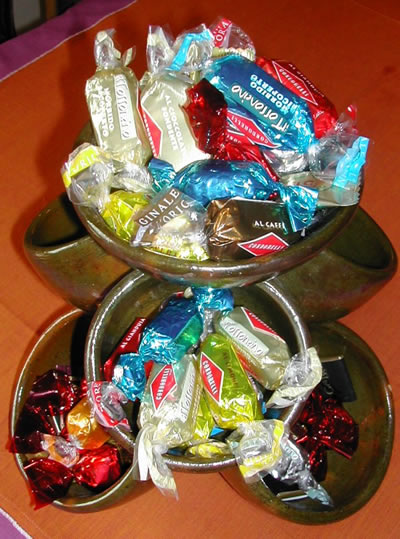
torroncini

Well, sweets are easy. But what to do about our main holiday meal? Do we even have a family tradition? When Enrico’s grandmother was alive, for the Christmas first course she made passatelli in brodo – a tradition from her side of the family, which came from Emilia-Romagna (though she herself was born in Brazil). When, in later years, we had Christmas in Abruzzo, we often had scripelle in brodo, which I adore. But Enrico forgot to get the scripelle (eggy crepes) while he was there, and no one in the family knows how to make them.

During our TVBLOB holiday lunch, I asked some of my colleagues about their family traditions. We have people from all over Italy (as well as the UK, Japan, Israel, Australia, and the US), so there was a wide variety. Italy’s south seems to lean towards various forms of pasta al forno (oven-cooked pasta, e.g. lasagne), while the north, broadly speaking, prefers broth-based first courses. Enrico voted for tortellini in brodo (which a Milanese colleague also told me was traditional in his family), while I was dubious that we needed pasta at all, since I had decided to make turkey with stuffing and mashed potatoes – none of which is part of any Italian tradition. Several colleagues told me that their families eat agnello (lamb) for their Christmas main course. I like agnello, but don’t know how to cook it, while I do know how to cook turkey.

My colleagues are mostly much younger than I am, and still have Christmas at their parents’ homes with Mamma to do the cooking. In our family, I am the lady of the house, and in charge of the holiday cheer – a responsibility not to be taken lightly.

Friday evening Enrico and I managed to meet up in Lecco to do some food shopping, including a stop at Rusconi, Lecco’s finest macelleria (butcher). We bought a piece of beef for brodo (broth), and a beautiful rolled roast of veal with chestnuts and lard, which I planned to make for Saturday dinner when Bruno and Ingvild arrived from Norway (where they get lots of great fish, of course, but meat is expensive).

Also traditional during the Christmas season are Italian winter fruits (apples, pears, mandarin oranges) and exotic fruits from all over the world. I’m not sure why the exotics, but it means that our fruttivendolo (greengrocer) had stuff that even I’ve never seen, from South America I guess, as well as the more familiar mangoes, papayas, and lichis.

My coup for Friday was getting Rossella‘s big Christmas present: a pair of shoes she had told us she lusted for. Ross every year well before Christmas starts telling us about all sorts of gifts she’d like – just in case we didn’t have any ideas of our own. This gives us plenty of scope to surprise her – she doesn’t know which, if any, of the requested items she will receive (certainly not all, given her expensive tastes and our limited budget).

She had described these shoes in loving detail, along with where to get them, and mentioned that they were the last pair in the store. When I arrived, the owner remembered her trying them on the day before, and was surprised at my attempt to make a surprise of the gift: I refused to have it “wrapped” in a bag with the name of the store on, and didn’t even let them put their sticker on the anonymous gift wrapping they did.

Of course I ran into Ross on the street in Lecco five minutes later. “Did you get me something?” she asked mischievously. “Nope,” I said, pressing my anonymous cloth shopping bag under my elbow. “I’m just going to give you money, and you can buy what you want.” Later we passed by the shoe store window together and Ross gasped: “They’re gone!” “Oh, were they there? I guess I missed them. These other ones are cute…” I can’t believe she fell for it – I’m not that good an actor. But she claims that she was genuinely surprised on Christmas morning, and she certainly was genuinely delighted.

Saturday morning Enrico and I did more shopping, finally managing to find the fresh chestnuts that I needed to make stuffing. I use a recipe from Martha Stewart, but Martha has it easy: she can buy chestnuts frozen or canned. I have to buy them fresh, then roast and peel them myself. Here they are just before roasting:
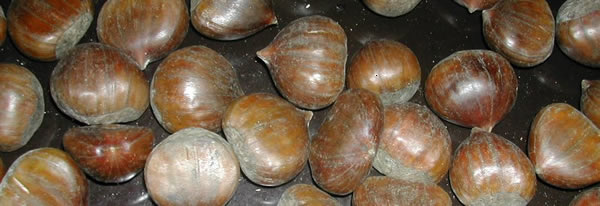
castagne - chestnuts

Each one had to be pricked with a knife so that it wouldn’t explode in the oven. It took me halfway through Sunday to get them all ready to be added to the stuffing.

Our plan to have the veal roast for Bruno and Ingvild’s welcome dinner was thrown off: they arrived very late Saturday night after a horrendous day of travel (Denver and Heathrow weren’t the only airports having weather problems). So we had to eat the roast on Sunday, although Christmas Eve (la vigilia di Natale) is traditionally a day of “fasting” – or at least, in modern times, light eating in preparation for the feast to follow. And we did have the tortellini in brodo that Enrico wanted, for Sunday lunch. (The leftover homemade broth was used in risotto last night.)
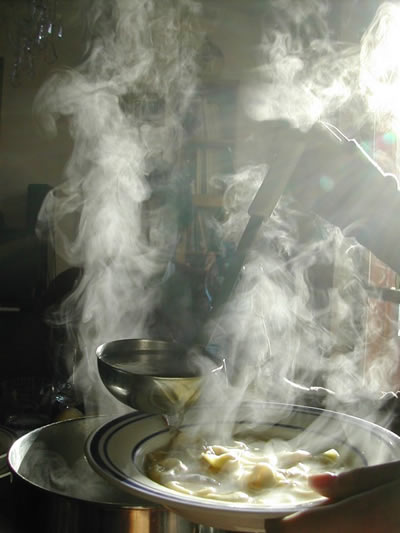
tortellini in brodo

On Sunday I made the cornbread and did everything else needed for the stuffing – had to make cornbread from scratch since I can’t get cornbread mix here. Someone on the Expats in Italy forum gave me a localized recipe using polenta. The result is not so great that I’d really enjoy eating the cornbread on its own, but it’s fine for use in stuffing, with a pleasantly gritty texture.

Some regions and families in Italy celebrate (with a big meal) right after midnight mass on Christmas Eve (which, once midnight has passed, is Christmas morning, I guess). Here in Lecco it seems that everyone goes to mass: Ross and her friends stopped in at Lecco’s main church at midnight with the idea of attending mass, but found it too crowded to hang around. Instead, they had their own version of Christmas eve dinner.

I think the Lecchesi after mass generally go home and to bed, waiting to open presents the next morning, as we did. Ross is now old enough, and stays out late enough, that we actually had to wake her for this! While I was waiting, I put the stuffing into the oven to bake, and started preparing the herb mixture for the turkey.

Our oven isn’t big enough to fit an entire turkey: I cook a turkey breast, using a recipe that calls for putting a mixture of herbs, onions, and lemon zest under the skin. Italian turkey breasts are packaged without the skin, so I spread the herb etc. paste over the bare breast and then layer on slices of pancetta (bacon):
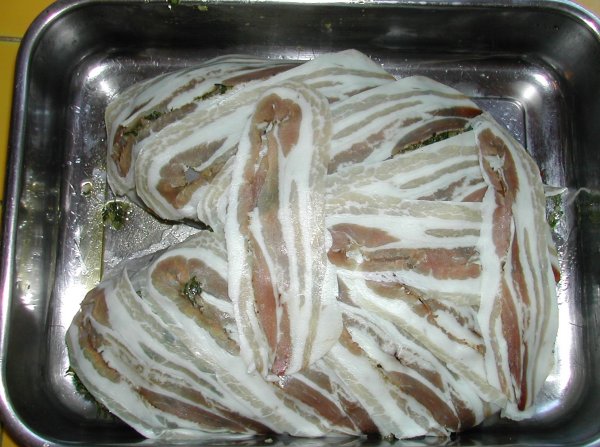
turkey wrapped in pancetta

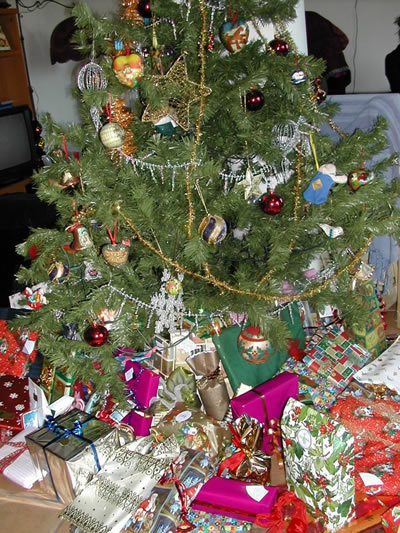
Then we went to open presents, as you might guess by the shapes: lots of books! (The amount of reading we do is also NOT typical of Italian families.)

We drag out present-opening as long as possible, taking time to enjoy each others’ gifts (and reactions). By the time we got through the pile, the stuffing was cooked and it was time to put the turkey in.

Italian poultry always takes a lot longer to cook than American recipes expect – maybe there’s less water in the meat? The recipe wanted me to cook the turkey for less than an hour, but it took more than two before the meat thermometer registered done.

We didn’t just sit there hungry and waiting, however: we had a wonderful antipasto. Bruno and Ingvild always bring lots of yummy salmon with them (they say it’s the only thing that’s relatively cheap in Norway). Salmon can be found year-round in Italy, but a lot of it is sold at Christmas: it has become a standard holiday luxury item. We ate two types (one smoked, one marinated) with toast, butter, and mustard sauce, which was plenty to hold us until the rest of the meal was ready. After the antipasto everyone drifted away from the table again, browsing through their Christmas books, drinking prosecco, and (in my case) checking email.

We re-set the table and got lunch onto it by around 2 pm. I have finally learned how to make mashed potatoes from scratch really well: the trick (thanks to the Silver Palate cookbook) is to cook the potatoes very soft, drain them, heat a mixture of milk and cream separately, then beat the two together with a hand mixer.

After lunch, I took a nap.

In the evening, we noshed some more on salmon and turkey, then watched “Brokeback Mountain” – not very Christmassy, I know, but I had got it for Ross for Christmas because she loved it, but I had never seen it myself. Wow. Amazing movie. I dreamed about it afterwards.

Today is Santo Stefano, St. Stephen’s day, also a national holiday in Italy – a wise tradition, I think, as we all need time to recover from holiday excesses. This is the day when families traditionally go on a gita (daytrip), but I let Enrico go with the in-laws – after a frantic week, I’m enjoying the peace and quiet at home. Ross has left for Bormio where she and a bunch of friends are renting a house together for a week. Their original idea was to ski, but there’s no snow (this winter so far has been unusually warm and dry) – the poor dears will have to make do with the hot springs.

* A Note on Panettone

I actually don’t like panettone all that much. But we learned a trick from Julia while we were staying with her and Dani back in April (for Rosie’s funeral). At the time, Italy’s traditional Easter cake, colomba (shaped like a dove, sort of) was already available in stores. I brought one as a gift for Julia and Dani. Julia said it was similar to Mexican pan dulce, and treated it the same: sauteed in a pan with lots of butter. Yum!

This turns out to work very well with panettone, too: the warmth and slight crispness make it much more interesting.

What (and from where) are your holiday traditions?