Tag Archives: Italian language

Everyday Italian: Newspaper Headlines 12

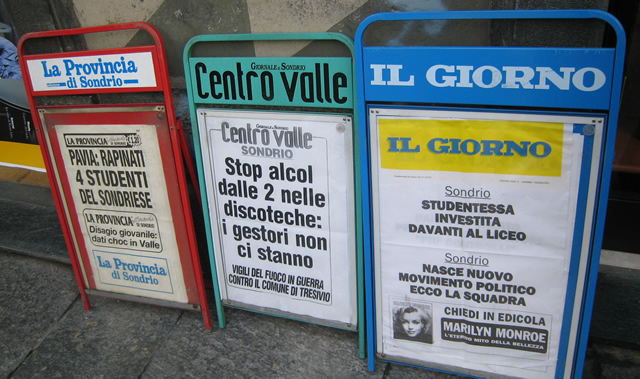
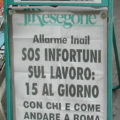
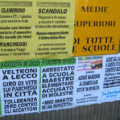
Recent headlines from Sondrio:

Pavia: 4 students from the Sondrio area are robbed – The province: youth disagio, shock data from the Valley

Stop [serving] alcohol from 2 am in the discos: the owners won’t stand for it – Firemen at war with the city hall of Tresivio

Sondrio: [female] student hit [by car or other vehicle] in front of high school – Sondrio: a new political movement is born, here is the team – ask at the newsstand: Marilyn Monroe [a book or something being sold along with the newspaper]

Everyday Italian: Newspaper Headlines 11

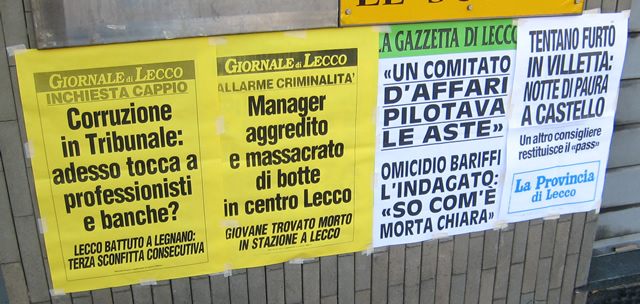
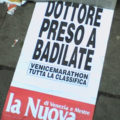
The above recent newspaper headlines in Lecco read:

Corruption in court: is it now the turn of professionals and banks? – Lecco [team] beaten at Leganano: third consecutive defeat

Manager attacked and “massacred” with blows in downtown Lecco [NB: He didn’t die – massacrato doesn’t mean killed.] – Young [man] found dead at Lecco [railway] station

A business committee steered the auctions [of public property, I think} – Bariffi murder. The suspect: “I know how Chiara died”

Attempted robbery of a [small house], night of fear in Castello [a neighborhood of Lecco] – another [city] councilor turns in his “pass” [parking pass?]

Everyday Italian: Newspaper Headlines 10

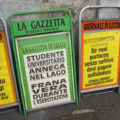
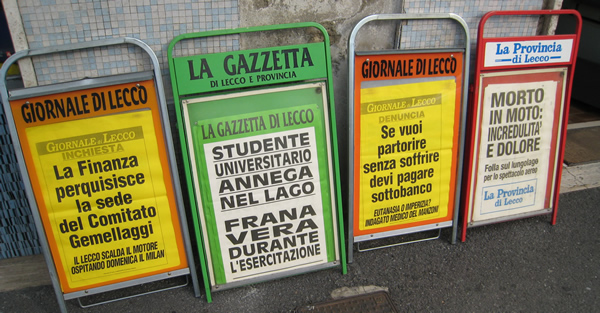
left: The Financial Office inspects [under warrant] the offices of the Twinning Committee. (Throughout Europe you see signs upon entering towns and city saying “This town is twinned with…” followed by one or more names of towns elsewhere in the world. This twinning is used to promote cultural exchange and tourism, I’m not sure with what degree of success.) – Lecco [the team] warms its engines. Sunday to host AC Milan

center left: University student drowns in the lake – Real landslide during practice [This probably refers to practice runs by an Alpine rescue team. Some Italian hikers and climbers volunteer as part of these teams, and for the “Civil Protection” units, it’s part of their job.]

center right: Denounces: If you want to give birth without suffering, you must pay under the table. [Probably refers to the fact that an epidural during labor is far from standard practice in most Italian hospitals. This may be because there aren’t enough anesthesiologists able to administer one, and they are busy with emergencies and surgeries. Some say that it’s (also) because Italian culture and the medical establishment believe women should suffer in labor. Whatever the reason, it can be difficult or impossible to have an epidural for childbirth. If it’s possible to get one only by paying a bribe, well, that’s not good.] – Euthanasia or inexpertise? Manzoni’s doctor investigated.

right: Dead on a motorcycle: incredulity and pain [I don’t get the incredulity – people die on motorcycles frequently around here.] – Crowd on the lakeshore road for the air show.

Italian Animal Idioms

In Italian, as in any language, there are many popular sayings and metaphors using animals, based on human perceptions of those animals’ lives and habits.

Cats

It seems that, in Italian culture, the distinguishing feature of cats is their greed for food.

Non c’e’ trippa per gatti

“There’s no tripe for cats.”

This is used when there’s absolutely no hope that you’ll get what you want. I suppose tripe is considered something that cats would like, but humans (at least some Italians) also like it, and are not about to share it with mere felines. At the European football championships in Athens (spring 2007), a group of Italian Milan fans unfurled a banner saying (in English) “There’s no tripe for cats,” meaning that there was no hope for the other team to win, though probably only the Italians understood it that way.

Tanto va la gatta al lardo che ci lascia lo zampino

“The [female] cat goes so often to the lard that [sooner or later] she will leave her little paw [print] in it.”

In other words, the cat is so irresistibly attracted to the lard (to eat it), that sooner or later you will know exactly whom to blame: a habitual malefactor will eventually be caught. This reflects the fact that many criminals don’t seem to have much imagination, but keep exploiting the same formula over and over again, which makes it easier for the good guys to catch them.

Dogs

Dogs are known for not having easy lives. Which is certainly true in Italy – urban dogs become neurotic cooped up in tiny apartments, and when out for their walks are the targets of hatred from non-dog-owners, who know that most Italian dog owners will not clean up after their pets, rendering city streets disgusting and parks hazardous for children to play in.

Every year thousands of dogs (and cats) are abandoned on the roadsides by families who are going away for the usual long vacation and can’t think of anything better to do with them. At this time of year the newspapers are full of pious “moral campaigns” pointing out that this is hazardous to humans as well as cruel to the animals: lost dogs wandering onto highways cause traffic accidents.

It’s not surprising that in Italian, as in English, people refer to…

Una Vita da Cani

“A dogs’ life.”

Dirlo ai Cani e Porci

“Tell it to dogs and pigs.”

To broadcast something, probably someone’s personal news, to every possible listener, no matter how unlikely to be interested.

Birds

Conosco i miei polli – “I know my [own] chickens”. Used when you know someone so well that you can predict how they will behave in a given situation. My own speculations on the origin of this phrase.

I know I’m missing more animal idioms – feel free to add!

Italy’s Amazing Summer Fruits

sculpture above done by Ross when she attended liceo artistico

Summer has arrived, and with it everyone’s favorite fruits – along with the desire to mangiare leggero (“eat light”) in the heat. At this time of year it’s not unusual to see mounds of cherries served as dessert, antipasto, or snack at parties and dinners. Juicy, sweet, bursting with flavor, all these need is a place to discard the pits and stems:

An Italian saying related to cherries (and applied to other things) is: una tira l’altra (“one pulls another”), as in: “I ate so many because they just kept coming out of the bowl, one after the other, their stems entangled…”

Have you ever seen more perfect plums? They come in many varieties and colors (blue, red, yellow, pink, purple), and all taste as good as they look:

If you’re visiting Italy in summer, here’s a restaurant tip: instead of dessert, order frutta di stagione (seasonal fruit). You may be asked what you want specifically, so here’s a little vocabulary:

  • pesche [PESS-kay] peaches
  • prugne [PROON-yay] plums
  • albicocche [al-bi-KOK-kay] apricots
  • ciliegie [chili-AY-JAY] cherries
  • pesche noci [PESS-kay NO-chee] nectarines
  • fichi [FEE-key] figs – these are often served as an antipasto, with prosciutto crudo – don’t miss it!
  • lamponi [lam-PONE-ee] raspberries
  • mirtilli [meer-TEEL-lee] blueberries

NB: Berries are known collectively as frutti di bosco (“forest fruits”). If you get a chance to eat fresh-picked wild blueberries (very occasionally available at restaurants and fruitsellers) do NOT pass it up. If you hike, keep your eyes peeled: you can find wild raspberries and blackberries free for the picking.

Peaches, plums, apricots, and cherries may be served floating in, or alongside, a large bowl of cold water. Dip the fruit in and swish it around to clean it, then eat! Many Italians peel their peaches with a knife before eating (often they are so ripe that the peel will slip away from the flesh with very little assistance), but you’re not obliged to – you’ll find that the skin is much thinner than you’re used to on American peaches.