Tag Archives: Italy travel

Airport Reports: Malpensa

Looks as if I’m a frequent traveller again this year, and I hope that will hold true for some time to come. I’ve been relatively quiet for the last six years – usually only one annual trip outside Europe – but it’s time to spread my wings again. Travel woman: that’s who I am and what I do.

Today’s flight, courtesy of Sun Microsystems, takes me from Milan to Frankfurt to Denver, on a United Airlines-Lufthansa code share. First problem arises from “code share.” I woke up at 3 am with an anxiety attack (I do that sometimes) and thought I should check in online in advance, as I had done coming back from my last trip on British Airways (they even had a very cute online application that let me choose my seats).

The tickets for this trip were purchased (by AmEx Business Travel, using my credit card), from United Airlines, but the aircraft appears to be Lufthansa all the way. So I went to the Lufthansa.com to check in. They didn’t recognize my credit card, kept asking for another. And that was the only option offered – no possibility to enter the record number, which I have on the printed out e-ticket.

I tried United’s website, and they apparently recognized me via the credit card, but told me I had to check in with Lufthansa. Argh.

Went back to sleep, woke up at 5:15, showered, drank coffee, dithered and fiddled until Antonello (o peerlessly faithful taxi driver!) arrived bang on time at 6. In spite of a sudden thunderstorm along the way, we reached Malpensa just after 7, and I was checked in by 7:15.

Malpensa is not the world’s most interesting airport – no real bookshops and no music/video shops. I had another coffee (decaf this time), fresh-squeezed OJ, and a chocolate croissant for breakfast, went on through security (no line! I am always going to fly on Tuesdays from now on for the rest of my life – flights on Tuesdays are cheaper, too).

There are lots of expensive fashion shops at Malpensa, but nothing I’d actually buy. A nice business class lounge would be a welcome refuge, but KLM, in spite of the Platinum status they reinstated me to a while ago, won’t let me sit in their lounge because I’m not flying on them or one of their partner airlines (what good is Platinum membership if I can’t use it anytime I damn well please?). And I can’t use Lufthansa’s lounge because I’m not flying business class with them.

So I’m sitting on the floor by the departure gate next to a wall socket (look for them on the columns near the windows) – might as well save my laptop’s battery while I can, it’s going to be a long trip. This is the only socket for miles and I’ve got it – several other laptop owners are eyeing me jealously.

Destination for this flight is Frankfurt. Also not my favorite airport. I’ve flown through there to India several times, and the terminal those flights leave from is remarkably lacking in services. Probably the US flights leave from a different terminal, hopefully with something a little more exciting in the way of food than German sausages and beer (which are only available from smoke-filled bars).

Security

Here in Milan, I did not have to take out my laptop or take my shoes off. Does this mean their equipment is different (it looks the same as any other airport x-ray)? Or should I be worried about lax security? Or (sshh! don’t tell!) does this mean that the elaborate procedures at other airports are designed to make us feel more secure when actually we aren’t?

Dressing for Travel

In the travel forums I frequent, American tourists often ask how they can dress to not look like tourists in Italy. Some other American tourists reply: “They’re going to know you’re a foreigner anyway, so why bother?” But that misses the point.

I wish all American tourists were so attentive to the cultures they are visiting as to actively research how to dress for the local culture. On my last trip through Heathrow, I noticed a group of teenage girls travelling together (I always wonder where these globetrotting kids are going, and why), and was horrified by their attire. Most were wearing sweatshirts, baggy capri-length trousers, and flip-flops. One even had her U-shaped travel pillow stuck firmly around her neck. They all looked as if they had just come off the beach.

I’m neither a prude nor a snob, and there is something I like about Americans’ relaxed attitude towards dressing. It can be a profound relief after the “keeping up with the Joneses” fashionability of Italians (I don’t always bother). But, when in a foreign country, it seems disrespectful. I wish some of my fellow citizens would think a little harder about the impression they make on others.

Translating italia.it

The Italian government (just before it fell) launched with great fanfare italia.it, the country’s new tourism portal, along with a logo which:

As for the website… oh, dear god. They reportedly spent 45 MILLION euros for a site that lacks basic features (such as an RSS feed) that we have come to expect from a modern website. It has technical problems which anyone in Italy who knows anything about the web (and that’s a lot of us) is gleefully (and ruefully – our tax euros wasted!) tearing to bits.

Given my own skills and biases, what I first noticed was the English translation. Here’s a sample paragraph which I did not have to look hard to find:

For having more precise vision click on “+”: in this way it will be visualized an historical period in the detail.
For having, instead, one vision of entirety click on “-” and the period will be visualized a large historical period contain more events. The period comes shown in the Timeline to the right of the zoom: the blue bar will increase or decrease the dimension based on your choice.

This kind of laughably bad translation, like the manuals we so often see with Chinese electronics, gives the consumer no reassurance that there is anyone competent standing behind the product (the product, in this case, being Italy).

^ Someone else in need of a good translation service. The title on this clip in YouTube is "Rutelli inglese maccheronico" – Rutelli’s maccaronic English. Maccheronico (maccaroni-like) is the term Italians themselves use for heavily Italianized English (or other language).

Until a few weeks ago, I might have said that my Italian was good enough that I could translate an English text into decent Italian – not quickly, but I could do it, in fact had been asked to do it several times at the office (we have an office full of Italians, why ask me?).

Then we put this supposed skill of mine to the test. Ross is applying to attend Woodstock School next year. The application form includes recommendations to be done by various teachers and other people at her current school, none of whom (except the English teacher) reads or writes comfortably in English. So the form needed to be translated into Italian.

I took a first cut at it, and thought I had done a reasonably creditable job. Then Ross took it in hand, and came out with something completely different. I realized that my translation had been understandable, and grammatically fairly correct, but probably about as funny to a native Italian speaker as the text above is to a native English speaker.

Around the same time, Antonio, one of the delightful people I met at barCamp Roma, commented about me on his blog: Cavolo l’ho sentita zittire e mettere in riga decine di uomini con un italiano corretto, ma inglesissimo! – "Cavolo! I heard her shut up and straighten out dozens of men in very correct – but very English – Italian." Okay, I’m slightly embarassed about the shutting up and straightening out (not exactly my intention, but definitely my character). But the very correct and very English Italian… hmm.

I stand before you now, chastened and humbled: my Italian is good, but I sure as hell don’t speak or write like a native.

And this is a lesson that many Italians have yet to learn. Just because you can read and understand another language well, and maybe even translate well from that into your mother tongue, does not mean that you can translate in the other direction with comparable competence. If you need a text to sound professional and persuasive, leave it to an expert.

So… I’m looking for someone to translate my resumé into Italian…

Funny Italian Street Names

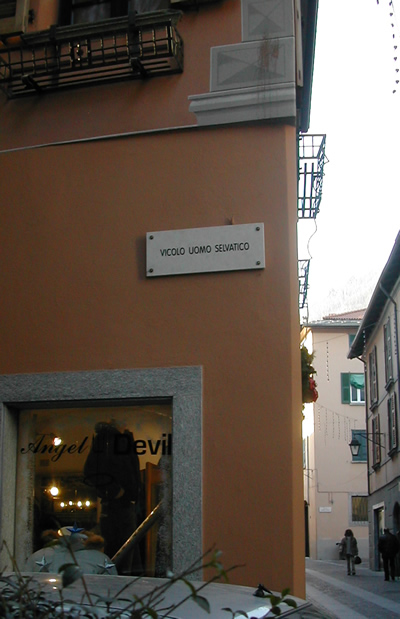
above: “Wild man alley” – with a shop called Angel Devil on the corner. Chiavenna

The US is full of streets named after trees, or simply called “Main,” or given numbers or letters. Washington DC is built on a grid of numbers and letters of the alphabet. I won’t even attempt to explain Salt Lake City. These two schemes reflect an extreme tidiness of mind, but have the disadvantage that they’re easy to mix up or mis-type, no doubt causing the postal service all kinds of headaches.

Italian street names can be repetitive, but at least they’re not boring. They generally fall into two major categories: history and geography. Geographic names can be of towns or geographic features in Italy or in other countries; Milan has a Corso Buenos Aires and a Piazza Lima, every town in Italy has a via Roma and probably a via Milano. There are also streets named after important dates, such as Piazza XXV Aprile, commemorating the official day that Italy was liberated from the Nazis. (In these cases, the date is always given in Roman numerals, which are also used in print to refer to centuries.)

Don’t look for Italian street signs stuck up on a pole on the corner, as you see in the US. In the cities, street signs are marble plaques cemented to the corners of buildings. When the street is named for a person, the plaque often includes his dates of birth and death and what he was famous for, so you can have a history lesson just walking around. Somehow it had never occurred to me that the Falloppian tubes were named for somebody, until I saw a street sign with the name Antonio Falloppio and the tag “anatomist.”

The historical figures named run the gamut from ancient Rome to Aldo Moro, but most of them are men. The few women I’ve noticed are queens, saints, and Maria Montessori (whose image was also on the last 1000-lire note).

The older streets nearer the city centers are generally named for older historic figures. The further you get out into the suburbs, the more modern the names, including some non-Italians. There is a via Washington in Milan, and I have seen several via Kennedys in various towns, and even a via Fratelli Kennedy (Kennedy brothers). Still further out in expanding city suburbs, recently-created streets have been named for Gandhi and Salvatore Allende.

Some streets are named for items of strictly local importance. Lecco’s most famous son was Alessandro Manzoni, author of I Promessi Sposi (The Betrothed), considered the first modern Italian novel. So in Lecco proper we have a Piazza Manzoni and Ospedale Manzoni, and every town in the province of Lecco seems to have streets named for his characters: Renzo, Lucia, i Bravi, Don Abbondio…

Funny Italian Street Signs

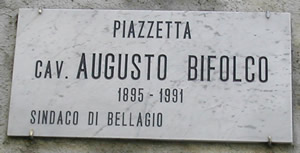
This piazzetta in Bellagio honors a former mayor, whose name”Bifolco” literally means “peasant”, but also carries the connotation of “yokel” or “bumpkin.” Evidently the man outshone his name, being named a Cavaliere (knight, an honorific title nowadays), as well as elected mayor.

I’ve found unusual street names in the historical parts of some towns:

Viterbo

viterbo_oct_15_03_184


^ “Mane,” in the sense of a big head of hair.


viterbo_oct_15_03_183

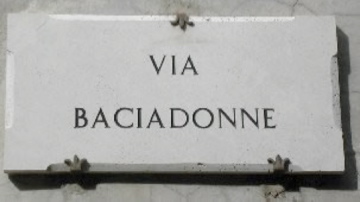
“Kiss(es) Women”

Pitigliano

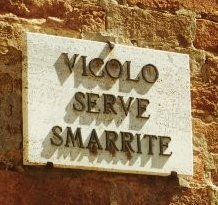
vicolo Serve Smarrite, Pitigliano

“Street of the Lost Maidservants.” ???

vicolo

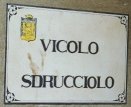
“Slippery Lane”

Volterra

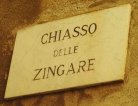
Chiasso delle Zingare, Volterra

“Narrow Alley of the Gypsy Women.” I was misled by this at first, because in modern Italian chiasso means “noise,” but a reader corrected me.

Pienza

And here’s an interesting sequence (yes, these streets actually are adjacent to each other).

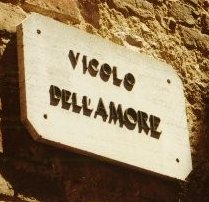
vicolo

First comes love..

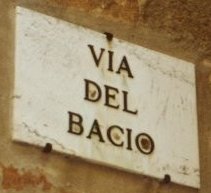
via

…then a kiss…

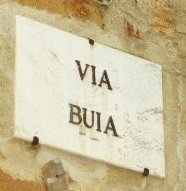
via

…and over the rest we draw a veil of darkness…

What’s the funniest street name you’ve ever seen (anywhere)?

Bellagio: “Beauty and Comfort” on Lake Como

Bellagio, Lake Como’s best-known tourist destination, lies at the tip of the triangle between the two southern branches of the lake. You can get there by road or get there by boat from Menaggio or Varenna.

Personally, I find Bellagio a bit overrated. During the season it’s overrun with tourists, and the shops are accordingly filled with overpriced souvenirs, most of which have nothing to do with the region (okay, I’m a souvenir snob – I only want something that authentically represents the place).

I concede that the views are stunning – but there are views at least equally stunning from other points on the lake.

But I end up in Bellagio a lot whether I want to or not, because our foreign visitors usually want to see it. My favorite way, during the summer, is to take the slow boat from Lecco.

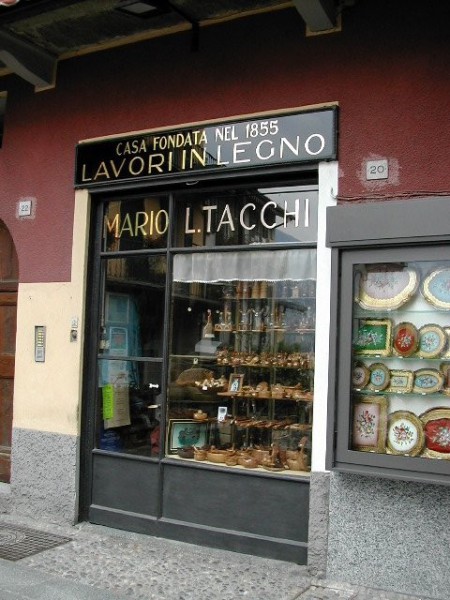
Bellagio’s charm, for me, is in its verticals – everything runs uphill from the lakefront. (Which means that, to really appreciate it, you must be prepared to walk.)Above is a view up Bellagio’s main salita, with the (justly) famous Bilacus restaurant on the right. Below is a shop whose sign I’m fond of – I love the antique typography you can still find on many shop signs in Italy.

front of a shop selling wooden objects (Works in wood)

Il Muro di Sormano: Where Bicycle Racers Hit THE WALL

On a sunny Sunday in January, we drove up to the triangolo Lariano – the peninsula jutting into y-shaped Lake Como, whose tip is Bellagio. It’s an area famous in Italian bike racing history (there’s even a church dedicated to cycling, with relics of famous racers – including their bikes) As we drove, part of the road was stencilled with Muro di Sormano, over and over again. We had never heard of this, and thought it must refer to some ancient ruin of a Roman or medieval wall.

After lunch at the top of the hill in Colma, we noticed a tourism signpost for “Muro di Sormano – 2 km” with an estimated walking time of two hours. This seemed like a lot of time to cover two kilometers. So we started walking down the very steep slope of a newly-paved road, which was painted with altitude markers and stencils of local plants, and viewing spots where you could look out and identify the mountain peaks all around. More mysterious were the large quotations from Italian cyclists, painted on the ground so as to be read from the bottom up.

We ran into a local couple who were happy to tell us all about it. I love hearing stories from people like this, who have been in a place forever and known every inch of it for decades. Myself, I have a breadth of knowledge about many parts of the world, but I will never have the depth of knowledge that comes with being deeply, permanently rooted in your native soil. I’m not sure I would trade, but I do enjoy seeing the other side.

As they explained, the “wall” of Sormano is the road itself. It used to be part of the Giro di Lombardia (and maybe the Giro d’Italia). Because of its steep grade, the cyclists perceived it as a wall. Which doesn’t appear to have stopped them – in one part of the video you can see what are apparently the record times for covering this damn-near-vertical distance.