Tag Archives: Italy travel

Return to Bormio

My birthday present this past weekend was a trip to Bormio, to indulge in the natural hot spring water as we have before. Enrico and I left Saturday morning, while Ross was in school – we are thankful that she is now old enough to be left home alone from time to time!

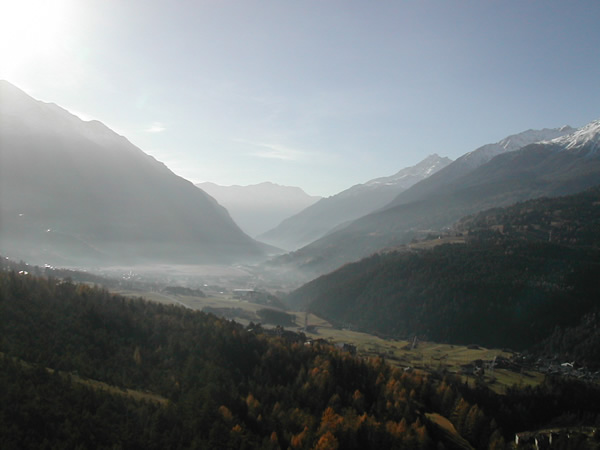
To get to Valtellina, you head north from the top of Lake Como and turn right. It’s a deep valley surrounded by high, rocky mountain faces.

As we neared Sondrio, where most of Valtellina’s wineries are headquartered, we debated whether to try visiting any, though I knew from recent research that none offered Saturday visits without advance reservation. But we decided to try Nino Negri, the area’s biggest wine producer, whose offices are a recently-refurbished 14th century castle.

The lady at reception was willing to sell us some wine, but, as expected, said we couldn’t have a tour of the cantina without a previous reservation. While we were choosing a dozen different bottles (including some new to us, one completely new developed to celebrate the re-opening of the castle, and the Novello that I enjoyed so much a few years ago and never was able to find again), I mentioned to her that I had emailed recently about the possibility of a visit. As I suspected, she was the same woman I had corresponded with. I talked about my website and how we had met Casimiro Maulé, the enologist and managing director of the Nino Negri winery, some years before.

“I’ll go see if Dr. Maulé is still around,” the lady said. “He was here just a minute ago.” He was, and gave us an hour-long tour of the cantina, with a head-spinning recital of facts and figures.

What I took away was that Valtellina before the 1900s was one of Italy’s chief wine-producing regions – da Vinci centuries ago mentioned that the area produces “wines that are very strong – and how!” The phylloxera plague that destroyed most of Europe’s vines took a heavy toll on this region as well, from which it has not yet recovered its previous glory. Nino Negri, founded in 1897, is the largest producer in the area now, thanks to Dr. Maulé’s talents as both enologist and businessman… and I will write more about all that when I have time to go into the details.
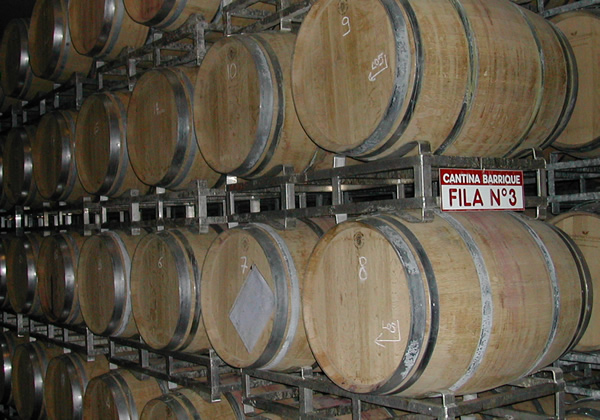
barrique barrels

wine being aged in wooden barrels (barriques) for additional flavor

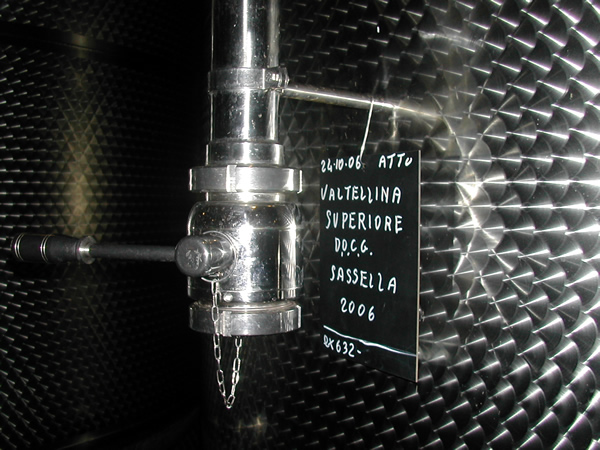
The winery goes several stories down, covering a city block or more underground in cavernous vault-ceilinged rooms and long, sloping tunnels. On a Saturday, no workers were around, and an eerie silence reigned in which it was easy to concentrate on the all-pervading odohuger of wine – unfamiliar and sour at first, then overwhelming and heady in the room where the first “cooking” of the grapes takes place in big fat stainless-steel tanks.

Other rooms contain rows and rows of wooden barrels two or three meters in diameter, or rows of stainless-steel fermentation tanks, and other equipment, all of which Dr. Maulé explained in every kind of detail – the tour was an education in both the art and the business of wine-making.

You can arrange your own tour, including tasting (and, of course, buying), Monday through Friday from 8 to 12 and 14 to 18, Saturday from 9 to 12:30. Call the winery in advance on 0342 485211 (or write to negri@giv.it) to arrange it, especially if you will need a tour in English as they have to get someone in for that. Nino Negri is located in the town of Chiuro, just outside Sondrio, in Via Ghibellini 3.

(NB: I hope to be able to report on other Valtelline wineries in the next few months.)
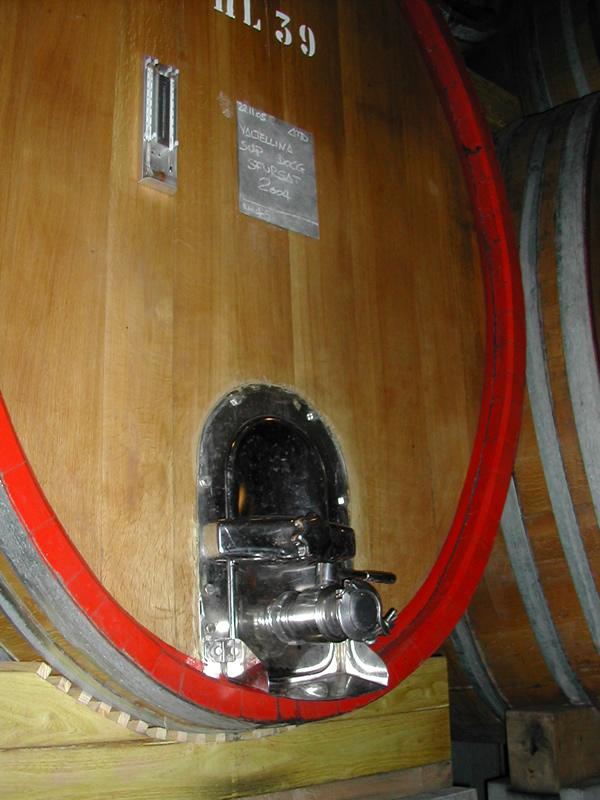
wine barrique

As we prepared to leave, it was nearing lunchtime, so we asked Dr. Maulé to recommend a restaurant on the way to Bormio. He said that it would have been easier to recommend one in the other direction (Chiavenna): Lanterna Verde, Passerini (where Enrico and Ross have eaten once before – they tell me it’s good) and il Cenacolo, which we hadn’t heard of and will have to go try sometime. He was less pleased about the options on the way to Bormio, until he remembered a place in Grosio, a hotel called Sassella with “Ristorante Jim” attached, which proved to be an excellent choice.
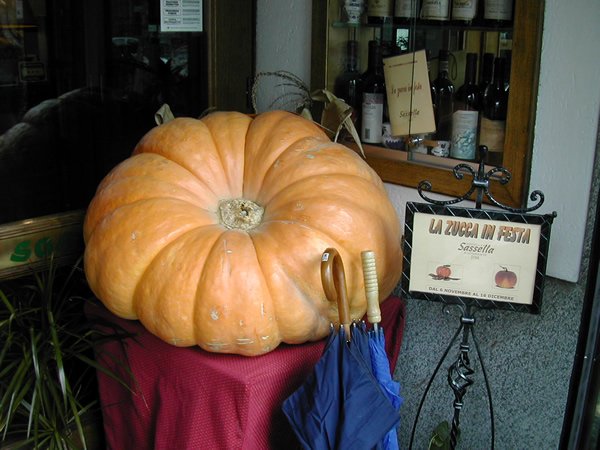
giant pumpkin

Jim (named after found Jim Pini), in addition to a very interesting general menu, was offering a “Festival of Pumpkin”, which made me very happy – I adore pumpkin. The little welcoming taster was two different yummy pumpkin-based spreads, with a basket of very good whole-wheat bread. I then had a mixed platter of pumpkin based antipasti (some good, some a bit strange).
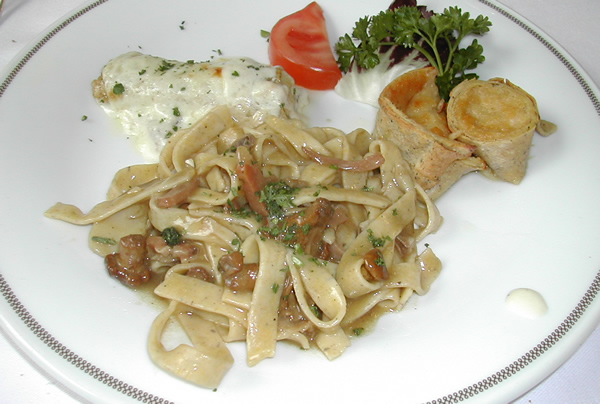
pasta

For our first course, we had a trio of local specialties (clockwise from upper left):

  • Toscanei di baita – a whole-wheat crepe with creamy melted cheese inside and out, toscanei being the name of the crepe while a baita is a mountain hut where cheeses are made.
  • Manfriguli alla Grusina – manfriguli are another type of whole-wheat crepe (Grusina derives from Grosio, the name of the town), this time filled with a mixture of breadcrumbs soaked in milk and grated cheese. These are sliced into rounds and then gratined in the oven to a crisp brown.
  • Bastardelle di Fraina in Salsa Alpina – bastardelle are whole-wheat ribbon pasta (I have no idea what Fraina means), in this case served with an “Alpine” sauce of pancetta (bacon) and wild mushrooms.

We were full after all that, but there were so many tempting secondi on the menu that begged to be tried. Jim is a Ristorante del Buon Ricordo (part of the “good memories” restaurant group) whose signature dish is cervo (venison). But the Piatto del Buon Ricordo was an expensive piatto unico (single-course meal) that included gnocchi, and I’d already had enough pasta. So I ordered a costoletta di cervo (venison rib steak), which was somewhat disappointing – it seemed very heavy. I might have enjoyed it more had I not already eaten so much.

Enrico made the better choice with a bastone (stick). This was a wooden rod wrapped in a thin layer of pancetta, then a thin layer of beef, and cooked on the piotta (or pioda), a heated stone – a local tradition. Designed to be eaten, as the waiter said, alla primitiva – primitive style:
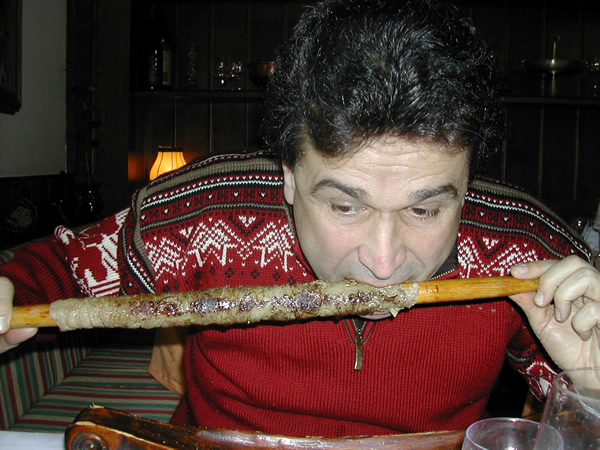
Italian kebab

Seated by a window at street level, we were startled to see a procession of priests and other men/boys in vestments, carrying tall golden croziers – and one carrying a pair of loudspeakers on a pole. “Don’t be scared,” said the waitress. “It’s just a funeral. They’re going to pick up the body from the house. There are only 5000 people in this town and they all know each other so, since it’s Saturday afternoon, everyone will turn out for the procession to the church.”

Sure enough, we soon saw a parade of townsfolk going in the other direction. “They take the old people first,” explained the waitress, “to make sure they get seats in front.”

We finished off our meal by sharing a pumpkin-apple-chocolate cake with pumpkin ice cream and amaretto (dessert goes into a different compartment in the stomach, right?), then coffee to brace us for the drive on to Bormio. The whole meal, including a half-bottle of wine (Inferno; the entire wine list is from Valtellina), cost only 69 euros – a steal by today’s standards. There were many other intriguing items on Jim’s menu – we’ll be going back.

Another thing we’ll be going back for, leaving from nearby Tirano, is the Rhaetian Railway, a little train that goes up the Bernina Alps, reportedly the highest railway in the world (or something; at any rate, it should be a beautiful ride).

We reached Hotel Miramonti in Bormio around 4, and I immediately had to try out the big tub in our “junior suite,” which had a lovely (if somewhat head-endangering) sloped wooden ceiling with heavy beams. We took a nap to sleep off some of that lunch, followed by a walk around downtown Bormio – which didn’t take long, especially as some shops and restaurants were closed. Bormio is mostly a ski resort, and it’s not quite ski season there yet – even less so than usual as this month has been unseasonably warm and dry.
Return to Bormio Part 2

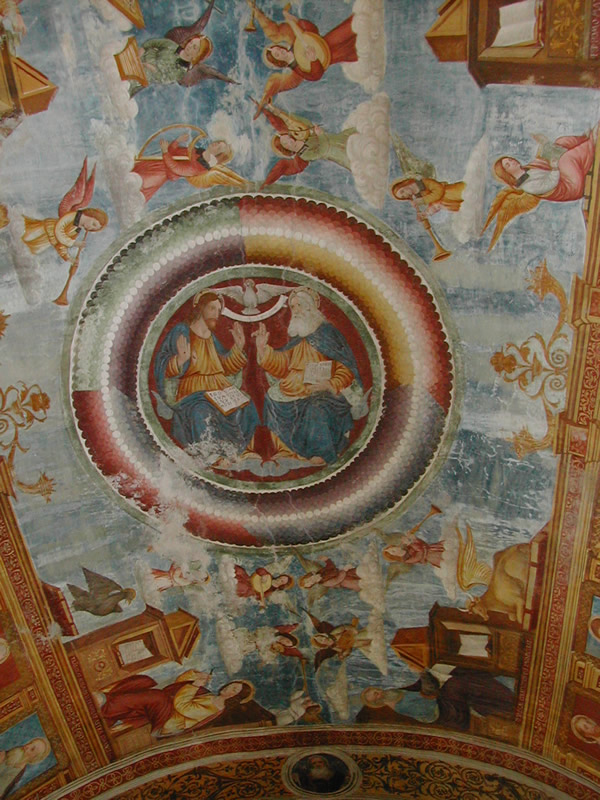
ceiling of a small chapel – this must have been recently restored, as we did not see it on our previous trips to Bormio, and there was no explanation anywhere in the room, though there were display cases seemingly ready to hold text of some sort

In the evening we went out again for snacks and beer at a pub, which got very rowdy with a large group of young men singing largely incomprehensible songs. We never did figure out what tribe they belonged to, but one song went “Ocker, ocker, ocker, viva i pizzocher’ !” Only in Italy would a drinking song be an ode to the local pasta specialty: pizzocheri, buckwheat pasta cooked with potatoes and greens, then baked with cheese, garlic, sage, and butter.

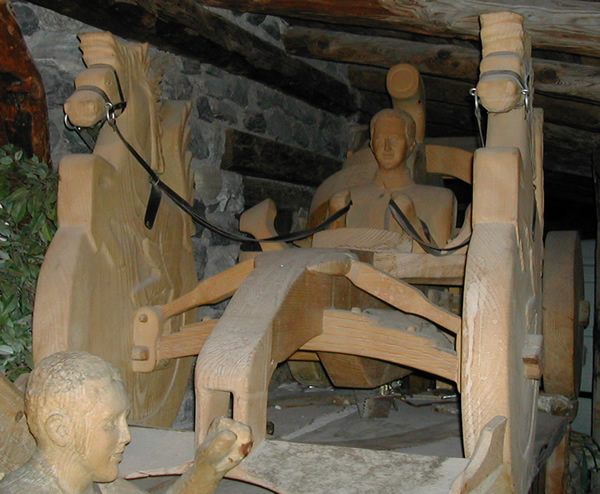
wooden Schumi

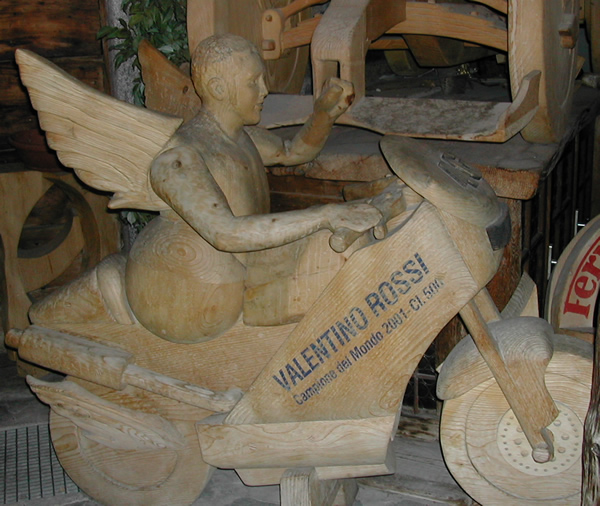
During our walk, we saw outside a restaurant called Rasiga these fanciful carvings of Schumacher with his Ferrari cavallini (horses) and Valentino Rossi, the motorcycling champion

wooden Rossi

The next morning we got up in good time for our included breakfast, then drove up to the Bagni Vecchi (Old Baths), a few hundred meters above the town. We had been warned to reserve in advance because the Bagni Vecchi were likely to be crowded while the Bagni Nuovi are undergoing restoration. We got there half an hour before our reservation time of 11:00, and then they couldn’t find our reservation, but they let us in anyway.

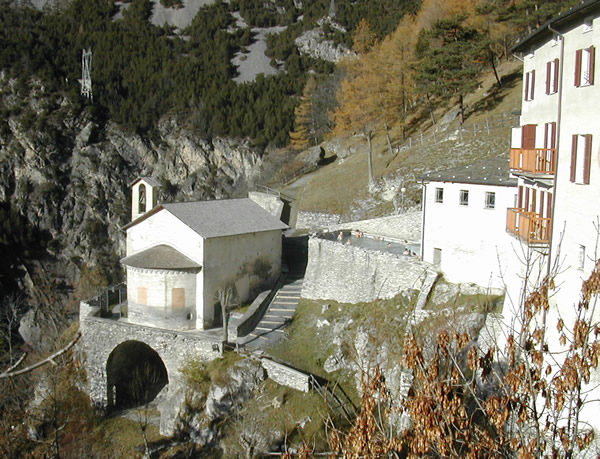
Bagni Vecchi di Bormio, external view

external view of the Bagni Vecchi showing the outdoor (hot water) pool next to the old chapel. To the right is the main spa and hotel building.

The price has gone up considerably: at 35 euros each, it’s well over twice what we paid on our last visit to Bormio, and a ten-percent discount voucher from our hotel did not do much to ease the sting. Oh, well. All good things must go up in price, I suppose, and, the once a year or so that we manage to go, we can afford it.

Once we had checked in and paid, we were given a token to get a locker key and a package containing tubes of bath gel/shampoo and body lotion. Then we went along to a desk where a lady gave us big white bathrobes and towels, and plastic flip-flops (presumably sterilized for our use); you pay a 5 euro deposit for these.

The locker rooms are unisex, with curtained booths where you change into your bathing suit (forgot your suit? apparently you can buy one embroidered with the crest of the Bagni Vecchi, though I did not inquire about price). After changing and stuffing our clothes, coats, and bags into the (smallish) lockers, we strapped our locker keys to our wrists, and away we went.

Our first stop was perhaps the oldest part of the baths, a dark, steamy, echoey tunnel carved into the living stone of the mountain. The tunnel splits, with one side ending in a spherical steam room with stone benches, the other trailing even further back and filled about four feet deep with hot water. In deep winter, due to some weird thermal effect, this water is almost unbearably hot (even for me, who adore very hot baths), but the surrounding earth wasn’t frozen enough yet last weekend, so it was merely pleasantly warm.

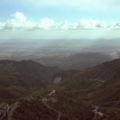
We then went on to Enrico’s favorite feature, the outdoor pool, which is constantly refilled with fresh hot water from an open wooden trough running along three sides, with close-fitting wooden spigots. It also has several kinds of Jacuzzi jets. But the best thing about the pool is that you’re floating in hot water enjoying this view:

view from the pool, Bagni Vecchi, Bormio

(There used to be a great webcam view of the pool, but it was taken down a few years ago, perhaps for privacy reasons.)

My own favorite feature of the Bagni Vecchi is “Garibaldi’s baths”, a long stone pool in a cavernous dark room, with three waterfalls crashing down five meters or so from near the ceiling. You can sit under these waterfalls and get an excellent massage on your head, neck, and shoulders, and the water was the hottest in the entire spa that day.

There are also saunas – two small, traditional dry ones, and one larger with a view (the “Sauna Panoramica”), and two new large ones which are more like wood-panelled sweat rooms – I liked these even better than the dry saunas. (I was also fond of the mud baths that these have replaced, but apparently I’m in a minority on this.) There is a “chromatherapy” room with stone walls, where you lie on a divan and watch colored lights change while listening to “soothing” music – I didn’t bother with this. Several other “relaxation” rooms are scattered throughout, but I have a bone to pick with whoever thinks that shrill pipe music, however New Age, is soothing!

Apparently the Bagni Romani (Roman Baths) that used to cost extra are now included in the package, but we forgot to go to them – they’re basically rooms five feet deep in hot water. We also never made it into the standard Jacuzzi-style pools; we managed to fill three hours going back and forth among the aforementioned features, plus some time just lying in the sun in our damp bathing suits and bathrobes (which we should not have been able to do in late November! global warming?).

By 1:30 or so we were thoroughly waterlogged and relaxed, and I was getting hungry. We showered, changed, returned out towels etc., dried our hair, and went to the spa’s café for a snack of fruit and yogurt.

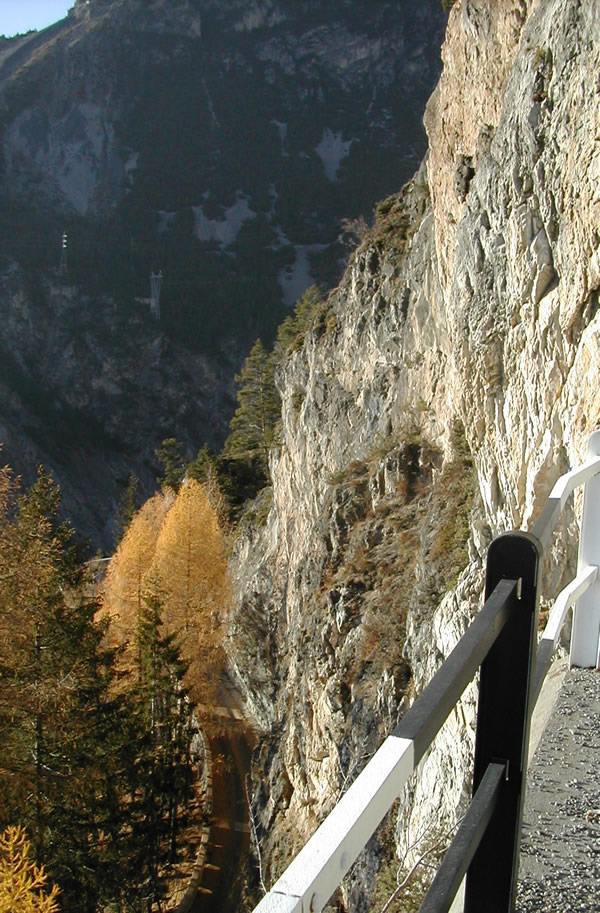
The road to the Passo dello Stelvio starts just beyond the turnoff for the Bagni Vecchi, and it was already closed for the winter – which seemed odd, considering how little snow had fallen. So we were able to take a walk up the road, completely unmolested by cars.

I was puzzled as to why so many pine trees had turned yellow. Surely that can’t be normal?
yellow pines

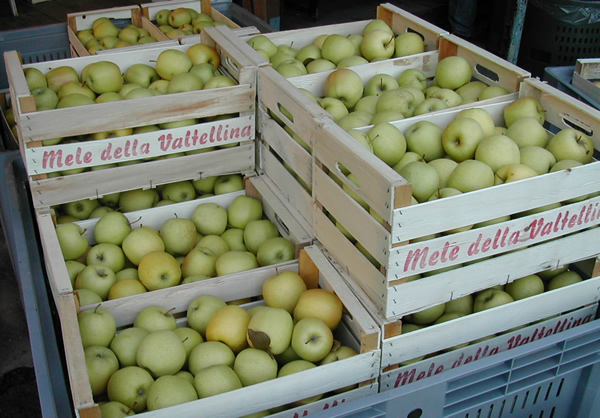
As we returned to our car, we saw climbers practicing on a rock face nearby.We headed for home, stopping along the way to fill our water bottles with fresh spring water, and to buy apples from one of the many stands along the way. The minimum we could buy was six kilos, so we’ll be eating a lot of apples for a while!

apples in crates

Sunday Hike: Canete to Tabia Dasci

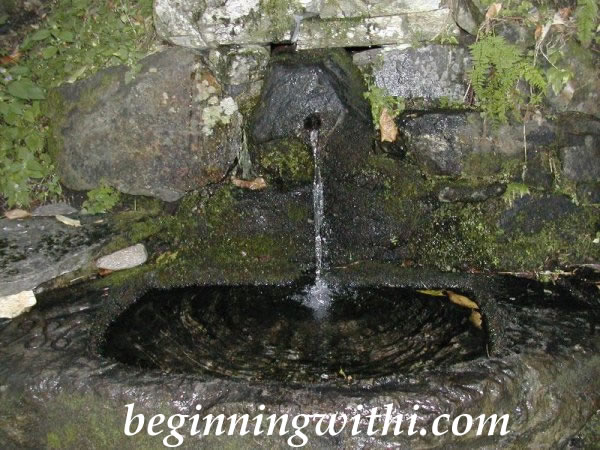
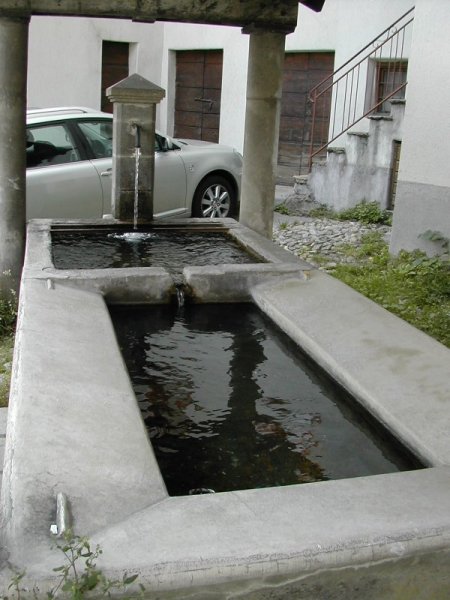
On Sunday Enrico and I woke up early, not wanting to waste what promised to be a beautiful end-of-summer day. We drove north through Chiavenna (stopping along the way for a second coffee and a slice of strudel) and up the tiny mountain road that leads to our favorite restaurant, la Lanterna Verde. Just beyond there we stopped for water: we save up the plastic bottles from mineral water, juice, etc., and refill them (dozens at a time) with good mountain water. Not that there’s anything wrong with our tap water, but mountain water tastes better, and is free. And it’s easy to find: every mountain community in Italy has an open tap connected to an underground spring. Traditionally this was where people got water for their homes, and washed their clothes (the wide ledges on the lower trough of this fountain are designed for scrubbing).

ancient stone laundry tub, Italian Alps

We got our first batch of water at a fountain in the woods near the village of Chete, which had been recommended to Enrico by some locals during an earlier visit, as having particularly good water.

Though the water was very good, we didn’t fill all our bottles at the fountain above – it was a bit of a walk back to the car carrying them.

We drove on and parked near the village of Canete, at the point where the road becomes “permit only,” such permits being given (we would later find) to people who have summer homes up on the mountain.

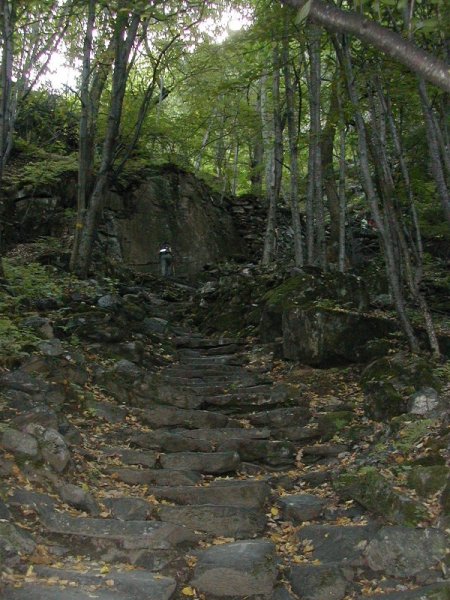
large stone stairs on a mountainside, Italian Alps

From here we started up a path that was around 400 years old (according to something Enrico read somewhere), a lot of which looked like this the above, a granite staircase, built into the mountainside, going up and up and up… These paths were built to reach the alpeggi (Alpine pastures) and malghe – buildings where cheese is made.

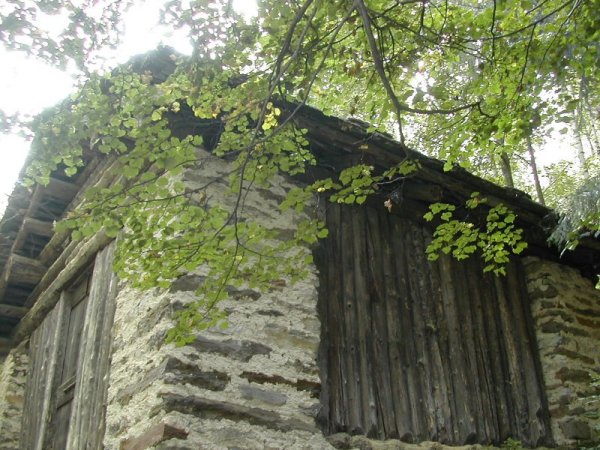
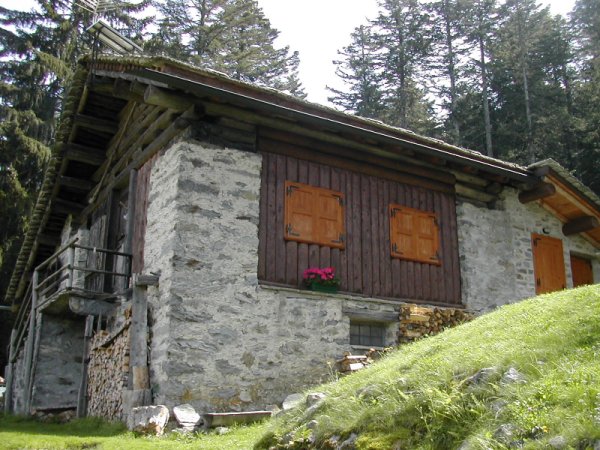
In the typical example below, the spaces between the logs are not sealed, so there’s plenty of air flow. There are dozens, if not hundreds, of these buildings all over the mountains in the area, though many are now in disuse – few people make their own cheese nowadays. (Those who do are very good at it – the bitto cheese made here is similar to parmigiano, but wilder, being made from the milk of cows and goats that pasture in the high Alps all summer.)

malga - Italian Alpine cheese-making hut

We stopped early to eat part of our sandwiches, at an open space on the mountainside where several families had built or were building summer homes. A man sat up on a scaffolding, sanding (by hand) the end of a wooden beam. It must have been his own house, because no one would be working for pay on a Sunday. All these little houses had photovoltaic panels on their roofs, probably just enough to power a few lightbulbs – the usual water, gas, and electricity lines don’t reach up there.

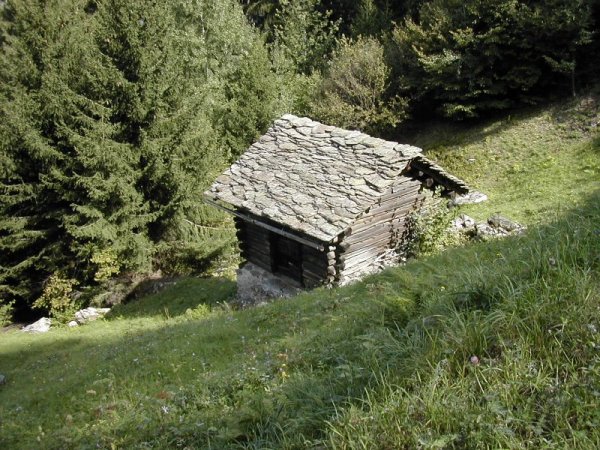
stone roof of an Alpine hut, Italy

Here’s an example of a different kind of mountain hut, likely used for storage as it is smaller and more tightly sealed. I love the stone roofs.

Somewhere along this road we came to a fork with signs pointing to Monte Cantone in one direction, and “Tabia Dasci” in the other. We had no idea what Tabia Dasci might be, but it was probably closer than Monte Cantone, so we went that way.

We crossed paths with a dozen or so people along the way, many of them coming back down from an early-morning mushroom expedition – with enviable hauls of porcini (boletus – Italy’s favorite ‘shroom). Any mushrooms left in plain sight were likely to be poisonous. (And some, even to our untutored eyes, very clearly were.)

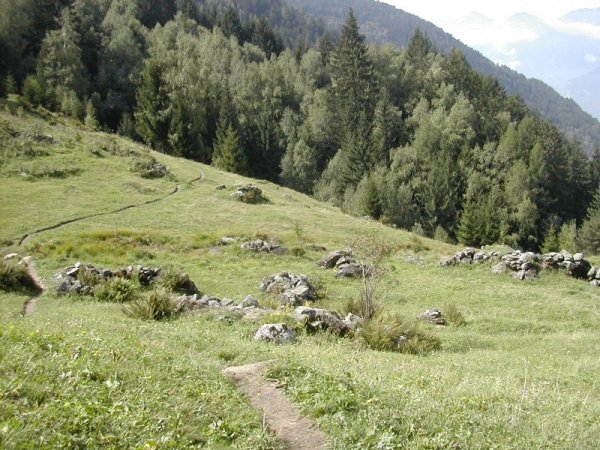
We eventually reached what must have been an ancient village, with many buildings still standing. I’m not sure whether these clumps of rock had also once been buildings, or had simply been piled up to clear the pasture land (there was evidence of goats in the area).

rock piles, Italian Alps

The old malghe here were all in good condition and possibly still in use, while many of the huts had been turned into comfortable vacation cottages.

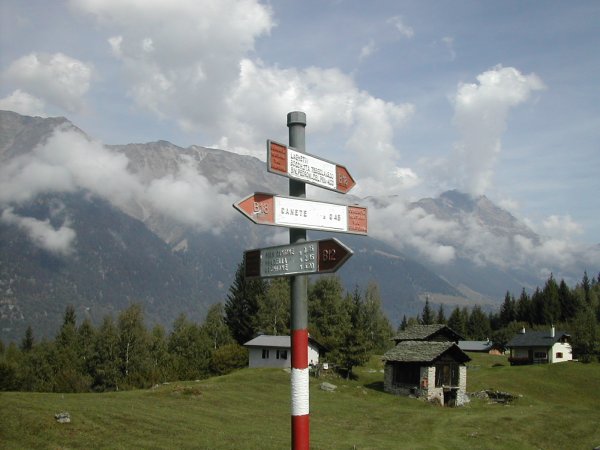
mountain path signs, Italian Alps

Only for fairly hardy residents, however – the road had ended some way down the mountainside, at least 20 minutes’ stiff walk from here.

Tabia Dasci proved to be this house (why it had its own signpost we never did find out):

Tabia Dasci

…which I photographed mainly for the geraniums. They look charming, and someone must have gone to a lot of effort to get them all the way up here!

Its owner directed us, in a thick, non-Italian accent (his house is only about a kilometer from Switzerland), to the laghetti (little lakes) further along the path, but warned us that they were hardly there – no water. And in fact, though we could see the bed of the stream that probably had fed them, we never found any water at all.

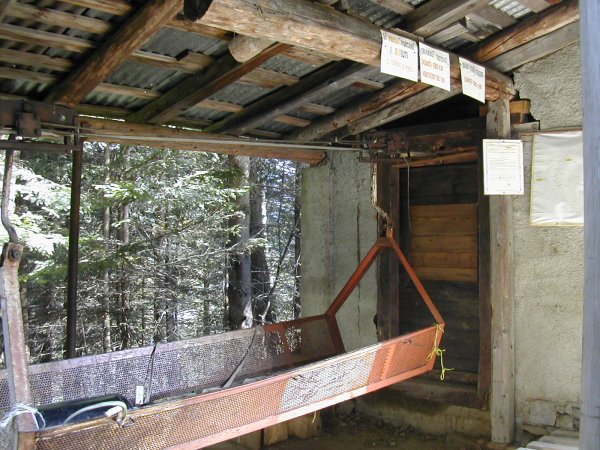
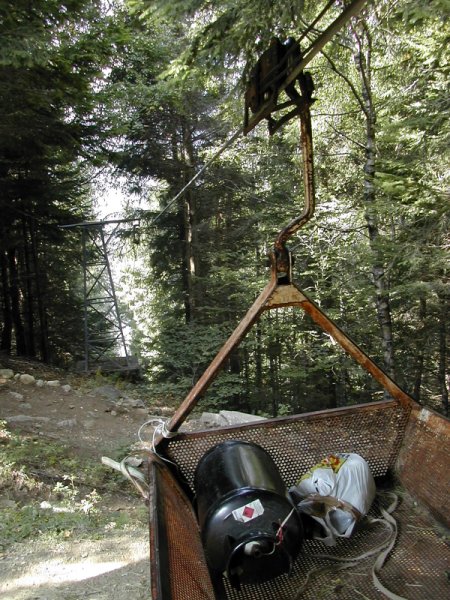
It’s likely that the man at Tabia Dasci is the only person who lives up here year round (if he does). In spite of the community’s isolation, the local health authorities keep an eye on garbage disposal. Residents have to send their garbage down the hill on the teleferica, a cable car for goods that runs up and down the mountain on a weekly schedule:

teleferica

^ Here you can see it loaded with somebody’s gas cannister, ready to go down for exchange and refilling.

We couldn’t ride the teleferica down, so we had to retrace our steps part of the way on the steep path, til we reached the mostly-paved road. That was the longer way back than the granite stairs, but easier on my knees.
teleferica, Italian Alps
We stopped in Chiavenna on the way back to sample the Sagra dei Crotti (food festival of the local cavern-restaurants – more on those some other time!). I was hungry again from all that walking and happily put away a serving of luganega (the local sausage) with polenta.

We had also picked up some local food to take home: bisciola [bih-SHOAL-ah] – a round, lumpy-looking cake, heavy with dried figs, raisins, and nuts – and a tub of promising-looking jam made from wild blueberries.

see the complete photo gallery here

Milan Central Station: Safety Tips

Almost anywhere in the world, large railway stations are dangerous. Large crowds of travellers, many of them new to the place and a bit bewildered, offer tempting targets for pickpocketing and other crime.

Milan’s Central Station is no different, and, especially lately, is even worse. I have long been leery of the area outside the station, and would not ever walk there alone at night (on advice of long-time residents of Milan).


I do use the Central Station at night, quite often, but I arrive by metro, from whence I can walk directly into the main hall of the railway station, passing through well-lighted areas with plenty of people around. If you take a taxi to the station, they drop you off at one of the main entrances under the portico – again, well-lighted with lots of people around.

Note: If you take an airport bus to the Central Station, when you get off, walk forward (in the direction the buses are facing), along the side of the station. You will first come to a side entrance with stairs going up to the departure platforms. If you need the main hall (to buy tickets), keep going around the front of the building. (There is construction right now with barriers coming and going so this is hard to describe.) Taxis are available both on that side and in the front under the main portico.

The key is not to be caught anywhere around there alone. I have even been warned against taking very early trains into Milan and arriving when the station is still largely deserted. I did arrive once around 6 am (had to catch an early train for Rome), and the atmosphere was decidedly creepy – the few people around did not look like people I wanted to let get close to me. I went into the coffee bar til I could board my train.

The area outside the station is now the target of big crime clean-up plans by the city of Milan, in response to a spate of rapes and other problems originating there. One recent, egregious case was of two young French women, just arrived, who accepted a ride in a car from two young Tunisian men who, like themselves, spoke French. These men took them to an isolated house and raped them for hours.

<insert disclaimer about not blaming the victim> but… how dumb do you have to be? Why would any woman, anywhere, ever accept a ride from a stranger? If it really needs saying, okay, I’ll say it: DON’T ACCEPT RIDES FROM STRANGERS. No matter how nice they seem, or how well they speak your language. For that matter, don’t accept much of any kind of help, especially if it involves accompanying you somewhere or telling you how to get somewhere. If you’re lost, try not to look it, until you can seek help from someone reliable. There are lots of uniformed police around these days (especially in the station) – ask them.

One of the new safety measures under discussion for Milan is to require taxi and bus drivers who drive lone women home to wait until they see their passengers safely inside the front door. (I have noted – and appreciated – that my taxi driver friend Antonello already does this, though it hardly seems necessary outside my own gate in suburban Lecco! He spent many years in the US, and probably developed that instinct there.)

All of this is not to say that Milan is dangerous – it’s less so than most cities of comparable size. But, like any large city, it’s got more safe and less safe areas. Unfortunately for the tourists, one of the least safe, for now, is the area around the Central Station. So… be careful out there.

Jul 8, 2007 – This MSNBC video of pickpockets operating outside Milan’s Central Station may be too “good” to be true – can anyone really be that oblivious to the boy repeatedly dipping into her bag? But in any case it’s a lesson: it pays to be aware of what’s going on around you.

add your own Milan safety tips and comments below

Airport “Security”: Reflections on Our Times

After all the fuss in the UK last week about terrorists toting Gatorade bottles, we faced our return flight to Italy with some trepidation. Not because we were afraid of being blown up, but because the “enhanced security measures” widely reported in the media promised hours in line waiting to be pawed over by TSA agents of questionable competence, for no increase in our actual safety.

I worried a great deal about how to pack. Not what to pack, because I didn’t have much choice about that – we had arrived in the US with two iPods, a laptop, and a digital still camera. Once there, we picked up my videocamera (which had been sent for repairs), and Ross got a new digital SLR for her birthday. Everything else might be expendable, but I was damned if I was going to pack a brand-new and expensive camera in checked luggage. And we had done a lot of other shopping, so our two large suitcases were already bulging (and tempting).

I checked the TSA and airline sites daily, and was relieved to see the former being frequently updated with new information. By a day or two before departure, it was clear that, as far as TSA was concerned, I needn’t worry about carrying on the electronics. But I still stressed about it, wondering if overzealous airline staff might give me a hard time – US Airways’ site had not been updated after the first day of fear, so I had no way of knowing if their policies had changed.

I was relieved to find that the new suitcase locks I had bought were TSA-friendly (meaning that security agents have keys to open them). Normally I prefer to use non-TSA locks and accompany the bags myself through the initial scan, but, under the circumstances, I didn’t want to give anybody any excuses to get paranoid about my luggage.

We flew from Baltimore BWI to Philadelphia to Milan last Thursday. On the advice of US Airways, we arrived at BWI three hours ahead of flight time – which turned out to be totally unnecessary. Check-in was smooth, once I had figured out that I was supposed to do it myself on a touch screen terminal – I guess this is increasingly common in the US, but it’s still fairly new to me. Then it took the agent a while to figure out how to ring up our $100 charge for overweight luggage. In light of everyone emptying their usually heavy carry-ons (on advice of TSA and the media), it would have been a nice gesture on the part of the airline to add a little to the checked baggage weight allowance (though my own suitcases were heavy for other reasons).

We dutifully drank our bottles of orange juice before heading into security. First stop was an air-puff bomb sniffing machine, then the usual “everything off/out” x-ray and metal dectector. The line was minimal, the TSA staff efficient and seemingly competent. We ended up with way too much time to hang around in the terminal (and then the flight was late).

My large new backpack contained my laptop, videocamera, still camera, books, non-liquid toiletries, and iPod. In addition, I was carrying a nearly-empty purse, for easy access to my wallet, tickets, passports, etc. Weirdly, it was the purse they decided to swab for bomb-making chemicals. The TSA agent apologized for the delay and said it was “something about the way things were laying in it.” Possibly the metal coil on a small spiral-bound notebook had looked strange on the x-ray.

At the gate there were recorded announcements that you couldn’t take liquids etc. on the plane, but no one was actually looking at bags, so I could easily have gotten away with buying something in the terminal and carrying it on.

We had a three-hour layover in Philadelphia – plenty of time for a security check which we didn’t actually go through. Depending on what terminal you switch to in any given airport, you may or may not have to go through security again when transiting between flights. We had gone through security in Philadelphia on the way in, but didn’t on the way out.

At the gates, again there was a recorded announcement about liquids, but no actual check. I noticed that duty-free bags were being handed over at the plane door. Though I did not look closely at what was in them, some of it may have been cream-type cosmetics. I guess this is okay if you receive it at the door and it’s in a sealed package, though I wouldn’t absolutely rely on this, and would not myself risk buying expensive cosmetics in the duty-free just now.

I usually like a strong finish on my articles, but perhaps it’s best that I refrain from any flippant remarks about how easily anyone with half a brain could circumvent all this “security.” In America these days, you never know who’s reading your mail…