Category Archives: bio

FemCamp Bologna 2007

Saturday morning I got up bright and early – way too early, considering that I had barely slept Friday night (jet lag – I had just returned from Colorado Thursday). Succumbing to travel paranoia, I took a taxi down the hill rather than wait for the first bus at 7 am, and got to Lecco station in time to catch the (late) 6:47 train to Milan. Which may have been wise, since the later train I’d been planning to take was also late. As it was, I got into Milan over an hour before the 9 am train to Bologna on which I and several other FemCamp participants would be travelling.

I had breakfast (coffee and a croissant), and discovered some newly-restored corners of Milan’s Stazione Centrale.

The station was crowded with people, many headed out for a weekend at some beach or other. Eventually I spotted Sara, and we soon met up with Michelle. My friend and colleague Lisa met us in the station as well, but she had to take a later train as the one we were on was sold out. The rest of us, including three women from Style.it, had all booked seats in the same train car, but weren’t sitting together, or so we thought. But by some weird logic of numbering, I found that my seat 86 was next to Susan’s 82. Which was great: we had a good long chat (she had said she wanted to take a nap, but I rudely preferred that she stay awake – I was afraid that if I gave in to sleep, I would never wake up).

Although we made the entire journey together, including the walk from Bologna station to the site in via San Felice, I never actually talked to the Style.it women; they didn’t introduce themselves, and they seemed such a compact gang that I was shy to intrude (had Mafe been with them, it would have been different – I already knew her from the Girl Geeks Dinner). Oh, well. I had plenty of good conversation with the others, in a random mix of Italian and English.

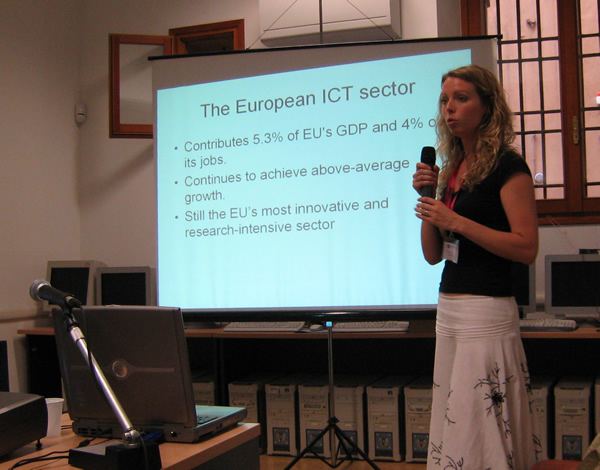
Arriving at the site (the HQ of TechneDonne), we were startled at the number of people present, and even more at how many were men. Seeing the attendee list on the wiki, we had already been perplexed at the intent of so many men to participate in what was billed as a women’s event. The guys seemed nervous, however: during the early part of the day they milled about, talking and taking pictures mostly among themselves (to the extent that the photos on Flickr show far more men than women!).

Women were only a slight majority at the camp. Nonetheless, a presenza femminile so much larger than at most tech events seemed to cow the men. Later in the day they warmed up and mingled better – I guess they figured out that we weren’t going to bite them (a disappointment for some?).

There were lots of congratulations for Lele, recently hired to be the official blogger for Cisco Italy. Quite a coup for the Italian blogosphere: blogger goes corporate (our very own Robert Scoble). I reflected that I was hired two months ago to help the storage software group at Sun Microsystems with blogging (among other things); evidently I have failed to capitalize on the self-promotion value of that!

delymyth

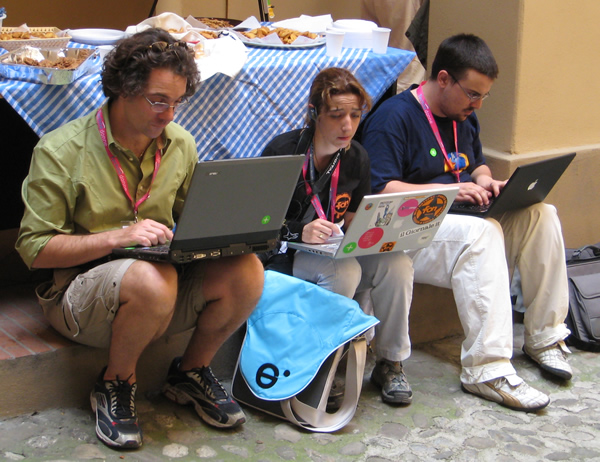
Alessio, Delymyth, Gioxx

The presentations began almost on time (only half an hour late, for a barCamp in Italy, is a near-miracle), but I did not attend any in the morning. Not that they weren’t potentially interesting, but I was enjoying talking with friends new and old in the courtyard, and the interiors were crowded. Everyone else complained of the heat, but I had seen Susan’s warning on Twitter that the forecast for Bologna that day was hot and sunny, so I was dressed entirely in linen, and very comfortable.

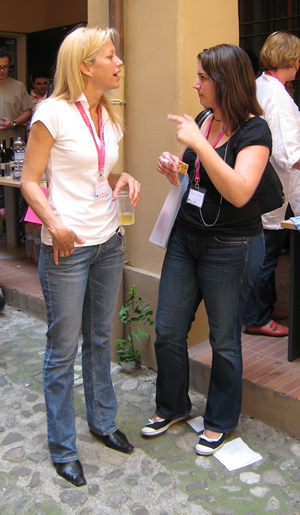
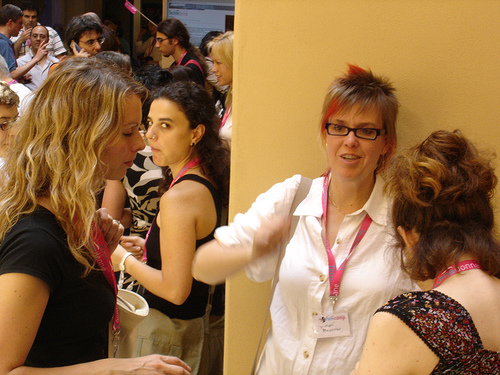
Amanda, Deirdré, Tara

photo by Luca Moretto shows off my new hair to advantage.

Amanda on the left, Tara on the right. I don’t know the identity of the person with the skeptical expression in the background.

I’d just had my hair done the day before. My hairdresser had proposed blonde streaks to lighten up for summer, but I dismissed these as unnecessary – my hair will lighten up by itself in the sun. But somehow Ross persuaded me to do something radical. She’s certainly an influence on my style!

Lunch, as usual, was provided by San Lorenzo. Thanks to the vagaries of jet lag and the half dozen or so coffees I’d already had, I wasn’t that hungry: I ate mortadella, salame, porchetta, bread, a few olives, and, later in the day, biscuits. Then went for more coffee. I didn’t dare touch the wine, or someone would have tripped over me sleeping in a corner of the courtyard.

Marta

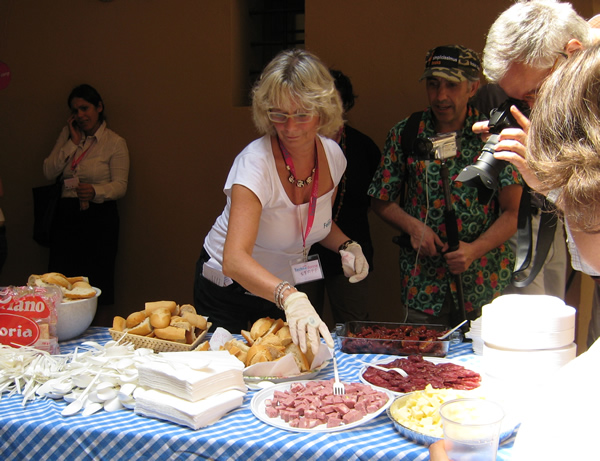
Giovanna dishes up yummies, carefully observed and recorded

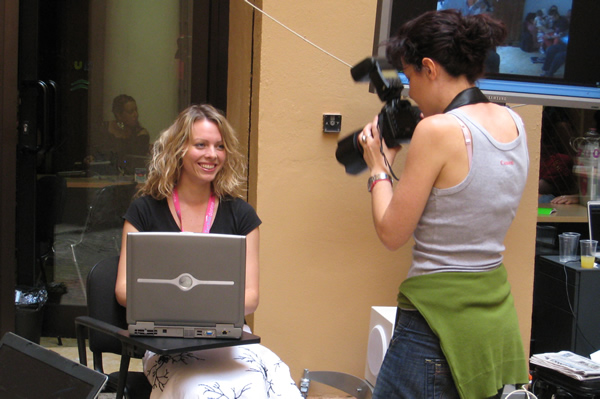
Glamour magazine is getting its tech on lately: the photographer I’d already met at Girl Geeks and RitaliaCamp was present, setting up all sorts of shots. Here, again, is the lovely (and very smart) Amanda:

Amanda glam

She also shot Lisa and me for an article on women and networking (I think it was – the journalist who’s to write it was home ill, and will be contacting us later for the actual material). We’ll be happy to talk about women and networking and TVBLOB!

Italian Garden 2007: May

Yes, I know this green guy isn’t a beetle, but at least he’s cute – even if he was probably eating my irises

We had a lot of beetles this year, I’ve never seen the like in Italy!

In May we had roses, oh how we had roses! I was so busy taking the close-up shots of them that I love:

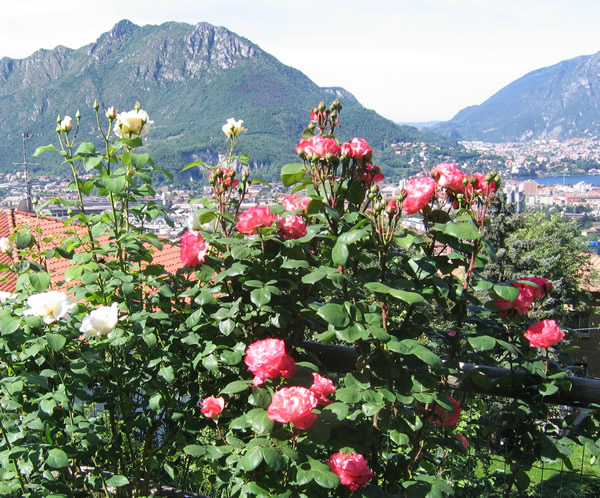
…that I neglected to get any good pictures to show off the mass of blooms along our back fence. This is the best I’ve got:

roses overlooking Lake Como

Italian Milk

It’s the Little Things That Surprise You

When you move to a foreign country, you expect (if you are wise) that the food will be different from what you’re used to. For the adventurous this is a welcome change, a chance to explore new flavors and habits (though sometimes you also crave the taste of home, wherever that is for you).

It takes you by surprise, though, when even the basics are different.

When I was a kid, milk was simple. In Bangkok, the Foremost milk truck came to our house once a week. It was a huge refrigerated vehicle with thick little doors on the sides that opened to disgorge wonderful things: milk in orange and white cartons, ice cream, and fudgesicles. I don’t know if Foremost even had a skimmed milk option in those days; I don’t remember ever seeing it.

In the US, milk came in the same paper cartons and in big white plastic gallon jugs. We always bought gallons, and the jug was always finished before the milk went bad, in part because I drank it so fast. But even as I got older and drank less milk (when I returned to the US for college), I still bought gallons, and it never went bad.

One of the first things that surprised me in Italian food shops was the size of the milk: it came in half-liter or liter Tetra pak bricks, nothing larger. A family of three or four, especially with small kids, would easily go through one or more liters a day, and one of the cliches of Italian family life is someone having to run out to a neighborhood shop early in the morning to get milk for the family breakfast (tall, steaming mugs of hot milk, with the kids having a drop of coffee in it – caffé latte – even from very young ages).

So why wasn’t milk available in larger packages? I soon found out: it goes bad incredibly quickly. Once opened, a carton has to be finished in a day or two, three if you really push it. I initially blamed this on the packaging: the only way to open a Tetra pak brick is to cut or rip a corner off it. This can make for messy pouring (depending on the cut you make and whether you are able to hold the full brick without squeezing), and then the carton can’t be closed again in any meaningful way. At least American-style half-gallon milk cartons fold in on themselves to protect their contents.

A few years after we moved to Milan, innovations in milk packaging began to appear on supermarket shelves: round Tetra pak cartons with screw-on lids, American-style fold-in cartons (though only in a half- or one-liter size, the latter very similar to an American quart carton), and plastic bottles. At least one ecologically-minded company offered returnable glass bottles, but that didn’t last long.

However, even in resealable packaging, the milk still went bad quickly. I guess we drink less than the average Italian family. It tasted different, too. Better, worse, I don’t know – it wasn’t like the American milk I was used to, but it was certainly drinkable, and anyway I was drinking far less than I had in childhood.

But I do like milk in my coffee, and with the cereal I sometimes eat (Ross practically lives on Special K, which tastes far better in Italy than in its native land, interestingly). I’m a disorganized shopper at best, and, especially where we live now, running out in the morning to grab some milk is not an option. So trying to keep fresh milk in the house is a constant irritant.

An alternative you have probably thought of, if you’ve lived anywhere outside the US in your lifetime, is UHT milk: the ultra-high temperature process it’s subjected to gives it a shelf life of months. But it tastes horrid, and some brands worse than others. I know people who drink it all the time and are happy. I could never get used to it.

Lately there’s a new kid on the block, micro-filtered milk. I don’t know what exactly micro-filtering consists in, but the flavor is excellent and it keeps for weeks. (Maybe this is the process they’ve been using in the US all along?) This is now my milk of choice, when I can find it. Stores aren’t stocking it much yet, perhaps because the public is suspicious. Our friend Michele, who used to own a bakery (and bakeries always sell milk for those early morning breakfast emergencies), said his customers wouldn’t buy it.

I do, whenever I can. It’s so nice to be able to stock up and know that I don’t have to think about buying milk for a while!

May 10 – One of the commenters on this article wondered why you can’t buy milk in Italy in a reseable one-gallon plastic jug. Aside from the aforementioned spoilage problem, there’s also a problem of space: Italian refrigerators are much smaller than American ones, reflecting the fact that Italians shop more often, and their homes are smaller. Even in our big new house, the “big” new refrigerator we bought is only 60 cm wide.

Many American fridges these days are built with very deep doors where big beverage bottles and jugs can be stored for easy access. In Italy, it can be difficult to fit a two-liter bottle anywhere at all.

What food surprises have you encountered in a new country?

Getting Ready for Woodstock School – Some Practicalities

So my daughter will be going to Woodstock School. Given my obvious enthusiasm for the place, you may assume that I’m ecstatically happy about this – and I am. But there is also plenty of room for doubts and worries and sorrow. What do I do with feelings like these? What I always do: write about it! <wry grin>

First, there’s the practical side: we have a lot to do to get ready. So, for the benefit of other current and future Woodstock parents, I figured I might as well write about that.

Health

Every seasoned traveller knows that before travelling to (what used to be called) third-world countries, you need to get shots. Ross and I went through this two years ago in preparation for our trip to India in the summer of 2005. The travellers’ health clinic of our local health agency in Lecco was able to advise on and administer everything we needed. Ross made an appointment to check what was needed this time around. Since she’s still a minor, I had to go with her.

Turns out we had forgotten to get her Hepatitis A booster that was due 6-12 months after the first one – the nurse scolded us, but didn’t seem to think it was really a big deal. She gave us a lecture (again) on when Ross should take malaria prophylaxis, and that was that – at a cost of 45 euros.

Enrico is concerned about health care for Ross at Woodstock – not that she has any special needs, he’s just worried about health in India in general (although, during our trip in 2005, it was me who got sick, not Ross).

There wasn’t much information on the school or SAGE website about this (an oversight now being remedied), but I know that the school has its own health center with nurses and a doctor, and that Landour Community Hospital (LCH), where many Woodstockers were and still are born, is just outside the school gates. I also know that India can boast world-class healthcare these days, at least in the big cities – indeed, “health tourism” is becoming a booming business.

As it turns out, LCH is getting a facelift (maybe much more – I don’t have details yet), thanks to my classmate Sanjay (who has also revamped the school’s kitchens – an area of natural interest for him as he’s in the restaurant business). So the quality of care available right on Woodstock’s doorstep is improving.

There is also some sort of catastrophic health insurance available through SAGE I think, we’re waiting to hear about that from them. I’m not sure it provides for a medical evacuation to the home country, but someone mentioned that it would pay a ticket for a parent to come in case of serious hospitalization. I’ll report the details when I have them.

The SAGE package we received recently includes a medical history and a form to be filled out by our family doctor with data from a physical exam, plus Ross will have to get blood, urine, and stool tests. This all makes sense – the school needs to know up front that these kids don’t have health problems when they arrive. But it’s going to be a mad scramble to get it all quickly – SAGE wants these forms back by June 1st.

Normally such tests might be free or subsidized in the Italian health care system, but waiting times can be so long for non-emergency testing that I’ll probably have to pay to have the lab work done privately. At least the exam by the family doctor shouldn’t cost.

What to Bring?

It may seem ironic for a school in India, but my greatest concern in this category is warm clothing. Woodstock is 7000 feet up in the “foothills” of the Himalayas, where it’s plenty cold and snowy in winter, and most of the buildings are far too old to have anything like central heating.

For this reason, the school year traditionally ran from late July to late June, with the long vacation from early December to mid February. It could still be bitterly cold even in late February – I remember one year when music practices were suspended because our fingers were too stiff to play.

Lucky Ross: the school calendar is changing this year, with classes starting August 8th, vacation December 14-Jan 22, and graduation May 30th. The idea is to align Woodstock with US schools and colleges, in part to have more time to prepare for AP exams in the spring. So the students will be in Mussoorie for much of the winter – brr!

Ross initially pooh-poohed my suggestion of long underwear (SO unfashionable). I have tried to explain to her that you’ve never known real cold until you’ve had chilblains. I’m buying her the long underwear anyway – and she’s more convinced now that she’s seen it on the packing list we just received from SAGE. At least she recognizes the depth of motherly love demonstrated by my offer to give her my very warmest ski socks (I have a fetish for socks, and my feet are always cold).

Ross has also been put in touch with a current SAGE student whose advice she can ask on what else is and isn’t needed.

One major purchase will be a laptop; though the school has computers for student use, Ross is accustomed to having her own: at home she uses my “old” desktop, and she can’t imagine life without it close at hand to organize and PhotoShop her photos.

Student Visa

I dread facing the Indian consulate in Milan again, it’s always chaos. We will have to go there to get Ross a student visa for India, but we can’t do it until after June 1st (at the earliest), because the visa is good for exactly one year. Getting the visa should be straightforward – the school is sending a “bona fide student” letter vouching for her status. But I’m always afraid that something will go wrong with this, so I won’t really rest easy until she’s got that damned visa in her passport.

It’s amusing to compare and contrast all this with my own thirty-year-old memories of preparing for Woodstock.

Your thoughts?

Long-Distance Working – A Tale of Two Companies

Old Days, Old Ways: Adaptec

When I began working for Adaptec in 1995 (as a result of their acquisition of Incat Systems, the company which created Easy CD), I was already a remote worker. Fabrizio Caffarelli, who had founded Incat in Milan, had moved himself and the engineering staff to California in late 1993 with the goal of selling the company. In the meantime, though still living in Milan, I needed to work closely with engineering staff to document, test, and help to improve our software products. I began traveling to California regularly, but most of the time I worked from home, keeping in touch by phone and email.

Nobody at Incat had a problem with this, but the concept was foreign to Adaptec back then. In 1995, they had not even had email for very long because (so I was told) the company’s executives had resisted, fearing it would be “a distraction” (they may have had a point).

Adaptec at the time did not have any employees working permanently offsite, and they were not about to make exceptions for an unknown quantity like me so, in spite of my clearly-stated preference to become a “regular” Adaptec employee, I was taken on only as a contractor.

Adaptec’s employee benefits would not actually have been all that interesting or useful to me (e.g., I didn’t need US health insurance). However, although even the regular employees had California-standard “at will” contracts, I suspected that, as a contractor, I was more vulnerable than they to cyclical layoffs.

Some people at Adaptec even treated me as an outsider – not realizing (or perhaps resenting) that, to the CD-recording world, I was the face of Adaptec online.

On one memorable occasion, a customer reported to me that he had phoned tech support, quoting me on some technical question.

“Oh, she doesn’t know what she’s talking about,” responded the tech. “She’s just a consultant.”

I also had the uneasy feeling that, even among some of the people I worked most closely with, I wasn’t perceived as being part of the team, nor as being serious about my career. Part of the reason I started an MBA (via distance learning, of course!) was to demonstrate my seriousness – had I had to apply for the job I was already doing, the job description would have included “MBA strongly preferred.”

While I was doing one of my first MBA courses, an engineering colleague from Adaptec’s Longmont, CO office, Dan Maslowski, came up against a personal situation: he was perfectly happy in his job, but his wife had been offered the opportunity to open the European offices of the (Web) company she was working for.

Dan’s boss didn’t want to lose him, but wasn’t sure how to deal with a remote employee. So they talked to me, as an example of how it could be done, and Dan eventually moved to the Hague while still working for Adaptec. We were a mutual support society of two, commiserating on how difficult it was (and still is) to schedule phone conferences when you’re eight or nine time zones away from everyone else. I even wrote him up as a case study for my MBA course.

My own situation with Adaptec endured, but several changes of manager back at headquarters increased my sense of vulnerability, frustration, and alienation. From some perspectives, I had an ideal job: I could set my own hours (as long as those included lots of late-night phone conferences), and was largely managing my own work and that of two other contractors, all of us working from our respective homes.

But I was at a career dead-end. It was clear that, with Adaptec, I could never become a regular employee, let alone have a career path, as long as I was off-site. I was good at what I was doing, but had been doing it long enough to be getting bored. I could see things that (desperately) needed changing to make life better for Adaptec’s customers, but I would never be in a position to make those changes happen.

Hence my attempted move to California in 2000-2001, to participate in the Roxio spin-off. I wanted to help define, from the ground up, how a new company would deal with its customers, using the Internet as a tool for support, marketing, and relationship-building via customer communities.

I planned to move my family to the US for a year or two – long enough, I hoped, for me to launch a career and then find a way to move back to Italy, where my husband had his own career that he was not willing to give up.

That didn’t quite work out. The whole Roxio situation went sour for me, and I returned to Milan in March, 2001 – back to the same situation in which I had previously felt so vulnerable, alienated, and frustrated.

All those same adjectives still obtained, redoubled. The (ridiculously good) money was not enough to overcome my misery, especially when my mother-in-law was diagnosed with breast cancer. I didn’t think I could handle a major family crisis while hating my job every day. I quit in July, 2001. (My mother-in-law was successfully treated for the cancer and is still living; Roxio is no longer with us).

A New Dawn: Sun Microsystems

Corporate practice and technology have naturally moved on, and working remotely no longer seems as strange or difficult as it did ten years ago (although in Italy it’s still highly unusual). Having suffered through the early days with a resistant employer, I am now delighted to find myself working with a company that gets it.

Remember Dan? He ended up working for Sun Microsystems, where he’s currently a Senior Engineering Manager. When he realized in February that the new position he had just taken on entailed responsibilities for part of a website, he thought of me.

I knew nothing about Sun, except that Dan worked there and I liked what I could see of his management style. He had even left Sun for AMD, then gone back to Sun, and they’d kept his company blog waiting for him. This is standard practice at Sun (10% of whose ~33,000 employees have blogs open to the public), and is a subtle indicator of the company’s relationship with its people.

Obviously, Dan was asking me to join him knowing that I live in Italy and, though very willing to travel, this is where I’ll be staying. It didn’t occur to me to ask whether this would be a problem; his answer would have been: Of course not. His team was already spread across time zones from Silicon Valley to Beijing, so managing one more person in one more location wasn’t going to make much difference to him.

Arriving at Sun’s offices in Broomfield, CO for a first meet-and-greet visit in March, I astonished to learn that practically all of Sun is like this: teams seem to be formed on no geographical basis whatsoever, and many Sun employees work from home, wherever home may be. According to an official company statement I heard in an online presentation for newbies, at least 50% of Sun employees work from home at least one or two days a week.

This point was made most forcefully for me when I read the first blog post from Deb Smith, a Director in the software group I’m working for. Go read that now and you’ll see what I mean. As soon as I read it, I thought: I’m in the right place. The whole company is built for what they call OpenWork, with all the right systems – and, more importantly, attitudes – in place to make it work well both for the company and its employees.

This is probably a factor in the large proportion of women who stay with Sun – I’ve never seen so many women in an engineering organization!

And it’s not just the women: practically everyone at Sun seems to have been there for at least ten years (the company celebrates its 25th anniversary this year), with no intention of leaving. Upon getting to know Sun a little better, this does not surprise me at all. Sun demonstrates that it values its people, and understands the importance to those people of all aspects of their lives, not just their careers. That sounds like an organization I’d like to stick with.

what qualities do you look for in an employer?