Category Archives: bio

A School Year Abroad

In my encounters with fellow alumni of Woodstock School, many naturally ask me if and when my own daughter will attend. The answer is: with a great deal of luck, she will start in August, 2007, for an exchange year which will be her fourth/senior year at Woodstock, but only her penultimate year of Italian high school.

The application process has not been easy. Not surprisingly, the application forms and process for SAGE (Studies Abroad in Global Education, the US-based outfit that runs Woodstock’s exchange program) are slanted towards US students. There are differences between Italian and US school systems and cultures that could cause an Italian applicant to look “weak”.

American private schools and universities are fond of “well-rounded” applicants, expecting students to be doing sports, public service, paid work, arts, etc., in addition to lots of schoolwork (apparently, no one is allowed time to just be a kid anymore).

Almost none of this is likely or even possible for Italian kids.

Italian Students Are Not “Well-Rounded” – Here’s Why

There are no extra-curricular activities in Italian public schools (I assume for lack of funding). The only sport is PE. There is no music, no school newspaper or yearbook, rarely drama, no clubs. There is student government (mandated by law), but only two class representatives (plus two for the whole school) are elected per year, and they don’t do much. There are occasional special events that students can volunteer to participate in (Ross is usually the photographer). Ross’ current private school does try to get their kids to do volunteer work, in a very limited way (Ross tutors a younger girl in English).

Some kids do after-school sports or dance, a few competing very seriously, but participation at that level is expensive and takes a lot of time. Otherwise, Italian kids don’t have opportunities for awards or recognition. Volunteerism exists in Italy only on a small scale, and few kids are encouraged to participate. Almost none but the truly needy work after school or during summers – it was unusual that Ross did an internship last summer, at the company where I worked.

Italian kids simply don’t have time or opportunity to do much of anything outside of school and homework. One effect of this is that kids who are not good at academics may never get a chance to shine at anything, nor to realize that they may have non-academic skills that are useful and valued in society. This can’t be good for their self-esteem. No wonder so many seem to be drifting and unmotivated.

The SAGE application asks about a “guidance counselor,” a role which doesn’t exist in the Italian system. No guidance is offered about university entrance or careers – kids figure these things out together with their parents, which may be part of the reason that many university students seem profoundly uninterested in the degrees for which they are studying.

Some high schools used to have part-time psychological counsellors available, but those positions have disappeared from public schools with recent cuts in education funding.

There is no tracking in Italian schools, no honors levels or anything of that sort: everyone does exactly the same classes as their classmates, sink or swim. If you fail three or more subjects in a year, you repeat the year, and the failure rates are astonishing. In Ross’ first year of high school, six or seven of the 25 kids in her class failed. The same thing happened again in her second year (which was when Ross herself failed). I’m not crazy about the American practice of “social promotion,” either, but there’s got to be a happy medium somewhere!

Italian grading is a mystery to me. In high school, students are graded on a scale of 1-10, with 6 being a pass, but grades above 7 don’t seem to be assigned at all routinely. Given that, and the high rate at which students fail classes and entire grade levels, I was amazed to learn last year that 97% of students pass the maturità (school leaving exam) on their first try, with some high proportion getting very good marks. Perhaps the teachers grade harshly throughout high school to keep them humble. In discussion about this on the Expats in Italy forum, one Italian participant opined that some high school teachers grade punitively to enhance their own sense of power. (Hey, she said it, not me!)

The SAGE application further asks: “Smoking, use of alcoholic beverages and drug abuse are unacceptable at SAGE schools. Does the applicant have a history of using any of these?”

My answer: “In Italy, it was until a few months ago perfectly legal for 16-year-olds to buy and consume alcohol. A new law says 18 [I’m not even sure this passed], but it’s doubtful that this will survive as law, let alone be applied in real life. Most Italian kids drink wine at home with their families from age 12 or even younger – this is a cultural norm. Smoking is legal from age 16, and many kids (unfortunately) smoke. Light drugs such as marijuana are treated lightly by the law. (Ross drinks, but she knows the rules, and will abide by them at Woodstock.)”

Anticipating a Difficult Re-Entry

A huge question mark over this whole exchange idea is what happens when the student returns. The Italian government encourages students to go on exchange programs during both high school and university, and increasing numbers are doing so, usually to English-speaking countries so that they can become fluent in English. But their re-entry into the Italian system is difficult.

The classes they take as high school seniors in average American public schools are far behind the levels at which their Italian peers study in the fourth year. Unless they had excellent grades when they left (which is difficult – see above), upon return to Italy most face the unappetizing prospect of studying (alone) all summer to make up the deficit, then trying to pass comprehensive exams before the new school year starts in fall, so that they can rejoin their peers in the fifth year. If they choose not to do this, or fail too many of the tests, they must repeat the fourth year.

Some of this process would be easier if we had signed Ross up to one of the several established exchange programs in Italy, but these give you no control over where you end up and for Ross, who doesn’t need to learn English, going to some random school in the US is not particularly appetizing. For the sake of future Italian students who may wish to attend Woodstock (which likes to be as international as possible), I may eventually talk to some of these agencies and see what the prospects are for working together, but they would not move in time to help Ross for next year (one I wrote to months ago never responded to my email).

So we’re doing this on our own. Because Woodstock has much higher standards than most American public schools, I am hoping that Ross will be able to avoid some re-entry hassles if we carefully match what she studies there (e.g., in math, physics, and science) with what she’ll be missing here. Some subjects, such as Dante, she will certainly have to do on her own.

Assuming that she’s even accepted to Woodstock in the first place. With Ross’ long history of being a misfit in the Italian school system, her grades are disastrous. But the prospect of going to Woodstock seems to be a powerful motivator: now, when it’s almost too late, she is throwing herself into her studies, and starting to see results. It’s not easy for her, and probably never will be, but she’s trying hard. Let’s hope it achieves the results she desires.

what Ross wrote about it

Further Addendum from D

Mar 4, 2007

In the flurry of gathering papers and filling in forms, I forgot to mention perhaps the most important result I’d like to see for Ross if she attends Woodstock: friendships. Not that she lacks for friends here, but there’s something qualitatively different about the friendships one makes in a situation like Woodstock. My classmates, staff, and other friends from Woodstock are my family: the people I can rely on to understand me deeply and be there for me, as I am for them.

And this doesn’t just apply to the people who happened to be there when I was there. With the shared bond of this very unique (okay, weird!) experience, superficial differences like nationality or religious belief simply fall away. I can meet any Woodstocker, anywhere in the world, and, no matter whether I’ve met them before or they’re twenty (or more!) years older or younger than me, I know that, at the very least, I can look forward to a good conversation.

Addendum: Rossella was accepted into Woodstock School. Now we have a lot to do.

Fun in a Photography Studio

Family portraits have been on my mind because, during our January visit to my dad and Ruth, I received an unusual birthday gift: a photo session at Venture “New Generation Portraits,” a UK-based franchise with a new approach to the photo studio business. Dad and Ruth had had their portraits done a year ago, and had so much fun doing it that they gifted sessions to Ruth’s sister and brother-in-law, and now to me and Ross. I had seen Dad and Ruth’s pictures, and knew that we were in for something different from the usual stiffly-posed studio portrait.

Before we left the house, Ross did an excellent makeup job on me (as well as herself). I ordinarily never wear that much makeup – wouldn’t have time or patience to put it on every morning even if I knew how – but it looked great.

We were told to choose clothing that we felt comfortable and looked good in. There’s a dressing room at the studio and you can change as many times as you want during a session, but in the end we didn’t bother: we chose one outfit each and didn’t bring any extras (to the photographer’s surprise – she said girls usually bring lots of changes).

Once in the studio, the photographer (an energetic young woman named Lucy) asked us (and Ruth) questions about ourselves, our relationship (“are you cuddly?”), and what we wanted to get out of the session. We didn’t really know, mainly just wanted to see what it was like and have fun, and let Ross see how a (different kind of) professional portrait photographer works. I looked forward to having a nice photo of myself for a change: Ross rarely photographs badly, but I am not nearly so photogenic or comfortable in front of the camera.

The business end of the studio was a big white space with studio lights. We took our shoes off, then Lucy had us get physical: sitting on the floor and pushing our backs against each other, tickling, and combat-crawling on our elbows towards the camera (Ross won that race by miles, which isn’t surprising – that’s how she always crawled as a baby):

Lucy asked if we would dance, but Ross wouldn’t dream of dancing in front of her mother and a camera, and the music wasn’t sufficiently inspiring (we could and should have brought our own).

Lucy did things with the lighting: red, purple, and blue bounced off the wall behind us. We did some individual shots. For me, she set up the lights to halo my head from the back so you could get the full effect of my hair which, when it’s behaving the way my hairdresser intended, fluffs up like a dandelion – so we did one with me “tearing” my hair, which came out very funny.

The photo session took an energetic hour, and we knew we’d gotten some good shots. We had an appointment to come back two days later to see the results – Ruth had begged them to schedule it in quickly so we’d be in time to choose our photo before we headed back to Italy on Monday. They gave us a price list to study at home, which only confirmed what Ruth had already told me: all I can afford right now is the 8×10″ that comes with the gift voucher. Prices after that start at 169 pounds for a 5×7″! And go up well into the thousands for the poster-sized and multiple jobbies encased in lucite – which is clearly where Venture make their money.

So we knew we would have to choose only one picture. (For now: they keep the photos on file for two years, during which time you can always go back and order more prints, though I winced to hear that they store them on CDs, a medium with which I have long experience and very little trust.)

The photo viewing was an emotional experience, complete with a box of tissues ready to hand. Out of about 80 photos that had been shot, we looked at 40, projected onto a wall. In the first pass we were unusually ruthless and got it down to about 20, by discarding the ones in which either looked less than perfect.

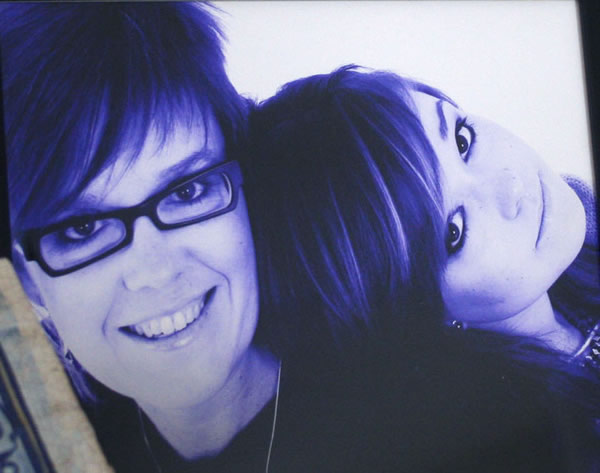
None were standard studio portraits – all had been manipulated in some way with Photoshop, for example adjusting the colors to blue- or violet-toned black & white, or bleaching out features to emphasize the eyes (Ross complained that in one shot her nose almost disappeared). They were shot and/or rotated to unusual angles, and some were designed to be printed in a widescreen format.

I liked the combat crawl shot, with me far in the background as Ross lunges towards the camera. I felt it was symbolic of my supporting role in her life: I’m there to stand behind her, whatever she wants to do. But it wasn’t so great as a portrait of us both.

There was an outstanding model shot of Ross, but then, it’s easy to get outstanding shots of Ross.

Ross liked one in which I stand skeptically looking on while she jumps in the air, kicking up her heels. Again lots of fun and very symbolic, but it would be better as part of a tableau with one or two more serious shots.

The one we ended up with is shown at the top of this article.

(The intrusion in the lower left corner is a ceramic tile from Castelli that is propping up the picture on a bookshelf til we figure out where it will live permanently.)

Bellagio: “Beauty and Comfort” on Lake Como

Bellagio, Lake Como’s best-known tourist destination, lies at the tip of the triangle between the two southern branches of the lake. You can get there by road or get there by boat from Menaggio or Varenna.

Personally, I find Bellagio a bit overrated. During the season it’s overrun with tourists, and the shops are accordingly filled with overpriced souvenirs, most of which have nothing to do with the region (okay, I’m a souvenir snob – I only want something that authentically represents the place).

I concede that the views are stunning – but there are views at least equally stunning from other points on the lake.

But I end up in Bellagio a lot whether I want to or not, because our foreign visitors usually want to see it. My favorite way, during the summer, is to take the slow boat from Lecco.

Bellagio’s charm, for me, is in its verticals – everything runs uphill from the lakefront. (Which means that, to really appreciate it, you must be prepared to walk.)Above is a view up Bellagio’s main salita, with the (justly) famous Bilacus restaurant on the right. Below is a shop whose sign I’m fond of – I love the antique typography you can still find on many shop signs in Italy.

Sweetness and Dark on Lake Como

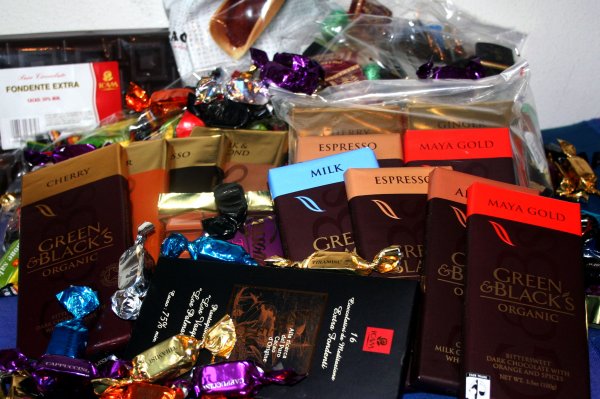
Some evenings, stepping off the train as it arrives in Lecco, there’s a slightly toasted, coffeeish scent of rich, dark chocolate in the air. It’s not a hallucination: Lecco is the home of Icam, one of the world’s largest manufacturers of organic chocolate. They process 6000 tons of raw cocoa beans per year, and when those beans get to cookin’, the whole town is wrapped in a sensuous fog of aroma.

I had long been aware of Icam as a purely local phenomenon – Icam-branded chocolate doesn’t even show up much in Italian stores, though some friends had proved to us that Icam’s chocolate-hazelnut spread was far superior to Nutella. I knew that Icam had a spaccio (outlet store) at the factory down in Pescarenico, but I never managed to get there until we’d been in Lecco for a while, and then only because they ran extended hours during the Christmas season.

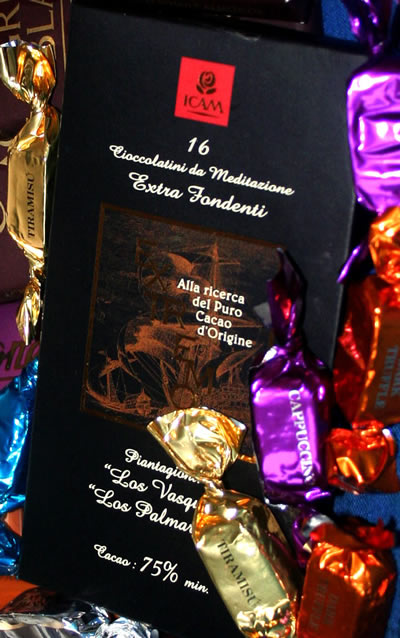
I discovered one Christmas that they make very good “cru” (single-origin) tasting squares of “Extremo” 75% dark chocolate – I bought some for family Christmas presents.

More recently, I was surprised to notice that our friend Michele was selling Green & Black’s, the famed UK brand of organic chocolate, at his bakery in Lecco.

“Where did you get that?” I asked.

“They make it right here in Lecco!”

He told me that a British couple had stopped for a chat at his shop. Turns out the man was a financial officer with Green & Black’s, in town to visit their production partner. He told Michele that some (surprisingly large) percentage of Europe’s chocolate, including much of Green & Black’s, is made by Icam – exactly how much I have not been able to confirm. He may have been referring specifically to the organic chocolate market – I have not so far located any definitive figures on European chocolate production, though I did find a list placing Icam as number 89 among the Top 100 Global Confectionery Companies. They evidently manufacture for others who sell organic chocolate, such as Seeds of Change.

So Icam was on my Christmas shopping list again last December. I came away with:

  • three half-kilo bags of mixed chocolates (many of them Green & Black’s), at 5 euros each
  • two bags each containing ten bars of Green & Black’s
  • one bag of non-chocolate candies
  • a 1-kilo bar of dark chocolate for cooking
  • a 1-kilo bag of unsweetened cocoa powder for cooking
  • a half-kilo tub of “Icam-ella” or whatever they call their spread
  • a sampler box of the Extremo (pictured above)

Yes, it was a lot to carry! But I couldn’t resist – the bill for all this was only about 50 euros. Both at home and at the office, we had a very sweet Christmas.

Icam is doing so well that it needs to expand, but apparently is not finding encouragement to do so in Lecco. However, last I heard, their efforts to build a new factory in a nearby town were also frustrated by some strange local resistance.

<sigh> It can be inexplicably difficult to do business in Italy. Icam would probably have fewer hassles and lower costs if they moved their operation to some other part of Europe. But Icam is a family-owned business, and we can all be thankful that Italian families and businesses are stubborn about sticking to their roots!

You can visit Icam’s factory outlet store during the hours 8.30-13.00/14.00-17.00, Monday through Friday.

When a Spell Checker Won’t Save You

70 million blogs, and thousands more “professional” news sources online, collectively produce billions of words every day. I rejoice that so many people are able to publish their thoughts and seek an audience, at low or no cost – information is good, freely shared information even better.

But I cringe at the abuses I see daily heaped upon the English language. Not “just” by bloggers, but also by journalists and others who should know better, working for news organizations that once upon a time had copy editors on staff.

Why should you care about excruciatingly correct grammar, spelling, and word use?

  • Anything less makes you look sloppy and amateurish, calling into question the reliability of your information. Rightly or wrongly, we are all trained to believe that information presented in polished prose is more authoritative, more likely to be accurate, than SMS-speak.
  • Poor writing is harder to understand than good, distracting the reader from the gist of your argument as she tries to tease out your meaning from a welter of poorly-chosen (or misspelled) words.

The very least you can do, as a courtesy to your readers, is to use a spelling checker – which is so easy that leaving misspelled words in your writing shows contempt for your readers and, indeed, your own work.

However, there are some kinds of mistakes that a spell check won’t catch: such as when a word is spelled correctly, but used in the wrong place. This happens most often with homonyms (words that sound the same but are spelled differently). Here are a few commonly-abused homonyms that you can easily learn to use properly:

affect effect impact

Affect

  • verb: to influence- “This product recall will adversely affect our profits.”
  • noun: an emotional state (mostly used by psychologists): “When I saw
    Mrs. Smith, she was quite depressed and had a flat affect.”

Effect

  • verb: to cause or bring about – “They managed to effect a compromise between the quarrelling parties.”
  • noun: a result – “Please don’t start drilling. That Novocaine has had no effect whatsoever.”

Impact used to be a noun: “The impact of his speech was enormous.”

Impact as a verb: Twenty years ago, the only thing that could be properly said to be impacted was a wisdom tooth or a bowel. Nowadays, everybody uses it as a verb (“That’s going to impact our bottom line”), a usage which has crept into the general language from bureaucratic Pentagon-speak. Ugh.

bated baited

bate means “1 : to reduce the force or intensity of : RESTRAIN <with bated breath>” (Webster’s online)

bait to entice or lure, as in fishing.

If you’re really waiting with “baited breath”, you just keep on waiting – ain’t nobody gonna kiss you!

flair flare

Flair is a noun, meaning a certain talent or ability: “As a child he had a flair for numbers, so he grew up to be an accountant.”

Flare is a verb, meaning to flame up: “Tempers flared on the field after the ref’s disastrous call.”

But it’s also a noun: “The soldiers broke the darkness by sending a flare into the sky.”

horde hoard

Horde, a noun, means a large group: “A horde of locusts descended upon the field.”

Hoard can be a verb, meaning to amass or hold aside something so as to accumulate a lot of it, or a noun – the mass so accumulated: “The dragon slept on his hoard of gold.”

(Confusingly, Genghis Khan’s Golden Horde refers to his army, not to any treasure they may have carried with them.)

its it’s

Any third-grade English teacher worth his or her salary should have taught you this, but it seems to be forgotten by many.

It’s true that ‘s indicates a possessive when tacked onto most nouns: “The boy’s ball was in the dog’s mouth.”

However, it’s is a special case: it’s a contraction for it is, just like he’s = he is, she’s = she is.

To indicate possession by an it, use its: “The dog had the ball in its mouth.”

lay lie

Lay is a transitive verb: you have to do it TO something: “Lay the gun down on the floor and move away slowly.”

It is often confused with lie, an intransitive verb meaning “to be or to stay at rest in a horizontal position“. Therefore, “Do you need to lay down for a nap?” is incorrect.

Don’t be confused by the children’s prayer “Now I lay me down to sleep” – lay is correct here because the child is (somewhat archaically) laying himself (his body) down. (That the child is then called upon to contemplate the possibility of his own death during the night strikes me as not likely to produce sweet dreams!)

lead lead led

NEW! (Because frequent mis-use of these is making me crazy.)

Lead, pronounced LEED, is the present tense verb, as in “to lead the pack.”

Spelled led and pronounced LED, it is the past tense of that same verb: “The old wolf led the pack until she died.”

Spelled lead and pronounced LED, it is a metal, as in “He killed Colonel Mustard with the lead pipe in the studio!”

Therefore, constructions such as “That question has lead a group of researchers to examine…” are WRONG.

peak peek pique

Peak is a noun for the top of a mountain: “Tenzing and Hilary scaled the peak of Everest.”

It can also be a verb, meaning to reach a height (from which you/it/something will then descend): “Brangelina fever peaked when…” – oh, who cares!

Peek can be a verb – to take a quick and/or clandestine look at something. In the UK, it’s synonymous with peep. “The children snuck down the stairs and peeked into the room to see what Santa had brought them.”

It can also be a noun: “Take a peek through this keyhole.”

Pique is most often used as a verb. Derived from the French piquer (to sting, prick, prod), it means to stimulate: “Her curiosity was piqued by the bartender’s odd behavior.”

But you can also have a fit of pique (irritation).

What you cannot do is to have a sneak peak (a sly mountaintop?) or to have your interest peaked (though your interest may peak of its own accord).

pore pour

Both are verbs, both can be used with “over”.

To pore over means to read or study attentively: “She pored over her notes for hours before the exam.”

To pour means to cause to flow in a stream: “He poured maple syrup over his pancakes.”

If your student is pouring over her notes, you’d better make her take a break!

pouringover

above: even the New York Times makes this mistake

prostate prostrate

The prostate is a strategically-placed male gland.

Prostrate is an adjective – (prone, lying on the ground: “They saw his prostrate form on the mountain path.”)) – or verb (to lie down on the ground, usually in front of somebody – “He prostrated himself before the golden idol.”)

Don’t confuse these two. The mental pictures conjured up are just too painful.

[free] reign or rein?

Reign is a noun meaning sovereignty or rulership: “During the reign of King Henry VIII…” Reins are what you attach to the bridle of a horse to steer by. “Free rein” means to give someone liberty to do as he likes. “Free reign” is an oxymoron.

I have not yet seen anyone offering “free rain,” and hope I never do!

tenants tenets

Tenants are the people who rent a place from you. Tenets are beliefs. You probably don’t hold core tenants, unless you need that rent money very badly.

than then

Than is a conjunction “introducing the second element in a comparison” (Webster’s New World Dictionary). “Mumbai is hotter than Miami.”

Then is an adverb, often (but not always) meaning “at that time” or “next in order of time”: ” “We’ll have dinner, then go to a movie.”

NEVER “I’m bigger then you are.”

their there they’re

Their – Possessive pronoun meaning “belonging to them”: “The kids wore their uniforms on the bus on the way to the ball game.”

There – That place: “When they got there, it was raining.”

They’re – Contraction for “they are”: “But now the sun’s out and they’re going to have a great game.”

theirs there’s

Theirs – Possessive pronoun again: “They said that no ball of theirs had ever had stitching like that.”

There’s – Contract for “there is”: “Now there’s going to be an investigation by the Little League.”

wreck havoc

The correct phrase is “wreak havoc”, wreak meaning “to cause,” “havoc” – devastation or disorder. To “wreck havoc” would presumably be a waste of time – havoc is already pretty much wrecked. To reek havoc? Let’s not even go there.

Here endeth the lesson. For today.

Feb 10 – Thanks to Jackson Day for the affect/effect grid and David Bratt-Pfotenhauer for some more pet peeves!