Category Archives: bio

Italians Flying the Flag

Italians are not much for patriotic displays. You rarely see Italy’s ‘Tricolore’ flag flying, except during World Cup soccer. During his first run for office ten years ago, Silvio Berlusconi brought to Italian politics the very American notion that ‘flag = patriotism = [my] political party’. Billboards for his Forza Italia party were swathed in red, white, and green. As owner of the popular AC Milan soccer team, he also managed to mix sport into his message: ‘Forza Italia’ (‘Let’s Go, Italy!’) sounds like a cheer for the Italian national team – no accident, of course.

As I recall it, that election coincided with a World Cup, or maybe it was a European championship. At any rate, between that and Berlusca, there were Tricolore flags everywhere. I asked my daughter, then three years old, if she knew what that flag meant. “Oh, yes,” she said brightly: “Those are the colors of Milan” – the football team!

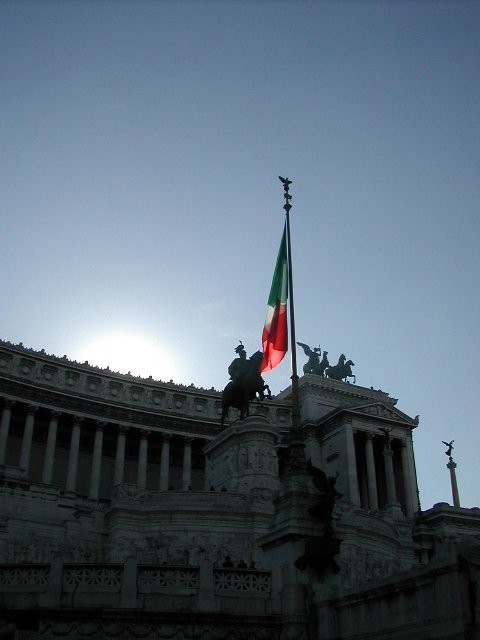
photo: The Tricolore flying at the Vittorio Emmanuele monument in Rome.

Silver Threads Among the Gold

One thing I do like about my hair is its color. When I was little it was white-blonde, partly because I lived in Bangkok and spent a lot of time out in strong sunlight. It darkened as I got older, to its present ash-blonde, with random (and completely natural) patches of lighter and darker color here and there. A very cliché gay hairdresser I went to, years ago, gasped in delight: “I just LOVE your streaks!”

Now I’m getting my first white hairs, and I rather like the effect. The individual hairs are thicker than my other hair, so they spring out and catch the light, sparkling against the soft tones of the rest. I don’t think I’ll mind at all when my hair eventually goes completely white.

What’s in a Title? Signora vs. Signorina in Italy

I’m 42 today and, waking up with blue circles and bags under my eyes, I look it. Well, that’s the result of two days on my feet in the kitchen, cooking for 35 people (yes, I did have lots of help – thank you, Shannon!) for our annual Thanksgiving/ birthday/ housewarming feast (the housewarming part is not meant to be annual). Most of the time, people say I look young for my age, and I don’t think it’s just idle flattery.

I’ve been trying to understand the logic by which Italians decide to call me signora (Mrs.) or signorina (Miss). When Ross was small and I was in daily contact with her teachers and other parents at her schools, I was accustomed to being signora, because everyone assumed that, as a mother, I must also be a Mrs.

This signora habit almost got me arrested once. I was getting off the bus in Milan, in a hurry to pick up Ross from daycare, and swept right past the squad of public transport inspectors doing one of their random checks. I completely ignored the calls behind me of “Signorina! Signorina!,” assuming they couldn’t be directed at me. So the inspectors thought I was running away to dodge a fine for travelling without a ticket (actually, I am always scrupulous about bus and train tickets, except when I forget to stamp them).

I’m often called signorina even now. This may be because I often dress informally, by Italian standards, in jeans and sweaters. In a business suit and heels, I’m almost always signora. On some occasions, the choice of address seems to be based on the speaker’s desire to flatter me, and which term they think will accomplish that.

The God Gene: Why Some of Us Just Don’t Get Religion?

In this new book, Dean Hamer discusses possible genetic components of “a personality trait known as self-transcendence, originally identified by Washington University psychiatrist Robert Cloninger. Cloninger found that spiritual people tend to share a set of characteristics, such as feeling connected to the world and a willingness to accept things that cannot be objectively demonstrated. … Hamer confirmed what earlier studies had found: heredity is partly responsible for whether a person is self-transcendent or not.” (quoted from a review on Amazon)

The book has been attacked on various grounds; I won’t bother to attack or defend since I have not yet read it. But the theory that religious feeling (or spirituality) may be genetically determined would explain something that otherwise puzzles me greatly: why do many intelligent people believe in god?

A number of religious people have been part of my life, including some who, while not following any organized religion, believe in or crave some sort of “spirituality.” I try – I really do! – to be respectful of their beliefs, because I respect these folks personally for other reasons.

But, frankly, I just don’t get it. I don’t feel a need for god or spirituality. I can feel connected to the world, and delight in its many wonders, without needing to thank anybody. I have my own strong moral compass that tells me how to treat people and the world, without reference to any scripture. I have no belief in a spiritual world I can’t see, and don’t feel the lack of that belief. Some people are born color-blind; I guess I was born god-blind.

Religions have an explanation for people like me: we haven’t been exposed to, or have refused to accept, the word of god – we haven’t seen the light (as I said: god-blind).

Until now, I’ve been groping for a way to explain them. “Opiate of the masses” only covers the ignorant and easily-led, and assumes complete bad faith on the part of every spiritual leader who ever lived. I can’t go that far. So I’ve had to assume that people whom I know to be intelligent in every other way are just dumb in this particular area, or victims of a traditional upbringing. Which, of course, is no explanation.

I therefore like the idea that the need for religion may have a genetic component. This would explain why some people feel this need strongly, and others not at all. The desire for this feeling of self-transcendence is independent of any specific religion, and even of the question as to whether there is a god. There may or may not be something “beyond” what science will ever be able to explain; for genetic reasons, some of us care a lot about being in touch with whatever it may be, and others don’t. In either case, we can’t help it – we were born that way.

 

Woodstock 150th: Hanifl Center

Lots of broken image links to fix… when I have time. Meanwhile, you can see the full gallery here.

Hanifl Center terrace

We were the first large group to stay at Hanifl Center, and a very pleasant residence it was, with comfortable beds (some private double rooms, some with four or eight bunkbeds), incredible views, and almost enough hot water (entirely solar-heated) for everyone to take showers in the morning (or whenever they got up).

Sanjay had made all the arrangements, including bringing up three cooks and a busload of supplies from Bombay. Excellent hot breakfasts (pancakes – with peanut butter!, cereal, parathas, eggs, toast) were provided there at Hanifl, other meals varied, though many were in fact cooked by these same talented cooks.


On the morning of Monday, November 1st, Dick Wechter invited us up for tea and biscuits to watch the sunrise over the snows. I didn’t wake up in time, so was a bit late for the actual sunrise…

Delhi