Category Archives: bio

Woodstock School Meta-History

The reason (well, excuse, really) for this trip to Mussoorie was to get started on a project for Woodstock School. The school will celebrate its 150th anniversary in 2004, an occasion which calls for a book of some sort. Detailed histories have previously been published, covering the period up to 1983, and a glossy picture book was produced a few years ago. The school has also recently published a collection of essays by alumni (yes, including me), and a book about alumni artists and their work. A group of alumni is working on a history made up of personal stories collected during reunions (see Living on the Edge).

So what could we do that would be new and different? And how can we attract a larger audience than the few thousand alumni, former staff, and families who are somehow personally connected to the school? And why me to head this up?

I puzzled over that last question, but, the further I get into this project, the more it seems that I was destined for it, in spite of a lot of things that I am not.

My connection with Woodstock, unlike others’, does not stretch back generations. The epitome of the old Woodstock family is the Alters: D. Emmet Alter was principal from 1940 to 43. One of his sons, Bob, graduated in 1943 and later returned to the school several times in several capacities, finally as principal from 1968 to 1979; he was instrumental in transforming the school into the international institution that it is today. Bob and Ellen Alter’s three sons (Steve, Joe, and Andy) all attended Woodstock; Steve, a novelist now teaching at MIT, wrote about it in All the Way to Heaven: An American Boyhood in the Himalayas.

Tom Alter, a nephew of Bob, took Indian citizenship and is now a well-known actor and cricket commentator, based in Mumbai. He married a woman who taught at Woodstock at one time. There are other significant Alters; I need to construct a family tree to sort them all out!

I had never heard of Woodstock until Bob and Ellen Alter came on a recruiting visit to Dacca, Bangladesh, around January of 1977. My family had arrived there in October of 1976 (my dad as local head of Save the Children), confidently expecting that I would be able to attend the American school in Dacca for the 8th grade. We were wrong. The school was so small that it had room for only 15 students per grade, and the 8th was already filled. We considered a Bangladeshi school (“English medium”, meaning that all teaching is done in English) but the standards were too different: they were way ahead of me on math and sciences, way behind me on English and writing.

So I began 8th grade work by correspondence, through the Calvert School in Maryland. I initially started it with another girl in the same plight as myself, being taught by her mother. That didn’t go too well, either: I didn’t like the mother.

This had been going on for a few weeks when the Alters appeared. Clearly, my school situation needed fixing, and Woodstock seemed like a good solution. All I remember about my meeting with them was being very concerned that I would be allowed to put up my own posters in my dorm room; I had carried those posters carefully from Pittsburgh to Connecticut to Dacca; they were part of my travelling “home.” The Alters assured me that I could stick up whatever I wanted in my room; I sought detailed advice on what sort of tape to bring.

My 9th grade year at Woodstock would begin in July of 1977, and, having gotten a late start, I had to finish 8th grade in a hurry. I abandoned my study partner and finished 8th grade at double the speed recommended by the Calvert School. I had some help with algebra from an American friend then living with us; otherwise, I did it all on my own (both my dad and stepmother were intensely involved with their own work).

I started 9th grade at Woodstock just in time to save my sanity. The four years I spent there nurtured me, gave me self-confidence, and helped to heal the wounds of my parents’ divorce and other upheavals. Years later, my therapist told me that if I hadn’t gone to Woodstock, I would probably have ended up “gibbering in a corner somewhere.” So my involvement with Woodstock, though it does not (yet) span generations, has been extremely important to me.

In my time, the school was undergoing an important demographic shift, from a student body composed largely of American and Canadian missionaries’ children (mish kids) to a more international mix. My own class represented the “ideal” of 1/3 North Americans (mostly mish kids) – 1/3 Indians – 1/3 Other.

As usual for me, I didn’t fit in with any particular group. In fact, I took pains to set myself apart from some, being vociferously atheist in a Christian school. Nor was I a typical Woodstocker in many other ways. Hiking was popular, given our stunning Himalayan environs, but after a horrible (for me) required 9th grade activity week trek, I never again went on any sort of organized hike.

The school is famous for its music program. I dutifully took piano lessons for three years, but was the despair of my teacher, combining beautiful, long-fingered piano hands with no musicality whatsoever. I gave up on choir after less than a semester because the music was boring.

But Woodstock is so all-embracing a community that I soon found my own niches and ways to contribute. I became a public works artist: I painted murals on the walls of the girls’ dorm; made large batiks to decorate the elementary school; was called upon to create Bottom’s ass’ head and the lion costume for “A Midsummer Night’s Dream.” I was for a time editor of the school paper, and later president of the girls’ dorm. I worked on the yearbook. And, during my senior year, I got interested in the community around us, Mussoorie and Landour.

I originally had an ulterior motive. During Activity Week every autumn, students leave campus in chaperoned groups, in pursuit of activities that interest them: trekking, community service, tourism, sports, music, etc. The tradition was that seniors could set their own programs for Activity Week and go pretty much where they liked, or at least the boys could. For safety reasons, girls could only leave town with chaperoned groups, although they could do independent projects alongside whatever the group was doing. The only way for me to avoid supervision was to stay in Mussoorie and do some sort of project right there. So I elected to stay in a guest house near the school, and learn about Mussoorie and its history.

There wasn’t much printed material available in Mussoorie, so I had to get out and see things and talk to people. My homeroom teacher, a long-time staff member well integrated into the local community, arranged for me to meet some of Mussoorie’s leading lights, such as Ruskin Bond, a famous Anglo-Indian writer.

Though I reveled in my week of unsupervised freedom, I did not actually break any school rules. But I had some adventures, met lots of interesting people, and got better acquainted with some I already knew. Mr. Abhinandan, the tailor who had been making my clothes for years, invited me to his house for lunch. I hadn’t realized that, being strict Jains, he and his wife were prohibited from actually eating with me, so the lunch consisted of them serving me! Which was somewhat embarrassing, but the food was excellent, and I enjoyed talking with them.

So that was how my interest began in the town beyond the school.
On My Way to India, November 2002

Nov 11 – Milan Linate airport to Heathrow

Paranoid traveller that I am, I ordered a taxi for 6 am. This got me to Linate, Milan’s city airport, at 6:15 – for an 8 am flight. Check-in was soon accomplished, and I planned to relax and have breakfast in the British Airways business lounge (still exploiting the frequent flier mileage accumulated during those frantic last months with Roxio).

But the lounge is on the other side of security, and, as I discovered, the line to get through security on a Monday morning is appallingly long. So I had coffee at the airport bar, bought a book by Andrea Camilleri (“Il Corso delle Cose,” which I subsequently realized I’d already read; I enjoyed it again anyway). I killed time here and there, and finally, reluctantly, joined the very long queue at 6:58 – I had to walk to the other end of the airport to actually find the end of the line. I read as I shuffled along in line, finally passing security at 7:23. From there, straight onto my flight, which was already boarding.

The flight was relatively empty, so I had the row to myself. I sat on the aisle, and put my backpack under the middle seat. Just before takeoff, a flight attendant told me that my luggage had to be stowed underneath the seat in front of me during takeoff and landing, “due to CAA regulations.”

“I’m not trying to make trouble,” I said carefully, “But what difference does it make whether it’s under this seat or that seat?”

“It’s a regulation,” she repeated.

“What does the CAA care?” I asked (whoever they are).

“If they made a rule, they obviously care,” she snapped.

“It’s a stupid rule,” I said, and she did seem to agree with me.

Why is it that people insist on applying rules even when we all know they’re stupid?


Heathrow to Delhi

Getting several hundred people onto a plane efficiently and safely is no easy job, especially when most of them have excessive hand luggage, and some are elderly and/or inexperienced and/or speak no English.

The flight attendant in our section was amazing. She crisply but politely hurried everybody into their seats. She stood up on seats to rearrange luggage in the overhead lockers so that more could fit. She then lifted the luggage, some of it very heavy, and slotted it in there herself – all without turning a hair or laddering her stockings. She prodded, cajoled, and pleaded until almost everyone was seated, except for a middle-aged Sikh who had apparently checked in late, and therefore had not been assigned a seat next to his wife. In his determination to sit with her, he rudely ordered the man whose assigned seat that was to move. The flight attendant did not take kindly to this, and told him off sharply. A little later the Sikh gentleman did manage to switch seats with somebody, apparently by asking nicely.

The flight was uneventful, and I couldn’t concentrate on any of the 12 channels of movies. As often happens, conversation with my neighbors only began in the last hour or two. (Perhaps we’re all afraid to find each other boring, and then be stuck being polite through a long trip.) When we did get to talking, I found both of them interesting. One was a young woman of Indian descent, born and raised in London. She told me they call themselves BBCDs: British-Born Confused Deshis (deshi is a Hindi word meaning native, as opposed to videshi, foreigner).

more

What Happens When You’re Not a Native of Anywhere?

I’ve been living in Italy so long that I seem to be losing what minimal ability I ever had to pass for a “real” American. My accent is becoming indefinable, or so I guess. Some Americans have told me that I sound vaguely British, and a few years ago in Dallas, someone asked me if I was a foreigner. I catch myself using a hybrid language, translating Italian idiom far too literally into English (and vice-versa).

I’ve become Italian in my sense of personal space. Italians have an extraordinary ability to block public thoroughfares, for example stopping to have a chat at the top of an escalator, or in the only patch of sidewalk that isn’t already blocked by parked cars. But at least they don’t take it amiss when you brush past them, as you often have to do. Life is lived smaller in Italy; we’re crowded together, so some physical overlap is to be expected and must be tolerated. I’m used to it. Other Americans evidently are not.

When my daughter and I set off for our US trip this summer, we had a stopover in Paris. I hate airports, so I try to get through them as quickly as possible. My tactics for doing so include taking stairs two at a time rather than standing behind people on the escalator, and zipping around and through crowds to get to whatever point comes next. I don’t cut lines, but I do try to be first to where the line is forming.

So Rossella and I were racing through the airport, when I heard an American woman I had just passed say sniffily: “Huh! This is just like being back in Italy.”

The same thing happened while we were waiting for a plane in Austin. We discovered we were supposed to be lined up over there rather than over here, but the path from here to there was blocked by a long line of people. I chose an opening that looked large enough (to me), and ducked through. The woman I had passed in front of glared as if I’d molested her.

My problem in dealing with my fellow Americans is that I look and sound American, but am not, quite. Culturally I’m a mishmash, a Third Culture Kid. I just don’t notice many of the American cultural cues, so I don’t respond the way Americans expect me to. They sense vaguely that something is wrong, but can’t quite put their fingers on what. Of course I miss cues in other cultures as well, but non-Americans make allowances for the obvious fact that I’m foreign; indeed, they would be surprised if I acted exactly as they do. (Americans usually extend the same courtesy to obvious foreigners in America.) For me, though, it’s different: in America I’m actually a foreigner, but camouflaged as a native, so I don’t have the privilege to screw up that someone clearly foreign would have.

Most of the time I don’t even realize that I’m doing something “wrong.” I eventually notice that I’ve rubbed people the wrong way, but I have no idea how that happened. Several Americans have told me, after knowing me for a while: “When I first met you, I thought you were a real bitch.”

Movie Review: Lagaan

It was easy this year, as usual, to overlook the Oscar nominees in the Best Foreign Language Film category. If you did, you will have missed a great movie, Lagaan, (Amazon UKUS) India’s nominee.Set in British-ruled India in 1893, it’s the story of a village oppressed by heavy taxation (“lagaan”). The local hero rashly accepts a bet with the British army captain that the villagers can beat the Brits at cricket, a game the villagers know little about. (The bet is set off by the villagers’ disparaging remark about grownup British men so intent on a game “just like gilli-danda, which we played as children.”) If the villagers win, they will pay no taxes for three years. If they lose, they must pay triple the usual tax – and they’re already facing hard times due to drought.

The story is predictable and formulaic, with the British captain cartoonishly evil and the village improbably clean – those starving villagers seem to have quite a few changes of clothing! But who cares? It’s tremendously fun, especially the songs and dances. And it’s much more realistic than many Bollywood films: the young lovers, while singing and dancing, are not miraculously transported to the Himalayas, the tulip fields of Holland, or any other scenic locations meant to illustrate the height, depth, and intensity of their feelings.

The score by A.R. Rehman, a lush blend of western and Indian musical styles, is the most exciting film music I’ve heard in years; I wish A.R. would move to Hollywood and take over from John Williams. (Sadly, the full score doesn’t seem to be available on CD, only a collection of the songs.)

The film naturally climaxes in a three-day cricket match. Unfortunately, cricket has in the meantime become India’s national game, and the screenwriter assumes an understanding of it that I never achieved in five years of living in India, so some of the dramatic tension drained away as I puzzled about wickets, runs, and overs. But of course the home team does win, the local British regiment is dissolved, and the villagers deliriously celebrate as the long-awaited rain finally washes down.

Slow Food, Good Wine, Hot Baths

Last September I joined the Slow Foodassociation, dedicated to the appreciation and conservation of good food worldwide. We’ve been to three dinners so far, two of which emphasized wine, and one in which every dish somehow involved chocolate. The wine dinners also featured excellent food, and vice-versa. The international Slow Food association is divided into local groups, in Italy called condotte. Outside of Italy they’re called convivia, which fits: after you’ve been drinking good wine together for an hour or so, everyone does get very convivial!

The most recent dinner we attended began with a tasting of Sfursat, a wine from Valtellina, an Alpine valley northeast of Lake Como. Sfursat (dialect for sforzato – “forced”) is made by drying the harvested grapes for three months before pressing, so that their sugar content – and therefore the percentage of alcohol in the wine – is high, at least 14.5%.

The best of the four Sfursat we tasted that night was Sfursat 5 Stelle from the Nino Negri vineyard, and we had the privilege of sharing a dinner table with Casimiro Maule’, the vintner who created it. He told us a great deal about winemaking in Valtellina, most of which I can’t remember (too many glasses of Sfursat and other grand Valtellina wines!). I do remember that it’s difficult to grow wine there; the terrain is steeply mountainous and the soil not extremely fertile. But Sig. Maule’s Sfursat, and other excellent wines from the region, prove that it can be done, and done very well indeed.

Signore Ciappone

I’m not sure how easy it is to obtain Valtellina wines outside of Italy, but if you love good wine, it would be worth the effort to track them down or demand them from your local supplier. A more common type is called Inferno – yes, it’s a hell of a wine. A good example of this is Giuseppe Rainoldi’s Inferno Barrique, which has a wonderful complex flavor because it’s aged in small wooden casks.

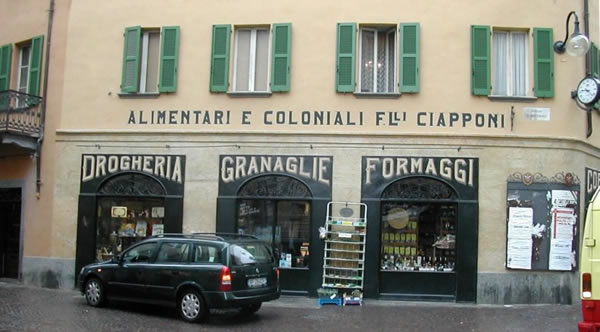
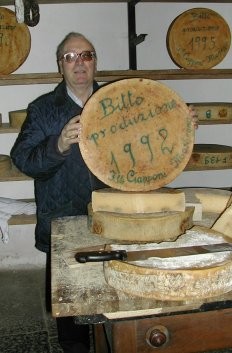
In the spirit of Slow Food, last week Enrico and I explored Valtellina, making our first stop in Morbegno at the renowned shop of Fratelli Ciapponi. We spent two hours there with one of the senior brothers Ciapponi, taking a tour of the shop and its underground wine and cheese rooms, and got a complete explanation of how the local bitto cheese is made and successfully matured. (“I caress these cheeses more than I do my wife,” said Sig. Ciapponi, probably not for the first time.) We tastedbitto of various ages. There were noticeable differences at one, two, and six years, partly due to ageing, but also because this is a handcrafted cheese that depends heavily on environmental conditions: more rainfall means better grass in the high Alpine pastures, and tastier milk from the cows and goats who produce the raw materials.

Sated with cheese, we continued on our way to Bormio, a ski resort town. I don’t ski, and it’s been a bad season for skiing anyway, so why did we go there? For the natural hot spring spas. These date back at least to the Romans; Pliny the Elder described the baths in the first century AD. The Bagni Vecchi (“Old Baths”) have been expanded and refurbished over 2000 years to their present glorious state, which includes:

  • a 30-meter y-shaped tunnel dug into the mountain, debouching into a natural steam room on one side and a channel full of very hot (46 Celsius) water on the other
  • pools with hot waterfalls – natural massage!
  • mud baths
  • steam rooms and saunas
  • an outdoor hot water pool with a view of the mountains all around

It was heaven. We spent all afternoon there, and I went back the next day while Enrico went skiing. If you love to get into hot water, this is the place to do it.

Caveat: The Bagni Vecchi are closed in May, and in the summer the water is not nearly so warm – for some odd geothermal reason, when the ground freezes, the water gets hotter. Best and least crowded times to go are probably November before the ski season really gets underway, and March/April when the season is ending.

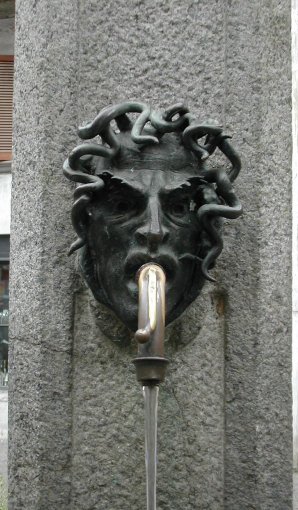
Morbegno Fountain