Category Archives: food

Thanksgiving 2007: Martha Stewart, Move Over!

I’m leaving for India Wednesday, so we had to have our traditional Thanksgiving dinner early. The first step, which started two days in advance, was to roast and peel the chestnuts for the stuffing – unlike Martha Stewart, I cannot buy them pre-cooked and frozen or canned.

Above you see them ready to go into the oven (I had two oven pans, both almost full), with an x scored across the flat side of each with a knife, as per instructions in the Silver Palate cookbook. They didn’t all have an identifiable flat side, and I was scared of slipping with that sharp little knife and cutting my fingers.

This is how they looked partway through the roasting; it took over an hour to get the last ones done enough to peel relatively easily. Per Italian tradition I should have roasted them over an open flame in a pan with holes in the bottom (which would have been faster), but I don’t own one of those pans. Hmm. Something to get for next year.

Peeling them all took hours. Depending on degree of doneness and other mysterious factors, any given chestnut can be more or less difficult to coax out of its woody outer shell and then the papery inner one. Like walnuts, they have wrinkles and crevices from which any woody bits must be removed so that guests don’t break their teeth – you don’t always get a perfect whole chestnut as shown above.

I no longer have an oven large enough to roast a whole turkey, so in the last few years I’ve had to find another solution. An American recipe for herb-roasted turkey breast expects me to have a turkey breast with the skin still on, something you don’t find in Italy. You can order a whole turkey breast from the butcher, but it arrives skinless.

My solution was to replace the skin with thin-sliced pancetta (Italian bacon). Instead of working the herb mixture under the skin, I just slather it onto the turkey, then lay on the pancetta slices to completely cover the surface. This retains moisture in the meat, adds lots of flavor, and becomes a nice, crispy addition to the dish.

Italian poultry takes longer to cook than the estimates given in American cookbooks. The Joy of Cooking says 10-12 minutes per pound for turkey. By this calculation, this 3.8 kg (8.4 lb) turkey breast should have cooked in less than two hours. But I knew from previous experience that this was not going to happen. The turkey was perfect at three hours – cooked through, but still moist. (I used a meat thermometer, let it reach the “poultry” marking and stay there 10-15 minutes.)

I had so many chestnuts this year that I saved some whole ones out from the stuffing and put them in the roasting pan with the turkey, adding more at the end when the turkey had shrunk and there was more room. They soaked up the gravy deliciously.

Italians don’t make the flour-thickened gravy traditional in America – it’s a lot easier to just use the pan juices as-is (had I thought about it, I should have tried adding Calvados and simmering as the recipe called for – but then there wouldn’t have been enough to go around). I simply poured the juices and chestnuts into a bowl, and people spooned it onto their slices of meat.

The above photo is by Duke, a young fashion photographer trying to make a career in a tough city (Milan). I figure, if I’m going to have my picture taken at all, I should leave it to the most competent person in the room. (He also plays a mean blues guitar.)

I was too busy cooking, serving, eating, and talking to take any pictures of the actual guests – there were about 35 people present, and during the first part of the evening we managed to get them into the taverna (instead of clustering in the dining room and kitchen as people tend to do) by putting all the wine and antipasti down there!

I wasn’t the only cook. Ivo brought his justly-famous cheeseball, plus veggies and dip. Darlene’s American/Asian style cabbage salad was a great accompaniment to the main course. There were many great desserts: Maryellen’s pumpkin pie, Fabrizio and Irene’s ricotta torte, Marianna and Zeno’s apple cake, plus various yummy store-bought sweets. Andrea and Nives also brought us some authentic Genovese pesto which we will have to eat before I leave.

And somehow we always end up with more wine than we started with at these things: I didn’t even buy any, and we have 6-8 bottles left over! We finished off the Franciacorta that San Lorenzo had donated to Web Women Weekend, and I liked very much the 2007 Novello “Falò” that Andrea and Nives brought.

It was our usual mixed crowd: mathematicians, IT geeks/bloggers, neighbors, and various other friends. I was happy they all came and enjoyed themselves and the company, though I didn’t get as much time to talk to most as I would have liked. That’s what happens when you’re the hostess. But it was worth it. Happy Thanksgiving!

High Water (Not Hell) in Venice, part 6

Venice’s Bad Karma

On Saturday morning, I learned what a macchiatone (“big spotted one”) is: it’s basically a caffé macchiato (coffee “spotted” with steamed milk), with a bit more milk – so, somewhere between a macchiato and a cappuccino, served in a cappuccino cup. I had it with a delicious little torta di riso (rice cake).

Then Enrico and I explored some more.

^ “In this antique home of the Dario family, Henri de Regnier, poet of France, Venetianly lived and wrote in 1988 and 1901.” Venetianly?

^ This was a mystery. Was the pigeon already dead when someone gored it with an umbrella?

The apartment we were staying in was owned by a Jewish family. On the wall near the kitchen was a framed edict of 1777, issued by a prince of Venice on the orders of an “Inquisitor of the Arts”, detailing horrifying restrictions on Venice’s Jewish community. Sobering reading. The Venetians invented the concept of ghetto, apparently.

Venice is indeed a beautiful city, but it has many centuries of bad karma to pay off.

Venice 1, 2, 3, 4, 5, 6, 7

restaurant

High Water (Not Hell) in Venice, part 5

When in Venice, Eat… Curry

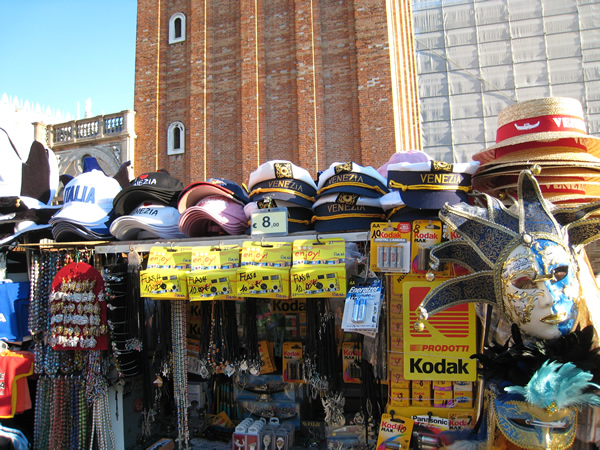
In St. Mark’s Square, Jeet bought some necessary props (above).

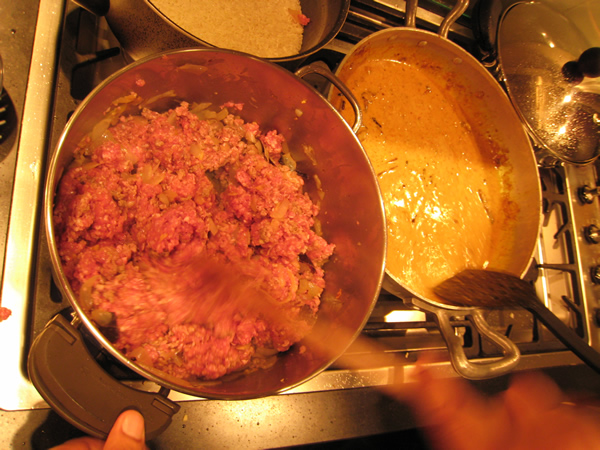
We returned to the apartment to greet Andrew and Victoria, arrived from Paris. Jeet and Andrew set to work making a fantastic Indian meal.

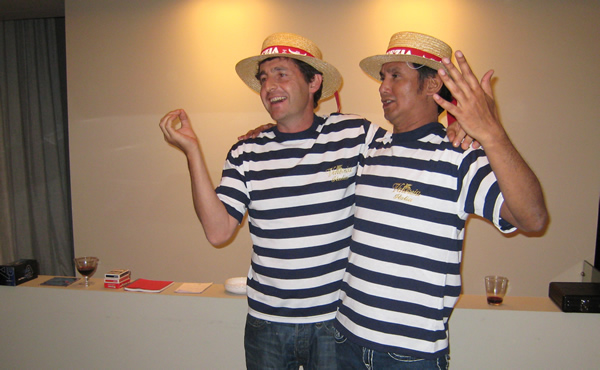
Which they served in appropriate national costumes:

(Hey, I just live my life, in all its glorious weirdness – don’t ask me to explain it!)

Jeet learned his Indian cooking from Tsering and Tenzing, old friends from Woodstock. While we were enjoying the results of their lessons in Venice, our daughter, on quarter break from school, was staying with them at their home in Mussoorie. Yes, we’re all just one big happy family!

Venice 1, 2, 3, 4, 5, 6, 7 , restaurant

Sweetness and Dark on Lake Como

Some evenings, stepping off the train as it arrives in Lecco, there’s a slightly toasted, coffeeish scent of rich, dark chocolate in the air. It’s not a hallucination: Lecco is the home of Icam, one of the world’s largest manufacturers of organic chocolate. They process 6000 tons of raw cocoa beans per year, and when those beans get to cookin’, the whole town is wrapped in a sensuous fog of aroma.

I had long been aware of Icam as a purely local phenomenon – Icam-branded chocolate doesn’t even show up much in Italian stores, though some friends had proved to us that Icam’s chocolate-hazelnut spread was far superior to Nutella. I knew that Icam had a spaccio (outlet store) at the factory down in Pescarenico, but I never managed to get there until we’d been in Lecco for a while, and then only because they ran extended hours during the Christmas season.

I discovered one Christmas that they make very good “cru” (single-origin) tasting squares of “Extremo” 75% dark chocolate – I bought some for family Christmas presents.

More recently, I was surprised to notice that our friend Michele was selling Green & Black’s, the famed UK brand of organic chocolate, at his bakery in Lecco.

“Where did you get that?” I asked.

“They make it right here in Lecco!”

He told me that a British couple had stopped for a chat at his shop. Turns out the man was a financial officer with Green & Black’s, in town to visit their production partner. He told Michele that some (surprisingly large) percentage of Europe’s chocolate, including much of Green & Black’s, is made by Icam – exactly how much I have not been able to confirm. He may have been referring specifically to the organic chocolate market – I have not so far located any definitive figures on European chocolate production, though I did find a list placing Icam as number 89 among the Top 100 Global Confectionery Companies. They evidently manufacture for others who sell organic chocolate, such as Seeds of Change.

So Icam was on my Christmas shopping list again last December. I came away with:

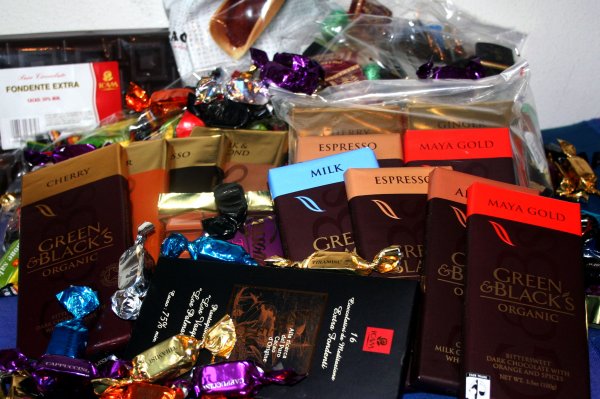
  • three half-kilo bags of mixed chocolates (many of them Green & Black’s), at 5 euros each
  • two bags each containing ten bars of Green & Black’s
  • one bag of non-chocolate candies
  • a 1-kilo bar of dark chocolate for cooking
  • a 1-kilo bag of unsweetened cocoa powder for cooking
  • a half-kilo tub of “Icam-ella” or whatever they call their spread
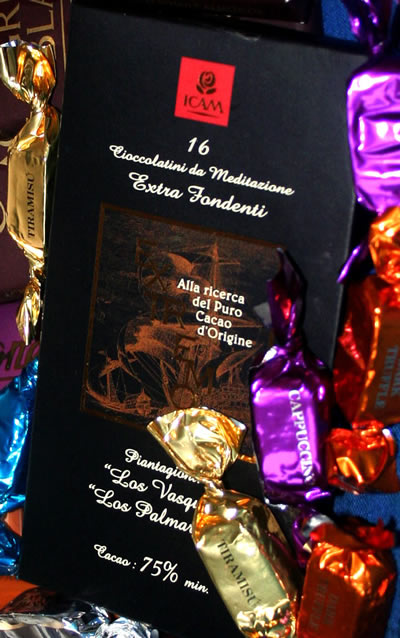
  • a sampler box of the Extremo (pictured above)

Yes, it was a lot to carry! But I couldn’t resist – the bill for all this was only about 50 euros. Both at home and at the office, we had a very sweet Christmas.

Icam is doing so well that it needs to expand, but apparently is not finding encouragement to do so in Lecco. However, last I heard, their efforts to build a new factory in a nearby town were also frustrated by some strange local resistance.

<sigh> It can be inexplicably difficult to do business in Italy. Icam would probably have fewer hassles and lower costs if they moved their operation to some other part of Europe. But Icam is a family-owned business, and we can all be thankful that Italian families and businesses are stubborn about sticking to their roots!

You can visit Icam’s factory outlet store during the hours 8.30-13.00/14.00-17.00, Monday through Friday.

Dining in America (and Italy)

I instinctively dislike chain restaurants: when someone says “Let’s eat at a [name of chain restaurant],” I wince. And it’s getting harder and harder to find a restaurant in the US that isn’t part of a chain. However, my instincts may be out of date: chain restaurant food seems to be improving. During this recent trip I ate at TeKei’s (Chinese/Thai), Razzoo’s (Cajun), Sarovar (north and south Indian), and something else with a southern (American) theme. I think they’re all chain franchises, but they were also all good. I still prefer to support local and personal cooking creativity where possible, but… sometimes you gotta make do.

What puzzles me is the concept of waiting to get a seat at a restaurant. In 15 years in Italy, I have almost never waited for a restaurant. I’m sure it must have happened once or twice, but I can’t actually remember a single instance. The handful of times I can remember arriving somewhere and finding it full, there was always someplace just as good nearby to go to instead.

But, in the US, no matter how saturated with restaurants an area may be, it’s not uncommon to arrive at a restaurant and find you have to wait half an hour for a table – even though American restaurants are usually HUGE compared with Italian ones, and manage several seatings per table per night, as Americans rarely linger over their meals. I can’t figure it out. Maybe Americans simply eat out more often than Italians (with today’s prices at Italian restaurants, that wouldn’t be surprising).

Restaurant congestion is so bad that, throughout my recent trip, everyone I had lunch with wanted to eat at 11:30 am to avoid the rush. If I hadn’t had jet lag, I would never have got used to this, but it was good preparation for CES, where, if you don’t eat early, you don’t eat at all.

America seems to be obsessed with eating. You can’t go anywhere without being bombarded by advertising for food. It’s effective, too: hearing or reading adjective-stuffed descriptions and seeing perfectly-staged food photographs (there’s an art to it), I always get hungry.

I can’t remember ever hearing food advertised on Italian radio (not that I listen to it regularly). Nor are restaurants advertised on TV in Italy, except McDonald’s. I guess that’s because there aren’t any non-fast-food restaurant chains in Italy (well, there is one, Pastarito – I don’t recommend it), and it doesn’t make economic sense for a single restaurant to advertise nationally.

In America, the marketing doesn’t stop once they’ve got you in the restaurant. The typical American menu is larded with sensual adjectives: “creamy this, delicately folded into tangy that, with a hint of zesty the other…” Some menus include photos, though the food on your plate rarely comes out quite as beautifully. All of this – words, pictures, page layout, fonts – is designed to encourage you to buy the items on which the restaurant makes the biggest profit margin. The waiter may also, asked or unasked, recommend those high-margin items.

There’s no art of selling in Italian menus: they generally only give the name of the dish and a price. In most Italian restaurants, this is all that’s necessary, because most stick to well-known classics with maybe one “house specialty” dish. In the rare cases that you don’t know what a dish’s name means, you ask the waiter, who gives you a bare description: “pasta with sauteed eggplant and salted ricotta.”

The fancier restaurants do tend to be more creative and therefore need to explain their dishes, but the explanations are usually simple statements of fact: “sauteed local trout with diced vegetables” – which hardly does justice to one of Lanterna Verde‘s amazing dishes. But then, the food at Lanterna Verde is so good that you need not be seduced into eating it, and you will certainly not be disappointed, whatever you choose.