Category Archives: Italian language

Italian Animal Idioms

In Italian, as in any language, there are many popular sayings and metaphors using animals, based on human perceptions of those animals’ lives and habits.

Cats

It seems that, in Italian culture, the distinguishing feature of cats is their greed for food.

Non c’e’ trippa per gatti

“There’s no tripe for cats.”

This is used when there’s absolutely no hope that you’ll get what you want. I suppose tripe is considered something that cats would like, but humans (at least some Italians) also like it, and are not about to share it with mere felines. At the European football championships in Athens (spring 2007), a group of Italian Milan fans unfurled a banner saying (in English) “There’s no tripe for cats,” meaning that there was no hope for the other team to win, though probably only the Italians understood it that way.

Tanto va la gatta al lardo che ci lascia lo zampino

“The [female] cat goes so often to the lard that [sooner or later] she will leave her little paw [print] in it.”

In other words, the cat is so irresistibly attracted to the lard (to eat it), that sooner or later you will know exactly whom to blame: a habitual malefactor will eventually be caught. This reflects the fact that many criminals don’t seem to have much imagination, but keep exploiting the same formula over and over again, which makes it easier for the good guys to catch them.

Dogs

Dogs are known for not having easy lives. Which is certainly true in Italy – urban dogs become neurotic cooped up in tiny apartments, and when out for their walks are the targets of hatred from non-dog-owners, who know that most Italian dog owners will not clean up after their pets, rendering city streets disgusting and parks hazardous for children to play in.

Every year thousands of dogs (and cats) are abandoned on the roadsides by families who are going away for the usual long vacation and can’t think of anything better to do with them. At this time of year the newspapers are full of pious “moral campaigns” pointing out that this is hazardous to humans as well as cruel to the animals: lost dogs wandering onto highways cause traffic accidents.

It’s not surprising that in Italian, as in English, people refer to…

Una Vita da Cani

“A dogs’ life.”

Dirlo ai Cani e Porci

“Tell it to dogs and pigs.”

To broadcast something, probably someone’s personal news, to every possible listener, no matter how unlikely to be interested.

Birds

Conosco i miei polli – “I know my [own] chickens”. Used when you know someone so well that you can predict how they will behave in a given situation. My own speculations on the origin of this phrase.

I know I’m missing more animal idioms – feel free to add!

Italy’s Amazing Summer Fruits

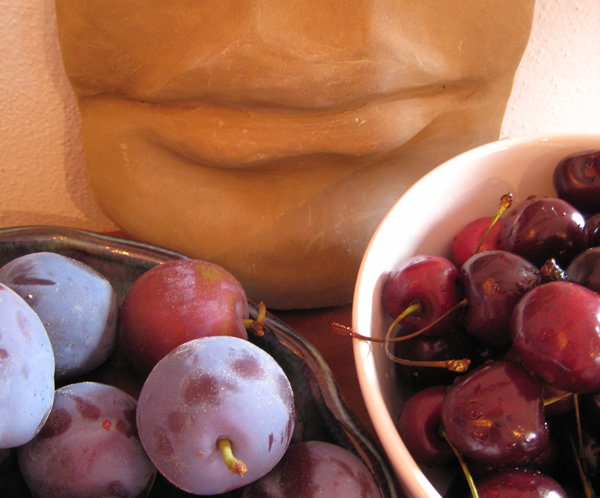
sculpture above done by Ross when she attended liceo artistico

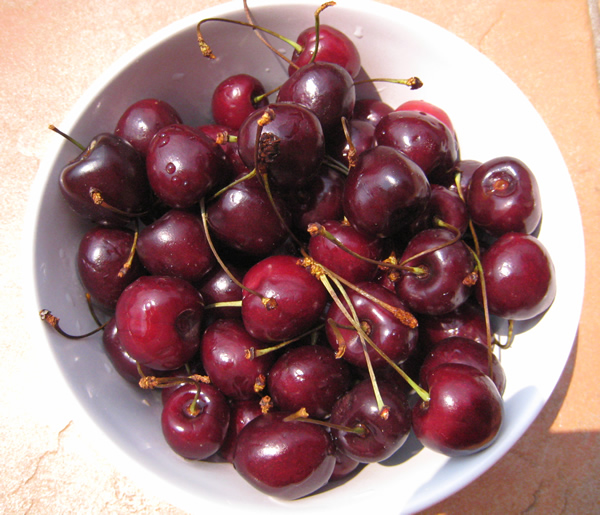
Summer has arrived, and with it everyone’s favorite fruits – along with the desire to mangiare leggero (“eat light”) in the heat. At this time of year it’s not unusual to see mounds of cherries served as dessert, antipasto, or snack at parties and dinners. Juicy, sweet, bursting with flavor, all these need is a place to discard the pits and stems:

An Italian saying related to cherries (and applied to other things) is: una tira l’altra (“one pulls another”), as in: “I ate so many because they just kept coming out of the bowl, one after the other, their stems entangled…”

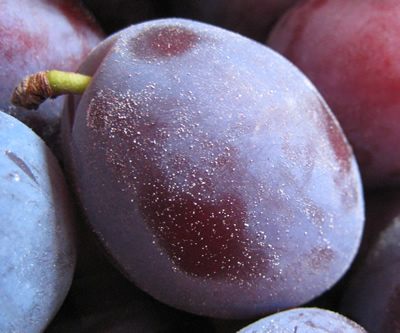
Have you ever seen more perfect plums? They come in many varieties and colors (blue, red, yellow, pink, purple), and all taste as good as they look:

If you’re visiting Italy in summer, here’s a restaurant tip: instead of dessert, order frutta di stagione (seasonal fruit). You may be asked what you want specifically, so here’s a little vocabulary:

  • pesche [PESS-kay] peaches
  • prugne [PROON-yay] plums
  • albicocche [al-bi-KOK-kay] apricots
  • ciliegie [chili-AY-JAY] cherries
  • pesche noci [PESS-kay NO-chee] nectarines
  • fichi [FEE-key] figs – these are often served as an antipasto, with prosciutto crudo – don’t miss it!
  • lamponi [lam-PONE-ee] raspberries
  • mirtilli [meer-TEEL-lee] blueberries

NB: Berries are known collectively as frutti di bosco (“forest fruits”). If you get a chance to eat fresh-picked wild blueberries (very occasionally available at restaurants and fruitsellers) do NOT pass it up. If you hike, keep your eyes peeled: you can find wild raspberries and blackberries free for the picking.

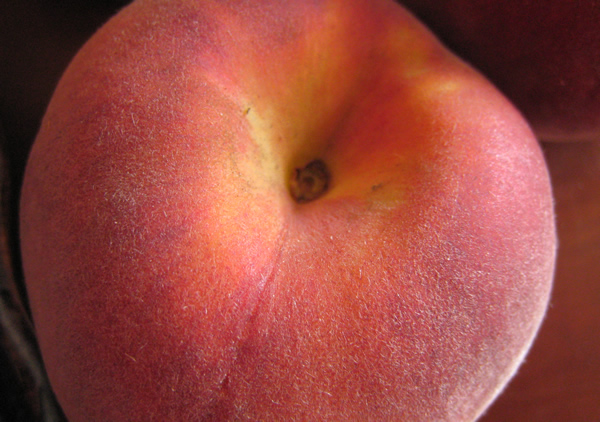
Peaches, plums, apricots, and cherries may be served floating in, or alongside, a large bowl of cold water. Dip the fruit in and swish it around to clean it, then eat! Many Italians peel their peaches with a knife before eating (often they are so ripe that the peel will slip away from the flesh with very little assistance), but you’re not obliged to – you’ll find that the skin is much thinner than you’re used to on American peaches.

Learn Italian in Song: Com’é Profondo il Mare

Lucio Dalla, 1978

Com’é Profondo il Mare

How Deep is the Sea

Siamo noi, siamo in tanti We are us, we are many
Ci nascondiamo di notte we hide ourselves at night
Per paura degli automobilisti for fear of the automobilists
Dei linotipisti Of the linotypists
Siamo gatti neri We are black cats
Siamo pessimisti we are pessimists
Siamo i cattivi pensieri we are the bad thoughts
Non abbiamo da mangiare We don’t have anything to eat
Com’è profondo il mare How deep is the sea
Babbo, che eri un gran cacciatore Dad, you who were a great hunter
Di quaglie e di fagiani of quail and pheasant
Caccia via queste mosche Chase away these flies
Che non mi fanno dormire that don’t let me sleep
Che mi fanno arrabbiare that make me angry
Com’è profondo il mare How deep is the sea
E’ inutile It’s useless
Non c’è più lavoro There’s no more work
Non c’è più decoro there’s no more decorum
Dio o chi per lui God, or someone in his place,
Sta cercando di dividerci is trying to divide us
Di farci del male to hurt us
Di farci annegare to drown us
Com’è profondo il mare How deep is the sea
Con la forza di un ricatto With the force of a ransom
L’uomo diventò qualcuno Man became someone
Resuscitò anche i morti He raised even the dead
Spalancò prigioni Opened wide prisons
Bloccò sei treni Blocked six trains
Con relativi vagoni with their respective cars
Innalzò per un attimo il povero He lifted the poor man for a moment
Ad un ruolo difficile da mantenere to a role difficult to maintain
Poi lo lasciò cadere Then let him fall
A piangere e a urlare to cry and scream
Solo in mezzo al mare alone in the midst of the sea
Com’è profondo il mare How deep is the sea.
Poi da solo l’urlo Then, by itself, the scream
Diventò un tamburo became a drum
E il povero come un lampo and the poor man like a lightning bolt
Nel cielo scuro In a dark sky
Cominciò una guerra began a war
Per conquistare to conquer
Quello scherzo di terra that joke of earth
Che il suo grande cuore which his great heart
Doveva coltivare should have cultivated
Com’è profondo il mare How deep is the sea
Ma la terra But the earth
Gli fu portata via was taken away from him
Compresa quella rimasta addosso including that which was still on him
Fu scaraventato he was flung
In un palazzo,in un fosso into a palace, into a pit
Non ricordo bene I don’t remember well
Poi una storia di catene Then a story of chains
Bastonate beatings
E chirurgia sperimentale and experimental surgery
Com’è profondo il mare How deep is the sea
Intanto un mistico In the meanwhile a mystic
Forse un’aviatore perhaps an aviator
Inventò la commozione Invented sympathy
E rimise d’accordo tutti And got everyone to agree again
I belli con i brutti The beautiful with the ugly
Con qualche danno per i brutti At some cost to the ugly
Che si videro consegnare Who saw themselves given
Un pezzo di specchio a piece of mirror
Così da potersi guardare so they could look at themselves
Com’è profondo il mare How deep is the sea
Frattanto i pesci In the meantime the fish
Dai quali discendiamo tutti from whom we are all descended
Assistettero curiosi looked on, curious,
Al dramma collettivo at the collective drama
Di questo mondo of this world
Che a loro indubbiamente Which to them undoubtedly
Doveva sembrar cattivo must have seemed wicked
E cominciarono a pensare And they began to think
Nel loro grande mare In their great sea
Com’è profondo il mare how deep is the sea
Nel loro grande mare In their great sea
Com’è profondo il mare how deep is the sea
E’ chiaro It’s clear
Che il pensiero dà fastidio that thought causes irritation
Anche se chi pensa Even if the one who thinks
E’ muto come un pesce is mute as a fish
Anzi è un pesce In fact, is a fish
E come pesce è difficile da bloccare And as a fish, is difficult to stop
Perchè lo protegge il mare because the sea protects him
Com’è profondo il mare How deep is the see
Certo Certainly
Chi comanda he who is in charge
Non è disposto a fare distinzioni poetiche is not disposed to make poetic distinctions
Il pensiero come l’oceano Thought, like the ocean
Non lo puoi bloccare you cannot block
Così stanno bruciando il mare So they are burning the sea
Così stanno uccidendo il mare so they are killing the sea
Così stanno umiliando il mare so they are humiliating the sea
Così stanno piegando il mare so they are bending the sea [to their will].
if you find this useful and want more, let me know!

Hot Chestnuts! Two Romans Explain How

When I visited Rome for barCamp in January, I stayed with family friends Serena and Sandro – true Romans both. We had grand plans to film Sandro explaining Roman swearwords (with gestures), as an addition to my Italian slang section, but then we drank a lot of wine and laughed and talked a lot, so all the footage I got was this short clip about chestnuts.

As well as explaining a bit about chestnuts, it’s is a good example of a Roman accent, though Sandro’s is not heavy – he’s even laying it on a bit more for the video than is normal for him (at least in conversation with non-Romans). Some day we’ll get around to those videos about swearwords. Sandro is also amazingly knowledgeable on the history of Rome and religions – a resource I hope to make better use of someday.

The phrase la sua morte needs some explanation. It literally means “It’s his/her/its [proper] death.” It’s used to mean: “the very best way to cook or eat x.” I’ve never heard it used except in reference to food.

And, yes, fresh-roasted chestnuts with red wine are delicious.

Italian SMS-Speak

“Texting” – sending text messages via cellphone – has been popular in Italy far longer than in the US, in part because it’s cheaper than calling. When I can’t reach someone by email, I use SMS for non-urgent communications – it’s less intrusive than a call, and I have a phobia of disturbing people.

Italian kids in particular text a lot, though many have now moved on to instant messaging on their computers. They’ve developed a shorthand which is useful for both; I give some examples here (and will expand on them as I run into new ones, particularly with illustrations).

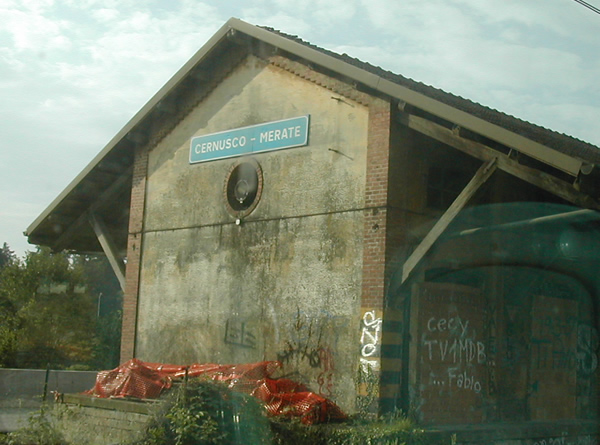
The graffito on the side of the building pictured above reads: Cecy TV1MDB… Fabio.

TVB – ti voglio bene – “I love you” – predates cellphones; I remember my daughter and her middle school friends scribbling it on each others’ school diaries and backpacks. (The advertising applications for TVBLOB are instantly apparent.)

The graffito above is another variant: 1 is (obviously) uno, the number one, but it’s also the article “a” or “an”. So this reads: Ti voglio un mondo di bene – “I desire for you a world of good,” or “I love you a lot.”

Cecy, BTW, pronounced CHAY-chee, is a nickname for Cecilia [cheh-CHEE-lee-ah].

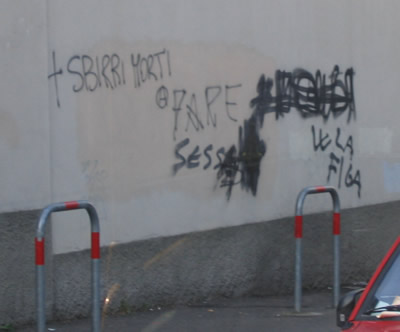
+ is of course the mathematical plus sign, pronounced piu’ [PYOO]. But piu’ also means “more”. So the ugly sentiment expressed above is “more cops dead.”

At the bottom right is the VV symbol meaning “hurray for!”figa (cunt). (A rather pleasanter sentiment.)

Other Abbreviations

(For which I don’t yet have photos.)

6 – sei means “six” or “you are”.

cmq – comunque – anyway

k – The letter k is pronounced kappa in Italian (the name is Greek because k is not actually part of the Italian alphabet). But Italian kids, knowing that in English it’s pronounced [kay], use it as shorthand for -che, a common Italian syllable.

x – This is not the letter x, but the multiplication symbol, called per in Italian. The word per is also a preposition meaning “for”, and, again, a frequently-used syllable in Italian.

So: xk = perché – “why?” – a savings of four letters when entering text!

what are some more Italian SMS abbreviations I’m missing?