Category Archives: Italy

Exact Change Required

One thing that baffles me about Italy is the inability of retail establishments – or anyone who has to take cash payment – to make change. This in a society where most store purchases are made in cash! Automatic teller machines give out 50,000 and 100,000 lire notes (NB: At current exchange rates, one US dollar is worth about 2100 lire), but this isn’t a factor; no matter what size bill you’ve got or what your total is, shopkeepers somehow never have enough coins and or smaller bills, or, when they have them, they don’t want you to use up the whole supply! You pull out your “large” note, and watch the cashier’s face fall as she or he plaintively asks: “You don’t have anything else?”

Lack of change usually isn’t a disaster – if one shopkeeper can’t do it, he or she will run and get change from a neighboring shop. Or, if you’re in a shop where they know you, they’ll say: “Pay me next time.” Amounts up to 200 lire are simply shrugged off by either party. (There were 10 and 20 lire coins – made of aluminum – in circulation when I first came to Italy, but no longer.) It can get problematic, however, if you take a taxi late at night (pay a taxi by credit card? Unheard of!) or are shopping in an unfamiliar place.

I have grown so accustomed to this that I routinely count out exact change, or as close as I can get, everywhere I shop. Italian shopkeepers are always grateful, and don’t flinch at the extra math involved in figuring out the difference between what I gave them and what I owe. But this behavior causes cashiers in the US to stare at me in resentful bafflement: they rarely deal in cash at all, and some have a hard time figuring out how much change to give.

Back in Italy, just think what fun we’ll have in January, when we all have to start using euros! The transition from lire to euros is supposed to take two months, but no one seems to know yet how it will occur. If I pay in lire, do I get euros in change? If so, some fancy calculating will be involved – the lire-to-euro rate is not a nice, round number (it’s 1936.27 lire to the euro). The wheels of commerce are likely to grind very slowly for a while…

Mar 15, 2007

As I revisit this topic, six years and a new currency later, not much has changed.We now pay in euros, and there’s been a huge upsurge in the popularity of credit cards, but making change is still a problem.

Just today I stopped at a small supermarket near the office to buy a few items, for a total of 6.87 euros. I’m always happy to clear heavy coins out of my purse, so, standing there right in front of the cashier, I opened my wallet, pulled out a five-euro note, and then opened the coin flap to see if I had enough change to make up the remaining 1.87. I didn’t – I was about 40 cents short. I shrugged apologetically, put the five away, and pulled out the next-smallest bill I had, which was a twenty.

The cashier’s face fell.

“Don’t you have anything else?” she asked mournfully. “Two euros? I’ve been making change all afternoon.”

Sweetie, you’re a cashier – surely that’s part of the job description?
Alex Britti in Concert

This summer we went to a concert by Alex Britti, a singer-songwriter as yet unknown outside Europe. He’s popular with the bubblegum set for a few immensely singable songs such asLa Vasca (The Bathtub), but he considers himself more a guitarist – and turns out to be a hell of a good one.Unfortunately, we hardly got to hear him sing during the concert, due to the chorus of teenyboppers who sang along enthusiastically (and badly) with most of the songs. Early on, I asked the girls behind us to stop: “I came to hear him, not you,” I pointed out. Their mother retorted: “Lady, if you want to hear the music, buy the CD. This is a concert.”

Defeated by this, er, logic, I retired from the battle, and had to be grateful for the guitar solos: delightfully un-singalongable, and very well played. These seemed to confuse much of the audience, who muttered to each other: “What song is this?” or got up and went for a beer.

Alex Britti must be frustrated. He’s made lots of money and gained some artistic freedom thanks to his lighter bestsellers, but his audience doesn’t seem to understand or appreciate the stuff that he himself likes best!

Other musical experiences this summer were less than stellar. Roseto, the little town on the Adriatic coast where my in-laws live, used to be a pleasantly sleepy place with nothing to do at night except stroll around, eat gelato, and watch kids on the carnival rides. But now it aspires to the trendy disco status of the Adriatic’s hotter spots, so the beachfront establishments all have permission to play music til 1 or 2 am.

This would be somewhat bearable, or at least understandable, if the music was good. However, it was all REALLY bad, mostly youngsters basically doing karaoke with automated music machines – their equipment was far more impressive than their abilities deserved.

One band started out relatively promising, playing real instruments, with an admirable selection of blues tunes and guitar licks ripped off from Stevie Ray Vaughan. But the guitar wasn’t quite in tune with the keyboard, and the singer wasn’t in tune with anything. After hearing “Pride and Joy” murdered two or three times, we were ready to strangle the drunk who kept demanding encores.

We could easily perceive even that detail, because my in-laws’ apartment overlooks the beach, within a stone’s throw of two of these establishments (alas, I had no stones). After we finally dropped off to sleep at 2 am one night, I was awoken at 8:00 by a group of retirees just arrived on an group tour. “Ecco il mare!” shouted one enthusiastic fellow – “Look! The sea!” (And just what did you expect to find on a trip to the seaside…?)

Note: I have also translated some of Alex Britti’s songs into English.

How to Eat Like an Italian: Fundamentals of the Mediterranean Diet

You’ve probably heard about the “Mediterranean diet”, and know that it involves a lot of carbohydrates, olive oil, tomatoes, and other fresh vegetables, as well as lots of good red wine.

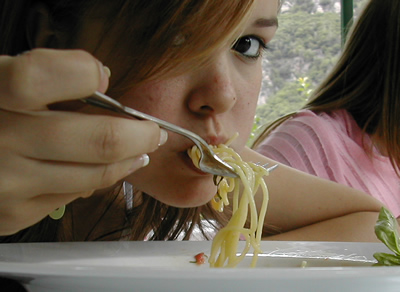
So what does a typical Italian meal look like? A restaurant meal may involve up to four courses: an antipasto, primo (first course), secondo (second course), and dessert. The antipasto and dessert are optional and often skipped, but to make a comfortably full meal you’re likely to want both the first and second courses. The first course is where you get the bulk of your carbohydrates, in a dish of pasta or rice (in the form of risotto).

A word about pasta: I have occasionally (reluctantly) eaten in trendy Italian restaurants in the US, at the behest of colleagues who thought it would be a treat for me. I do appreciate their kind intentions, but… It’s positively alarming what Americans will do to pasta! No matter what the menu claims, any single pasta dish that involves too many ingredients (sun-dried tomatoes, olives, tomato sauce, artichoke hearts, etc.) is not likely to be an “authentic” Italian dish. Furthermore, Italians don’t eat much chicken, and I have never seen an Italian put chicken in pasta. And feta cheese, being Greek, is not typically found in Italian pasta dishes.

…where was I? Ah, yes. The second course is where you get your proteins. It usually consists of meat or fish, very simply prepared, for example grilled over a log fire. You will also want to order one or more contorni (side dishes), such as vegetables, salad, or potatoes, since the meat usually arrives completely unaccompanied.

If you’re vegetarian, there’s not a lot of choice at most restaurants, but grilled scamorza (smoked cheese) and grilled vegetables are often available, and always yummy. There are some traditional vegetarian dishes such as melanzane alla parmigiana (eggplant parmesan) but, if you are a very strict vegetarian, you should ask, as often apparently vegetarian dishes do involve meat, e.g. a risotto with mushrooms will likely be cooked in meat broth.

Italian cooking is mostly very simple. It doesn’t need to be elaborate, because the basic ingredients are so good that it would be a shame to cover up the foods’ inherent flavors with heavy sauces and spices.

You can also have a cheese course after the second course, then dessert and/or fruit, then coffee. Coffee is not served with the dessert unless you specifically ask. Caveat: ordering a cappuccino after dinner is the sure mark of a tourist (if the waiter offers it, you’re in the wrong restaurant!). Italians rarely drink cappuccino after 10 am, and never after a meal.

A friend in Milan on business went alone to a restaurant for dinner. He overheard the couple at the next table – clearly Americans. When he answered his cellphone, they realized that he, too, was American, so they said hello. “The food is good here,” they said, “but the servings of pasta are really small!”

Yes, portions are small in Italy. Or, from the European point of view, portions in America are enormous! (And Europeans often add: “No wonder so many Americans are fat!”) That’s why in Italy you generally order a first course and a second course, as well as side dishes. A meal made up of a single course is called piatto unico (single plate), but these are not common.

Volterra: An Ancient Town in Tuscany

The old Roman roads still serve, though they’ve been repaved a few times in the last few millennia. We left Rome on the Via Aurelia (which goes up the west coast from Rome to Genoa), heading for a friend’s summer house in Marina di Bibbona in the Maremma region of Tuscany. Marina di Bibbona is a resort town with little to recommend it unless you’re there for the beach. Our friend commented that, since the tourists who come there are mainly German, there aren’t any good restaurants. <grin>

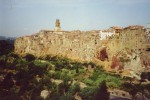
Leaving Marina di B., we headed east to Volterra, originally founded during the 8th century BC by the Etruscans. Like many such towns in Italy, it is richly layered with the accretions of successive conquering cultures.

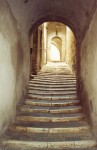
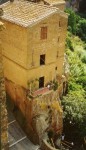
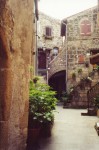
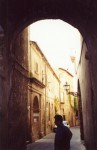
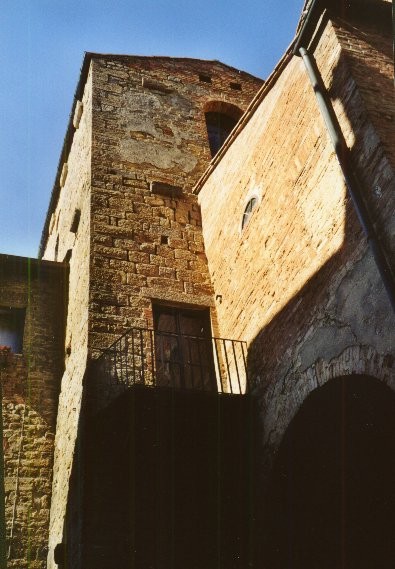
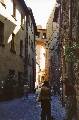
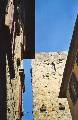
Volterra Volterra Volterra Volterra Volterra

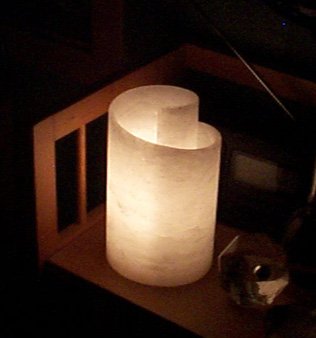
A long-exploited natural resource of the area is alabaster, found in the surrounding hills in the form of large and small nodules embedded in clay. The artisans of Volterra carve this soft, luminous stone into urns, tabletops, lamps, statues, and chess sets. The most interesting work we saw was a chess set with pieces in the liknesses of film stars (Marilyn Monroe for the queens, John Wayne for the knights, etc.). The board was made of separate, undulating strips of celluloid – all carved from alabaster, of course.

alabaster lamp, Volterra

Left: An alabaster lamp.