Category Archives: Italy

Not in Tune with the Holiday Season

I have long said that shopping is America’s national sport. It certainly seems to inspire Olympic-level frenzy among the media and many citizens. Hands up anybody who knew ten years ago what “Black Friday” meant? Today, how could you not know?

America’s Thanksgiving headlines this year, as most years, were largely obvious and useless: the age-old stories on weather, traffic, and turkeys. There’s no need to rewrite these every year – change a few details of location and statistics from last year’s stories, and you’re done.

But this year the standard holiday stories had competition from those about the day after Thanksgiving – “the biggest shopping day of the year”, as we were told breathlessly and endlessly. There were stories about people lining up for hours to be first in line to get some special “door buster” deal at a store. The media rewarded shopping commitment taken to absurd levels, reporting on some man who was wounded by a shotgun blast and nonetheless insisted on standing in line. What a legacy: to be remembered as the guy that obsessed with buying a videogame console.

I have commented on this to Americans before, and got some reactions on the order of “But you CAN get really good deals, so it’s worth it.” Not to me. To me, nothing is worth standing in any line unless there is absolutely no alternative. I can’t think of an object that I so desperately need to buy at anydiscount. (Oh, I’m sure someone could come up with a deal to tempt me, but the temptation level of the average American seems to be far lower than mine.)

I am thankful that Italy doesn’t yet make such a big a deal of the Christmas shopping season, though some seem to be trying. In the past, Christmas decorations did not go up until the Feast of the Immaculate Conception (Dec 8th), a national holiday usually made into a long weekend, hence offering a similar day-after-the-holiday shopping opportunity.

But the Christmas “season” has been inching up in Italy, as elsewhere. Lights went up a few weeks ago, and were turned on last week. Last Sunday many shops were open, and most are already decorated for Christmas, which I find tiring. (But at least I don’t live in the UK, where they start decorating for Christmas in early October!)

So far, in spite of it all, I’m not in a Christmas mood. Any other time of year, I enjoy buying presents for people. Right now it feels like a chore. I have no idea what to get for anybody (except Rossella – she’s easy), and I’m broke anyway. I don’t even know what I’d want for myself. Enrico and Rossella asked me what I wanted for my birthday, and I couldn’t think of much (except warm socks – I always need more socks). I have Amazon wish lists, but can’t remember anything on them that I couldn’t live without.

I do enjoy experiences: a good meal, a show, or a weekend like the one we just spent in Bormio, which was my birthday present from Enrico. For this year’s Christmases and birthdays, my dad and his wife got everybody tickets to see “Spamalot” in London when Ross and I visit in January, which will be fabulous. Unfortunately, it’s difficult for me to do anything analogous for them (or anyone else).


Return to Bormio Part 2

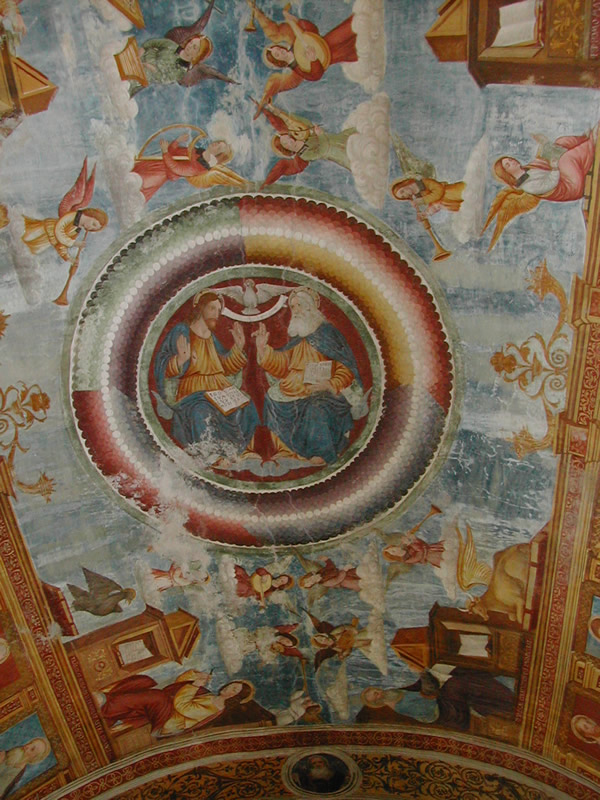
ceiling of a small chapel – this must have been recently restored, as we did not see it on our previous trips to Bormio, and there was no explanation anywhere in the room, though there were display cases seemingly ready to hold text of some sort

In the evening we went out again for snacks and beer at a pub, which got very rowdy with a large group of young men singing largely incomprehensible songs. We never did figure out what tribe they belonged to, but one song went “Ocker, ocker, ocker, viva i pizzocher’ !” Only in Italy would a drinking song be an ode to the local pasta specialty: pizzocheri, buckwheat pasta cooked with potatoes and greens, then baked with cheese, garlic, sage, and butter.

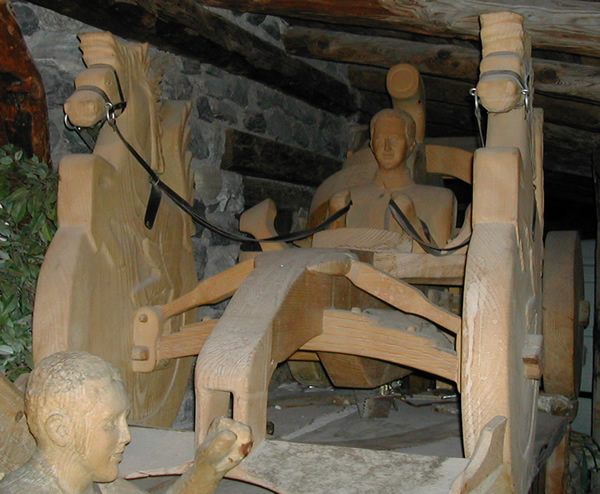
wooden Schumi

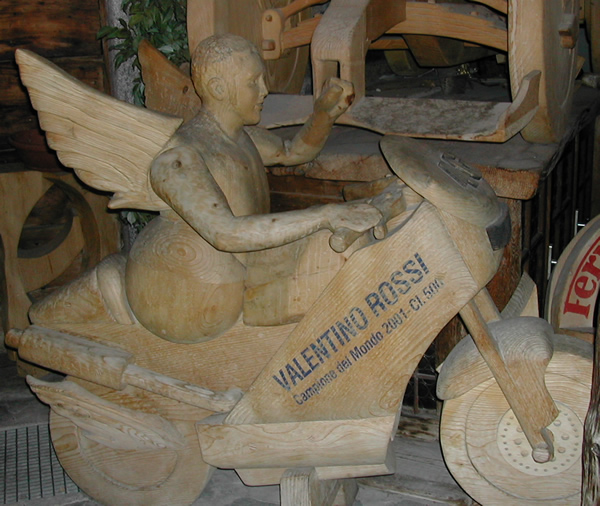
During our walk, we saw outside a restaurant called Rasiga these fanciful carvings of Schumacher with his Ferrari cavallini (horses) and Valentino Rossi, the motorcycling champion

wooden Rossi

The next morning we got up in good time for our included breakfast, then drove up to the Bagni Vecchi (Old Baths), a few hundred meters above the town. We had been warned to reserve in advance because the Bagni Vecchi were likely to be crowded while the Bagni Nuovi are undergoing restoration. We got there half an hour before our reservation time of 11:00, and then they couldn’t find our reservation, but they let us in anyway.

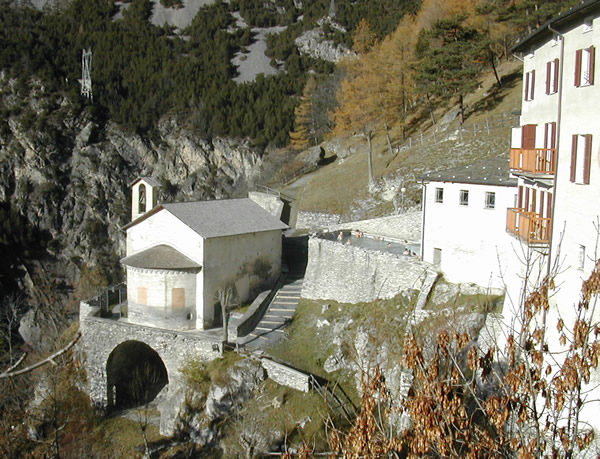
Bagni Vecchi di Bormio, external view

external view of the Bagni Vecchi showing the outdoor (hot water) pool next to the old chapel. To the right is the main spa and hotel building.

The price has gone up considerably: at 35 euros each, it’s well over twice what we paid on our last visit to Bormio, and a ten-percent discount voucher from our hotel did not do much to ease the sting. Oh, well. All good things must go up in price, I suppose, and, the once a year or so that we manage to go, we can afford it.

Once we had checked in and paid, we were given a token to get a locker key and a package containing tubes of bath gel/shampoo and body lotion. Then we went along to a desk where a lady gave us big white bathrobes and towels, and plastic flip-flops (presumably sterilized for our use); you pay a 5 euro deposit for these.

The locker rooms are unisex, with curtained booths where you change into your bathing suit (forgot your suit? apparently you can buy one embroidered with the crest of the Bagni Vecchi, though I did not inquire about price). After changing and stuffing our clothes, coats, and bags into the (smallish) lockers, we strapped our locker keys to our wrists, and away we went.

Our first stop was perhaps the oldest part of the baths, a dark, steamy, echoey tunnel carved into the living stone of the mountain. The tunnel splits, with one side ending in a spherical steam room with stone benches, the other trailing even further back and filled about four feet deep with hot water. In deep winter, due to some weird thermal effect, this water is almost unbearably hot (even for me, who adore very hot baths), but the surrounding earth wasn’t frozen enough yet last weekend, so it was merely pleasantly warm.

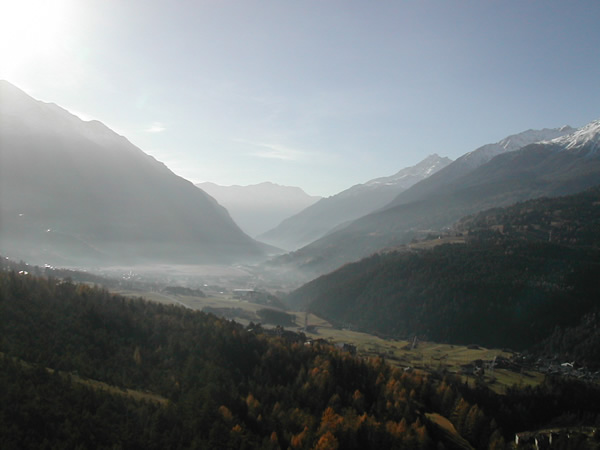
We then went on to Enrico’s favorite feature, the outdoor pool, which is constantly refilled with fresh hot water from an open wooden trough running along three sides, with close-fitting wooden spigots. It also has several kinds of Jacuzzi jets. But the best thing about the pool is that you’re floating in hot water enjoying this view:

view from the pool, Bagni Vecchi, Bormio

(There used to be a great webcam view of the pool, but it was taken down a few years ago, perhaps for privacy reasons.)

My own favorite feature of the Bagni Vecchi is “Garibaldi’s baths”, a long stone pool in a cavernous dark room, with three waterfalls crashing down five meters or so from near the ceiling. You can sit under these waterfalls and get an excellent massage on your head, neck, and shoulders, and the water was the hottest in the entire spa that day.

There are also saunas – two small, traditional dry ones, and one larger with a view (the “Sauna Panoramica”), and two new large ones which are more like wood-panelled sweat rooms – I liked these even better than the dry saunas. (I was also fond of the mud baths that these have replaced, but apparently I’m in a minority on this.) There is a “chromatherapy” room with stone walls, where you lie on a divan and watch colored lights change while listening to “soothing” music – I didn’t bother with this. Several other “relaxation” rooms are scattered throughout, but I have a bone to pick with whoever thinks that shrill pipe music, however New Age, is soothing!

Apparently the Bagni Romani (Roman Baths) that used to cost extra are now included in the package, but we forgot to go to them – they’re basically rooms five feet deep in hot water. We also never made it into the standard Jacuzzi-style pools; we managed to fill three hours going back and forth among the aforementioned features, plus some time just lying in the sun in our damp bathing suits and bathrobes (which we should not have been able to do in late November! global warming?).

By 1:30 or so we were thoroughly waterlogged and relaxed, and I was getting hungry. We showered, changed, returned out towels etc., dried our hair, and went to the spa’s café for a snack of fruit and yogurt.

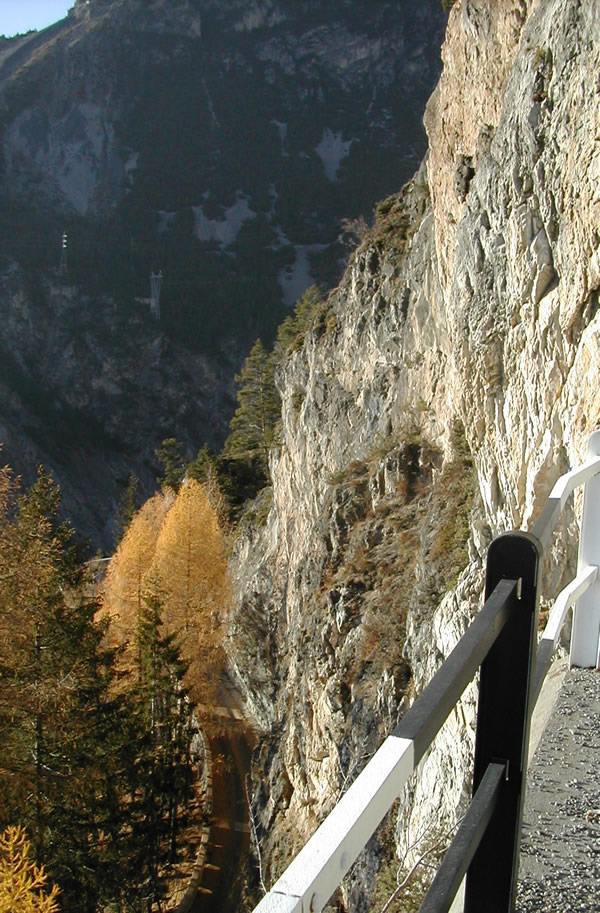
The road to the Passo dello Stelvio starts just beyond the turnoff for the Bagni Vecchi, and it was already closed for the winter – which seemed odd, considering how little snow had fallen. So we were able to take a walk up the road, completely unmolested by cars.

I was puzzled as to why so many pine trees had turned yellow. Surely that can’t be normal?
yellow pines

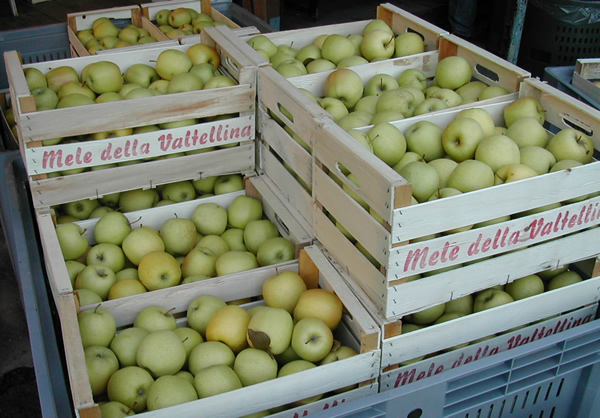
As we returned to our car, we saw climbers practicing on a rock face nearby.We headed for home, stopping along the way to fill our water bottles with fresh spring water, and to buy apples from one of the many stands along the way. The minimum we could buy was six kilos, so we’ll be eating a lot of apples for a while!

apples in crates

Learn Italian in Song: Azzurro

A version sung last summer by the victorious Azzurri (Italian national football team), apparently as a fundraiser for charity. The guy in the blue shirt is Gianni Morandi (not a football player).

Azzurro – Sky Blue
Paolo Conte - Tournee - Azzurro

by Paolo Conte, made famous by Adriano Celentano

Cerco l’estate tutto l’anno I look for summer all year long
e all’improvviso eccola qua. And all of a sudden, here it is.
Lei é partita per le spiagge She has left for the beaches,
e sono solo quassu’ in citta’ , And I’m alone up here in the city.
sento fischiare sopra i tetti I hear whistling above the roofs
un aeroplano che se ne va. a plane that’s leaving.
Refrain
Azzurro,il pomeriggio é troppo azzurro Blue, the afternoon is too blue
e lungo per me. And long for me.
Mi accorgo I realize
di non avere piu’ risorse, That I have no more resources
e allora so now
io quasi quasi prendo il treno I could almost take the train
e vengo, vengo da te, And come, come to you
ma il treno dei desideri But the train of our desires
nei miei pensieri all’incontrario va. In my thoughts runs backwards.
Sembra quand’ero all’oratorio, It’s like when I was at the oratorio*
con tanto sole, tanti anni fa. With so much sun, so many years ago.
Quelle domeniche da solo Those Sundays alone
in un cortile, a passeggiar… Walking around in a courtyard
ora mi annoio piu’ di allora, Nowadays I get more bored than I did then
neanche un prete per chiacchierar… Not even a priest to chat with.
(refrain)
Cerco un po’ d’Africa in giardino, I look for a bit of Africa in the garden
tra l’oleandro e il baobab, Between the oleander and the baobab
come facevo da bambino, As I did when I was a kid
ma qui c’é gente, non si puo’ piu’, But there are people here, I can’t do that anymore
stanno innaffiando le tue rose, They’re watering your roses
non c’é il leone, But there’s no lion
chissa’ dov’é… who knows where it is.
(refrain)
*Oratorio in this context means a youth center, run by and physically attached to a Catholic church. They offer after school and summer programs to keep neighborhood kids out of trouble if their parents have to work.

if you find this useful and want more, let me know!

Italian Slang: B

Italian Slang Dictionary: intro A B C D E F G I L M N O P Q R S T U V X Z

Balle

[BAHL-lay] Balls. Usually synonymous with “Bullshit!” Mi ha raccontato un sacco di balle – “He/she told me a whole bunch of lies” (literally, “a bag of balls”). Can also be used like palle. Che due balle/palle – “What two balls” – can also be used like “What a pain in the ass.”

Barbone

[bar-BONE-ay] “Having a big beard”, but also used for homeless men.

Battona

[baht-TONE-ah] Streetwalker, because she “pounds (battere) the pavement”.

Beh

“So?” or “So what?” In some parts of Italy, this may be equivalent to boh. Not particularly rude.

Bocchino

[bock-KEE-no] “A little mouthful” – fellatio.

Boh

A verbal shrug. This isn’t rude – you can use it any time.

Botta

[BOT-ta] A blow, a punch, a coup, but also used to mean a dose of cocaine. Hence in botta is used to mean high (but not necessarily specifically on cocaine).

In Roman slang, botta or bottarella means a fuck. Le ho dato una bottarella – “I fucked her [a little].”

Italian Slang: C

Italian Slang Dictionary: intro A B C D E F G I L M N O P Q R S T U V X Z

Caca

[ca-ca] Means poop, of course. Used with/by children, or ironically.

Cacchio

[KAHK-yo] A mild replacement for cazzo.

Cagare

[cah-GAR-ay] To shit.

  • Si stanno cagando sotto – “They’re shitting themselves below [with fear]”.
  • Non mi caga niente – “He/she doesn’t shit me anything,” i.e. “He/she doesn’t give a shit about me. ” In some areas, this means “I don’t give a shit about him/her” while you would need Non mi caga per niente to mean “he/she doesn’t give a shit about me.”
  • Mi fa cagare – “It makes me shit” – “It disgusts me.”
  • Va a cagare – “Go shit!” Used as an alternative to vaffanculo.

Cagacazzo

[CAH-ga-CAHZ-zo] Cagare + cazzo = “a shit dick”. (???) A rompiballe.

Cagata

[cah-GAH-ta] A shit, used of a worthless event or action or object. Can be used similarly to minchiata or cazzata : Ho fatto una vera cagata (I did something hugely stupid).

Canapa

[CAH-na-pa] Marijuana.

Canna

[CAHN-na] Literally a cane, as in bamboo, but used for a joint/reefer/ doobie – a marijuana cigarette (for which I don’t know the current American slang!).

Casino

[cah-ZEE-no] This has two basic meanings: “a lot” or “a mess”.

  • Mi piaci un casino is a slangy (but not rude) way to say “I like you a lot.”
  • Io ci sono stato un casino di volte = “I’ve been there a ton of times.”
  • E’ stato un casino = “It was a huge mess.”

Not to be confused with casino’ (the accent on the final o indicates that the stress is on that syllable, so pronounce it [cah-zee-NO]). This means casino in the American sense – a place where you gamble.

Cavolo

[CAH-voh-low] Literally, cabbage. Used as a mild replacement for cazzo: Non si sa che cavolo vuole (“No one knows what the heck he wants”).

  • Col cavolo! – Literally, “With cabbage!” but used as “Like heck!”

Cazzarola

[CAHTZ-a-roll-a] Another mild replacement for cazzo, used when you realize in the middle of the phrase that you shouldn’t say cazzo in present company. The Italian equivalent of using “frick” for “fuck”.

Cazzata

[caht-ZAH-tah] Something stupid. Ho fatto/detto una cazzata – I did/said something stupid. As Dario Fo has pointed out, a cazzata is something stupid, whereas a figata is something great. (Thank Alice Twain for that tip!) See also minchiata.

Cazzo

[CAHT-zoh] The quintessential Italian swearword, the one you’ll probably hear most often. A vulgar term for penis, but used in many contexts much as “fuck” is used in English:

  • Che cazzo vuoi? – “What dick you want?” – What the fuck do you want?
  • Che cazzo! “What dick!” – WTF!
  • Non rompermi il cazzo – “Don’t bust my dick” – Don’t hassle me.
  • Testa di cazzo – dickhead
  • Cazzo! – Shit!
  • Non fa un cazzo – He/she/it doesn’t do shit. Hence, fancazzista – one who does nothing.
  • Stare sul cazzo – “To stay on one’s dick” – to annoy terribly.
  • Sono cazzi tuoi – “Those are your dicks” – That’s your problem.
  • Fa i cazzi tuoi – “Do your own dicks” – mind your own business. If you want to be a little politer, say Fa i cavoli tuoi.
  • Cazzi amari – “bitter dicks” – bad stuff.

Cazzo d’Oro

[… doro] “The golden prick.” Said of a man who marries money by dint of his sexual prowess, at which point he can attaccare il cappello.

Chiappe

[KYAHP-pay] Butt cheeks. Often used in muovere le chiappe – move your butt, get a move on. Or alzare le chiappe – lift your butt up (out of that chair and do something). Chiappe can be used as a politer substitution for culo. It can also be a surname!

Cesso

[CHESS-oh] A rude word for toilet, but also used to describe a very disgusting place or a very ugly woman.

Chiavare

[kya-VA-ray] To fuck.

Citrullo

[chih-TROOL-oh] Derived from cetriolo (cucumber) – used of somone large, lumpy, and rather flavorless/dense. You can use this in polite company – just don’t let the person you’re referring to hear you!

Coglionare

[coal-YONE-ar-ay] To make a fool of, see coglione below.

Coglione

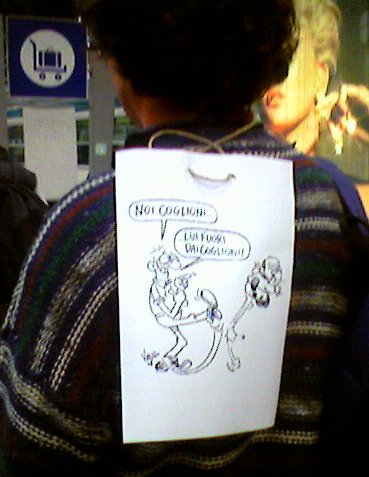
[coal-YONE-ay] A vulgar term for testicle, but also used to mean idiot (Che coglione! – “What an idiot!”). Apr 5, 2006 – Used in this sense by Berlusconi to define people who intended to vote against him in the recent election (which he lost, barely). Il Corriere della Sera translates coglione as “dickhead.”

  • Fuori dai coglioni – “Get out of my balls” (“stop bugging me,” but on the rudeness scale equivalent to “fuck off”). As in the political cartoon shown above, worn by people intending to vote against Berlusconi: “Us morons, him out of our hair.” For a milder version, use fuori dalle palle.
  • Non rompermi i coglioni – “Don’t bust my balls.” (Don’t hassle me.) For a slightly politer version, substitute palle or scatole, milder terms for balls.
  • Bisogna avere i coglioni quadrati – “You need to have square balls” (a lot of nerve/guts).
  • Rincoglionare – to make stupid.

Controcazzi

[CON-tro-CAHT-zi] “Counter-dicks”. Used in the phrase Con i controcazzi, meaning “with every possible accessory, fail-safe, feature, etc.”

Cornuto

[cor-NOO-toh] “Horned” – literally, “cuckolded, betrayed.” Used similarly to the American “loser” – but MUCH more offensive. More used in southern Italy than northern, with the accompanying “Hook ’em Horns” hand gesture.

Cozza

[KOTZ-ah] Literally, “mussel” (shellfish), but used for an ugly woman. Funny that there’s no equivalent for a really ugly guy…

Cozze, alle

[AHL-lay KOTZ-ay] Literally “at the mussels” (as in the mollusk you eat), but used to mean exhausted, done in, or in a mess. (This phrase is not particularly rude – nobody’s shocked by shellfish. Unless maybe it means “only ugly women are left at this party” or something to that effect.)

Crucchi

[KROOK-kee] A nasty word for Germans, exactly like “Krauts” in English. (I’m sure they have their own nasty words for Italians…)

Cuccare

[KOOK-kar-ay] To rimorchiare successfully. This is a Lombard/Milanese useage.

Culattone

[cool-laht-TONE-ay] Derived from culo, roughly translates as ass bandit. A rude word for a gay man.

Culo

[COOL-oh] Ass or asshole, but also used to mean luck. Che culo! therefore does not mean “What an ass!” but “What luck!” or “You’re so lucky!”

Also used in Gli faremo un culo cosi’ – “We’ll make them an asshole this big” (with hands held apart to show just how big): “We’ll rip them a new one.”

Mettilo nel culo – “Put it in your ass”, similar to vaffanculo, is equivalent to the American “Shove it”.