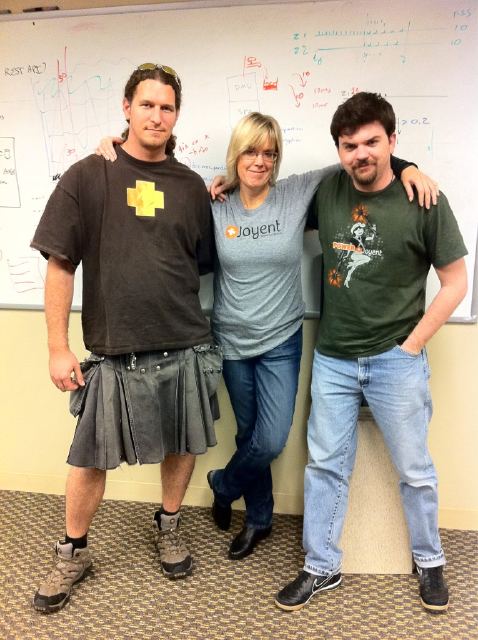
^ top: Ben Rockwood, Deirdré Straughan, Brendan Gregg
I received email from a concerned reader saying: “when a writer stops writing, one of two things is happening:
— you’re blissfully happy, too happy to attempt to put it into words
— you’re utterly miserable, too miserable to find the energy to put it into words”
As I told him, it’s been both. Between health problems and a job/company that were (increasingly clearly) not a good fit for me, I was not in a happy place for quite a while. I returned to work at Oracle in early November after ~5 weeks’ medical leave, but desperately wanted a change.
That change came on December 1st: I began a new job with Joyent, a company which several Sun luminaries (far more luminous than myself) had joined over the previous months. I’m not an engineer, but when big names in Solaris engineering such as Bryan Cantrill, Jerry Jelinek , and Brendan Gregg all head to the same company, it’s time to take a look at what that company might be up to. There were other companies worth looking at for the same reason (and I did), but Joyent won out.
What Joyent does is cloud computing, a buzzword that I suspect even the non-technies among my readers have heard by now. Wikipedia describes it thus: “Cloud computing is Internet-based computing, whereby shared servers provide resources, software, and data to computers and other devices on demand, as with the electricity grid. Cloud computing is a natural evolution of the widespread adoption of virtualization, Service-oriented architecture and utility computing“.
Joyent has been offering cloud computing as a service for over five years: some of your favorite Facebook games run on Joyent infrastructure. But recently Joyent has begun partnering with companies such as Dell to sell our cloud software with their hardware to third parties who want to run data centers and/or sell their own cloud services.
Where do I fit into this? As the new Director of Technical Education, it’s my job to help customers at every level – from end users to service providers to systems integrator partners – learn how to use our stuff. Which means getting highly technical information out of my colleagues and putting it into a format that can be shared with other people: a familiar theme in my working life.
I’ll still be using video, but in this job I will also be designing and likely even personally delivering technical courses, in the classroom as well as via video. This is a return to the early days of my high-tech career, when I designed and taught custom courses in desktop publishing, then installed and trained people to use desktop publishing systems for the World Bank in Cameroon and Tanzania.
As a working environment, Joyent is as different from Oracle as you can get. It’s grown from 22 to 100 employees this year (thanks to some investment, in particular from Intel) and there’s still way too much work for everyone to do. The attitude is very much that things need to get done, and “it’s better to seek forgiveness than ask permission” – which, as old Sun hands know, was once Sun head Scott McNealy‘s mantra. Those who have worked with me or observed me working know that I thrive in this kind of environment, though I’m having to unlearn some Oracle conditioning (amazing what a company can do to you in only nine months).
I was sad to leave my Sun colleagues (those who hadn’t already left themselves), though of course I was rejoining some. I spent Thanksgiving weekend editing The Faces of Sun, a video tribute to some (though nowhere near all) of the amazing people I got to work with and film at Sun.
Since I started at Joyent I’ve been extremely busy (startup hours), and expect that to continue and increase, including some travel. I probably won’t have a lot of time for my site/blog; the best way to keep up with my daily doings will be Twitter @deirdres
Warmest wishes for whatever holiday you celebrate and for a wonderful 2011!
see also: Illumos in the Cloud: What is Joyent Up to?