Caveat: The articles in this section are based on my family’s experience of the Italian education system in a specific time and place: Milan, and later Lecco, from 1991 to 2007. I haven’t lived in Italy all my life, nor ever attended any Italian educational institution myself, so my views may be biased, and your mileage may vary based on your location, specific school, and specific child.
A week or so ago I ran across this on the blog of one of my new colleagues at Sun:
To A Daughter Leaving Home
When I taught you
at eight to ride
a bicycle, loping along
beside you
as you wobbled away
on two round wheels,
my own mouth rounding
in surprise when you pulled
ahead down the curved
path of the park,
I kept waiting
for the thud
of your crash as I
sprinted to catch up,
while you grew
smaller, more breakable
with distance,
pumping, pumping
for your life, screaming
with laughter,
the hair flapping
behind you like a
handkerchief waving
goodbye.
In my encounters with fellow alumni of Woodstock School, many naturally ask me if and when my own daughter will attend. The answer is: with a great deal of luck, she will start in August, 2007, for an exchange year which will be her fourth/senior year at Woodstock, but only her penultimate year of Italian high school.
The application process has not been easy. Not surprisingly, the application forms and process for SAGE (Studies Abroad in Global Education, the US-based outfit that runs Woodstock’s exchange program) are slanted towards US students. There are differences between Italian and US school systems and cultures that could cause an Italian applicant to look “weak”.
American private schools and universities are fond of “well-rounded” applicants, expecting students to be doing sports, public service, paid work, arts, etc., in addition to lots of schoolwork (apparently, no one is allowed time to just be a kid anymore).
Almost none of this is likely or even possible for Italian kids.
Italian Students Are Not “Well-Rounded” – Here’s Why
There are no extra-curricular activities in Italian public schools (I assume for lack of funding). The only sport is PE. There is no music, no school newspaper or yearbook, rarely drama, no clubs. There is student government (mandated by law), but only two class representatives (plus two for the whole school) are elected per year, and they don’t do much. There are occasional special events that students can volunteer to participate in (Ross is usually the photographer). Ross’ current private school does try to get their kids to do volunteer work, in a very limited way (Ross tutors a younger girl in English).
Some kids do after-school sports or dance, a few competing very seriously, but participation at that level is expensive and takes a lot of time. Otherwise, Italian kids don’t have opportunities for awards or recognition. Volunteerism exists in Italy only on a small scale, and few kids are encouraged to participate. Almost none but the truly needy work after school or during summers – it was unusual that Ross did an internship last summer, at the company where I worked.
Italian kids simply don’t have time or opportunity to do much of anything outside of school and homework. One effect of this is that kids who are not good at academics may never get a chance to shine at anything, nor to realize that they may have non-academic skills that are useful and valued in society. This can’t be good for their self-esteem. No wonder so many seem to be drifting and unmotivated.
The SAGE application asks about a “guidance counselor,” a role which doesn’t exist in the Italian system. No guidance is offered about university entrance or careers – kids figure these things out together with their parents, which may be part of the reason that many university students seem profoundly uninterested in the degrees for which they are studying.
Some high schools used to have part-time psychological counsellors available, but those positions have disappeared from public schools with recent cuts in education funding.
There is no tracking in Italian schools, no honors levels or anything of that sort: everyone does exactly the same classes as their classmates, sink or swim. If you fail three or more subjects in a year, you repeat the year, and the failure rates are astonishing. In Ross’ first year of high school, six or seven of the 25 kids in her class failed. The same thing happened again in her second year (which was when Ross herself failed). I’m not crazy about the American practice of “social promotion,” either, but there’s got to be a happy medium somewhere!
Italian grading is a mystery to me. In high school, students are graded on a scale of 1-10, with 6 being a pass, but grades above 7 don’t seem to be assigned at all routinely. Given that, and the high rate at which students fail classes and entire grade levels, I was amazed to learn last year that 97% of students pass the maturità (school leaving exam) on their first try, with some high proportion getting very good marks. Perhaps the teachers grade harshly throughout high school to keep them humble. In discussion about this on the Expats in Italy forum, one Italian participant opined that some high school teachers grade punitively to enhance their own sense of power. (Hey, she said it, not me!)
The SAGE application further asks: “Smoking, use of alcoholic beverages and drug abuse are unacceptable at SAGE schools. Does the applicant have a history of using any of these?”
My answer: “In Italy, it was until a few months ago perfectly legal for 16-year-olds to buy and consume alcohol. A new law says 18 [I’m not even sure this passed], but it’s doubtful that this will survive as law, let alone be applied in real life. Most Italian kids drink wine at home with their families from age 12 or even younger – this is a cultural norm. Smoking is legal from age 16, and many kids (unfortunately) smoke. Light drugs such as marijuana are treated lightly by the law. (Ross drinks, but she knows the rules, and will abide by them at Woodstock.)”
Anticipating a Difficult Re-Entry
A huge question mark over this whole exchange idea is what happens when the student returns. The Italian government encourages students to go on exchange programs during both high school and university, and increasing numbers are doing so, usually to English-speaking countries so that they can become fluent in English. But their re-entry into the Italian system is difficult.
The classes they take as high school seniors in average American public schools are far behind the levels at which their Italian peers study in the fourth year. Unless they had excellent grades when they left (which is difficult – see above), upon return to Italy most face the unappetizing prospect of studying (alone) all summer to make up the deficit, then trying to pass comprehensive exams before the new school year starts in fall, so that they can rejoin their peers in the fifth year. If they choose not to do this, or fail too many of the tests, they must repeat the fourth year.
Some of this process would be easier if we had signed Ross up to one of the several established exchange programs in Italy, but these give you no control over where you end up and for Ross, who doesn’t need to learn English, going to some random school in the US is not particularly appetizing. For the sake of future Italian students who may wish to attend Woodstock (which likes to be as international as possible), I may eventually talk to some of these agencies and see what the prospects are for working together, but they would not move in time to help Ross for next year (one I wrote to months ago never responded to my email).
So we’re doing this on our own. Because Woodstock has much higher standards than most American public schools, I am hoping that Ross will be able to avoid some re-entry hassles if we carefully match what she studies there (e.g., in math, physics, and science) with what she’ll be missing here. Some subjects, such as Dante, she will certainly have to do on her own.
Assuming that she’s even accepted to Woodstock in the first place. With Ross’ long history of being a misfit in the Italian school system, her grades are disastrous. But the prospect of going to Woodstock seems to be a powerful motivator: now, when it’s almost too late, she is throwing herself into her studies, and starting to see results. It’s not easy for her, and probably never will be, but she’s trying hard. Let’s hope it achieves the results she desires.
In the flurry of gathering papers and filling in forms, I forgot to mention perhaps the most important result I’d like to see for Ross if she attends Woodstock: friendships. Not that she lacks for friends here, but there’s something qualitatively different about the friendships one makes in a situation like Woodstock. My classmates, staff, and other friends from Woodstock are my family: the people I can rely on to understand me deeply and be there for me, as I am for them.
And this doesn’t just apply to the people who happened to be there when I was there. With the shared bond of this very unique (okay, weird!) experience, superficial differences like nationality or religious belief simply fall away. I can meet any Woodstocker, anywhere in the world, and, no matter whether I’ve met them before or they’re twenty (or more!) years older or younger than me, I know that, at the very least, I can look forward to a good conversation.
Addendum: Rossella was accepted into Woodstock School. Now we have a lot to do.
School continues to be hell, not just for Rossella, but also for her parents. She scraped through her repeat second year at a new (private, Catholic) school with two academic debits (failed classes) – math and physics, as always.
Being in private school has advantages: last year she had private tutoring in math from a retired teacher with whom she got along very well, and even came close to passing a test or two towards the end of the year. Her regular math teacher was pleased with her progress, and actually in tears at losing her to another teacher this year.
This new teacher appears to be… inexperienced. While discounting for Ross’ prejudices against teachers, and especially math teachers, I do suspect there’s a real problem there. Ross’ story is that the teacher can’t keep control of the class or keep their attention; suggestions from the students on how to do so (e.g., have them do problems on the board, as their previous teacher did) were not heeded for long. So the teacher, out of some spirit of revenge, or because she thinks they should know the stuff, gives them long and complex tests which few of the class have any hope of getting through.
One group of students decided to divide up the test, each doing a part, and then swap their results. Those results were not necessarily correct, but at least they got through the whole test, which is more than most of the students toughing it out on their own were able to do.
I don’t know how they are pulling this off under the teacher’s nose – like most teachers in Italy, she seems to be blissfully unaware of (or deliberately ignoring) the massive cheating that goes on in her classroom.
This has long been a mystery to me. Every child and parent you speak to in Italy is well aware that cheating goes on. Many parents will admit to having done it themselves, and tacitly or explicitly condone their own children’s cheating. So how can the teachers not know that it’s occurring? Perhaps those who choose to become teachers were such academic swots (secchioni – big buckets – is the Italian term) in their own schooldays that they never needed or wanted to cheat, and therefore never learned the techniques, and don’t know what to look out for.
This widespread cheating is damaging in so many ways. In situations like the one with the current math teacher, Ross and others who don’t cheat will fail the test – without the cheating, according to Ross, almost all of the class would have failed that particular test. Were that to happen, the teacher and the principal would (I suppose) have to take note. I’m not a strong believer in bell curves, but if 90% of your class fails, something went wrong that you can’t just blame on the students.
However, those who cheated got higher marks than they otherwise would have, skewing the results. Were the teacher to be confronted on her unsuccessful teaching style, she could point to those kids and say: “Some of them obviously succeeded in learning from me.” They didn’t – they cheated. So the teacher can continue to believe that she’s doing a good job. And Ross, and others, will continue to struggle and fail – honestly.
Last year at this school, a girl close to graduating was discovered to have been cheating on her Greek tests for years. She was not allowed to take the maturita’ (school leaving exam), and was forced to repeat the year. But why did it take her teachers so long to catch on?
Jun 26, 2007 – The math teacher finally caught on when, on the last test of the year, 90% of the tests turned in were identical. Only Ross and one other student (out of a class of ~25) had not cheated. The teacher zeroed out the results of that test and gave another one the following week, which was to Ross’ advantage as she had not done well on the first one. But the teacher did not go back and re-evaluate what had happened on the previous tests, nor did she recalculate anyone’s final grades.
To my mind, there should have been a penalty for the cheaters. All these kids have now learned by experience that cheating is fine, as long as you can get away with it, and there are no real penalties even when you do get caught! And this in a class where the physics teacher had earlier been angry over the degree of cheating he observed on one of his tests, and warned them that if it happened again there would be consequences. But when it happened again with a different teacher, there were no consequences. Again, very poor moral lesson: if one "boss" catches you misbehaving, try it on another.
Situations like this make me just want to go and slap somebody.
Note: Some of what follows will be incomprehensible and/or dull to those who did not attend Woodstock School. I have recently learned that I have far more readers among Woodstockers than I ever imagined, so this one’s for them – and anyone else who’s interested!
The annual reunion of the Woodstock Old Students’ Association / North America (WOSA NA) was held at the YMCA Blue Ridge Assembly in Black Mountain, NC. Our “extended 81 reunion” group – aka the young ‘uns – was staying in the family lodge, which sleeps up to 62 people, but can do so comfortably only if they are mostly in family groups of 3, 4, or 5. So it was just as well that we didn’t fill the place – we were few enough that couples and families could have privacy, and there was plenty of room for the singles and the snorers to spread out.
Ross and I drove down to North Carolina with Susan ’78, sister of the classmate we’d been staying with in Virginia. Susan had impressed the Sikh rental car agent with her ability to correctly pronounce Uttaranchal (the name of the new Indian state in which Mussoorie now finds itself). For that or whatever reason, he gave us a convertible instead of the plain old mid-sized car we had reserved.
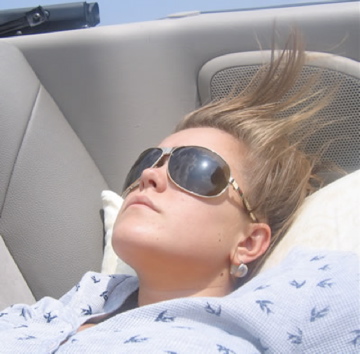
We took full advantage of it, making part of the trip on the Blue Ridge Parkway, which runs along the crest of the Blue Ridge Mountains from Virginia to North Carolina. It’s a slow road – speed limit 35 mph – so the trip took longer than it might have, but was well worth it to enjoy a top-down view of the beautiful scenery. Other drivers kept moving out of our way; either they were very polite, or they thought we were Thelma & Louise with a sidekick.
While Ross lolled in the back seat listening to her iPod, Susan and I found plenty to talk about. She was three years ahead of me at school, which seemed like a lot at the time, but such age differences are hardly noticeable now. It’s a pity we didn’t get to know each other better, sooner – we have much in common in our attitudes and behaviors, beyond the shared experiences of Woodstock and India.
After ten hours on the road, we arrived at Black Mountain on Wednesday evening, August 2 nd. We weren’t the first – the class of ’46 were having a big reunion, and, of our own group, Anita ’79 and Beth ’80 had already arrived from different parts of Florida. The Blue Ridge Assembly campus is beautiful, the land so heavily forested that you can hardly see the buildings. The family lodge, when we found it, proved to be spacious and comfortable, with huge living and dining rooms and an industrial-strength kitchen.
…which we didn’t actually use til after 10 pm, when James ’79 finally arrived. Though he lives nearby in Asheville, it had taken him hours to fit into his car all the food he had bought for us. He had been back and forth to his local Indian grocery store so many times that they’d finally asked him, mystified: “Kya shaadi ho jayega?” (“Is this for a wedding?”)
In the meantime, we sat around and talked. And talked. And talked. Some in the group had known each other well at school, but had new spouses to introduce, such as Laura’s (’81) husband Billy (who was a blast and a half). Others had been at school together, but had hardly known each other back then. And some were already good friends with fond memories, e.g. me and Beth.
But, when we were all there together, our previous relationships hardly mattered. Having a base of Woodstock gives you so much in common, even if you came from different backgrounds and went on to very different lives. There’s a level of comfort in being with other Woodstockers that comes from not having to explain anything. We don’t know all the details of each other’s lives, but in some deep sense we are family, closer even than blood.
There were about a dozen of us in the family lodge that first night, with more trickling in (and out) throughout the weekend. Neerja ’81 and her husband Anil, neither of whom had been to a Woodstock reunion before, enjoyed this one, and plan to attend more. Sharon ’79, after ten years’ work at Woodstock, was now free to NOT represent the school to the alumni, and excited about her new job at a United World College in New Mexico. (She didn’t entirely escape notice – she received a speech of thanks for her long service to alumni, and a commemorative fruit bowl.) Chris Starr ’81, whom we hardly saw because the alumni job is now his, so he had to concentrate on the larger Woodstock family, as well as his own parents (former staff) throughout the weekend.
David E.’78 came with his lovely wife Beth and three (also lovely) daughters – he’s still a musician, to nobody’s surprise, and so is Beth. And he still has in a binder somewhere the lyrics to the songs sung by the “Babushop Quartet” way back when – I have fond memories of those concerts, and am itching to get my hands on the lyrics to songs like “I’d like to be in my dhoti” [sung to the tune of “Octopus’ Garden”]. Even better would be a commemorative video, if we could get the four of them together… My own daughter asked me why one of David’s was wearing a sweatshirt with crosses on it (from a Christian summer camp). Culture gap: many Italians wear small crucifixes around their necks, but never on their clothing.
David T. ’80 is still a runner and hiker, and now a coach of runners. He’s raising mission funding to go with his family to teach in Tanzania. On the face of it, David and I have practically nothing in common, and I doubt we ever said ten words to each other back at school. But I learned at the reunion that he’s funny and warm and fun to be with. When he departed Saturday night (his wife was home coping with four kids and packing!), he left us copies of his family newsletter. Presumably aimed at raising funds for the mission, it was couched in religious language which was at best meaningless to me. But his motivations for wanting to teach in Tanzania were such as anyone could sympathize with: one of David’s life goals is “teaching kids to have a healthy lifestyle.” That’s a goal I’m willing to support.
Anita ’79 is doing civil rights work in Florida. Beth ’80 has just moved to Florida, where her musician boyfriend hopes to find more paying work. Beth is writing music-themed mystery novels, and has a flourishing business selling rare records on eBay. If you’re looking for something unusual, let me know!
There was so much to catch up on that our group felt no particular need for organized activities – just as well that we hadn’t organized any! A few went on a brief hike Thursday afternoon, while Ross and Laura took advantage of the YMCA’s crafts room.
Thursday night, after a fantastic meal of kheema (ground meat) and chole (chick pea) curries made by James, we had a bonfire at which we sat around and gabbed still more (while James went to the airport to pick up Boni ’79). Once again, most of us didn’t get to bed before 2 am and, once again on Friday morning, I bounced up at 7:30, unable to sleep any later. I amused myself in the kitchen with the industrial dishwasher, and prayed for James to hurry up and come make chai (spiced Indian tea) – we all drank gallons of his yummy chai throughout the weekend, which undoubtedly contributed to the not-sleeping.
There’s a lot to see in the Asheville area, and some people went on Friday to visit the Biltmore estates. I stayed on campus to do more meeting and greeting. The main reunion group began arriving Friday afternoon, so there were plenty of other old friends for me to talk to. My only regret at these reunions is that there simply isn’t time to talk with everybody as much as I’d like.
James was cooking not only for our subgroup, but also for the main reunion, supervising the making of endless chai and a big banquet for Saturday night. For the banquet, he put together all the spice mixtures and provided recipes and supervision to the YMCA kitchen staff (though he wasn’t allowed to actually be in the kitchen, for insurance reasons). Because he expected to be busy Friday night, I had committed to cooking Italian food for our group, which came out pretty well in spite of unfamiliar ingredients. I hadn’t expected the sheer physical labor is involved in cooking for a large group – stirring and turning 10 pounds of ground beef in a pan is hard work!
But it was fun having our own kitchen. Everyone pitched in on cooking, serving, and cleaning, which somehow seemed appropriate to a Woodstock group, even though we rarely had opportunities to cook while we were in school. The constant availability of informal shared spaces meant that we could all drift in and out as we liked. Conversations eddied and swirled as people moved from kitchen to dining room to living room to dance floor. (I teased Neerja’s husband Anil: “I bet you never expected to come here and dance bhangra with a bunch of gringoes!”) The lodge also featured a long front porch with rocking chairs – perfect for hanging out and hanging loose.
Friday night saw the arrival of Lauri S. ’81, who, after years as a merchant seaman, is now working for an educational publisher back home in Finland. He brought his daughter Meri – a tall, gorgeous 13-year-old with a delightfully creative fashion sense (she makes some of her own funky outfits) who wants to go into fashion. Lauri’s brother Kris and Kris’ wife Karen also came, though I barely got to speak with them.
Stan L. ’78 was a late addition to the group, and (as part of the official reunion activities) gave a talk on AIDS – he works for the CDC in Atlanta. Davy S. ’80 was persuaded to show up suddenly from Florida, where he does something in real estate and has recently become involved in race horses. (Joe P. ’80 hoped to make a surprise appearance, but couldn’t pull it off, and I didn’t get his email about it til my return to VA.)
Sunita ’81 and Shashi ’82 made it for lunch on Sunday. (They were in Black Mountain Saturday night, but somehow didn’t manage to find us!)
The official WOSA reunion began Friday night with an opening ice-breaker led by David Weidman ’76. Everyone had tags pinned to their backs; each tag contained a word in a category (Indian foods, names of hillside homes, names of hiking destinations, Indian cities…). You had to circulate and, by asking questions which could be answered with a yes or no, figure out what your word was and what category it belonged to, then find everyone else in your category. Then there were more activities to do within the groups, to learn each others’ names.
I didn’t actually participate in any of this because I had arrived too late to get a tag and was running around filming, plus constantly distracted by seeing more people I knew (such as the Wray girls).
After all this warming up, there was a presentation from a local resident about the Appalachian mountains. I didn’t stay for it: didn’t feel like sitting still that long. I went back up to the lodge for more chai and talk.
I don’t clearly remember who all showed up when. The family lodge was perfect for informality, so people came and went all weekend. Even many who had more formal lodgings as part of the main reunion group spent a lot of time with us, especially the younger set. Patty G. ’78 with her TCK/French husband Francois and their large, amiable dog. Greg W. ’78, though he lives nearby, had not been intending to come to the reunion at all, but was eventually persuaded (browbeaten?) by a combination of his mother, sisters, and other attendees – I never got a chance to talk to him, but he seemed to be enjoying himself.
Nathan Scott ’83 was present in his role as SAGE representative. Studies Abroad in Global Education recruits students for exchange programs at Woodstock and its sister school Kodaikanal, and has recently launched a summer “experience India” program as well. Nathan is the younger brother of one of my classmates, and I’ve gotten to know him over years of us both working on WS stuff. Plus he and his wife spent part of their honeymoon at our home in Lecco, though my visit with them on that occasion was cut short by the sudden death of my father-in-law.
There was an even younger contingent from the class of ’93, but, again regrettably, I barely got to see them. They seemed to be enjoying each others’ company, at any rate.
Amal C. ’78 and Brad T. ’75 were present as new members of the WOSA NA Council, which oversees fundraising and other alumni activities in North America, including these reunions. I hadn’t known Brad before, and greatly enjoyed talking with him.
WOSA NA has a demographic problem. If you’ve read some of my previous articles on Woodstock School, you’ll know that my four years there came during a tipping point in the school’s history when, under the guidance of Bob Alter, the student population changed from primarily missionary children to become, first, more international and, later, more Asian.
WOSA NA is currently Woodstock’s largest alumni group. Some missionary families can boast long histories at the school (the record is five generations), and most of those missionaries were American. But, as the missionary presence in India began dwindling in the 1960s and 70s, so the American alumni population is ageing now and will eventually decline*. Many Indian/Asian alumni of my generation have ended up in the north America as well, but younger alumni have not so far been eager participants in WOSA NA activities (though many make strenuous efforts to see their own classmates all over the world ).
So the WOSA NA reunions have tended to be populated by, and cater to, an older group, a fact which worries the Council and the school – to keep things going, you need to keep the younger alums interested. Which our modest initiative seems to have done!
We took steps to encourage a mingling of the generations. Saturday night we lured a bunch of our favorite “oldies” up to the lodge with promises of illicit substances (YMCA campuses being dry). Sunday, we had 50 guests for lunch. The YMCA refused to serve the (abundant) Saturday banquet leftovers in their own lunch line, so James had it all brought up to us, and we dished it out to everybody who showed up – and we invited as many as we could find after the Sunday morning activities. People still tended to congregate with their own age groups and old friends, but it was a start.
In the end, WOSA NA were so pleased with the outcome that they decided that future reunions should include an informal space like this for anybody who prefers it – and they will do all the organizing and money-gathering that was so painful for me this time. James and I will be happy to come along as consultants on how to throw a good party. <wink>
The formal events included several lecture tracks, with so many interesting topics that it was hard to choose between them. I saw part of Gabriel Campbell’s presentation on the people of the Himalayas (fascinating), then Marty Alter Chen’s on her studies on widowhood in India (grim, but not entirely). I accidentally missed part of Brian Dunn’s presentation on Woodstock’s new Religious Life Statement, but what I heard made a lot of sense, and seemed to be well received by the crowd. (More on that another time.)
Saturday evening saw a presentation by and then a salute to Bob and Ellen Alter, important “fixtures” at Woodstock for so many years, and beloved by many. Sunday morning there was a church service (which I slept through – finally catching up from my jet lag) and then some more activities. James (under duress) and I went along to the storytelling session, which I filmed and will eventually edit to share online.
Several times throughout the weekend, people came looking for me specifically to tell me that they read and enjoy my newsletters. I was very touched. One said, “I’m a Unitarian, so I agree with your philosophy” – which I was not expecting in the Woodstock context! Rossella was startled by the number of people who exclaimed upon meeting her: “I know all about you!” – having read my newsletters and followed my links to her fotolog. She began to wonder, a little uneasily, just what I’ve been saying about her, but so far that hasn’t motivated her to go read my site!
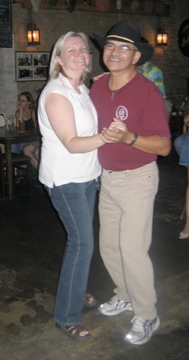
Laura and Billy
Ross herself got on well with everybody and was not as bored as she had expected to be among all us “old people.” Having heard that Ross would be getting a digital SLR camera for her upcoming birthday, Amal spent a couple of hours Sunday morning teaching her how to use his. One of the evenings she went into Asheville with Laura, Billy, Beth, and Nathan, and was pleased that she managed to get into a bar by claiming to be 18 (she was about to turn 17), though they wouldn’t let her drink – she hadn’t realized that drinking age was 21, or she might have tried for that. But she was mostly interested in hearing the music, and not impeding the others from entering the bar so they could enjoy it.
Ross also got to spend time with her friend Justin from theater camp two summers ago, who happens to live nearby in… Bat Cave, North Carolina (I swear!).
Sunday evening we were all exhausted, winding down with lazy talk on the front porch while some watched a weepy Hindi movie in the dining room. I had finally managed to make some compilation CDs with our old favorite dancing tunes, but no one had the energy to dance (though Davy was thrilled that I included Dum Maro Dum).
We had already said some goodbyes on Sunday, to people who had to drive home to be at work on Monday. The rest of us gradually detached ourselves Monday morning and left, Susan, Ross and I facing another long drive in our convertible. Near the end of our journey we were amused to realize that we were driving alongside Glenn and Peggy, also on their way back to the DC area, and honked when they passed us. It took two more passes back and forth and lots of frantic waving before they realized that we weren’t some random jerks being rude on the highway!
So… it wasn’t quite the Class of ’81 25th anniversary reunion we had hoped for, but it was fun, and Woodstockers are all friends, even when they’re not classmates.
* re. those old missionaries getting older, I should note that most of them are remarkably robust and active, and still travelling to far more exotic places than North Carolina! Must be the result of decades of clean living.
Reunion Additional Notes
Sep 30, 2006
…I knew I’d forget to mention some people and events…
First, I don’t think I made enough fuss over James in my original article. This satellite reunion was really a partnership, and he made the whole thing happen in so many ways – being there on the spot to deal with the YMCA people (with whom, thankfully, he has some personal contact – he cleaned up several contract messes), planning and buying all the food and cooking most of it, and in every other way playing host to my hostess. James, it was a blast, and, even though I spent five long days on my feet, I’d do it all over again (as long as someone else handles the money)!
I also wanted to mentioned that it was fun to catch up with Ajay’82 again, and I was glad to meet his wife Dhooleka. She’s at Yale, doing research on Indian immigration, which I look forward to hearing more about.
…someone remind me, who else am I leaving out? So much activity, talk, and friendship (and so little sleep) was packed into five days that it’s all become a big blur now!
Among the pleasures of a WOSA reunion are the auctions. Attendees donate items that they no longer want, most of them related to India and/or Woodstock, or other vestiges of exotic lives. As people retire and move into smaller homes, they have quite a lot to get rid of, so the pickings are rich for those of us in an earlier phase of life.
Most of the items are disposed of via a silent auction, where over several days you write your bids on a slip of paper next to the object(s) of your desire. Whoever’s bid is highest at the end of the auction period wins it. This year there were many beautiful textiles – for $22 I nabbed a gorgeous piece of cloth with embroidery, beads, and mirror work (probably fairly old, judging by the fine quality of the work), which will soon be hung in our house. I also got a teal silk sari with orange/gold trim, put up for auction by Anne, who had been a teacher during my day. When she told me that it had actually belonged to her sister Katie (who was our dorm supervisor), I realized that I have photos of Katie wearing this same sari. I’ve draped it over the curtain rod in our bedroom – we didn’t have any curtains, and the sari goes delightfully with the peacock colors of the other textiles in the room.
Ross walked off with the prize, a beautiful antique silver necklace donated by Lois, for only $37. She literally has not taken it off since she got it, and has received many compliments on it.
The best items are sold via a live auction on Sunday afternoon. I was slavering for a set of journals of the Himalaya Club, from the ’50s and ’60s. My husband loves to read about expeditions, so these seemed an ideal belated present for his recent 50th birthday. I winced when TZ (one of Woodstock’s wealthiest alumni) started bidding against me, but he let me get away with them for only $30. (These auctions probably raise less money than they could, because we all want to be nice to each other!) Turns out TZ was mostly interested in an article on skiing in Garhwal, so I’ll scan that into a PDF and email it to him. And Enrico does like them. Amusingly, one of the first items I ran across when flipping through one of the journals was a review of a book by Walter Bonatti, a famous Italian trekker.





 ).
).