Tag Archives: Italian food

Caffeination: Italians and Their Coffee

music: Manhattan Transfer – “Java Jive”

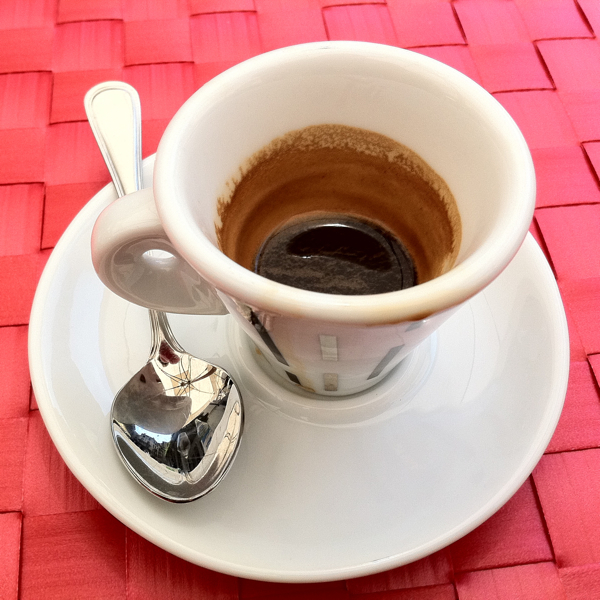
Although Italy has some of the best coffee in the world, Italians don’t drink nearly as much of it as you might think. My own routine, which I suspect to be fairly average, is:

  • one at home at 7:30, before starting my commute
  • one fairly soon after arriving at work, around 10 am
  • one right after lunch

If I’m having a particularly sleepy day I might have one sometime between 10 and 1 (pre-lunch) and/or, very rarely, one in the late afternoon. Five a day is unusual for me, and many people I know consider four overdoing it ¬– though I did talk to a barista once who said he used to drink 12 espressos a day.

Most people I’ve observed in this part of the country (Milan / Lombardia) stop with the post-lunch espresso. Some have an espresso after dinner, especially if they plan to be out later, but I don’t see many ordering post-dinner coffees in restaurants. At home we only make coffee at night if dinner guests want it for their own drives home.

It’s true that espresso is concentrated, but, per average serving, it contains less caffeine than American coffee, and Italians do not have the American habit (which I sometimes miss) of keeping a warm mugful on your desk or table and sipping at it for hours.

When foreigners come to Italy, the clash of caffeine culture can be funny. A Swedish colleague once apartment-sat for us in Milan. As part of his orientation, I took him downstairs to our usual coffee bar (which also made excellent gelato), introduced him, and asked them to treat him nicely. They talked for months afterwards about his peculiarities: he habitually ordered double espressos, which baffled them. For starters, a double won’t fit in the standard single espresso demi-tasse cup, and they disliked the aesthetics of serving espresso in a cappuccino cup. He also mostly lived on gelato that month (it was August), which, while they appreciated the compliment to their gelato, is not standard Italian behavior!

The other day, I overheard a young Italian woman on the train discussing a foreign guest who had visited their home. “We made a moka of coffee, and she thought it was all for her. She drank the whole thing!” “I could never drink that much coffee!” exclaimed her friend, “I wouldn’t sleep for days!”

When Italians make coffee at home, they most often use the moka, a screw-together pot you put on top of the stove. These come in capacities from 1 to 10 cups, and a family may own several sizes, to cope with various occasions. But a four-cup moka makes less coffee than you’d find in a Starbucks “tall” – no wonder the American guest was confused.

Yes, you can get fancy home espresso machines here just as you can in the US, but, to make consistently good espresso, they require a high degree of maintenance and skill. Most Italians can’t be bothered, especially when they can get better coffee for far less fuss at the bar down the street. (Though a few make it a point of fetishistic pride to be able to make at home a coffee “just as good as you get at the bar.” In counterpoint, some espresso machines in bars are decorated with the slogan “REAL coffee you can only get at the bar.”)

Coffee made in the moka can also involve more or less fuss, and is quite a different thing from bar espresso. It took me years to acquire the taste, and I still haven’t learned to make it consistently good. But I got tired of trying to reproduce the consistency and flavor of good American-style filtered coffee. I think that this winter, when I want a big hot drink, I’ll stick to chai.

what’s your poison?

The Perils of the Italian Quest for Fresh Wild Mushrooms

While out on a walk (which became a hike), I saw a couple of women heading into the woods with wicker baskets dangling from their backpacks – off to hunt for mushrooms. Italians, like hobbits, are very fond of mushrooms, especially the varieties which defy cultivation and can only be found in the wild (or bought, expensively, from someone else who found them).

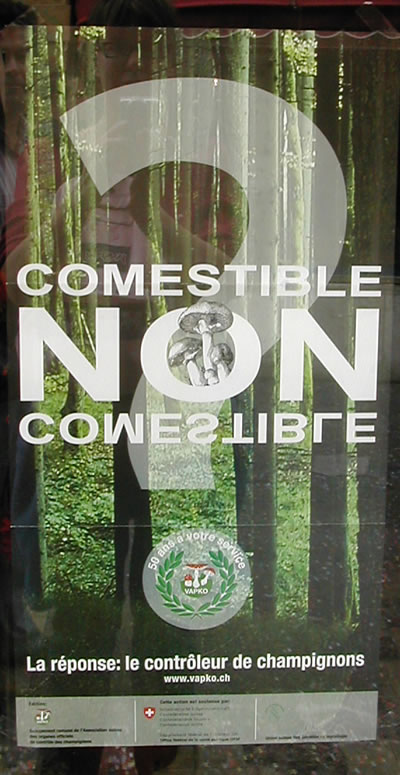
comestible

^”Edible or not? The answer: the mushroom checker.” A pharmacy sign in Switzerland.

To ensure that the mushrooms they pick are edible, many Italians have taken courses or otherwise learned how to distinguish various types. If you’re not sure, you can go to a pharmacy to have your catch examined – I guess pharmacists have to have some sort of mushroom qualification. Still, every now and then someone thinks they know more than the pharmacist does and ends up poisoning their entire family (usually not fatally). The wild mushrooms you buy in stores are certified safe, I presume.

But mushrooms have other ways of taking revenge on the humans who seek them so avidly. The mushroom courses apparently don’t include tips on how to pick them without killing yourself, so every year, during mushroom season, people fall off cliffs while out ‘shrooming. This past weekend saw one death, one serious injury, and two people needing to be rescued from whatever situation they’d got themselves into on a mountain somewhere; this morning’s local paper announces another death – all in quest of mushrooms. I think I’ll stick to buying them at the store.

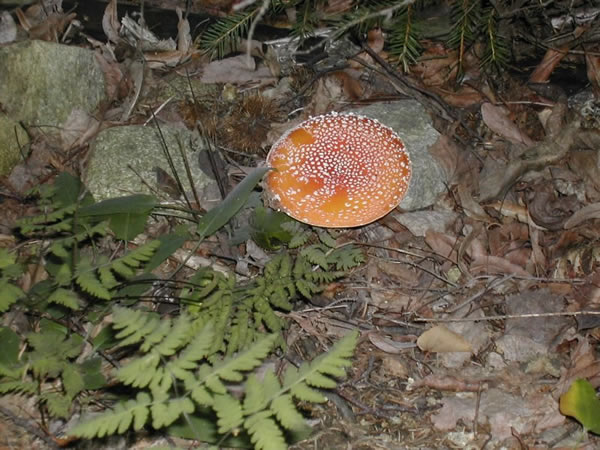
NB: The mushroom shown at top is of the “DON’T eat me” variety.


an American student in Viterbo on ‘shroom love

Italian Food in Video: RistoExpo, Erba

Ristorexpo, Erba: salumi, cheeses, coffee, fast food, slow food, cookies, cakes, chocolate, wine, grappa, liqueur… some of the things that make life worth living in Italy! Salame d’asino is made from donkey. The blue gelato shown at the end is “Smurf” flavor. No, they don’t make it from actual Smurfs.

Dining in America (and Italy)

I instinctively dislike chain restaurants: when someone says “Let’s eat at a [name of chain restaurant],” I wince. And it’s getting harder and harder to find a restaurant in the US that isn’t part of a chain. However, my instincts may be out of date: chain restaurant food seems to be improving. During this recent trip I ate at TeKei’s (Chinese/Thai), Razzoo’s (Cajun), Sarovar (north and south Indian), and something else with a southern (American) theme. I think they’re all chain franchises, but they were also all good. I still prefer to support local and personal cooking creativity where possible, but… sometimes you gotta make do.

What puzzles me is the concept of waiting to get a seat at a restaurant. In 15 years in Italy, I have almost never waited for a restaurant. I’m sure it must have happened once or twice, but I can’t actually remember a single instance. The handful of times I can remember arriving somewhere and finding it full, there was always someplace just as good nearby to go to instead.

But, in the US, no matter how saturated with restaurants an area may be, it’s not uncommon to arrive at a restaurant and find you have to wait half an hour for a table – even though American restaurants are usually HUGE compared with Italian ones, and manage several seatings per table per night, as Americans rarely linger over their meals. I can’t figure it out. Maybe Americans simply eat out more often than Italians (with today’s prices at Italian restaurants, that wouldn’t be surprising).

Restaurant congestion is so bad that, throughout my recent trip, everyone I had lunch with wanted to eat at 11:30 am to avoid the rush. If I hadn’t had jet lag, I would never have got used to this, but it was good preparation for CES, where, if you don’t eat early, you don’t eat at all.

America seems to be obsessed with eating. You can’t go anywhere without being bombarded by advertising for food. It’s effective, too: hearing or reading adjective-stuffed descriptions and seeing perfectly-staged food photographs (there’s an art to it), I always get hungry.

I can’t remember ever hearing food advertised on Italian radio (not that I listen to it regularly). Nor are restaurants advertised on TV in Italy, except McDonald’s. I guess that’s because there aren’t any non-fast-food restaurant chains in Italy (well, there is one, Pastarito – I don’t recommend it), and it doesn’t make economic sense for a single restaurant to advertise nationally.

In America, the marketing doesn’t stop once they’ve got you in the restaurant. The typical American menu is larded with sensual adjectives: “creamy this, delicately folded into tangy that, with a hint of zesty the other…” Some menus include photos, though the food on your plate rarely comes out quite as beautifully. All of this – words, pictures, page layout, fonts – is designed to encourage you to buy the items on which the restaurant makes the biggest profit margin. The waiter may also, asked or unasked, recommend those high-margin items.

There’s no art of selling in Italian menus: they generally only give the name of the dish and a price. In most Italian restaurants, this is all that’s necessary, because most stick to well-known classics with maybe one “house specialty” dish. In the rare cases that you don’t know what a dish’s name means, you ask the waiter, who gives you a bare description: “pasta with sauteed eggplant and salted ricotta.”

The fancier restaurants do tend to be more creative and therefore need to explain their dishes, but the explanations are usually simple statements of fact: “sauteed local trout with diced vegetables” – which hardly does justice to one of Lanterna Verde‘s amazing dishes. But then, the food at Lanterna Verde is so good that you need not be seduced into eating it, and you will certainly not be disappointed, whatever you choose.

Ristorante Belvedere: A Gem on Lake Como

We set out for a lunch somewhere along Lake Como, knowing only that we wanted a view. After pulling into a few parking lots and then changing our minds, we climbed the hill towards the Monastery of Piona, following signs for Ristorante Belvedere – with that name, it had to have a view.

The Belvedere advertised fish as its specialty and, like most Italian restaurants, had a menu posted outside. I was at first confused by the strange prices, not rounded neatly off to the nearest euros.

€ 4.13 for a first course? Then I realized that the prices were also given in lire, printed alongside their exact conversion into euros. This appears to be the only restaurant in Italy which did not take advantage of the change to the euro to gouge its customers. Before the euro, 8,000 lire for a plate of pasta would have been considered middling-reasonable. When the euro came along, most restaurants simply lopped off the extra zeroes to arrive at 8 euros for the same dish, an extortion to which we consumers have meekly consented. Ristaurateurs claim that their costs have risen, but Ristorante Belvedere has somehow managed to keep prices low, without compromising on quality.

Although the specialty was fish, I had a starter of homemade liver paté – I can never resist paté – which was good, mild-flavored, and creamy in texture. For a first course I had home-made pumpkin gnocchi, whose slight sweetness contrasted nicely with the home-made pesto they were dressed with. I didn’t have a second course, but the rest of the party had fresh-caught lavarello (a white fish native to Lake Como), simply baked in the oven, and freshwater shrimp braised in butter, all good.

My dessert was something special: locally picked wild blueberries with ice cream. They were probably the best blueberries I’ve had in my life.

Between the four of us we had two appetizers, three primi (pasta), three secondi, two desserts, three coffees, water, wine (a good Soave served by the liter), and a Limoncello. The total cost was about €97 – cheap at the price! We’ll definitely be going back to the Belvedere. (And the view was indeed spectacular.)