You haven’t heard from me in a while (and I may not be very coherent today) because I’ve been seriously ill for two weeks now, with a lung infection that came on during a nasty flu. I’m now doing a course of injected antibiotics (the oral ones didn’t make a dent); let’s hope that works. I am really bored of being mostly in bed, though perhaps it’s fortunate that I’ve also been too tired to mind it too much.
This gives me occasion to reflect on something that works very well in Italy: the public health system. I don’t understand everything about it, and the details change from time to time, but here’s what it looks like from one patient’s perspective:
Scuola materna (kindergarten) is a wonderful thing. In Italy, every parent has the right – though not the obligation – to put their child in preschool, free of charge, for three years, until they begin first grade in their sixth year.
Traditionally, this seems to have been regarded as a way to socialize kids to life outside the family, but the schoolday was kept short, on the assumption that mom was home anyway.
Nowdays, in many families both parents work, so most scuole materne offer full-time hours up to 4 pm, and after-school programs for parents who can’t pick up their kids that early. Essentially, this is very high quality, state-sponsored daycare.
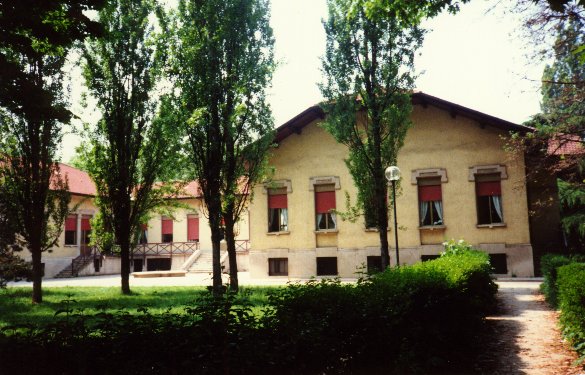
Ross’s scuola materna was part of a loose cooperative of pre-, elementary, and middle schools, all set in a large park, with each grade level occupying its own small building.
The park had originally been a track for trotting races, hence its name, Parco Trotter. In the early 1900s, it was well outside Milan, and sickly children were sent there to breathe clean air and take the sun. There had even been a swimming pool and a tall, airy gymnasium, though these and the dormitories are now ruined past repair. It had been a practical school, where the children tended gardens and raised farm animals as well as (presumably) studying the usual subjects.
Parco Trotter is now engulfed by the city, but remains an island of green among the gray cement; not surprisingly, it has a lower incidence of absences due to illness than any other school in Milan. The preschool kids spent a lot of time outside simply running around, as few kids in Milan are able to.
They weren’t expected to learn to read or write, but they did many pre-reading and pre-math activities, construction and art projects, and more – Montessori methods were very much in evidence!
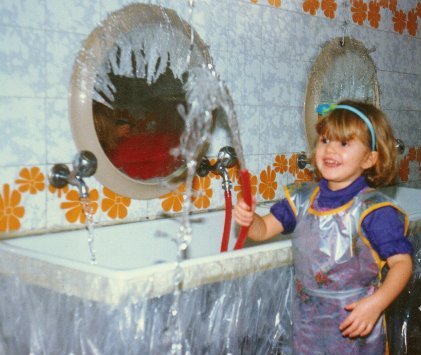
They could be as messy as they liked outside with sand, flour, dirt, and rocks. The bathroom was designed for water play as well as other uses. They decorated their spaces with trees made of cloth, and their own paintings and other creations.
For one project, parents were asked to show the kids around their workplaces, which included a car repair shop and a bakery. Afterwards, the teachers interviewed the kids about what it meant to work, and wrote down the answers, such as: “Work means sweating a lot.” “No one likes to work, but if you don’t work, you starve.”
As preparation for the passage to elementary school, the kids visited elementary classes to see what the older kids were doing, and afterwards were interviewed about what it means to “get big.”
School Food
At all educational levels, school hours used to be organized so that kids went home at lunchtime. Offices, shops, and factories would also close, so the family would gather around the dining table for a midday meal. Apparently, many Italian parents of my generation grew up this way, and still aren’t entirely comfortable with leaving their children at school for lunch.
But, again, modern life intrudes: many mothers as well as fathers now work full-time, often so far across town as to make the family lunch together impracticable. The city government stepped into the breach with a school lunch program, usually prepared somewhere else and then trucked to the various schools. Parco Trotter is fortunate to have a kitchen on the premises, so the food doesn’t have to travel far. The quality was quite good, though they sometimes served vegetables that no self-respecting child was likely to eat, such as boiled fennel bulbs.
It seemed that many parents were more concerned about this aspect of their child’s education than any other. The teachers would furnish daily reports on how well the child had eaten, and there was a parents’ committee to oversee the kitchen. Several times we were called upon to sign petitions protesting this or that aspect of the kids’ diets. (After four years of legendarily bad food at Woodstock, and seeing that Ross ate more at school than she did at home, I had a hard time taking these seriously.)
Every day when I picked up Ross from school, I’d hear the other mothers greeting their children. Invariably, the first question every mother asked was: “What did you eat today?” Just as invariably, my first question to Rossella was: “What did you do today?” And Ross would promptly tell me – what she had eaten.
David Pogue, technology writer for the New York Times, mentioned in his weekly column (some time ago) some ways in which Europe is technologically ahead of the US. We’re certainly far ahead in the use of SMS (short message service), by which you can use your cellphone to send text messages to someone else’s cellphone. I read elsewhere that SMS recently became available in the US, but not many people are using it. The problem, I believe, is that US cellphone companies have not yet captured the attention of the teenage market.
Italy has one of the world’s highest ratios of cellphones to people. They spread years ago from well-heeled to ordinary folk, with the introduction of pay-as-you-go plans: you buy a phone and “recharge” it with calling time whenever you need or can afford to, with no credit check or monthly fee. This has been a boon to people who cannot qualify for or afford a land-line phone, and to parents of teenagers: give the kid a set phone allowance each month, and when it runs out, they either do without or pay their own way.
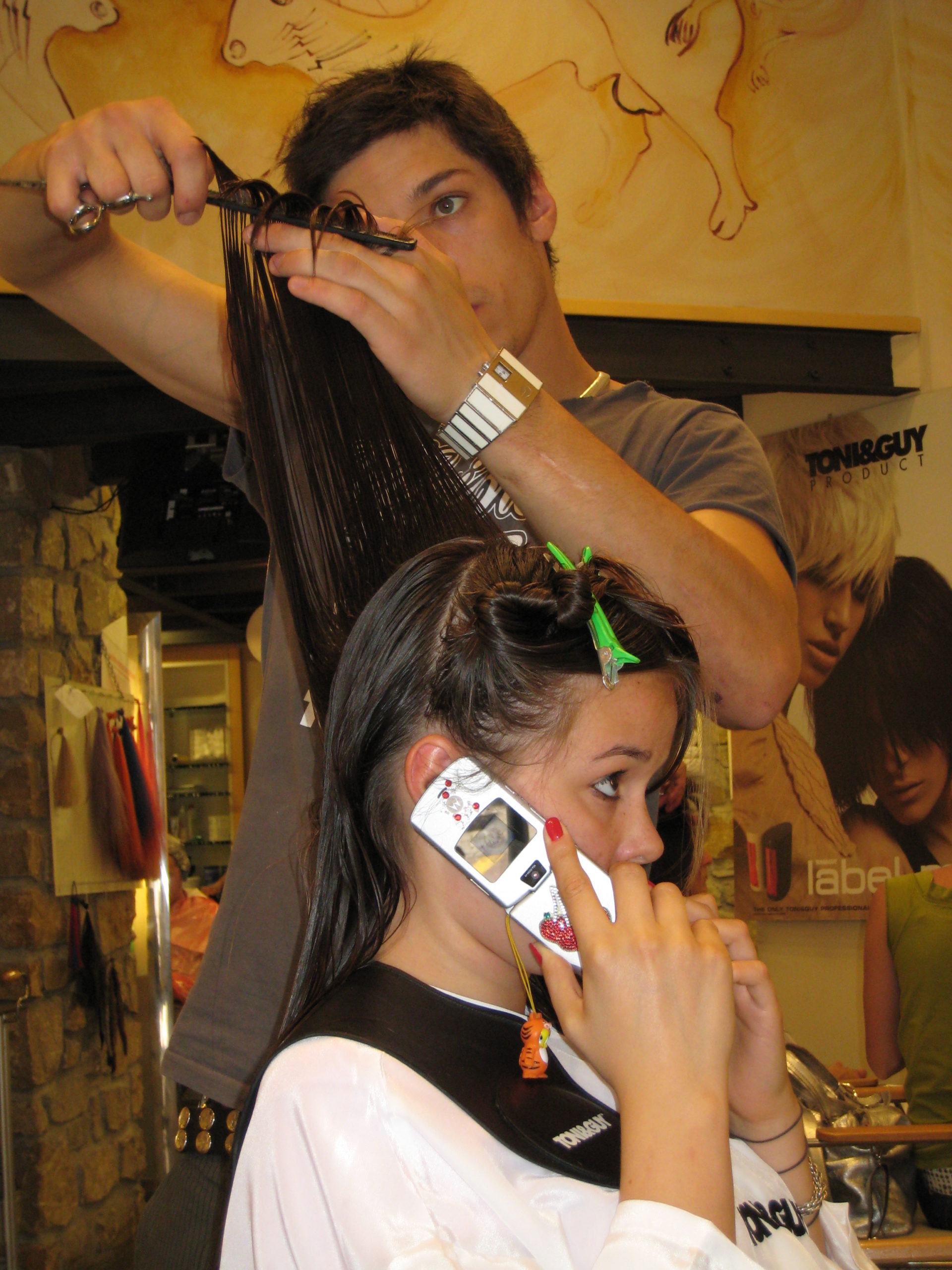
Still, the cost per minute of talk is fairly high, and varies wildly depending on whether you’re calling a phone in the same network, a different network, or a land-line. SMS cost only 10 to 12 cents per message, and are less intrusive than calls; the default signal for an incoming message is a single beep. Or you can set your phone to silent mode, and keep an unobtrusive eye on it. Some kids get away with using SMS to pass notes in class.
Being able to communicate textually instead of orally is great for adolescent boys, who tend to be tongue-tied in comparison with – and especially when speaking to! – their female peers. The same boy who blushes and stammers when confronted with a real live girl, sends wildly romantic SMS. At the beginning of the school year, my daughter was baffled by a boy who would spend hours in SMS conversation, but was too shy to speak with her in person. Later she was courted by a boy who doesn’t yet own a cellphone, which she considered an advantage as he was forced to actually speak to her.
Like many adults, I initially didn’t use SMS much, but am finding it increasingly useful. If I need to communicate a change of plans to my daughter while she’s in school, I can send a message. She’s got the phone set to “Silent” so it won’t disrupt classes, but I know she checks it during breaks.
School rules have evolved rapidly to cope with changing mores. At first many schools banned cellphones altogether. Some have or had rules that they must be turned off completely during school hours – rules which were routinely flouted, as so many rules are in Italy. I guess that by now most schools have given up.
There are downsides to being constantly in touch. I’ve seen my daughter (and others) sit in a roomful of friends, tapping away on her phone. I don’t get that: why not enjoy the friends you’re with, and catch up with the others later? Adults aren’t much better; during breaks in business meetings, everyones dive for their phones, missing that potentially very valuable informal time with their colleagues.
Speaking of air pollution: What is it about cars, anyway? Personally, I’m not fond of them. Because I went to high school in India, I did not learn to drive at the usual American age of 16. By the time I did learn, I had already been involved in two spectacular accidents (someday I’ll tell you about the Fabulous Flying Jeep Trick), so I am a nervous auto passenger, let alone driver.
However, Austin, Texas, is one of those American cities designed on the assumption that everyone drives, so when I transferred to university there, it was time for me to learn how. It was a triumph when I got through driving school and actually earned a license. I lost a few points on the road test for poor parallel parking, and was surprised when the driving instructor told me: “I thought you’d get 100%.” I didn’t know then that this is actually easy to do in the US!
I inherited my grandmother’s ancient AMC Hornet and began cautiously to drive it. Within a month or two, I accidentally ran a red light in a fit of nerves while trying to get onto Interstate Highway 35 (which has some of the worst-designed entrances and exits ever to grace a highway), and ran head-on into someone else’s car. That was the end of the Hornet, but at least no humans were hurt.
After that, I had few opportunities to drive, and even less desire to. My college roommates both had cars, and were kind enough to ferry me around when needed, in exchange for cooking or helping them study for exams.
During my college study abroad year in Benares, we all rode bicycles, and I travelled across northern India by train and bus. I do not recommend bus travel in the Himalayas: after a harrowing trip from Simla to Mussoorie, I understood why so many of those buses end up plunging down mountainsides!
When I began my working life, in Washington, DC, I was able to rely on the subway. But then I moved out to suburban Virginia. After several months of valiantly trying to do everything on bike and foot (even in the snow), it was time to face that car thing again. My boss let me borrow his Pontiac Fiero to practice on; I didn’t tell him about the time I accidently made it spin out on gravel. <grin> When I finally felt ready, my dad accompanied me to look for a new car. We bought the first thing we saw, a Dodge Colt (actually manufactured by Mitsubishi), on ruinous financing terms.
The Colt and I got along all right. I never wrecked it, but neither did I drive it long distances (I let Enrico do that). We gave it to his brother when we left for Italy, and it went on to sturdily face winters in the northern US and Canada.
I have never yet driven in Europe. That would mean getting an Italian driver’s license, which is hard – people routinely fail the written exam several times. I could probably handle the traffic in Milan, when it moves slowly (the other drivers would hate me, because I’d be moving even more slowly). Stopping, however, would be a challenge, since it requires parallel parking in spaces only ten centimeters longer than your car, or head-in parking with half the car on the sidewalk. I’ll stick to public transport for now. It’s the ecologically responsible thing to do.
When I was a kid in Pittsburgh and Connecticut, waking up to find snow on the ground was always exciting, because it meant the possibility of a snow day – a day off from school due to dangerous road conditions. I’d crouch over the radio, holding my breath for the longed-for announcement that my school district was closed, so I’d be free to play all day in the wonderful snow.
It snows very rarely here in Milan, never enough to close the schools. But in January we almost had an analogous phenomenon: smog days.
Northern Italy normally gets enough rain in the winter to wash away the poisons belched into the air by oil-burning heating systems and far too many cars. But not this year: we went nearly sixty days with no rain at all. As we enjoyed the sunshine, the poisonous gases and particulates accumulated to dangerous levels. After the air quality had been officially “terrible” for nine days in a row, environmental laws forced many communities to close their streets to traffic. In Milan, we had several Sundays of no cars at all, which was very pleasant; the streets were delightfully quiet. However, this was not likely to have much effect on the smog, because many Milanese go out of town on the weekends anyway and do their driving elsewhere.
The next solution tried was four days of “alternate license plates” – on even-numbered dates, only cars with even-numbered license plates could be on the road, and vice-versa for odd dates. This meant that many more people were forced to take public transport, so, to lighten the load on the buses, trams, and subways, the regional government also decreed that all middle- and high-school students would start school at 10:00 rather than 8:00. (The kids, of course, were heartbroken.) There was even the threat of a no-cars Friday, which would have meant closing all city and state government offices and schools, but then it rained just enough for a last-minute reprieve.
We’ve since had enough wind and rain to clear the air thoroughly, but the lesson gets clearer as the air gets murkier: Italy has a serious, long-term pollution problem that we can’t depend on the weather to solve. Real, long-term solutions in sight? Few. For now, as for so many years, hopes of truly effective change appear to be lost in a sea of political wrangles, while more and more cars continue to squeeze into Italy’s smog-choked cities.