Category Archives: bio

Why Italians Drink Bottled Water

From time to time in the travel forums, I run across people complaining about the added expense of bottled water at restaurants in Italy. It is possible to drink tap water at any restaurant in Italy, and in some areas it’s the norm, but in many places the request is considered unusual.

Although the water that comes out of our taps is perfectly potable, urban Italians drink almost exclusively bottled water. Not because it’s bottled, but because it comes from real mountain springs (like the one pictured above), and simply tastes better.

City tap water in most parts of Italy that I’ve experienced has a heavily chemical taste – lord knows where they get it from, or what they do to it in purifying. It is also very “hard” – full of calcium. When you see how quickly the inside of your teakettle furs up from boiling tap water, you have second thoughts about trying to process that stuff through your kidneys every day. (Although the technology is available here, very few households have installed the water softening systems that are so common in the US.)

The further you get out into the country, and particularly into the mountains, the better the tap water is: it’s often piped, unprocessed, directly from mountain springs into homes. Many town squares still feature the municipal fountains where people used to get their water before indoor plumbing became common. (In some places, water is so abundant that these can’t be turned off: they simply run, all the time, a waste which always disturbs me.) In communities that have particularly good water, restaurants will put a carafe of the local water on the table before offering you the bottled.

For home consumption, most city households buy bottled water in six packs of 1.5 liter bottles. There are dozens of brands, some local, some national. San Pellegrino is a national brand in Italy – in fact, the town and springs of San Pellegrino are not far from where we live. Most Italian bottled waters actually come from mountain springs in specific locations, and are bottled near the sources for which they’re named. Most come in fizzy and non-fizzy varieties, with the fizzy ones being artificially carbonated, but a few, such as Ferrarelle, are naturally fizzy. Some have recognizable flavors, and after a while you develop preferences (I, for example, can’t stand Ferrarelle).

There is lots of competition between brands, with ads touting their supposed health-giving properties (especially for the house brands at the terme – traditional health spas), low sodium, etc. I don’t take these claims seriously, but it is indisputable that water (bottled or not) is the healthiest thing you can drink – no calories, for starters, and one of the few health statements that most experts seem to agree on is that everyone should drink lots of it. In Italy, this is no problem: not many households keep soft drinks or beer ready in the fridge, but everyone’s always got water. The only two beverages that you see on most Italian tables are water and wine.

You don’t always have to pay for good water in Italy. Enrico and I routinely recycle plastic bottles by taking them to the mountains and refilling them with good spring water:

Cisco Expo 2007 Italia

It’s all Lele’s fault again. Or maybe Luca’s. They mentioned in their blogs that they would be speaking at this year’s Cisco Expo in Milan and, since that’s relatively close to home, I figured I’d go along and cheer for them. I also wanted to learn more about Cisco’s new “Telepresence” and other online video products, to see what ideas I could pick up for TVBLOB.

The venue was a hotel way out in the southern part of Milan. In addition to my usual 1.5 hours from home in Lecco to Milan, I had to take the metro almost to the end of the line, then a bus, then walk another 15 minutes to the conference registration on the back side of the hotel. But I had company: getting off the bus, I fell in with a teacher from Como and a guy in the web services business who were going my way, so I learned some things.

The teacher had come, on her own initiative, to keep up to date in her field: she teaches “systems” at a technical school in Como, training future programmers and, presumably, system admins. She told us that there are no government refresher courses for IT teachers. Some of her colleagues teach their students programming in Pascal for three years, and maybe some Delphi – this aspect of the curriculum is totally up to them, and they have no particular incentive to delve into more modern computer languages. The teacher I talked with seems to be one of the motivated ones who works hard to keep learning and teaching new things, though she admitted (with some embarrassment) that she’s behind on new media phenomena like YouTube.

Perhaps I should offer to speak on these topics in Ross’ IT class at school – if her teacher wouldn’t take such an offer as a slur on her own professional skills.

Anyway, the conference… It started with a plenary session of half-hour talks by local Cisco luminaries. From my (sparse and illegible) notes:

  • many people [in Italy?] will in coming years still be watching “general” TV, but they might see personalized ads (someone in the audience near me snorted at this – clearly he’s not watching general TV anymore).
  • Second Life is a virtual place generating real business – Adidas’ personal trainer service there has sold 21,000 [units of some sort]. (I created a Second Life persona, Deirdre Guru (!), a few months ago, but haven’t had much time to explore this virtual world, especially since it doesn’t display properly on my laptop – I have to use my daughter’s desktop computer. So far I can say that flying is fun, except for that time I got stranded high above the sea and then the whole world crashed.)
  • Cisco believes that company CIOs should be the “directors of innovation,” helping their colleagues enter the new era of the “human network.” Hmm. If you want to promote the human aspects, the CIO (Chief Information Officer) may not be the best person for this role.

While wandering around the expo and battling the crowd for a not-very-good lunch, I kept seeing faces that looked familiar. I am hugely handicapped in business by my poor memory for faces. Or rather, I recognize faces and know that I have met them before, but have no recollection of what their names are or in what context I met them. (In my defense: I have probably already met far more people worldwide than most individuals have to deal with in a lifetime…maybe my people memory is just overloaded!)

So I kept seeing people I thought I knew, but was too embarrassed to talk to them in case I was wrong, and no one acted as if they knew me. I began to wonder if I actually had met them or just thought I had, because so many looked like each other. The crowd was 95% male, most dressed in blue or gray suits with shirts and ties, similar haircuts and (for those who wore them) similar glasses. Another style among the men was wide-wale corduroy trousers in rust, red, or beige, with Clarks-style suede shoes and a sweater. Then there were a few guys in jeans with suit jackets. The women were uniformly dressed in black (as was I – but at least I had a beige sweater under my black suit jacket, and I’m pretty sure I was the only person there in cowboy boots!).

I don’t get it. We’re in Milan, one of the fashion capitals of the world, and the end result is that everyone looks the same? I longed for a real fashion statement, a Hawaiian shirt perhaps. If I’d seen one, I would have hugged its wearer, whether I knew him or not. Someone missed out on a hug.

Another thing that caught my eye was spelling errors. If I were projecting PowerPoint onto an enormous screen to an auditorium full of people (many of them potential buyers of very costly products), I would bloody well run a spell check on my presentation! I caught multiple errors in both English and Italian in the slides shown by Cisco’s top executives. That’s just embarrassing, and bad for business. If that’s how they treat me as an audience, what kind of attention to detail can I expect when I’m a client?

In the afternoon I watched a presentation about Cisco’s extremely expensive new “telepresence” system. I wonder if they even have one installed in Italy [June – they’re installing it now] – at $300,000 for a six-seat/one location configuration, I can’t imagine they will have many customers worldwide. And it was curious that they did not even show us a video of the system in action (though I had already seen such a video months ago, thanks to Robert Scoble.)

There was a video loop running during the lunch break, showing a lot of the same footage as in the ad above. Some parts of it seemed to show the telepresence system (kids talking to each other in classrooms in, apparently, Tibet, and someplace caucasian), with a note at the bottom: “Images on screen are simulated.” Uh, right. Not exactly a demo of the system’s real capabilities. And I’m pretty damned sure that there is no classroom in Tibet which enjoys the Internet bandwidth needed to support this system.

I stayed through a presentation about Cisco’s digital signage system (and, yes, got some good ideas), but left when someone started to talk in excruciating detail about the installation of high-end security systems.

Between urban transit and train connections, it took me three hours to get home to Lecco, at the end of which I was done in – still suffering with that sinus infection as well. I decided to skip the next day of the conference to work from home and rest up. I was sorry to miss Luca and Lele, but, having seen the agenda, I knew that I wasn’t really their target anyway – I am already very familiar with the stuff that they would be explaining about blogs, new media, etc., for the benefit of this Italian corporate audience – indeed, I probably could have given these talks myself.


Flowers and Male Strippers to Celebrate International Women’s Day

Many countries throughout the world (but not the US) celebrate March 8th as International Women’s Day, in Italy known as the Festa della Donna.

Everyone is supposed to show their appreciation for women’s achievements on this day. Men take their female colleagues to lunch and give them flowers. In Italy, the flower of choice for this is the mimosa. I have in the past cynically speculated that the reason for this choice is that, at least in northern Italy, mimosas are not yet in bloom as early as March 8th, so the flowers must be imported – on March 8th, everybody from street hawkers to greengrocers has little sprigs of mimosa to sell at ridiculous prices.

This year, global warming has foiled the profiteers: our neighbors’ mimosa trees are already in luscious full bloom, perfuming the air with their sweet scent, and enlivening the scenery with feathery foliage and bright yellow blooms like tiny pom-poms.

This is unfortunate for me, because I am dreadfully allergic to mimosa. And someone always gives me some for the Festa della Donna. I gracefully acknowledge (and truly appreciate) the gesture, then get rid of the flowers as quickly as I can. I would prefer red roses and dark chocolate, but I guess that would have been more appropriate for Valentine’s Day.

As with most holidays in this day and age, la Festa della Donna has become commercialized, with bars and restaurants offering what the Brits would call “hen nights” – male strippers, drinks and music, and a fixed menu including a cake called mimosa – a white cake base with lots of whipped cream, decorated with fluffy little yellow balls of something that look like mimosa blooms. (Also not my favorite – give me devil’s food any day.)

What will I do to celebrate this year? Probably what I do on this day every year, and what women mostly do all year round: work. I’m not feeling very celebratory. On top of premature spring allergies, I have my usual drug-resistant long-running sinus infection which refuses to go away after more than month. I’m on my second round of antibiotics now, plus aerosol etc. to try to clear out the gunk. Another effect of global warming (I suppose) has been an unusually dry winter, so Milan’s pollution is worse than ever. Between that and the boss’ cigars, going in to the office has become hazardous to my health.

Mar 9, 2008 – Read something about the origins of La Festa della Donna that I never knew!

A School Year Abroad

In my encounters with fellow alumni of Woodstock School, many naturally ask me if and when my own daughter will attend. The answer is: with a great deal of luck, she will start in August, 2007, for an exchange year which will be her fourth/senior year at Woodstock, but only her penultimate year of Italian high school.

The application process has not been easy. Not surprisingly, the application forms and process for SAGE (Studies Abroad in Global Education, the US-based outfit that runs Woodstock’s exchange program) are slanted towards US students. There are differences between Italian and US school systems and cultures that could cause an Italian applicant to look “weak”.

American private schools and universities are fond of “well-rounded” applicants, expecting students to be doing sports, public service, paid work, arts, etc., in addition to lots of schoolwork (apparently, no one is allowed time to just be a kid anymore).

Almost none of this is likely or even possible for Italian kids.

Italian Students Are Not “Well-Rounded” – Here’s Why

There are no extra-curricular activities in Italian public schools (I assume for lack of funding). The only sport is PE. There is no music, no school newspaper or yearbook, rarely drama, no clubs. There is student government (mandated by law), but only two class representatives (plus two for the whole school) are elected per year, and they don’t do much. There are occasional special events that students can volunteer to participate in (Ross is usually the photographer). Ross’ current private school does try to get their kids to do volunteer work, in a very limited way (Ross tutors a younger girl in English).

Some kids do after-school sports or dance, a few competing very seriously, but participation at that level is expensive and takes a lot of time. Otherwise, Italian kids don’t have opportunities for awards or recognition. Volunteerism exists in Italy only on a small scale, and few kids are encouraged to participate. Almost none but the truly needy work after school or during summers – it was unusual that Ross did an internship last summer, at the company where I worked.

Italian kids simply don’t have time or opportunity to do much of anything outside of school and homework. One effect of this is that kids who are not good at academics may never get a chance to shine at anything, nor to realize that they may have non-academic skills that are useful and valued in society. This can’t be good for their self-esteem. No wonder so many seem to be drifting and unmotivated.

The SAGE application asks about a “guidance counselor,” a role which doesn’t exist in the Italian system. No guidance is offered about university entrance or careers – kids figure these things out together with their parents, which may be part of the reason that many university students seem profoundly uninterested in the degrees for which they are studying.

Some high schools used to have part-time psychological counsellors available, but those positions have disappeared from public schools with recent cuts in education funding.

There is no tracking in Italian schools, no honors levels or anything of that sort: everyone does exactly the same classes as their classmates, sink or swim. If you fail three or more subjects in a year, you repeat the year, and the failure rates are astonishing. In Ross’ first year of high school, six or seven of the 25 kids in her class failed. The same thing happened again in her second year (which was when Ross herself failed). I’m not crazy about the American practice of “social promotion,” either, but there’s got to be a happy medium somewhere!

Italian grading is a mystery to me. In high school, students are graded on a scale of 1-10, with 6 being a pass, but grades above 7 don’t seem to be assigned at all routinely. Given that, and the high rate at which students fail classes and entire grade levels, I was amazed to learn last year that 97% of students pass the maturità (school leaving exam) on their first try, with some high proportion getting very good marks. Perhaps the teachers grade harshly throughout high school to keep them humble. In discussion about this on the Expats in Italy forum, one Italian participant opined that some high school teachers grade punitively to enhance their own sense of power. (Hey, she said it, not me!)

The SAGE application further asks: “Smoking, use of alcoholic beverages and drug abuse are unacceptable at SAGE schools. Does the applicant have a history of using any of these?”

My answer: “In Italy, it was until a few months ago perfectly legal for 16-year-olds to buy and consume alcohol. A new law says 18 [I’m not even sure this passed], but it’s doubtful that this will survive as law, let alone be applied in real life. Most Italian kids drink wine at home with their families from age 12 or even younger – this is a cultural norm. Smoking is legal from age 16, and many kids (unfortunately) smoke. Light drugs such as marijuana are treated lightly by the law. (Ross drinks, but she knows the rules, and will abide by them at Woodstock.)”

Anticipating a Difficult Re-Entry

A huge question mark over this whole exchange idea is what happens when the student returns. The Italian government encourages students to go on exchange programs during both high school and university, and increasing numbers are doing so, usually to English-speaking countries so that they can become fluent in English. But their re-entry into the Italian system is difficult.

The classes they take as high school seniors in average American public schools are far behind the levels at which their Italian peers study in the fourth year. Unless they had excellent grades when they left (which is difficult – see above), upon return to Italy most face the unappetizing prospect of studying (alone) all summer to make up the deficit, then trying to pass comprehensive exams before the new school year starts in fall, so that they can rejoin their peers in the fifth year. If they choose not to do this, or fail too many of the tests, they must repeat the fourth year.

Some of this process would be easier if we had signed Ross up to one of the several established exchange programs in Italy, but these give you no control over where you end up and for Ross, who doesn’t need to learn English, going to some random school in the US is not particularly appetizing. For the sake of future Italian students who may wish to attend Woodstock (which likes to be as international as possible), I may eventually talk to some of these agencies and see what the prospects are for working together, but they would not move in time to help Ross for next year (one I wrote to months ago never responded to my email).

So we’re doing this on our own. Because Woodstock has much higher standards than most American public schools, I am hoping that Ross will be able to avoid some re-entry hassles if we carefully match what she studies there (e.g., in math, physics, and science) with what she’ll be missing here. Some subjects, such as Dante, she will certainly have to do on her own.

Assuming that she’s even accepted to Woodstock in the first place. With Ross’ long history of being a misfit in the Italian school system, her grades are disastrous. But the prospect of going to Woodstock seems to be a powerful motivator: now, when it’s almost too late, she is throwing herself into her studies, and starting to see results. It’s not easy for her, and probably never will be, but she’s trying hard. Let’s hope it achieves the results she desires.

what Ross wrote about it

Further Addendum from D

Mar 4, 2007

In the flurry of gathering papers and filling in forms, I forgot to mention perhaps the most important result I’d like to see for Ross if she attends Woodstock: friendships. Not that she lacks for friends here, but there’s something qualitatively different about the friendships one makes in a situation like Woodstock. My classmates, staff, and other friends from Woodstock are my family: the people I can rely on to understand me deeply and be there for me, as I am for them.

And this doesn’t just apply to the people who happened to be there when I was there. With the shared bond of this very unique (okay, weird!) experience, superficial differences like nationality or religious belief simply fall away. I can meet any Woodstocker, anywhere in the world, and, no matter whether I’ve met them before or they’re twenty (or more!) years older or younger than me, I know that, at the very least, I can look forward to a good conversation.

Addendum: Rossella was accepted into Woodstock School. Now we have a lot to do.

Fun in a Photography Studio

Family portraits have been on my mind because, during our January visit to my dad and Ruth, I received an unusual birthday gift: a photo session at Venture “New Generation Portraits,” a UK-based franchise with a new approach to the photo studio business. Dad and Ruth had had their portraits done a year ago, and had so much fun doing it that they gifted sessions to Ruth’s sister and brother-in-law, and now to me and Ross. I had seen Dad and Ruth’s pictures, and knew that we were in for something different from the usual stiffly-posed studio portrait.

Before we left the house, Ross did an excellent makeup job on me (as well as herself). I ordinarily never wear that much makeup – wouldn’t have time or patience to put it on every morning even if I knew how – but it looked great.

We were told to choose clothing that we felt comfortable and looked good in. There’s a dressing room at the studio and you can change as many times as you want during a session, but in the end we didn’t bother: we chose one outfit each and didn’t bring any extras (to the photographer’s surprise – she said girls usually bring lots of changes).

Once in the studio, the photographer (an energetic young woman named Lucy) asked us (and Ruth) questions about ourselves, our relationship (“are you cuddly?”), and what we wanted to get out of the session. We didn’t really know, mainly just wanted to see what it was like and have fun, and let Ross see how a (different kind of) professional portrait photographer works. I looked forward to having a nice photo of myself for a change: Ross rarely photographs badly, but I am not nearly so photogenic or comfortable in front of the camera.

The business end of the studio was a big white space with studio lights. We took our shoes off, then Lucy had us get physical: sitting on the floor and pushing our backs against each other, tickling, and combat-crawling on our elbows towards the camera (Ross won that race by miles, which isn’t surprising – that’s how she always crawled as a baby):

Lucy asked if we would dance, but Ross wouldn’t dream of dancing in front of her mother and a camera, and the music wasn’t sufficiently inspiring (we could and should have brought our own).

Lucy did things with the lighting: red, purple, and blue bounced off the wall behind us. We did some individual shots. For me, she set up the lights to halo my head from the back so you could get the full effect of my hair which, when it’s behaving the way my hairdresser intended, fluffs up like a dandelion – so we did one with me “tearing” my hair, which came out very funny.

The photo session took an energetic hour, and we knew we’d gotten some good shots. We had an appointment to come back two days later to see the results – Ruth had begged them to schedule it in quickly so we’d be in time to choose our photo before we headed back to Italy on Monday. They gave us a price list to study at home, which only confirmed what Ruth had already told me: all I can afford right now is the 8×10″ that comes with the gift voucher. Prices after that start at 169 pounds for a 5×7″! And go up well into the thousands for the poster-sized and multiple jobbies encased in lucite – which is clearly where Venture make their money.

So we knew we would have to choose only one picture. (For now: they keep the photos on file for two years, during which time you can always go back and order more prints, though I winced to hear that they store them on CDs, a medium with which I have long experience and very little trust.)

The photo viewing was an emotional experience, complete with a box of tissues ready to hand. Out of about 80 photos that had been shot, we looked at 40, projected onto a wall. In the first pass we were unusually ruthless and got it down to about 20, by discarding the ones in which either looked less than perfect.

None were standard studio portraits – all had been manipulated in some way with Photoshop, for example adjusting the colors to blue- or violet-toned black & white, or bleaching out features to emphasize the eyes (Ross complained that in one shot her nose almost disappeared). They were shot and/or rotated to unusual angles, and some were designed to be printed in a widescreen format.

I liked the combat crawl shot, with me far in the background as Ross lunges towards the camera. I felt it was symbolic of my supporting role in her life: I’m there to stand behind her, whatever she wants to do. But it wasn’t so great as a portrait of us both.

There was an outstanding model shot of Ross, but then, it’s easy to get outstanding shots of Ross.

Ross liked one in which I stand skeptically looking on while she jumps in the air, kicking up her heels. Again lots of fun and very symbolic, but it would be better as part of a tableau with one or two more serious shots.

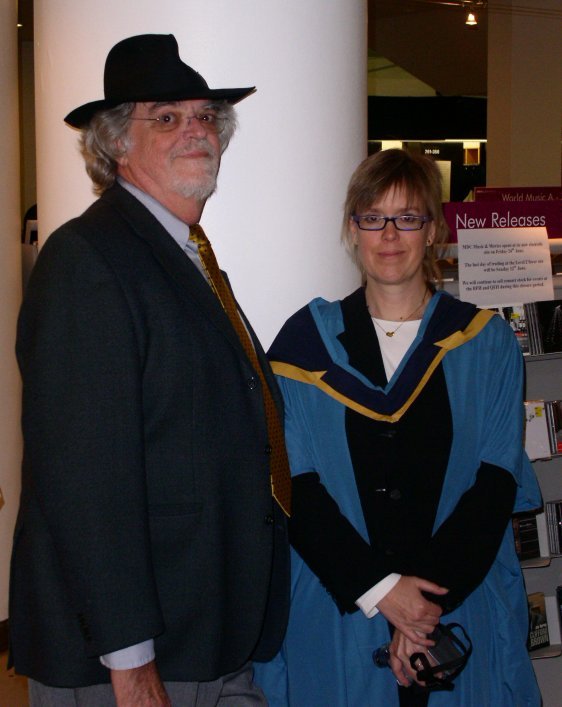
The one we ended up with is shown at the top of this article.

(The intrusion in the lower left corner is a ceramic tile from Castelli that is propping up the picture on a bookshelf til we figure out where it will live permanently.)