Category Archives: bio

Just Another Brick in the Wall

In the past year, with a daughter struggling in middle school, I’ve had occasion to reflect on the various evils of various educational systems. And of course Woodstock School is much on my mind, as I consult live and printed sources to try to understand what makes that particular school great, preparatory to writing a book about it. I don’t have any answers – I surely wish I did! – just many questions.

My own scholastic experience was vast and varied. By the time I finished high school, I had attended 10 schools, all of them quite different from each other. Some were good, some were not. At the time I was hardly a reflective participant in the process, but I’ve been thinking it over, trying to pinpoint what made the difference between the good schools and the bad ones.

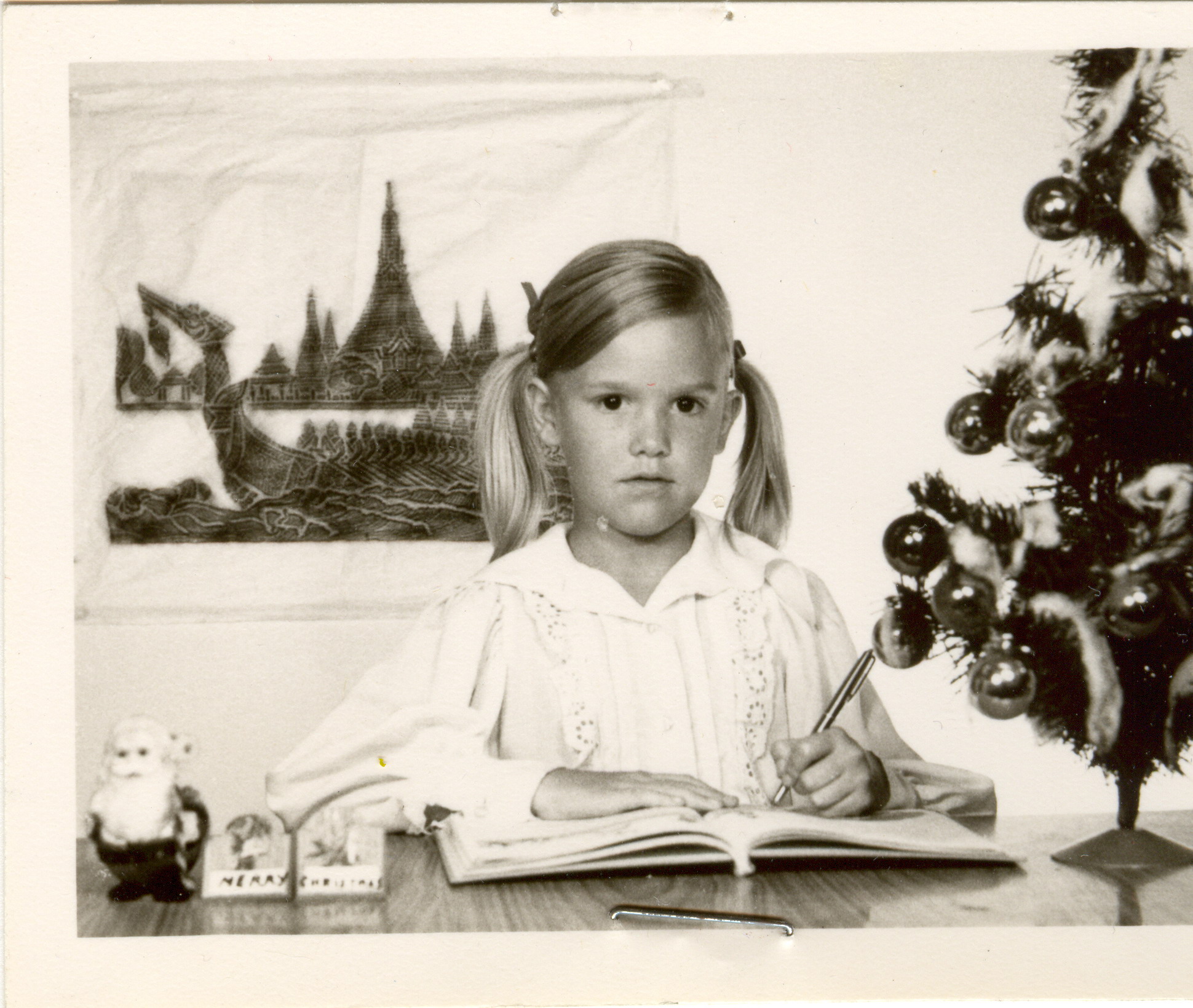
Mrs. Stevens’ School, Bangkok

Mrs. Stevens’ School, where I attended 1st and 2nd grade in Bangkok, was a small, private school run by an Anglo-Indian woman. I don’t know what her qualifications were, but I remember being enthralled by the number of children’s books she had. (It wasn’t easy to get English-language books in Bangkok in those days, so I owned very few, and was an avid reader.) When prospective new students and their parents came to see the school, Mrs. Stevens would trot me out to read for them as an example of what could be achieved. I dimly realized that there was something fishy about this: shehadn’t taught me to read – my mother had.

Although I was a biddable child, Mrs. Stevens couldn’t tame my hair. Straight, fine, and prone to tangles, it hung down in a floppy fringe (bangs, to you Americans) that got in my eyes, so I was constantly pushing it back while reading to impress the parents. Mrs. Stevens felt that this distracted from my performance, and nagged me to tell my parents to have my hair cut. I don’t know whether I failed to report this message (forgetfulness? rebellion?), or they failed to act on it, but finally she could bear it no longer, so she cut my hair herself, badly. That was too much for my parents, so I left her school.

International School Bangkok (ISB)

I then attended the International School Bangkok (ISB). At the time, due to the large population of servicemen’s families and other US government employees in Thailand to support the war in Vietnam, the students and teachers were mostly American. We were given a smattering of Thai language and culture, but for all practical purposes we could have been in any school in the US.

For 3rd grade I had a crotchety old lady teacher who should have retired earlier. She was the cause of my first overt rebellion against authority. We were supposed to do library research about George Washington; I failed to see the charm or the point, and told her I’d rather do research on someone I actually cared about, such as my own father.

For 4th grade, I took part in/was subjected to an educational experiment. Four 4th-grade classes were put together with four teachers in one enormous room, where we would circulate to different areas for different subjects. This was known as the “pod” system.

What were they thinking? One hundred nine-year-olds in a single room? It was chaos. But I appreciated that; it was easy to get lost in the crowd. I could slip away from subjects I didn’t like, such as math, and hide behind a partition with my best friend Kathy, where we would read or draw or write stories. I remember liking some of the teachers, especially Mrs. Johnson, even though she did teach math. She wrote a note on my report card which has achieved the status of family legend: “We will all be glad when Deirdré decides that math is here to stay.”

Liberty School, Pittsburgh

Then my parents divorced, and my father and I moved to Pittsburgh, where he would go to graduate school. He didn’t have much money, so we lived in an apartment in an iffy part of town, and I went to Liberty, the local public school.

The change was catastrophic. I had been living in a huge house in Bangkok, with a big yard, two maids (who also acted as nannies to my infant brother), three cats, three kittens, two dogs, fish, a snake, two parents, and a baby brother. I suddenly found myself alone in an apartment with my dad.

Living with Dad was fine, though we ate a lot of tuna casserole, and I had to wash all the dishes. The problem was that I had nothing in common with the kids at school, who mostly talked about football, baseball, and hockey. They thought me an awful snob when I talked about my life in Thailand, the only life I had known. I was different, so they teased me. In response, I showed off my intelligence; that was a certainty I clung to, about the only one I had left.

I continued to rebel against authority. I refused to recite the Pledge of Allegiance, then standard practice in some American schools. “Under God”? I didn’t believe in God. “One nation, indivisible, with liberty and justice for all?” My parents had been involved in the Civil Rights movement in Louisiana and Texas in the 1960s; even at age ten, I knew how little truth there was to “liberty and justice for all” in America.

I survived 5th grade, and even made a couple of close friends, so I started 6th grade at Liberty willingly enough. But someone in authority had had a bright idea: put the slower 7th and 8th graders in the same classes as the faster 6th graders. I was one of the latter. The older kids of course resented being lumped in with younger kids and publicly branded as stupid, so they sought to put us in our place. My instinct for self-preservation not being well-developed, I reacted to their teasing, letting them know that I was a lot smarter than they were. The abuse rapidly became physical. I came home one day bruised all down one side of my body, from being slammed against a locker in the hall by an older girl who didn’t like my attitude. My dad withdrew me from the school.

Shady Lane, Pittsburgh

I then went to Shady Lane, an “alternative” school. Classes were small and the atmosphere generally pleasant and cooperative, but I was scared by now, and tended to avoid most of my classmates. I read a lot (something that teachers always liked), and I don’t remember being made to do too much that I didn’t like academically, though I did finally conquer fractions. And I met Anna Levy, destined to remain my best friend for several years.

Shortly after Christmas, however, my dad was hospitalized as a result of some gastrointestinal bug he’d picked up in Mexico the previous summer. I had spent that summer with my aunt Rosie in Texas, and it was to Rosie that I now returned. She lived (and still does) in the country, outside the tiny town of Coupland, then famous for its barbecue.

Coupland School, Coupland Texas

I joined Coupland School, where the 5th and 6th grades were taught by a single teacher in one classroom, and even so there were only about 12 of us in the room. By this time I was so afraid of my peers that it took me a long time to realize that these kids genuinely meant to be kind to me. I spent recess and lunch periods in hiding, reading.

We participated in a regional spelling bee. I didn’t make a single mistake, so when it came time to give prizes for our age group, I waited expectantly. The man giving the prizes picked up the blue ribbon, glanced at the name on the back, frowned, and put it down. He then went through all the others, down to sixth place, and my name was never mentioned. I stepped forward and pointed to the blue ribbon. “I think that’s mine,” I said. It was; he just hadn’t known how to pronounce my name.

Ellis School, Pittsburgh

In late April I returned to Pittsburgh for my dad’s wedding to Nancy, and didn’t go to school for the remainder of that academic year. For September, my dad had somehow got me into Ellis School, an expensive private girls’ school where he had been working part-time in the library. They suggested that, since my previous school year had been very disrupted and Ellis was academically demanding, I should repeat the sixth grade. I don’t recall minding this particularly; I was emotionally less mature than my peers, and felt better able to cope with slightly younger girls.

Ellis was where I finally got to grips with a lot of things, including math. Within a few months I was sailing through all the work, usually getting my homework done in class while the teacher was still lecturing. I liked the English teacher, who didn’t mind that during her classes I drew stories in picture form; she even asked me to hang them up and explain them to the class. NB: I could and did listen while I drew; drawing helps me concentrate on what I’m hearing.

I liked the music teacher, who let us sing songs from musicals. Science class was also excellent: we built electrical circuits, and for human anatomy there was a dummy torso that you could open up and take out the organs, stuck in on brass pins, to see how it all fit together.

Ellis had the excellent facilities and equipment you’d expect of an expensive school, but perhaps what really made the difference was that the teachers took a real interest in the students. The English teacher took us to see a local production of “Camelot,” and I laughed at Lancelot’s arrogance in the song “C’est Moi.” The teacher said to me gently: “Maybe your classmates sometimes see you that way.” I thought that over. Maybe they did. I still defended myself from teasing by letting the teasers know that, whatever might be weird about me, I was certainly smarter than they were.

7th grade school pictureReizenstein, Pittsburgh

My dad couldn’t afford another year of Ellis, so for 7th grade I went back into the public school system. I was bused to a newly-built school, Reizenstein. Since the school was brand new, we had the opportunity to determine important things like a name for the sports teams. Which was a stumper: what goes with “Reizenstein”? The principal liked “The Rise-and-Shiners,” but we all thought that was stupid.

Reizenstein, with all its newness, seemed to hold out hopes of a better school experience for me: at this school, everyone was a new kid. I was put into accelerated reading classes and a “gifted and talented” program. This was cool; there were only five or six of us in the class, and we learned to dance the tarantella. I wondered about the academic value of this (though I now live in Italy, it’s a skill I’ve never needed), but didn’t complain: it beat being bored and teased in regular classes.

I still had problems with my peers. I was far from being racist, but many black girls seemed to have it in for me. After a verbal battle with one, we both ended up in the principal’s office. In the midst of his thoughtful lecture about getting along, we gave each other sidelong glances, sharing a moment of solidarity over how unlikely this was to resolve anything.

The school launched a busy program of extra-curricular activities. I was thrilled at the chance to participate in a production of “Oliver!” We first listened to the songs and were told the story, then it was time for auditions, singing one of the two songs we had learned. After auditioning several dozen kids, the teacher decided there wasn’t any more time; she would assign the parts, and the rest of us would be in the chorus. This was unfair, especially to me: I already knew all the songs by heart. So I insisted on auditioning, sang a song the group hadn’t yet learned, and was awarded the role of Bett (a minor part, but a step up from the chorus).

Unfortunately, only a week or two later I learned that we would be moving to Connecticut, where my dad had a new job as director of a drug rehabilitation program. So I never got to be in the show.

West Rocks Middle School, Norwalk CT

Dad’s job was in Westport, a wealthy bedroom community for NYC executives, whose kids had enough money to buy expensive drugs. For parties, these kids would clear out their parents’ medicine cabinets, dumping all sorts of pills into a punch bowl, from which they would swallow them by the handful. By the time they reached the hospital, it was difficult for the doctors to know how to treat them… but I digress.

Dad worked in Westport, but we lived in Norwalk, a far less glamorous town, where I attended West Rocks Middle School. As usual, I made one or two good friends, and was brutally teased by everybody else. I had a few good teachers. Mr. Aylmer, an Irishman somehow transplanted to Connecticut, was an inspiration for social studies. I scandalized the class by reporting on a controversial article about how fast food wasn’t good for you, a fact that my classmates did not want to believe. (They’d have been even more shocked had they known that the article was published in “Penthouse,” a magazine largely devoted to pictures of naked women.)

Another good teacher was Bruce Schwartz, for English, whose ambition was to write musicals – I could certainly empathize with that! Norwalk is only a short train ride from Broadway, so he took us to see some shows, including the wonderful original production of “The Wiz” (ignore the stupid movie with Diana Ross and Michael Jackson). Yes, I saw Hinton Battle on stage, 25 years before he played a singing, dancing demon on Buffy.

At the end of 7th grade, I auditioned for and won a place in a small, elite school choir for the following year, so I had that to look forward to when 8th grade began. But I never got to sing; within a few weeks of the school year beginning, it was decided that we would move to Bangladesh. Trying to explain this to my peers was interesting; they had never heard of Bangladesh. “It’s next to India,” I said. No light dawned. Finally one kid said brightly: “I know! You’re moving to Bangladesh, Indiana!” (It could have been worse: my dad had also been considered for a position in Ougadougou, in the country then called Upper Volta, now Burkina Faso.) What happened next was covered recently in Meta-History: I did 8th grade on my own by correspondence through the Calvert School, then I went off to boarding school.

Why Do We Have Schools, Anyway?

So… what can I distill from all these experiences, plus my far happier years at Woodstock?

I once read that school as we know it today was designed at the time of the industrial revolution, to teach people to work to a schedule and obey authority; this training was needed to turn independent farmers into factory employees (and soldiers).

In general terms, we assume that the purpose of school is to prepare people to be productive members of the economy. However, the economy is now moving so fast that it’s difficult to predict what precise skills will be needed. Many of us are now doing jobs that simply didn’t exist when we were in high school, or even college.

Some would say that an important role of school is socialization: teaching children the laws, rules, and norms of the society they live in. For those who don’t easily fit in, this can be a brutal process – brutality largely supplied by one’s peers. Children are naturally conservative, and seemingly take to heart the Japanese adage: “If a nail sticks out, hammer it down.”

Woodstock School, I believe, has the right answers to both preparation and socialization. The Woodstock experience taught us to respect and enjoy differences. And, between Woodstock and the international lives that most of us already led, we learned to embrace change. I’ll elaborate on these themes in future; both are important to the Woodstock 150th Anniversary book I’m working on (project abandoned by the school, at least at of 2007). And maybe we’ll find a way to apply the lessons of Woodstock in other schools.

Holiday Hell – Italian Vacation Traffic

Almost every Christmas, we drive halfway down Italy to Abruzzo, where my in-laws are retired by the seaside. This puts us on the road with millions of other Italians going home for the holidays. Much of the flow is north to south: the many southern Italians who migrated to northern Italy decades ago to find work, but still have strong family ties in Sicily, Calabria, etc. So we are part of the grand “exodus,” carefully monitored by the media, with pre-analysis, traffic predictions, minute-by-minute developments, and (afterwards) death toll reports. In recent years we’ve driven on the 24th, when there’s the least traffic (except Christmas Day itself, which we may resort to one of these years). The Sunday before Christmas is also good, as no trucks are allowed on the highways.

There are trains, of course, but travelling by train with a lot of luggage is a pain, and trains have their own risks: The holiday season is when many public services choose to cause the greatest possible disruption, by going on strike. Trains don’t do it too often, but everyone else does. Public transit workers in Milan, Rome, and Genova were on strike for several days during the week before Christmas, causing huge traffic jams as everyone then had to drive to work. This probably put a considerable dent in holiday shopping; I suspect shop owners are not feeling very charitable about anyone’s right to strike at the moment.

Then another protest group got into the act. Italian milk producers are aggrieved because they keep getting fined for producing more milk than European Union quotas allow. For the last several years, they have brought attention to their plight (and won government support for discounts on their fines) by blocking major roads around Milan just before Christmas, particularly near Linate airport. There have been cases (though not this year) of holiday travelers having to walk the last five kilometers to the airport, carrying their own luggage.

(No, this has nothing to do with Parmalat, and I will refrain from any Parmalat jokes as I am sick of them already.)

Between Christmas and New Year’s there is a smaller but still significant movement of people, as many, having spent the obligatory “Natale con i tuoi” (Christmas with your family), now escape to go skiing or for more exotic destinations.

The big “counter-exodus,” of people returning to their working homes from wherever they’ve been, takes place around the Epiphany, January 6th. This year the air traffic controllers are adding to the fun by going on strike January 8th.

Italian Accents

“Stanlio, non fare lo stupeedo!”

When an American speaks Italian with a particularly bad accent, Italians often refer to Stanlio e Ollio: Laurel and Hardy, whose accents in the Italian versions of their films are legendarily hilarious, full of flat Rs and words stressed on the wrong syllable.

I used to wonder why these films had been dubbed so badly. Laurel and Hardy are funny enough without silly accents, and why pick on these guys in particular in the dubbing? Everyone else gets dubbed into a normal Italian accent, usually very well.

Then I learned that the films were not initially dubbed by Italians; the voices are those of Laurel and Hardy. When their first talkies came out, it was impossible to dub a new soundtrack onto an existing film. The only way to make an Italian version was to reshoot the whole thing, with the actors doing the Italian dialog themselves. They either read it off cards or memorized it phonetically (as some Italian actors do today when acting in English films). But no one had instructed them in the finer points of Italian pronunciation, so they made mistakes like ‘stuPEEdo’ instead of ‘STUpid-oh.’

Italians found this so funny that, even when technology improved and it became possible to use Italian voices to dub a new soundtrack, the silly accent was maintained, and sticks to this day as a cliche of Americans (or Brits) speaking Italian.

Ask an American to imitate an Italian speaking English, and most of the time you will get the sort of accent heard in American mafia movies, which appears to be loosely based on the pronunciation of someone’s Sicilian or Neapolitan ancestors.

To an Italian ear, there are marked differences in regional accents, and some regional dialects are so different in pronunciation and vocabulary as to be unintelligible to outsiders. Many northern Italians despise the ‘uncouth’ accents of southerners, and would be offended to be lumped into a language category with them.

But maybe that’s changing.

I’ve been meaning for some time to talk about Andrea Camilleri’s Montalbano books, a series of police mysteries set in a small town in Sicily. Part of the appeal is that they are written in a semi-Sicilian dialect, giving a flavor that could be achieved no other way, though the publishers and Camilleri himself initially feared that the general Italian public would not be able to understand it. It turned out not to be a problem, even for me; after the first chapter or so, I didn’t find the language difficult. I’ve noticed that the language is becoming more and more Sicilian as the series goes on; perhaps Camilleri assumes that his devoted fans are now trained to handle it.

Montalbano in book form has been popular for years, and now has been made into a series of TV movies. Accent was again expected to be a problem, so for the first series our hero was made to sound ‘more Roman than Sicilian.’ For the second series, airing now, the accents sound quite Sicilian to me, though not so much that I can’t follow the dialog. Montalbano is wildly popular with all age groups, which seems to be having an interesting side effect: the Sicilian accent is now considered cool. My daughter and her Milanese classmates yesterday begged their school custodian, a Sicilian, to say ‘quattro’ (four), which he pronounces ‘quacchro’. He was baffled, and probably thought at first that they were making fun of him. But they explained that they like to hear him speak because he sounds just like Montalbano; then he was flattered!

The Montalbano books are being translated into English and appear to be selling well. They must lose something without the dialect, but they are still interesting stories with great characters, so I recommend them to mystery-lovers, and to anyone who might enjoy descriptions of Sicilian scenery and food. Montalbano loves good food, and so, presumably, does the author; the stories are frequently side-tracked by mouthwatering descriptions of dishes that Montalbano puts away with pittito lupigno (wolfish appetite). This is one aspect that, sadly, is not preserved in the television series; I guess they didn’t want to make it into a cooking show.

Montalbano links:

Watching Television in India

I rarely watch television as such. At home in Milan, our TV is used mostly to display videotapes, DVDs, Video CDs, and Super Video CDs. Italian television (almost completely in the hands of Prime Minister Berlusconi now) is so awful that it’s not worth switching on (except for Montalbano, about whom morehere).

So if I watch actual television, this usually occurs in a hotel room in some other country, when I’m too tired to do anything else. It’s a useful window onto a country and its culture. In the US, I was appalled at the number of true crime and crime re-enactment shows, in addition to the usual series about police and various sorts of private investigators. Flip a channel, see someone get killed. Yuck. No wonder so many Americans think they need to defend themselves with guns.

On my way back from Mussoorie, I spent a couple of days in a hotel in Delhi, where, since I was tired and not feeling well (sinus infection again), I spent many hours channel surfing, which was very educational.

There were CNN and MSNBC, in local editions with Indian announcers discussing Asian and Indian news and markets, as well as the usual international top of the hour stuff. There seemed to be a channel for each major Indian language, of which I could follow only Hindi (and that not as well as I’d like, given all the years I once put into studying it). There were Hindu, Muslim, Christian, and Jain religious shows. There were American cartoons dubbed into Hindi, and Hindi films with English subtitles. There was even a Hindi sci-fi series that looked rather like the original Star Trek, complete with cheesy 60s-stylish costumes.

There was MTV with the usual international pop stars, but there were also about six channels of Indian music videos, some of them numbers from films (almost all Indian movies are musicals), others stand-alone videos by popular singers. One of the most popular pop musicians is Daler Mehndi, a pudgy Punjabi who sings and dances to infectious bhangra dance music. He wears bright silk suits and turbans, and is generally surrounded by scantily-clad dancers. At least one of his videos appeared to have been shot somewhere in Italy.

At any hour of the day, you can see Amitabh Bacchan on every other channel. He’s a film actor, already famous when I was in school, sort of the Robert Redford of India, except that he’s made far more movies. I didn’t find him attractive when we were both younger, but I must say he has aged very gracefully; that touch of gray at the temples adds a lot. He’s still going strong, in fact was shooting a film in Mussoorie when I was there. (I didn’t see him, but it was big news in Mussoorie, and through a classmate I met a couple of bit players from the film.)

On an Indian equivalent to America’s Home Shopping Network (yes, we have them in Italy, too), I saw a long series of ads for ‘Sriyantr’, a crystal amulet purported to bring peace and prosperity to you and your household, for only Rs. 1999 plus postage and handling. I couldn’t make out all the Hindi, but it ran something like: ‘Aids concentration for exams or in driving! Small enough to put on your dashboard or carry in your purse!’ There were testimonials from a a student who passed his exams, a formerly nervous driver, and a businessman whose business perked up after the entire office gathered around Sriyantr to dopuja [worship] – I wonder how any non-Hindus in the office would have liked that?

One testimonial came straight out of myth. In the ‘Mahabharata,’ India’s great epic, the five Pandava brothers all marry Draupadi, a princess. Kunti, Draupadi’s new mother-in-law, tells her that it is critical for the brothers to remain united (they will eventually have to face their numerous cousins, the Kauravs, in battle), so she must try very hard not to play favorites, which would cause strife in the family.

So far, true to the original Mahabharata. The Pandavas, Draupadi, and Kunti are shown in elaborate costumes, smiling nervously at each other. Then Kunti takes Draupadi aside and gives her the magic item which will help to ensure family harmony: Sriyantr.

This seems to me a somewhat vulgar use of religion, a bit like having Jesus Christ endorse rosaries, which I’m fairly sure wouldn’t play well over here.


If you’re interested in knowing more about The Mahabharata, I highly recommend Peter Brooks’ version; you can buy it on DVD from Amazon here.

India, 2002

Nov 12 – arrival in Delhi, 1:30 am

After the intense disappointment of not being able to attend my class‘ 20th anniversary reunion in Mussoorie last year, I wanted this trip so badly that at every step of the way I feared something would to prevent it. I was afraid I would be refused a visa (though there was no reason I should be), some major terrorist thing would happen, or that for some unfathomable reason I’d be refused entry at the airport. So, when I finally passed the immigration counter, I was light-headed with relief, and deeply happy.

I was met at the airport by my very reliable travel agency, Uday Travels. In India, especially if you’re a woman travelling alone, you need a good agent there on the ground. For each of my trips, I arranged in advance by email to be met at the airport by a car and agent, and most of my in-country travel was also arranged by them.

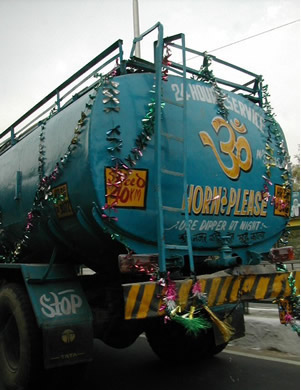
We drove from Delhi airport to Gurgaon, where I’d be staying with a classmate and his family. The traffic heading into Delhi at that time of night is horrendous: miles of trucks, which are only allowed into the city after midnight, and must pass a security checkpoint. We were fortunately going the other direction, but it was difficult to cross the line of traffic to get into the lane going the other way. India drives on the left, by the way. Roadside dhabas (snack stalls) vie for the truck drivers’ custom with huge, backlit signs and colored neon lights. The names are Hindi, but in roman script: “Manju ka Dhaba.”

My cellphone works! I was able to exchange SMS (text) messages with my husband and daughter. Being able to communicate more easily I hope will reassure them about my safety here.

Gurgaon used to be a small town in the state of Haryana. It is now a suburb of Delhi, calling itself “The Millenium City,” and it’s booming. Many multinationals, anxious to escape the crowding and expense of Delhi, have set up their regional headquarters in Gurgaon. There are gleaming tall buildings equal to any in Europe, some of them architecturally very interesting. It’s after 2 am, but I can see people inside working. Some may be employees of India’s famous call centers, providing English-language customer support worldwide.

There are tall apartment buildings, sometimes clustured together in blocks. My friend and his family live in one of these. The building is very well designed, and completely different from any apartment building I’ve seen before. Rather than a hermetically sealed box, it’s all angles and openings, both horizontal and vertical, so that air and light flow into the interior. The apartment entrances have screen doors as well as solid doors, so you can choose to be open to your neighbors, which creates a feeling of community. Yet it’s far less noisy than our Milan apartment, and at night it’s completely quiet.

My friends’ apartment is on two floors, with an interior staircase and a large exterior terrace two stories high, a wonderful place to sit and chat and enjoy the evening air (even a bit too cool, this time of year).

I arrived there at about 3 a.m., and went to sleep with a smile on my face. I had finally made it back to India.

I slept til 11, and woke up very slowly. I read The Financial Times, a four-page pinkish paper. It included discussions on tax reform, and simple and useful advice for investors. It’s wedding season, so there was a financial guide for new brides, advising them to retain financial independence: “You’re walking on clouds now, but you never know what the future may hold.” Another article touted platinum as “the hottest trend, especially in wedding-related jewelry;” Indian brides are traditionally given expensive jewelry. As the guide for brides pointed out, this becomes the bride’s personal property.

From the balcony I can see a wild green parrot and a squirrel. I suppose the wildlife has not been entirely driven out of Gurgaon yet. There isn’t much of a view, though, due to smoke and haze. Visibility is maybe 2 km.

Milk is delivered in sealed plastic bags that look like little pillows.

Delhi is taking steps to reduce its horrible pollution. The daytime ban on trucks is one such. A new bus and underground metro system, due to launch December 26, should also help. (Delhi has had buses for years, of course, but the new ones will replace the old smokers that contribute so much to the atmosphere.)

In the afternoon I took a car into Delhi to try to find a gemstone to replace the one lost from my engagement ring a few days ago (it wasn’t a diamond, fortunately). I went to a fancy jewely shop in the South Extension market (sort of a mini-mall), and found it full of families buying wedding jewelry. The man told me that the only loose gems they had were diamonds, an investment that didn’t interest me. He said I’d have to go to Old Delhi to find loose gems of any other kind. That’s an expedition that will require some planning.

Another shop in the market sold music and movies, including Video CDs – full length movies on CD in MPEG 1 format – for about $4 each. I bought a few to see how they look on my DVD player at home. The Video CD format is popular throughout Asia; you can buy standalone Video CD players, I assume that the players as well as the discs are cheaper than DVD.

That evening several classmates and friends who happened to be in Delhi (or live there) came for dinner, so we spent many hours talking, reminiscencing, and laughing.

Nov 13 – Delhi to Dehra Dun

The next morning I had to get up early again to catch a train to Dehra Dun. The train wouldn’t even be at the platform til 7, but it was one of those situations where if you leave early you end up sitting around at your destination for an hour, and if you don’t, traffic sets in and you’ll be late. So we sat at the station, and I chatted with the tour guide over sweet, milky tea.

Standards have declined since I last took the Shatabdi Express. It used to have only one class, and my agent didn’t mention that there’s now an Executive Car, which costs twice as much ($14 instead of $7), but is a lot cleaner. So I was in second class, and was not much amused to find small cockroaches crawling around my seat.

The windows are tinted yellow, to reduce summer glare, so the heavy mist outside looks unhealthy (and, this being Delhi, it probably is).

By the time the train reaches the countryside north of Delhi, the sun is up and people are in view, mostly men out shitting in the fields. (Where do the women go?) More palatable views include ponds with birds: white egrets, and something with a gray body, white breast, and black head.


Signs and Portents

Though an ever-increasing proportion of the population speaks English, Indian signage has lost none of its unintentional hilarity. A few examples:

Tress Passers will be prosecuted.

Accident prone area – please drive slow.

Plants on sale – also on rent

“Real fruit se full” This tag line for a brand of ice cream is a weird mix of Hindi and English. The  Hindi word se means “of”. But the construction follows Hindi grammar, so the sentence translates as “Full of real fruit.”

Traffic lights are the standard red-yellow-green; on some, the word “Relax” is painted onto the red light.

“Indian marble – looks Italian!”


Nov 13 – On the Shatabdi Express to Dehra Dun

Cockroaches aside, the Shatabdi is very civilized. We are first given bottled water and a newspaper, then served an early tea, with a thermos of hot water and two “tea kits,” consisting of a tea bag, sugar, and powdered milk. There is also a packet of two biscuits (cookies, to you Americans). At first I was afraid that this was all the breakfast we would get, and was glad I had brought along my own packet of biscuits. But after the first stop a full breakfast was served. I took the vegetarian option, which proved to be a spicy vegetable mix wrapped in mashed potatoes and fried (croquettes), served with spicy ketchup, and white bread with butter. And more tea.

Dehra Dun

We arrived in Dehra Dun, the end of the line, at about 1 pm. As soon as the train stopped, coolies (porters) swarmed aboard to take the luggage. Their uniform consists of a lunghi (a man’s sarong), red shirt, and turban, with a brass identification/license plate on a string tied to the upper arm or slung diagonally across the chest. One of them put my small bag over his shoulder and balanced my big bag on top of his turban. I ended up paying him 25 rupees (about 50 cents), considerably more than the official rate. Yes, I am a tourist patsy. After years of experiencing India as a poor student and having to haggle over every rupee, nowadays I just can’t be bothered. Especially when one rupee is worth all of 5 cents – so very little to me, but sometimes a lot to the recipient.

My classmate Yuti was on the same train, but we weren’t seated together, so we didn’t meet till we got off the train in Dehra Dun; she had to run down the platform to catch up with me and the fast-moving coolie. Outside we hunted for a taxi. To get from Dehra Dun to Mussoorie, you don’t want to use the official taxi office, because those taxis will only take you as far as Picture Palace bus stand at the beginning of Mussoorie, and you’d have to change to another taxi to get to Woodstock School on the other side of town. The total cost ends up being the same, but to avoid the hassle of changing, we sought out an unofficial Mussoorie taxi. Only official taxis are allowed to park near the station, so actually getting into the taxi was a business. We were taken in a three-wheeled scooter taxi to a little lane nearby, where we waited for our car, which turned out to be a very mini mini-van. We stopped for lunch at a restaurant in Dehra Dun, then headed on up the hill.

Mussoorie begins at about 6000 ft (2000 meters) up the first range of the foothills of the Himalayas. To get to Woodstock, you have to continue from there on a steep and winding road which runs up the ridge through Landour Bazaar. There are far too many cars nowadays, so there is always a traffic jam at the foot of Mullingar Hill (the steepest and narrowest part of the road); inevitably one or more cars have to back up and find ways to fit around each other; it’s like one of those puzzles where you slide the tiles around to get the numbers in order, and the fit is almost that tight! It can take half an hour to untangle the mess and get everyone on their way. On the whole it’s faster to walk, but not with luggage.

(Back when I was in school, when students arrived for the beginning of the term we would be dropped off at Picture Palace, where coolies would meet us to take our trunks, and we would walk from there to school.)


Uday Tours & Travel Pvt. Ltd
10/2459 Beadonpura, Karol Bagh
New Delhi [India]
Phone : 91-11-574 9207, 571 1278, 581 6352, 575 4840
Fax : 91-11-572 8103 or 575 7108
E Mail : uday@del2.vsnl.net.in & utt@ndf.vsnl.net.in