One of the things I do in my job (and my life) is social media. I’ve been communicating online since 1982, and have tried just about every major online communications tool to come along during that time, starting with CompuServe chat and BBSes in the early 80s. I began using Twitter in 2007; it has grown to be an important tool for my work as well. Yes, I do social media marketing (though I wince at the term).
As of today, I have about 1,947 followers on my personal Twitter account, @deirdres, and 583 on @JoyentSmartOS (I post technical news to both). These aren’t large numbers – plenty of famous people, non-famous people, companies, brands, organizations, and other entities, have many thousands or millions more. But I use Twitter well and get results: web traffic, attention, and sales for my employer, Joyent. Here’s a recent example that may be useful to fellow social media marketers.
The Event
My colleague Brendan Gregg is a well-known speaker on computer systems performance topics, but he’s best known – so far – in the world of Solaris, SmartOS, and company. We have worked together for years: he creates great technical content; I edit, film, and market it. On February 24th, 2013, he gave a talk at SCaLE on Linux Performance Analysis and Tools, which I went along to film. As his first talk about Linux, it presented both an opportunity and a difficulty.
Having other obligations in LA after the event, we only got back to the office on Wednesday, Feb 27th, but I had the video edited and uploaded to YouTube the morning of Friday, March 1st. By then I had also written a post and provided photos for the Joyent blog. Even by my standards, this was fast work. Why was I in such a hurry?
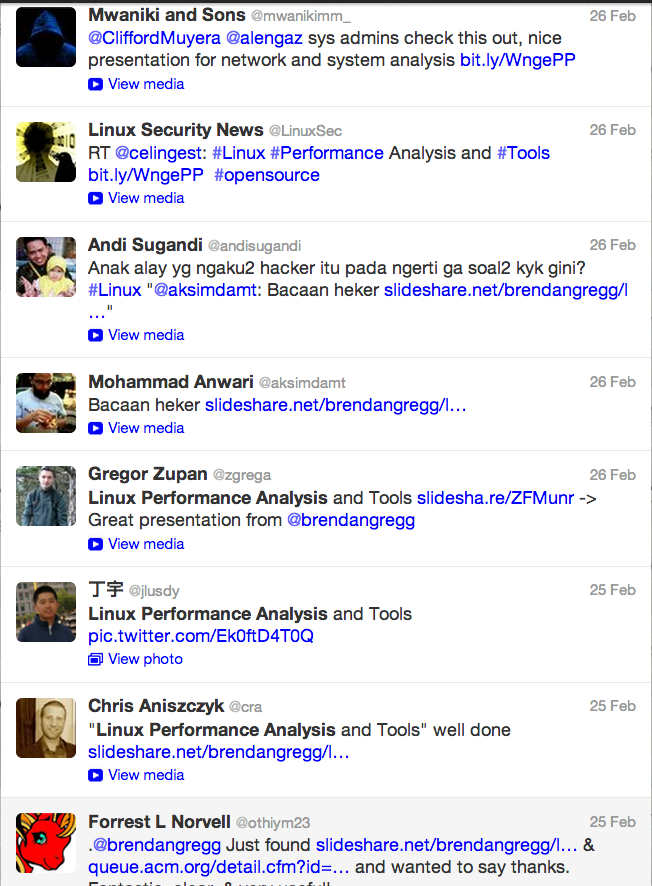
First, the talk had been popular: the 250-seat room was packed, with a very engaged audience who wanted to be able to re-read the presentation slide deck (dense with technical information) immediately. As is his wont, Brendan had put it up on Slideshare within an hour of finishing his talk, and announced it on Twitter:
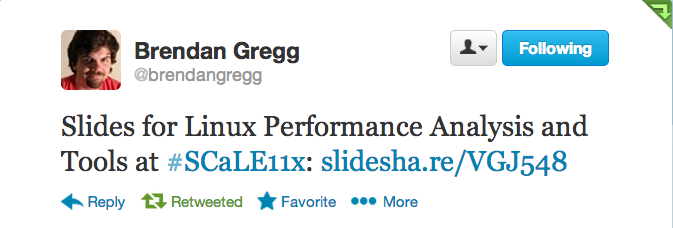
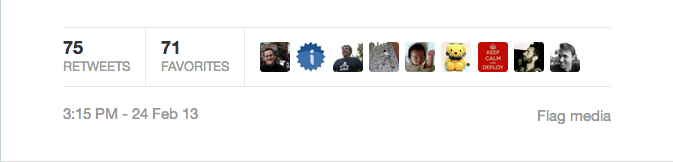
The slide deck got lots of attention, not just the retweets shown above (some from SCaLE attendees), but hundreds more tweets and thousands of views, most of them from people who had likely never heard of Brendan or Joyent.

The hail of tweets showed the reach of the (very large) Linux community. We were already aware of this but, as a SmartOS/Solaris shop, Joyent doesn’t often get a chance to tap into it.
I wanted to bring some of that attention to Joyent while the talk was still fresh in the minds of attendees and others – some of whom were already asking for video. I could have just posted it on my YouTube channel and told everybody it was there, but the company would benefit more from traffic to the Joyent site – hence the blog post.
We published that post as soon as the video was uploaded, on Friday morning, March 1st. We knew that that was not an ideal time: Friday morning in California is already the weekend in most of the rest of the world. Even so, the lack of response was frustrating. I started looking for more ways to draw attention to the post.
The Social Media Push
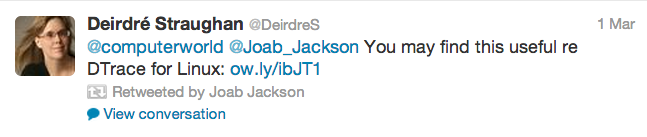
That same day, an article was published about Oracle’s Port of DTrace on Linux. Its author – and many others – tweeted about it. Since Brendan’s talk had included DTrace as a performance analysis tool for Linux, I tried to ride that wave using the same hashtags:

In the meantime, I scrolled back to many of the people who had originally tweeted about Brendan’s slide deck, and tweeted to them directly, one by one: “re Linux Performance Analysis and Tools – Video available now, too! http://ow.ly/idrWY ”
I approached this with caution: in every online marketing activity I undertake, I try hard to give information only where and to whom it is likely to be welcome. In this case, no one complained, and some even thanked me for the news: “moustafa_dba 12:25pm via Twitter for iPad @DeirdreS great ,thank you so much”
But, by Saturday morning, I still wasn’t satisfied with the traffic to the blog post and the video. I had shot my bolt on Twitter. My other usual forums are mostly populated with SmartOS/illumos/Solaris folks – not the primary audience for this talk. Where could I reach other technical people?
We’d had good results on HackerNews before, so I posted it there, and tweeted about it:
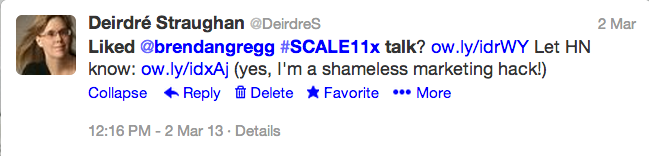
Blatantly asking people to vote it up worked: the post remained in the top 11 or higher on HN’s front page for at least seven hours, and garnered some nice comments. Someone else – who perhaps saw it on HN – posted it to reddit.
These two sites drove a spike of traffic to the post on Joyent.com over the weekend: 5,768 views from HN and 4,098 from reddit.
Altogether, from March 1st to today we’ve had:
- blog post page: 32,000 page views (with an average time on page of 32 minutes, thanks to the video)
- video: 6,332 views
- slide deck: 67,000 views; 1,707 downloads
Of greater importance in the long term: by the time the post had only been up for 18 hours, it was high in Google search results for “Linux Performance”. It is now the number one result. Which is ironic and amusing, considering that Joyent’s cloud is famously built upon a different operating system, SmartOS (though we also support Linux). It also subtly demonstrates that, when Joyent claims to provide high-performance cloud infrastructure, we know what we’re talking about. Or at least Brendan Gregg does. 😉
Coda: As of March, 2014, Brendan works at Netflix, mostly on Linux performance.
You might also like:




Perf Book Done!
Brendan Gregg‘s perf book is done. Yes, I edited this one as well.
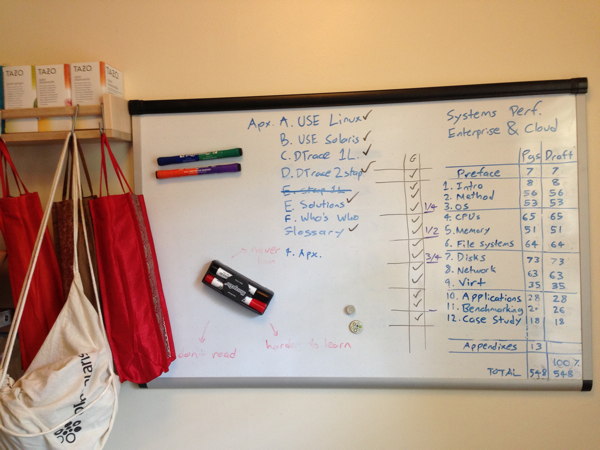
These photos show my kitchen white board before and after completion.
Expect it in print September.

ps You can now order the book from InformIT or Amazon.

We did a series of videos throughout the writing of the book, about how and why it was written. Start here.
You might also like:

All American
An amusing (depending on my mood) feature of Internet arguments is that they often reach the point where my interlocutor is reduced to statements like: “You must not be American” or “You’re not from Texas” or “You can’t understand because you’re not [some other tribe of reference]”.
So, to spare myself typing in future rebuttals, here is everything we know about my ancestry – which is a lot, because people on both sides of my family tree have been keenly interested in genealogy, for personal or religious (Mormon – yes, I know about them, too) reasons.
Straughan: My paternal grandfather. This is a rare Scottish surname, a variant of Strachan. The oldest ancestor we’ve located in the Straughan line was born in Virginia in 1747. That’s right, BEFORE the revolution. My more recent Straughan ancestors were farmers in east Texas; my grandfather escaped that by studying accounting and moving to the city (New Orleans, then Shreveport).
- NB: I have owned the straughan.com domain for over ten years (it was a gift from a friend, not named Straughan). No, I will not give it up or sell it. Sorry, other Straughans.
Tiemann: My paternal grandmother. Her family was Catholic (I was baptized). An ancestor of hers immigrated from Bavaria to New Orleans shortly before the Civil War; he was awarded a medal “for valor” by the state of Louisiana. Tiemann is also not uncommon as a Jewish surname; it’s possible that somewhere along the way this line of ancestors was forcibly converted to Christianity – so maybe I’m also Jewish!
Baird: My maternal grandfather. Don’t know a lot about him; the name is Scottish. He was an accountant, family in Mississippi. In the 1930s, he went to work for an American company in Havana, where my mother and her sister were born.
Cook: My maternal grandmother, whose brother (a WWII hero with an interesting story of his own) traced his family line back to one Koch, a Hessian mercenary hired by the British to fight against those revolting Americans. He deserted, married a local girl, and became a citizen of the new nation. Somewhere in this line of descent there’s also someone French.
And here’s an ancestor on the Cook side:
Assassination of F.M.B. “Marsh” Cook
On July 23, 1890, Marsh Cook of Jasper County was gunned down by six men after warning citizens that the 1890 Mississippi Constitutional Convention would likely limit voting rights and disfranchise black voters. Cook was a white republican candidate for delegate to the Constitutional Convention. He had urged black voters to organize against disfranchisement. No one was ever arrested or tried for his murder.
More on Marsh Cook (courtesy of my cousin Robert).
So, for those who care about such things, I can lay claim to being:
- American, since before 1900, on all sides of the family. In other words: if you define “American” as “people who have been United States citizens for generations”, then I am as American as anybody – and probably more so than most of the people who question my American-ness.
- Texan. Also got my BA from the University of Texas at Austin, so I’m a Longhorn – though I managed in all my years there never to see a single sporting event.
- Louisiana native – born in New Orleans.
- Deep Southern – most of my living relatives are still in Mississippi, Louisiana, and Texas. No discernibly Southern accent, however.
- Catholic – I have not practiced in any way since I was baptized, but that is true of many, many others whom the Church still claims as members. I have written to what was probably my baptismal parish in New Orleans, asking how I can have my name removed from the rolls. No reply. I’ll have to figure out how to get myself excommunicated.
Things I am not:
- In spite of being named Deirdre, I have no Irish blood in me, as far as I know.
…I’ll edit this as I think of more things I am or know (probably when I am accused of not being or not knowing them!).
A cousin from my mother’s side describes herself as “a child of “French Quarter beatnik” parents much involved in art, design and music.”



I Hated Walter Cronkite
My dad was always obsessed with keeping up with the news. When we returned from Thailand to the US to live in 1971, this meant that I woke up every morning hearing the news on the radio, and our dinners were accompanied by the CBS Evening News on TV, with Walter Cronkite.
I was only 9 years old, with little understanding of the events being covered. But I did know that my dad had been in Vietnam (as a civilian) for two years (1967-68). Back then I had understood even less – except to be quite clear on the fact that, although he was not shooting at anybody, he was in plenty of danger of being shot. Stationed in Vinh Long province, he had been caught up in the Tet Offensive, and evacuated (under fire) by US Marines.
In those years, Walter Cronkite ended every broadcast with a list of casualties, military and civilian, on both sides of the Vietnam war – so many hundreds or thousands injured or killed that day – followed by his famous line: “And that’s the way it is.”
I did not understand at the time that his dry recital of these facts was itself a commentary; he had reported his own conclusions about the uselessness of the war years before. All I knew was that each of those numbers represented someone’s loved one, someone’s daddy who had been in harm’s way, and not survived to tell the tale as mine had. I hated Walter Cronkite for the nightly reminder of those years of fear, and what I perceived as his callousness to those losses. But I never told anybody that; he was clearly venerated by everyone else.
When Saigon fell in 1975, I watched (live?) as the final US helicopters took off, leaving terrified south Vietnamese screaming and begging to be taken away. And I wept for all those who had not made it.


How the Next Book Got Done
Two and a half years ago, Brendan was finishing the DTrace book
.